Applied Materials: A Record Quarter Met with a Sharp Valuation Reset and Insider Selling

Key Takeaways
- Applied Materials (AMAT) posted a record third quarter with strong beats and confident guidance, yet its stock fell approximately 7.5% over two sessions, primarily due to already-high expectations, a shift in China revenue mix, flat near-term margin guidance, and an analyst-driven valuation reset.
- Prior to the earnings report, executives—led by CEO Gary Dickerson's $104.8 million in sales—offloaded a total of $142.5 million in company shares between June 15-30, 2026, at prices well above current levels.
- Despite overwhelming analyst optimism and raised price targets, AMAT trades at expensive trailing valuation multiples, and short-term technical indicators now show a bearish lean, creating a complex outlook for investors.
A Paradoxical Market Reaction to Record Results
Applied Materials, Inc. (AMAT) faced a challenging market reaction after reporting its third-quarter fiscal year 2026 earnings on August 13, 2026. The semiconductor equipment leader announced a truly record-breaking quarter: revenue climbed to $9.115 billion, a 25% year-over-year increase, and non-GAAP diluted earnings per share (EPS) surged 41% year-over-year to $3.50. GAAP gross margin reached 50.3%, contributing to a record operating income of $3.08 billion. Management also offered robust guidance for Q4 FY2026, signaling continued growth. CEO Gary Dickerson highlighted the company's highest sequential revenue growth in its history and expressed confidence in outperforming the market's growth rate in its core Semiconductor Systems segment for calendar year 2026.
Despite these strong results, the stock experienced a sharp downturn, falling approximately 7.5% over two trading sessions to close at $507.18 on August 14, 2026. This "sell-the-news" event, as described by market observers, stemmed not from fundamental weakness but from a combination of specific factors. Expectations were already exceedingly high, following AMAT's substantial rally of over 108% year-to-date into the earnings release, leaving little room for disappointment. Concerns also surfaced regarding a shift in its China revenue mix, which decreased from 35% to 28% year-over-year, even with management's positive outlook for growth in certain Chinese segments. Furthermore, guidance for flat near-term gross margins, coupled with rising operating costs for expansion, dampened sentiment. Notably, Bank of America explicitly cut its forward valuation multiple assumption for AMAT from 36x to 27x, citing a slower projected sequential growth rate compared to a peer, thereby signaling a valuation reset rather than a deterioration in fundamentals. This market behavior illustrates how robust performance can still lead to a stock decline when investor expectations for future growth, particularly at premium valuations, are not fully met.
The Shadow of Insider Selling
Adding another layer of complexity to AMAT's recent price action is a substantial cluster of insider selling that occurred in the weeks preceding the earnings report. Between June 15 and June 30, 2026, nine insider sales were filed, totaling $142.5 million, with no corresponding buys. These transactions, executed weeks before the Q3 FY2026 results, took place at prices ranging from $590 to $735, all significantly above the current trading price of $507.18.
The most prominent sales were from CEO Gary Dickerson, who executed four separate transactions totaling $104.8 million. Other key executives, including CTO Omkaram Nalamasu, President of Semiconductor Products Group Prabu Raja, and SVP Timothy Deane, also participated. While it's crucial to note these sales occurred before the earnings release, meaning they do not imply foreknowledge of the stock's post-earnings decline, the sheer scale and concentration of these transactions indicate a collective decision by high-level executives to take profits at what were then elevated valuations. This pattern offers a tangible data point on insider positioning, suggesting a lack of conviction to hold substantial shares at those higher price points, a signal worth careful consideration for investors.
| Executive Name | Date of Sale | Shares Sold | Price Per Share | Total Value ($M) |
|---|---|---|---|---|
| Gary Dickerson (CEO) | Jun 15, 2026 | 11,270 | $590.03 | $6.65 |
| Gary Dickerson (CEO) | Jun 16, 2026 | 71,732 | $593.75 | $42.59 |
| Omkaram Nalamasu (CTO) | Jun 16, 2026 | 24,263 | $593.43 | $14.40 |
| Omkaram Nalamasu (CTO) | Jun 15, 2026 | 10,737 | $591.95 | $6.36 |
| Timothy Deane (SVP) | Jun 15, 2026 | 8,619 | $590.76 | $5.09 |
| Thomas Iannotti (Director) | Jun 16, 2026 | 9,257 | $599.77 | $5.55 |
| Prabu Raja (President) | Jun 18, 2026 | 10,000 | $633.53 | $6.34 |
| Gary Dickerson (CEO) | Jun 29, 2026 | 58,329 | $700.36 | $40.85 |
| Gary Dickerson (CEO) | Jun 30, 2026 | 20,000 | $735.22 | $14.70 |
| Total Insider Sales | $142.50 |
Trailing Fundamentals Suggest Caution Despite Q3 Standout
While Applied Materials' latest quarter was undeniably strong, a deeper look at its trailing fundamentals reveals a more nuanced picture for investors. The stock currently trades at rich valuation multiples across various metrics: its price-to-earnings (P/E) ratio is approximately 43.7x, enterprise value-to-EBITDA (EV/EBITDA) around 35.3x, price-to-free cash flow (P/FCF) roughly 67.9x, price-to-book (P/B) 15.8x, and price-to-sales (P/S) 13.1x. These figures are deeply expensive on an absolute basis, consistent with quantitative valuation composite rankings indicating AMAT is priced at a significant premium.
This elevated valuation comes against a backdrop of trailing-twelve-month (TTM) growth metrics that are considerably softer than the headline Q3 numbers. Over the TTM, revenue growth was a modest 4.4% year-over-year, while net income declined by 2.5%, operating cash flow fell 8.3%, and free cash flow dropped a notable 23.9%. This disparity highlights that the exceptional Q3 performance was a significant rebound built upon three considerably softer prior quarters, rather than a sustained acceleration over the full trailing year. However, the latest quarter's margin snapshot does show a positive trend, with gross margin at 50.3%, operating margin at 33.7%, and net margin at 27.8%. These recent figures are genuinely stronger than the TTM averages, providing a positive counterpoint and suggesting potential for improved profitability going forward, even if the market remains sensitive to the pace of this improvement.
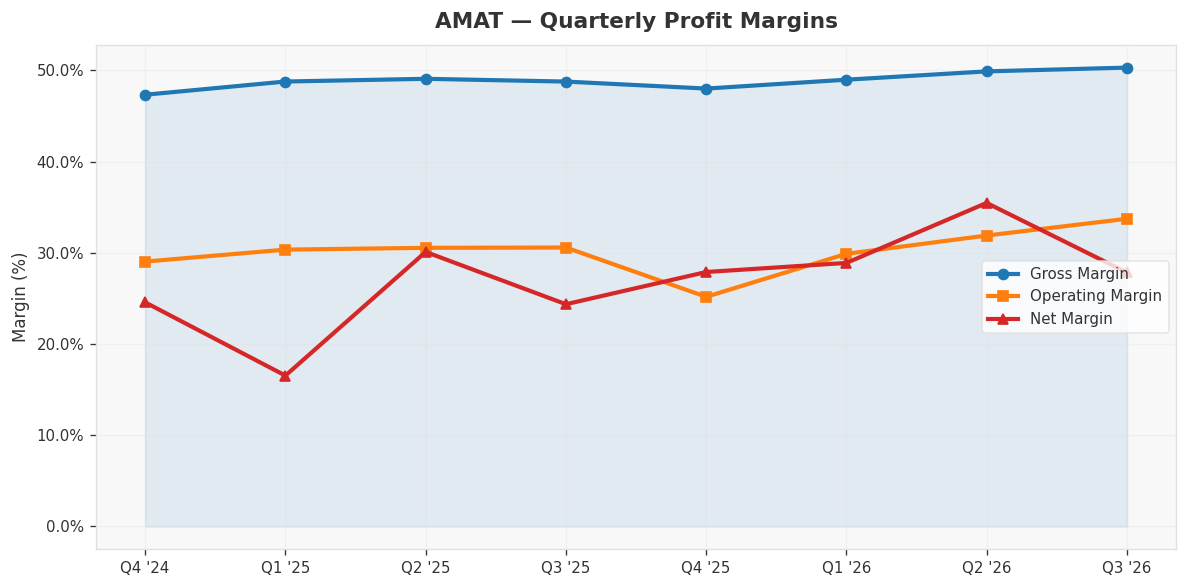 Latest quarter: gross margin 50.3%, operating margin 33.7%, net margin 27.8% -- stronger than the TTM average
Analyst Conviction Faces a Precarious Price Target Floor
The Wall Street analyst community maintains an overwhelmingly bullish stance on Applied Materials. A consensus of 53 analysts rates AMAT as a "Buy," with 1 Strong Buy, 40 Buys, and 12 Holds, but notably zero Sell or Strong Sell ratings. This strong sentiment is reflected in the analyst price targets: the consensus target stands at $671.30, with a median of $650.00. Relative to the current price of $507.18, the consensus target implies an impressive upside of approximately 32%. This post-earnings wave of target increases, with most major desks raising their projections, further underscores the Street's fundamental confidence in AMAT's business.
However, a closer look at the range of price targets reveals a critical detail often overlooked in headline consensus figures. While the high target is $900.00, the low end of the analyst price target range is $500.00. This lowest target sits just $7.18 below the stock's current trading price of $507.18. While a small cushion exists, this asymmetry suggests that while overall sentiment is highly optimistic, even the most conservative published estimates from analysts offer very limited immediate downside protection below where the stock currently trades. Investors relying solely on the consensus upside might overlook this indicator of a potentially precarious support level implied by the Street's most cautious forecasts.
Technical Signals Show a Post-Earnings Bearish Shift
The technical picture for Applied Materials presents a stark contrast to the strong medium-term run it experienced earlier in 2026. While some lagging technical signals still reflect the stock's strong prior performance (e.g., indicating an uptrend or outperformance against the broader market), the immediate post-earnings landscape has shifted. A comprehensive scan of 27 technical signals now registers 11 buy signals against a larger 16 sell signals, indicating a bearish lean in the short term.
This more nuanced technical assessment is corroborated by several internal quantitative ratings. Applied Materials' composite technical score sits at a middling 61 (on a scale of 0-100), but its more granular technical rating is weak at 37, its moving average score is low at 33, and its oscillator score is also poor at 41. Given the immediate context of the approximately 7.5% two-session drop following earnings, these weaker, more current technical readings are likely a more accurate reflection of the stock's current momentum and price action. The disagreement between some lagging bullish indicators and the more recent, bearish-leaning measures highlights the stock's ongoing digestion of new information and its efforts to establish a new price base. Investors should recognize this technical shift and the implications of the stock struggling to find immediate support.
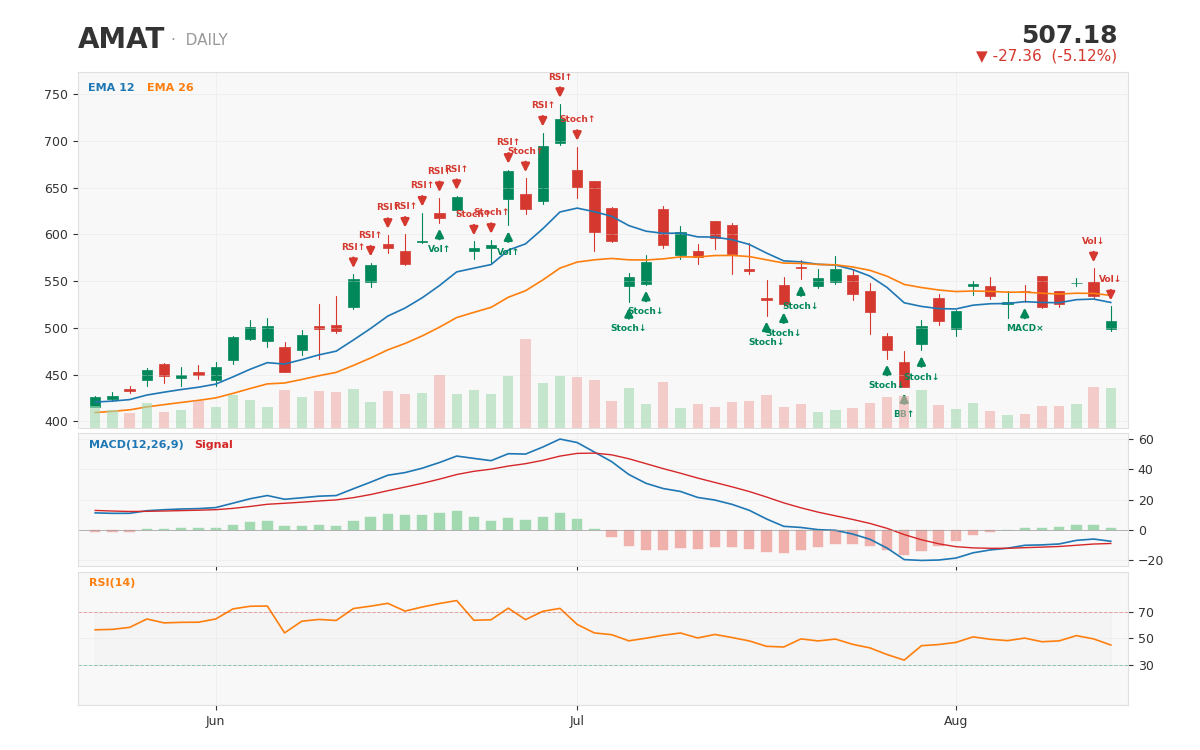 1-year daily chart with technical signals -- a genuinely mixed picture (11 buy vs 16 sell) as the stock digests a ~7.5% two-session post-earnings drop
Competitive Strengths and Strategic Tailwinds
Despite the recent market skepticism and valuation concerns, Applied Materials holds a strong competitive position and is aligned with significant long-term industry trends. The company has demonstrated its ability to outperform peers like Lam Research, KLA, and ASML on a year-to-date basis in 2026. Management asserts AMAT's leadership in process equipment for DRAM memory and its strength in CMOS periphery logic. The company strategically focuses on leading-edge foundry/logic, DRAM, and advanced packaging, segments it identifies as driving approximately 80% of wafer-fab-equipment (WFE) growth in 2026-2027. This structural thesis positions AMAT at the forefront of critical semiconductor innovation.
Furthermore, Applied Materials continues to invest in its ecosystem and innovation. Its EPIC co-innovation platform has expanded to 11 engagements, notably welcoming UC Berkeley in August 2026. From a capital allocation perspective, the company returned $860 million to shareholders in Q3 through buybacks and dividends, marking its ninth consecutive annual dividend increase with an approximate 18% compound annual growth rate. These operational strengths and strategic alignments provide a strong foundation for long-term growth, even as the market grapples with shorter-term valuation adjustments and sentiment shifts.
Investment Outlook: Navigating Growth and Valuation Challenges
Applied Materials finds itself at a pivotal juncture where its undeniable fundamental strength is clashing with market expectations and valuation sensitivities. The company's Q3 FY2026 performance was exemplary, showcasing robust growth and record profitability, and the long-term industry trends remain firmly in its favor. Wall Street analysts have largely acknowledged this strength by raising their price targets, signaling continued confidence in AMAT's future earnings power.
However, the stock's pronounced post-earnings decline, despite the strong results, underscores the market's high bar for companies already trading at premium valuations. The significant insider selling preceding the earnings, while not indicative of malfeasance, serves as a tangible data point suggesting that even the company's own executives found prior valuation levels attractive enough to offload substantial holdings. Coupled with expensive trailing multiples and a bearish shift in short-term technical indicators, investors are faced with a complex decision. AMAT’s long-term thesis remains compelling, yet current market dynamics suggest that much of this future growth is already priced into the stock.
The stock currently trades just above the lowest analyst target of $500.00, indicating a sensitive price point. For a long-term investor with a patient approach, a more conservative entry zone might be considered if the stock consolidates further into the low to mid-$400s, aligning with prior support levels from before its last major rally. This would offer a more attractive risk-reward profile and potentially allow for a re-evaluation of its growth trajectory.
Given the recent valuation reset, a 12-month target between $550.00 and $600.00 appears more realistic than the consensus $671.30. This range acknowledges the company's continued growth while factoring in the market's increased sensitivity to valuation. A sustained break below $490.00—a level just below current support—would signal a further deterioration in market sentiment and invalidate a constructive short-to-medium-term thesis, suggesting the market is actively repricing AMAT lower. Ultimately, Applied Materials offers a compelling long-term narrative, but its current valuation and market dynamics demand a disciplined and patient investment approach.
Want deeper research on any stock? Try Kavout Pro for AI-powered analysis, smart signals, and more. Already a member? Add credits to run more research.