Cintas's UniFirst Deal Is Approved — So Why Is the Arbitrage Spread Still 7.8%?

Key Takeaways
- Despite shareholder approval, UniFirst Corporation (UNF) still trades at an approximately 7.8% discount to the value implied by Cintas Corporation's (CTAS) cash-and-stock acquisition terms, signaling market concern over potential antitrust review for a combined entity that would command roughly 50% North American market share.
- The strategic logic for the acquisition is rooted in Cintas's superior operational efficiency, with its operating and net margins roughly four times higher than UniFirst's, alongside strong revenue growth contrasting with UniFirst's stalled top line.
- Recent insider selling at Cintas, including significant discretionary sales by its CEO and two directors in July and August 2026, offers a cautionary signal against the backdrop of the pending acquisition and the company's strong standalone financial performance.
The Persisting 7.8% Arbitrage Spread: A Signal of Regulatory Concern
As of August 15, 2026, UniFirst (UNF) shares still trade at a significant discount to the value offered by Cintas (CTAS) in their pending acquisition. UniFirst shareholders have already approved the transaction at a special meeting held on June 11, 2026, by an overwhelming majority, removing one major hurdle to deal completion. Yet, the market continues to price in a substantial risk, leaving a compelling arbitrage opportunity open for investors.
The terms of the deal, announced on May 19, 2026, specify that UniFirst shareholders will receive $155.00 in cash plus 0.7720 shares of Cintas stock for each UniFirst share they hold. Using Cintas's closing price of $199.52 on August 14, 2026, the implied value of one UniFirst share works out to $155.00 cash plus $154.03 in Cintas stock, totaling $309.03. With UniFirst currently trading at $286.76, this leaves an open spread of $22.27, or approximately 7.8% below the implied deal value.
This persistent spread, even after shareholder approval, suggests that the market is factoring in material completion risk. The most plausible explanation lies in potential antitrust concerns. Reports indicate that a combined Cintas and UniFirst would achieve roughly 50% North American market share in the uniform and facility services industry. Such a concentration level often triggers extended regulatory scrutiny, as authorities assess the deal's impact on competition. While no specific antitrust actions or timelines have been announced, the market's pricing reflects the uncertainty and potential delays or concessions that could arise from such a review. This dynamic makes the deal an interesting study in merger arbitrage, where the primary risk factor appears to be regulatory, rather than a lack of shareholder support or financial viability.
Cintas's Strategic Play: Acquiring Efficiency and Stalled Growth
The financial comparison between Cintas and UniFirst reveals a stark quality gap, providing the strategic rationale for the acquisition. Cintas operates with significantly higher profitability and efficiency, making UniFirst an attractive target for integration and margin expansion.
Consider the following core financial metrics:
| Metric | Cintas (CTAS) | UniFirst (UNF) |
|---|---|---|
| P/E | 40.2x | 43.3-43.4x |
| P/B | 15.5x | 2.36x |
| P/S | 7.1x | 2.09x |
| P/FCF | 42.4-42.5x | 59.8-59.9x |
| EV/EBITDA | 27.5x | 17.4x |
| Gross margin | 50.7% | 36.7% |
| Operating margin | 23.1-23.2% | 5.8% |
| Net margin | 17.8% | 4.6% |
| ROE | 41.8% | 5.3% |
| ROIC | 23.4% | 4.4% |
| Dividend yield | 0.9% | 0.5% |
| Debt-to-Equity (D/E) | 0.53 | 0.04 |
Cintas's operating margin, at over 23%, is roughly four times higher than UniFirst's 5.8%. Similarly, its net margin of 17.8% dwarfs UniFirst's 4.6%. The return on invested capital (ROIC) highlights this operational disparity further, with Cintas achieving 23.4% compared to UniFirst's 4.4%. This indicates Cintas's superior ability to generate profit from its assets and operations within the same industry. This strategic alignment underpins the estimated $375 million in synergies projected over four years, which would likely come from integrating operations and optimizing UniFirst's cost structure.
Moreover, Cintas demonstrates strong top-line growth, with trailing twelve-month (TTM) revenue up 8.9% year-over-year. UniFirst, in contrast, saw essentially flat TTM revenue growth of just 0.2%. This stalled growth trajectory likely made UniFirst's board and shareholders more receptive to a sale, seeking a premium for their shares in a deal that offers a clearer path to value creation. While both companies trade at rich price-to-earnings (P/E) multiples—Cintas at 40.2x and UniFirst at 43.3x—Cintas's premium is supported by its consistent growth and strong profitability. UniFirst's valuation, on the other hand, is increasingly tied to the deal's implied value rather than its standalone growth prospects. It is worth noting that UniFirst does maintain a stronger balance sheet with a lower debt-to-equity ratio (0.04 vs. 0.53), a lone financial highlight in an otherwise less efficient operational profile.
Insider Sales at Cintas Amid Deal Progress
The period around the UniFirst acquisition news and Cintas's recent earnings report has also seen a noticeable cluster of insider selling at Cintas. While not necessarily a red flag for the company's long-term prospects or the deal's success, it is a data point investors should consider.
Cintas CEO Todd Schneider disposed of 35,599 shares on August 10, 2026, at $202.71 per share, totaling approximately $7.2 million. This transaction represented a 5% reduction in his total equity holdings. While a significant sum, it does not constitute a full exit from his position, suggesting portfolio rebalancing rather than a loss of confidence.
A separate, non-discretionary disposition of 15,923 shares (valued at around $3.2 million) also occurred, related to a founder's equity vesting. This type of transaction is typically for tax withholding purposes and is a routine event, distinct from open-market sales driven by personal investment decisions.
Further corroborating the selling trend, Cintas has seen additional insider sales in the past month. Director Ronald W. Tysoe sold 4,363 shares at $199.90 (approximately $872,164) on July 22, 2026, and director Melanie W. Barstad sold 9,142 shares at $202.94 (around $1.86 million) on July 16, 2026. This pattern of four distinct insider sales (two discretionary and two non-discretionary/routine) clustered within a month from mid-July to mid-August 2026 suggests a broader trend of insiders monetizing portions of their holdings. This insider activity occurs as Cintas stock has experienced a slight dip, down roughly 2.7% since its last earnings report.
Cintas's Record Quarter vs. UniFirst's Stalled Growth
Cintas reported strong Q4 FY2026 earnings on July 15, 2026, showcasing record profitability. Revenue reached $2.91 billion, an 8.9% increase year-over-year from $2.67 billion. Earnings per share (EPS) came in at $1.29, comfortably beating the Zacks consensus estimate of $1.24 and up from $1.09 a year earlier. The quarter featured record profitability metrics and margins, confirming Cintas's efficient business model. Notably, Cintas's fiscal 2027 guidance explicitly excludes the pending UniFirst acquisition, meaning any contribution from the deal will be additive to the current outlook once it closes.
The market responded positively, with Bank of America upgrading Cintas to a Buy rating from Neutral on July 16, 2026, and raising its price target from $200 to $230. Cintas also boasts an impressive track record as a Dividend Aristocrat, having increased its dividend for 43 consecutive years.
In contrast, UniFirst's Q3 FY2026 earnings, reported on July 1, 2026, painted a picture of stalled growth. While its EPS of $2.17 beat the Zacks consensus of $1.93, this figure was flat compared to $2.17 a year earlier. This near-flat earnings performance year-over-year is consistent with its minimal TTM revenue growth. Following the deal's announcement and shareholder approval, UniFirst stopped holding quarterly earnings calls or providing guidance, signaling its transition into a deal-pending status.
Analyst Views and Technical Signals Reflect Deal Dynamics
Sell-side sentiment on Cintas is notably more cautious than the price-target gap alone suggests, while UniFirst's own coverage has effectively gone stale. Cintas currently trades at $199.52, below the consensus price target of $231.25, which implies an approximate 15.9% upside. However, the overall analyst grade is "Hold," with 12 analysts rating it a Buy, 16 a Hold, and 2 a Sell, suggesting cautious optimism.
For UniFirst, analyst coverage is notably thinner and less relevant. With only a single consensus price target of $262.00 from a small pool of 6 analysts (5 Hold, 1 Sell, 0 Buy), this target ironically sits below UniFirst's current market price of $286.76. This discrepancy highlights that the sell-side consensus for UniFirst has not been meaningfully updated to reflect the deal's implied value, further reinforcing the notion that its market price is now predominantly driven by merger arbitrage dynamics rather than independent fundamental valuation.
An interesting finding emerges from the technical signals for both stocks: their short-term profiles are almost identical. Both Cintas and UniFirst exhibit a roughly balanced but slightly bearish lean on their broader technical scans (Cintas: 13 buy, 15 sell; UniFirst: 11 buy, 15 sell). Both also share identical technical ratings of 47 and moving average scores of 50. This near-identical technical picture is a direct consequence of the pending stock-and-cash merger. As the deal progresses, the target company's stock price becomes increasingly anchored to the acquirer's price through the arbitrage spread. Trading in UniFirst shares is less about its independent fundamentals and more about the expectation of the deal closing and the price of Cintas. Despite Cintas trading above both its 50-day ($189.00) and 200-day ($185.55) moving averages, near-term technical indicators for both stocks, such as falling On-Balance Volume and trading below Volume Weighted Average Price, signal caution.
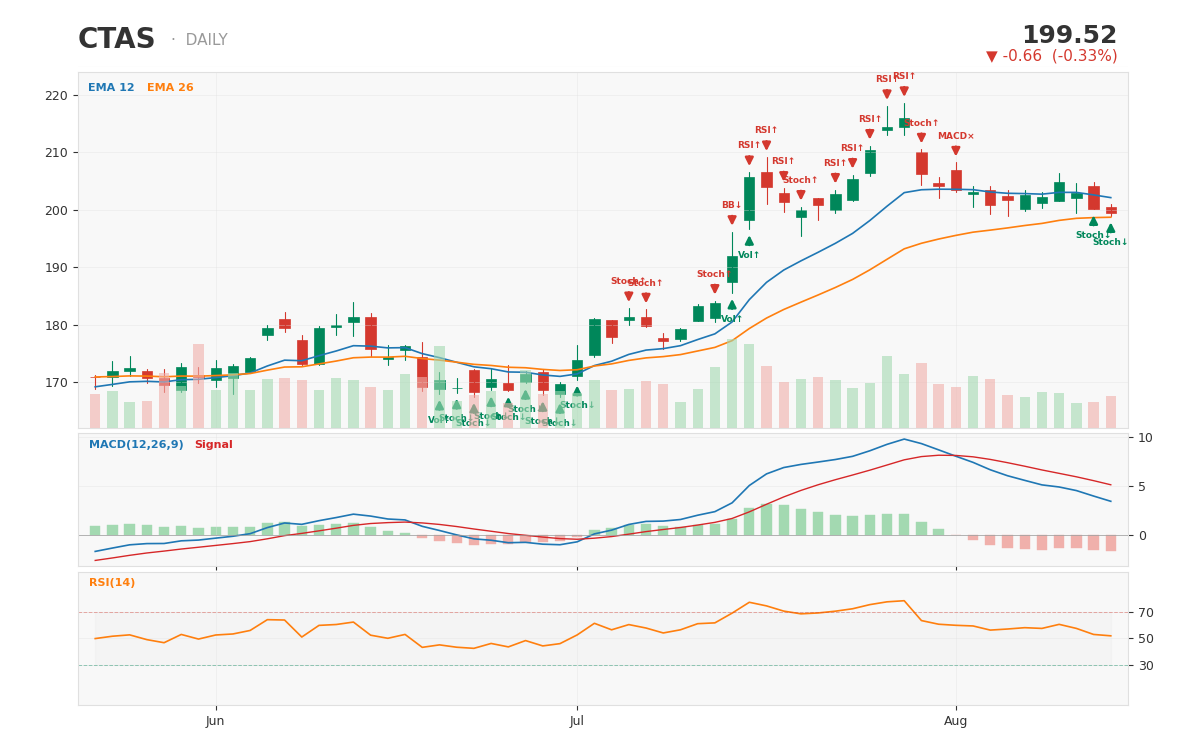 Cintas 1-year daily chart with technical signals -- a roughly balanced but slightly bearish-leaning near-term picture, 13 buy vs. 15 sell on the broader scan
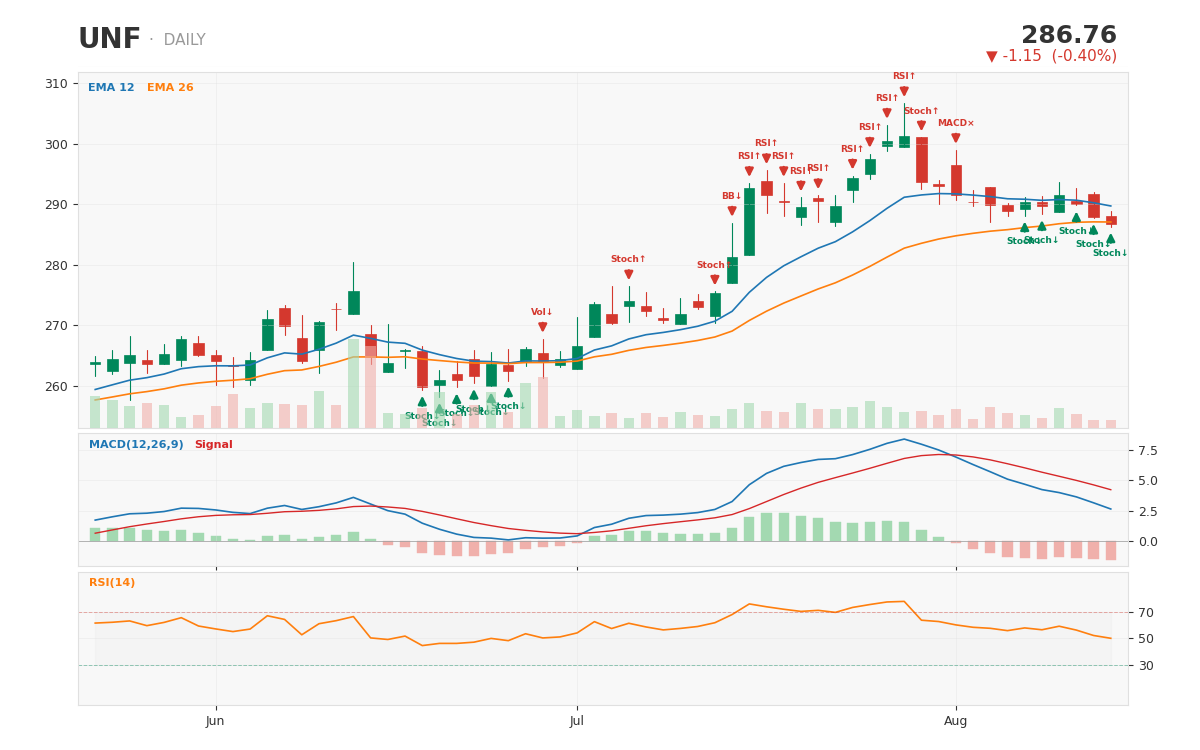 UniFirst 1-year daily chart with technical signals -- increasingly anchored to the pending Cintas deal, 11 buy vs. 15 sell on the broader scan
Smart Money Weighs In: Guru Holdings and Insider Moves
Examining "smart money" positioning provides further insight into how sophisticated investors are approaching Cintas and UniFirst.
For Cintas, a significant number of institutional gurus maintain positions. Twelve named holders, including T. Rowe Price Equity Income (the largest with 5.74 million shares), Ken Griffin, Steven Cohen, Paul Tudor Jones II, and Joel Greenblatt, are invested in the company. This institutional backing suggests confidence in Cintas's long-term value, aligning with its strong fundamentals and growth trajectory.
UniFirst also sees notable guru interest, with 11 named holders. T. Rowe Price Equity Income is again the largest, holding 331,522 shares. The roster of UniFirst gurus includes prominent deep-value investors such as Charles Brandes, Tweedy Browne, Hotchkis & Wiley, and Third Avenue Management. The presence of these value-oriented investors suggests that UniFirst may have been identified as an undervalued asset or a potential acquisition target well before the Cintas deal was announced, consistent with its historically lower multiples and more recently stalled growth.
Regarding insider activity, the detailed cluster of selling at Cintas from mid-July to mid-August 2026, involving the CEO and two directors, is a key point to monitor. This activity stands in contrast to UniFirst, which has shown zero insider filings during the same window, consistent with the company's quiet, deal-pending posture. Neither ticker has shown any notable congressional trading activity.
Explore this yourself: See live insider, congress, and guru activity on any stock
An Attractive Arbitrage Opportunity With Identifiable Risk
The Cintas acquisition of UniFirst presents a compelling merger arbitrage opportunity, driven by a sizable 7.8% spread that persists despite shareholder approval. This discount primarily reflects market concerns about potential antitrust review given the combined entity's dominant market share, rather than fundamental issues with the deal itself or the underlying businesses.
My stance is that UniFirst shares, trading at a meaningful discount to the implied deal value, offer an attractive risk-adjusted return for investors willing to endure potential regulatory delays. This view is underpinned by Cintas's demonstrated operational excellence and the clear strategic rationale for the acquisition, which aims to integrate UniFirst's assets and significantly boost its profitability toward Cintas's higher-margin profile. The insider selling at Cintas, while clustered, should be understood within the context of a robust, growing company making a strategic move, with some sales being routine for tax purposes.
An appropriate entry zone for UniFirst shares would be the current trading range, specifically around the $286-$287 price level. This provides immediate capture of the arbitrage spread if the deal closes as expected, offering a measurable upside. My twelve-month target for UniFirst shares is the $309.03 implied deal value. This target assumes the successful closure of the acquisition under the stated terms, reflecting the full premium offered by Cintas.
The primary invalidation level for this thesis would be any official regulatory challenge that either blocks the deal or imposes terms so onerous that Cintas withdraws. Alternatively, a significant and sustained drop in Cintas's stock price, materially eroding the value of the stock component of the deal, would also weaken the arbitrage's attractiveness. The spread itself is the market's thermometer for deal risk, and a widening beyond current levels would warrant re-evaluation. While insider sales offer a cautionary signal, the robust fundamental picture of Cintas and the mechanics of the approved acquisition suggest that the market's discount on UniFirst stock represents a clear opportunity.
Want deeper research on any stock? Try Kavout Pro for AI-powered analysis, smart signals, and more. Already a member? Add credits to run more research.