Cisco vs. Broadcom: Two Different AI Networking Bets, Both Sold Off After Beating Estimates
Key Takeaways
- Broadcom's AI semiconductor business, now nearing half of its total revenue, drives higher growth and margins, reflected in a premium valuation, but saw significant insider selling following its most recent earnings.
- Cisco's hyperscaler AI networking orders, while accelerating to $9.3 billion in FY2026, still represent a smaller, but rapidly growing, fraction of its broader business, offering a more balanced technical picture after its post-earnings correction.
- Both stocks experienced sharp post-earnings selloffs despite beating estimates and providing strong AI outlooks, indicating that the market demands an even more aggressive AI upside than currently delivered, particularly for the higher-growth Broadcom.
The Contrasting Post-Earnings Selloff: Expectations Outpace Strong Results
The recent price action for Cisco Systems (CSCO) and Broadcom (AVGO) underscores a demanding market for AI infrastructure plays. Both companies delivered strong earnings reports that surpassed analyst estimates, yet both experienced significant stock price declines shortly thereafter. Cisco, reporting its Q4 FY2026 results on August 12, 2026, saw its stock fall approximately 8.4% on August 13. This reaction came despite an impressive 18% year-over-year revenue growth to $17.252 billion and confirmed FY2026 hyperscaler AI orders of $9.3 billion—a substantial beat on previous guidance. The market's apprehension, however, focused on forward guidance deemed "conservative" by some analysts, prompting concerns about "peak growth," and an explicit link between growing hyperscaler hardware shipments and a compressing non-GAAP gross margin, which moved from 68.4% a year ago to 66.3% in the quarter.
Broadcom's Q2 FY2026 report, delivered earlier on June 3, 2026, similarly showcased robust performance, with revenue surging 48% year-over-year to $22.187 billion and AI semiconductor revenue more than doubling to $10.8 billion. Despite this acceleration, the stock plunged roughly 12-14% around the announcement. The market's dissatisfaction stemmed from weakness in software sales and an "unchanged" full-year AI chip forecast, which investors perceived as insufficient, suggesting much of the AI upside was already priced in. It is critical to note that these were distinct calendar events, several months apart, making direct comparisons of the selloff magnitude less about who "won" the week and more about the sector's overarching sensitivity to expectations. Broadcom's larger and earlier decline highlights its higher concentration in AI and thus greater vulnerability to any perceived slowdown or lack of upside surprise in that segment.
A Tale of Two AI Exposures: Semiconductor vs. Networking Gear
A key differentiator between Cisco and Broadcom lies in the magnitude and nature of their AI exposure. Broadcom has positioned itself as a pivotal supplier of custom AI semiconductors, with its AI semiconductor revenue reaching $10.8 billion in Q2 FY2026. This figure alone represents approximately 48.7% of its total quarterly revenue, illustrating a profound reliance and concentration on the AI buildout. The company's Tomahawk 6 switching silicon, shipping since June 2025, and Jericho 4 fabric routers are foundational to scaling AI clusters. Broadcom also boasts direct engagements with hyperscalers for custom AI ASIC (XPU) development, with named customers including Google (for TPU development), Meta (extended through 2029), Anthropic (via Google), OpenAI, ByteDance, and Fujitsu. While several large dollar figures circulating around these deals (e.g., $21-46 billion) are analyst or secondary estimates, not company-disclosed numbers, they underscore the scale of Broadcom's direct, high-value custom silicon engagements.
Cisco, while a significant beneficiary of the AI infrastructure boom, approaches it from a different angle and with a more diversified business base. The company's FY2026 hyperscaler AI orders totaled $9.3 billion, which, on a bookings basis, approximates 14.7% of its overall FY2026 revenue of $63.325 billion. This is a substantial and rapidly accelerating contribution, nearly double the company's initial guidance for the year, but it remains a minority of Cisco's total business. Cisco's offerings, such as its Silicon One G300 chip and N9000 and 8000 systems, are designed for high-performance AI data center networking. Confirmed hyperscaler customers like AWS and Microsoft leverage Cisco's technology to build out their AI-optimized networks. This difference in concentration means that while AI is a critical growth driver for Cisco, its broader portfolio of enterprise networking, security, and collaboration solutions provides a larger revenue base, potentially absorbing some of the volatility inherent in highly specialized, rapidly evolving markets like AI semiconductors.
Valuation Premium and Margin Power: Broadcom's Growth Commands a Price
The divergent AI exposures translate directly into fundamentally different financial profiles and market valuations for Cisco and Broadcom. Broadcom consistently trades at a significant premium, roughly 1.9 to 2 times Cisco's multiples across almost every valuation measure, from price-to-earnings (P/E) to enterprise value-to-EBITDA (EV/EBITDA) and price-to-sales (P/S).
| Metric | Cisco (CSCO) | Broadcom (AVGO) |
|---|---|---|
| P/E | 33.2x | 63.5-63.9x |
| EV/EBITDA | 23.0-23.1x | 45.6-46.2x |
| P/FCF | 31.4-32.4x | 57.1-57.4x |
| P/B | 8.8x | 21.3-21.4x |
| P/S | 6.9-7.0x | 24.8-24.9x |
| Gross Margin | 64.5% | 67.0% |
| Operating Margin | 24.3% | 43.7% |
| Net Margin | 21.0% | 38.8% |
| Revenue Growth (TTM) | +11.8% YoY | +23.9% YoY |
| Net Income Growth (TTM) | +30.3% YoY | +292.3% YoY |
The underlying fundamentals largely justify this valuation gap. Broadcom's operating margin, at 43.7%, is nearly double Cisco's 24.3%, demonstrating superior profitability on its revenue base. This operational efficiency fuels a much higher growth trajectory: Broadcom's trailing twelve-month (TTM) revenue growth of 23.9% is approximately double Cisco's 11.8%, and the difference in bottom-line expansion is even starker, with Broadcom's net income soaring 292.3% year-over-year compared to Cisco's 30.3%. Furthermore, Broadcom is growing operating cash flow and free cash flow robustly at 37.9% and 38.6% year-over-year respectively, while Cisco's cash flow generation is essentially flat or slightly declining despite its earnings growth. This divergence in cash flow generation is a tangible difference for investors focused on financial health beyond reported earnings. One additional balance sheet item of note is Cisco's current ratio of 0.93, indicating that current liabilities technically exceed current assets. While not uncommon for mature, investment-grade companies with reliable access to credit, it contrasts with Broadcom's stronger 2.24.
Sell-Side Conviction: A Clear Divergence in Analyst Sentiment
The differing financial profiles and AI exposures are further reflected in the sell-side analyst community's conviction levels for each stock. Both Cisco and Broadcom currently hold a "Buy" consensus rating, but the underlying sentiment distribution reveals a significant qualitative difference in support.
| Metric | Cisco (CSCO) | Broadcom (AVGO) |
|---|---|---|
| Current Price | $111.68 | $392.99 |
| Consensus Target | $131.73 | $506.50 |
| Implied Upside | ~18% | ~29% |
| Buy Ratings | 38 | 51 |
| Hold Ratings | 34 | 8 |
| Sell Ratings | 1 | 0 |
| Total Analysts | 73 | 59 |
| % Buy Ratings | 52.1% | 86.4% |
For Cisco, the current price of $111.68 sits below the consensus target of $131.73, implying an approximately 18% upside. However, the analyst rating split is almost evenly divided, with 38 "Buy" ratings against 34 "Hold" ratings. This 52.1% "Buy" conviction suggests a genuine level of hesitation among analysts, reflecting the margin compression concerns and "peak growth" worries that followed its recent earnings report.
Broadcom, by contrast, demonstrates much stronger, more one-sided conviction. With a current price of $392.99, its consensus target of $506.50 implies a more substantial 29% upside. More notably, 51 out of 59 analysts rate Broadcom a "Buy," translating to an 86.4% conviction rate, with only 8 "Hold" ratings and no "Sell" recommendations. This wide discrepancy in conviction highlights the market's stronger belief in Broadcom's ability to capitalize on the AI theme, despite the high valuation and recent post-earnings selloff. Post-earnings adjustments in targets for Cisco, such as Morgan Stanley's raise to $135 and Goldman Sachs' more cautious move to $125 due to margin pressures, underscore the nuanced views on Cisco's path forward. For Broadcom, its June earnings saw less immediate, explicit target changes, with one notable post-earnings raise to $480 citing continued confidence in its AI business.
Smart Money's Mixed Signals: Insider Sales vs. Guru Holdings
Examining the "smart money" flows from gurus and company insiders reveals a mixed picture that warrants careful consideration, particularly for Broadcom. Both companies are well-established, with broad institutional backing: Cisco boasts 22 named guru holders, while Broadcom has a somewhat deeper bench with 30. This suggests established institutional interest in their long-term prospects.
However, the recent insider activity presents a clearer signal of diverging behavior. In Cisco's case, the 60-day window shows minimal insider selling, with only one filing from an EVP for approximately $855,000 in June 2026. This activity is small and appears routine, lacking any strong directional signal for the stock. Broadcom, on the other hand, registers eight insider filings within the 60-day window, totaling a substantial $283.7 million in sales. The most prominent transaction was director Henry Samueli, a Broadcom co-founder, who sold 654,241 shares on June 24, 2026, for $250.0 million at a price of $382.13 per share. While this is a massive sale in dollar terms, it occurred near where the stock is currently trading ($392.99 as of today), suggesting it's more indicative of scale-driven liquidity management than a bearish signal on the company's future prospects. Additionally, the Chief Legal & Corporate Affairs Officer made several smaller, regular sales totaling around $32.4 million, consistent with a scheduled 10b5-1 plan. Minor congressional trading activity for both stocks was small-dollar and lacked a meaningful pattern.
Technical Divergence: Broadcom's Stretched Bull vs. Cisco's Balanced Picture
The technical landscape for Cisco and Broadcom reflects their recent price action and underlying market sentiment, presenting two distinct pictures.
Cisco's technical signals, when broadly scanned, appear roughly balanced with 9 buy signals against 8 sell signals. Key bullish indicators include a sustained price uptrend, a recent bullish cross in a momentum oscillator, and persistent outperformance relative to the broader market. The accumulation/distribution line shows an uptrend, and on-balance volume (OBV) is rising, indicating that trading volume is confirming the upward price moves. Price is also trading above a rising volume-weighted average price (VWAP), further supporting positive momentum. However, a 'supertrend' indicator has recently flashed a sell signal, indicating a potential near-term shift or consolidation, which aligns with the stock still digesting its approximately 8.4% post-Q4-earnings drop. This balanced picture suggests that while the long-term trend remains positive, the stock is currently in a phase of recalibration.
Broadcom, in contrast, exhibits a technically stronger, yet more stretched, bullish profile. A broader scan reveals 12 buy signals against 7 sell signals. This includes clear buy indicators such as a Parabolic SAR buy signal, a supertrend buy signal, and a recent Aroon Up crossover, all pointing to upward momentum. Like Cisco, Broadcom is also in an uptrend, outperforming the market, and showing confirmation from both the accumulation/distribution line and rising OBV. Its price action has broken above the Bollinger Band midline, with average true range (ATR) expansion indicating increased volatility often associated with strong moves. However, this robust bullishness comes with a cautionary note: three separate oscillator-based signals—StochRSI, Williams %R, and the Commodity Channel Index (CCI)—are simultaneously flagged as overbought. This combination suggests the stock's upward movement may be technically extended and vulnerable to a pullback, akin to the profile of several other high-flying AI semiconductor names recently. A reading indicating weakening trend strength provides a counterpoint to the otherwise strong bullish momentum.
Despite these differing technical nuances, both stocks show middling composite scores (Cisco 60, Broadcom 55) and weak technical ratings (Cisco 35, Broadcom 41), suggesting that proprietary quantitative models, which often incorporate longer-term or more complex factors, are less enthusiastic than the fresh, direct technical indicators imply. This discrepancy highlights a tension between near-term price momentum and broader quantitative assessments.
The daily charts visually reinforce these findings. Cisco's chart shows the recent sharp dip, with the stock finding some footing but still working through the negative sentiment. Broadcom's chart, while having corrected from its earlier June high, reflects a more persistent underlying bullish trajectory that is currently signaling overbought conditions.
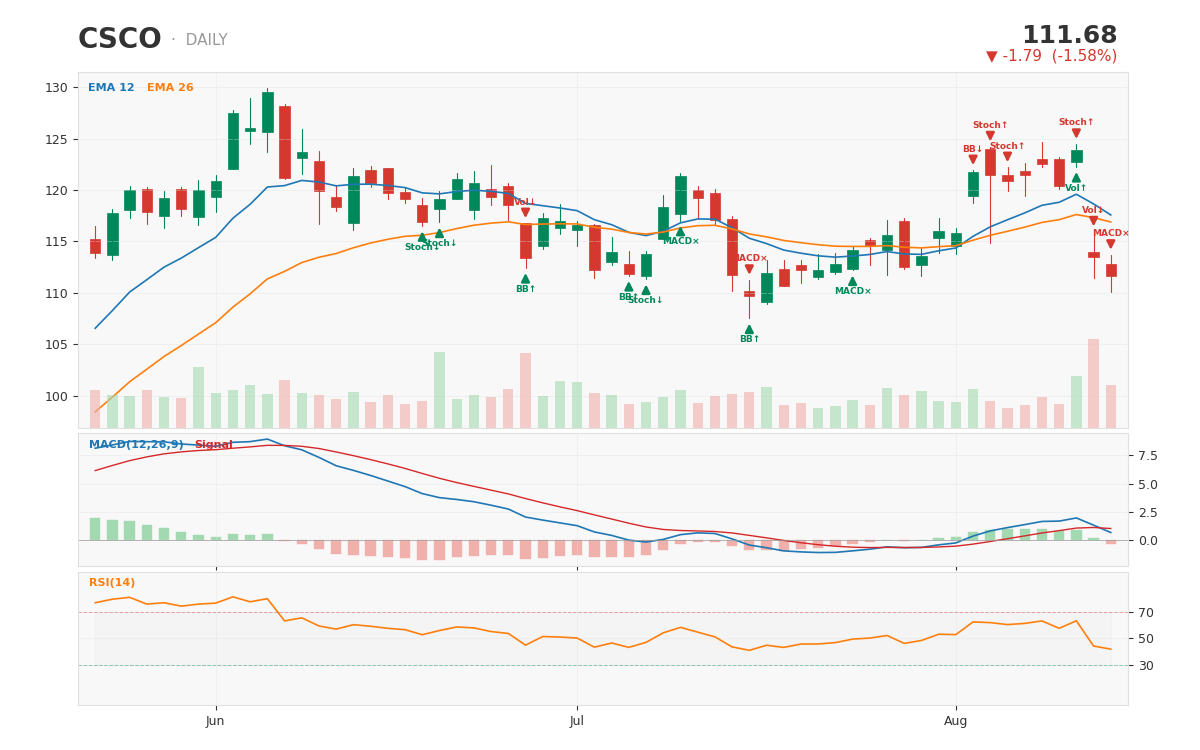 Cisco 1-year daily chart with technical signals -- a roughly balanced 9 buy/8 sell picture still digesting the ~8.4% post-Q4-earnings drop
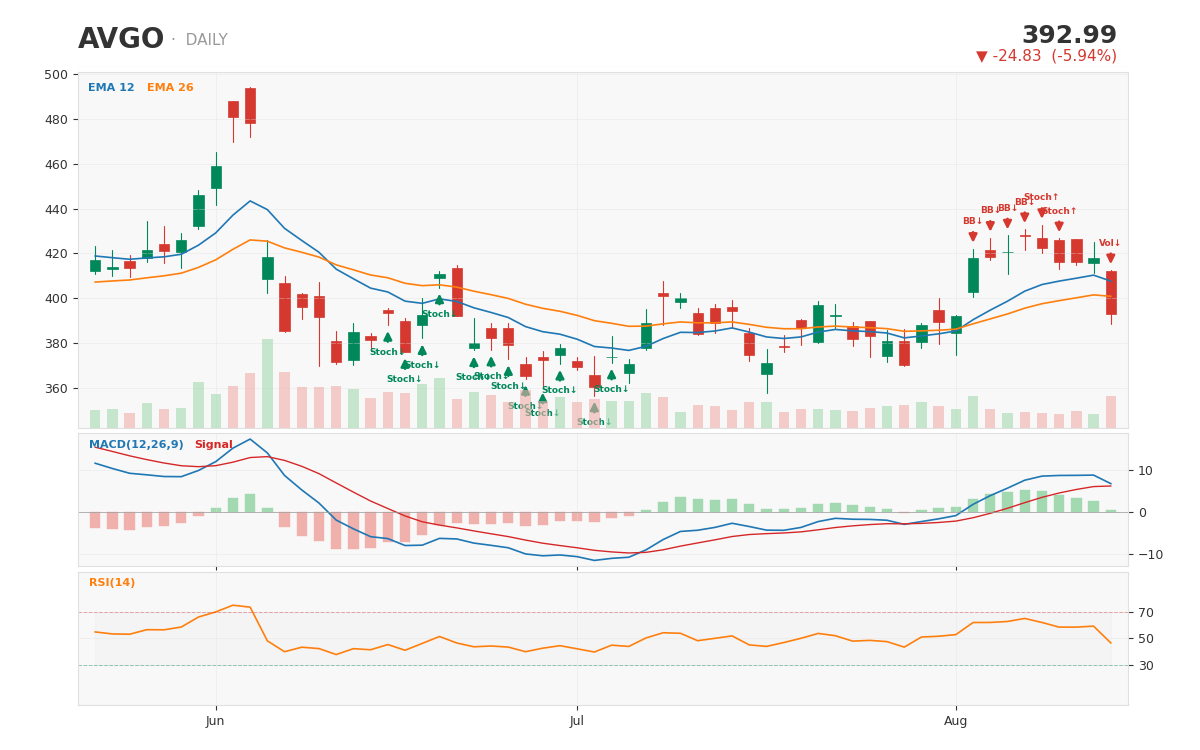 Broadcom 1-year daily chart with technical signals -- a broader, more bullish-leaning 12 buy/7 sell picture, now flagged overbought on three separate oscillators
Investment Thesis: Different Risk/Reward for the AI Infrastructure Buildout
The comparison between Cisco and Broadcom ultimately reveals two distinct investment propositions within the booming AI infrastructure landscape, each with its own risk-reward profile. Broadcom stands out as the higher-growth, higher-margin, and significantly more AI-concentrated bet. Its deep involvement in custom AI semiconductors and direct, large-scale engagements with hyperscalers position it to capture a larger share of the specialized silicon market, driving its premium valuation and impressive bottom-line expansion. However, this concentration also makes Broadcom more sensitive to any perceived shifts in AI demand or market expectations, as evidenced by its more severe post-earnings selloff on what might otherwise be considered strong results. The technical picture for Broadcom, while broadly bullish, flashes overbought warnings, suggesting that further upside may face near-term resistance.
Cisco, on the other hand, represents a more diversified, value-oriented approach to the AI theme. While its AI networking orders are accelerating impressively and constitute a significant growth engine, they remain a smaller portion of its overall revenue base. This provides a degree of insulation from the extreme volatility of the specialized AI semiconductor cycle. Cisco's lower multiples, more balanced analyst sentiment, and a technical picture that is still digesting recent weakness suggest a potentially more stable, albeit slower, growth trajectory. The challenge for Cisco lies in demonstrating that its growing AI contributions can translate into improved cash flow generation and margin expansion, especially as the hyperscaler mix influences overall profitability. Both companies face the challenge of an insatiable market demanding ever-higher AI performance and growth, often punishing even strong results if they do not exceed already elevated expectations.
Navigating AI's Demanding Landscape
Broadcom offers a compelling, high-conviction play on the most direct and highest-growth aspects of the AI semiconductor market, albeit at a demanding valuation. The stock's robust fundamentals and strong analyst backing are undeniable, but its elevated concentration in AI makes it sensitive to shifts in market sentiment, demanding higher risk tolerance.
Stance: We rate Broadcom (AVGO) as a Buy for growth-oriented investors comfortable with its premium valuation and concentration risk, with Cisco (CSCO) as a Hold for value investors seeking diversified exposure to the AI infrastructure buildout.
Entry Zone (AVGO): We would look for an entry closer to the $380 level, aligning with the lowest analyst price target and potential support around its recent post-earnings lows. This offers a more prudent entry point given the current overbought technical signals and the scale of recent insider selling.
12-Month Target (AVGO): Our 12-month price target for Broadcom is $505, near the lower end of the analyst consensus range ($493-$521). This implies roughly 28% upside from today's price, reflecting continued strong execution in its AI semiconductor segment, but acknowledging potential for valuation multiple compression if growth rates moderate slightly.
Invalidation Level (AVGO): A decisive break and sustained trading below $365 would invalidate our bullish thesis, suggesting a more fundamental issue than mere market overreaction or technical retracement.
Entry Zone (CSCO): For Cisco, an entry zone around $105-110, near its current price, aligns with its 52-week low range and could offer a more attractive risk-reward for investors seeking diversified exposure.
12-Month Target (CSCO): Our 12-month price target for Cisco is $130, close to the consensus median ($131.73). This reflects the accelerating AI contribution offsetting some of the margin pressure and slower traditional business growth, implying an 18% upside from the current price.
Invalidation Level (CSCO): A move below $100 would signal a breakdown in the broader uptrend and necessitate a re-evaluation of the company's growth narrative and AI trajectory.
While both companies are undeniably crucial players in the AI revolution, Broadcom represents a concentrated, high-growth bet that carries significant upside potential alongside higher risk, while Cisco offers a more diversified, stable approach that still benefits from the accelerating AI infrastructure demand.
Want deeper research on any stock? Try Kavout Pro for AI-powered analysis, smart signals, and more. Already a member? Add credits to run more research.