Meta's Strategic AI Push Meets Short-Term Financial Headwinds: A Mixed Signal Landscape
Key Takeaways
- Meta's recent Muse Glimmer open-weight AI model launch signals a strategic commitment to regaining developer mindshare from rapidly advancing Chinese competitors, although on Meta's own benchmarks, it trails key rivals.
- Despite robust top-line growth, Q2 2026 earnings revealed a significant earnings per share (EPS) miss and a nearly 91% collapse in free cash flow, primarily driven by massive AI-related capital expenditures that are inverting net income growth.
- Current analyst consensus maintains a "Buy" rating with an implied 25% upside to the price target, supported by deep institutional conviction from a diverse group of 30 named hedge fund gurus, suggesting long-term optimism despite the immediate financial pressures and mixed technical signals.
The AI Ambition: A Strategic Open-Weight Play in a Catch-Up Race
Meta Platforms, Inc. (META) made headlines on August 10, 2026, with the release of Muse Glimmer, its first major open-weight AI model since its flagship Muse Spark line transitioned to closed weights in April 2026. This move, underscored by a permissive Apache 2.0 license, positions Muse Glimmer as a developer-friendly model designed for single high-end consumer GPUs, signaling Meta's clear intent to re-engage the open-source community. The timing is critical; Chinese labs like DeepSeek and Qwen have dramatically increased their share of open-router token usage and Hugging Face downloads, putting Meta in a reactive position.
While a significant product release, Meta's own benchmark disclosures reveal Muse Glimmer's score of 35 on the Artificial Analysis Intelligence Index, placing it ahead of prior Meta models and Gemma 4 31B, but notably behind competitors such as Qwen3.6-27B and Ling 3.0 Flash, both scoring 38. Its hallucination rate also lags behind these rivals. This nuanced competitive landscape suggests that Muse Glimmer is a strategic defensive play to claw back mindshare, rather than a definitive leadership claim. It demonstrates Meta's commitment to the open-source ecosystem, a vital front in the broader AI race, but also highlights the intense competition and Meta's current standing as a challenger in some key performance metrics.
Q2 Earnings Reveal Financial Strain from AI Investments
The Muse Glimmer release landed just two weeks after Meta's Q2 2026 earnings report on July 29, 2026, which presented a stark contrast between top-line strength and bottom-line pressures. Meta reported revenue of $60.8 billion, a robust 28% year-over-year increase that comfortably beat expectations. However, this growth was overshadowed by a GAAP EPS miss, coming in at $6.18 against a Street consensus of approximately $7.14-$7.22. The primary culprit for this earnings compression was the aggressive increase in capital expenditures (capex).
The financial strain was most evident in Meta's free cash flow, which collapsed to $784 million in Q2 2026, a staggering 91% decline from $8.55 billion a year earlier. This dramatic drop is directly linked to the company's substantial investments in AI infrastructure, with capex soaring to $31.08 billion for the quarter. Meta subsequently raised its full-year 2026 capex guidance to between $130 billion and $145 billion, from an earlier range of $125 billion to $145 billion, indicating that the heavy investment cycle is set to continue. Additionally, the Reality Labs division continued to be a drag, reporting $431 million in revenue against a $4.619 billion operating loss for the quarter. Further dampening sentiment, Q3 2026 revenue guidance of $61-64 billion (midpoint $62.5 billion) fell below the consensus estimate of $63.15 billion. The market reacted swiftly, with the stock falling about 8% in the two sessions following the earnings print, from $593.41 to $539.03. While it has partially recovered to today's price of $594.29, it still sits just above its pre-earnings levels, reflecting ongoing investor digestion of the investment-heavy strategy.
Valuations Stretched by Capex, But Core Margins Remain Strong
| Metric | Trailing Twelve Months (TTM) | Latest Quarter (Q2 2026) |
|---|---|---|
| Gross Margin | 81.7% | 81.4% |
| Operating Margin | 38.1% | 30.9% |
| Net Margin | 29.8% | 26.1% |
| P/E Ratio | 22.09x | |
| EV/EBITDA | 15.05x | |
| Price/Free Cash Flow | 36.96x |
Meta's financial ratios highlight a nuanced picture of valuation and profitability. On a trailing twelve-month (TTM) basis, the company boasts exceptionally strong gross, operating, and net margins of 81.7%, 38.1%, and 29.8% respectively, among the highest for a mega-cap technology firm. However, a closer look at the latest quarterly figures reveals a compression in profitability, with gross margin at 81.4%, operating margin at 30.9%, and net margin at 26.1% for Q2 2026. This sequential dip visually demonstrates how the intensified capital expenditure associated with AI investments is actively absorbing cash and compressing quarterly margins, a trend visible in the provided margin charts.
This capex intensity is also reflected in valuation metrics. While Meta's price-to-earnings (P/E) ratio sits around 22 times, which isn't inherently excessive, its price-to-free cash flow (P/FCF) ratio is elevated at nearly 37 times. This divergence underscores the significant cash burn from investments, making the company appear expensive when measured against its actual cash generation. Furthermore, Meta screens as expensive across all three proprietary value-composite ranking measures, reinforcing the view that current valuation metrics are stretched. The most concerning aspect of the fundamental picture is the growth inversion: for fiscal year 2025, Meta saw revenue grow by a healthy 22.2% year-over-year, yet net income decreased by 3.1% and EPS fell by 1.6%. Free cash flow plummeted by 14.7% year-over-year, even as operating cash flow saw a robust 26.8% increase. This data clearly indicates that Meta's aggressive investment in AI is currently outweighing its ability to translate top-line growth into bottom-line profits and cash generation, painting a materially different story than a simple margin squeeze.
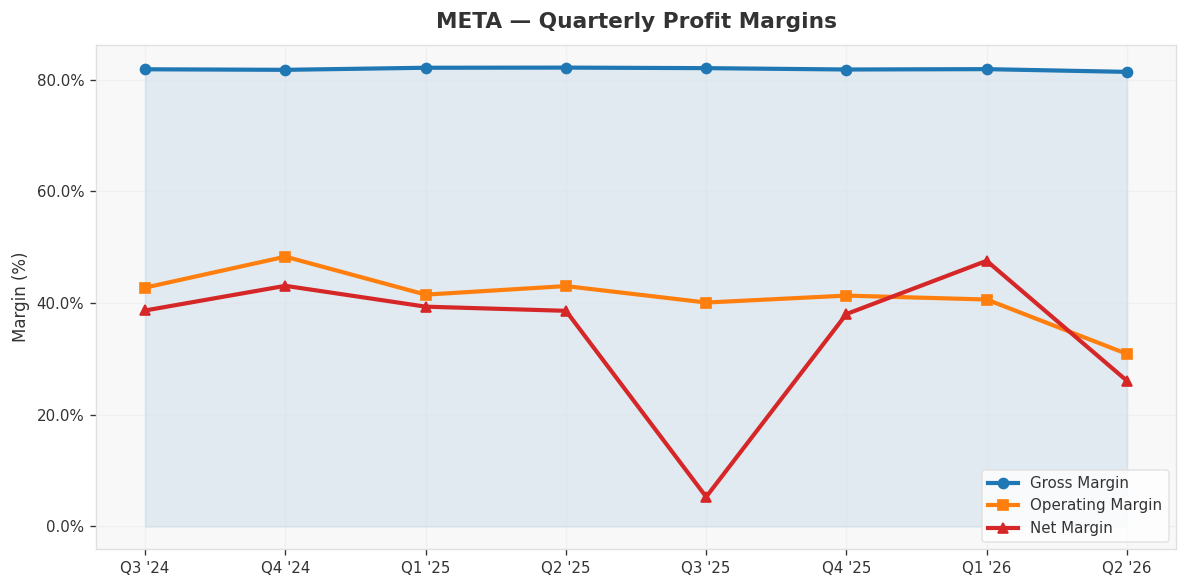 Latest quarter: gross margin 81.4%, operating margin 30.9%, net margin 26.1% -- the AI capex ramp visibly compressing margins quarter over quarter
Wall Street and Smart Money Maintain Conviction Despite Headwinds
Despite the immediate post-earnings disappointment and subsequent target cuts from individual firms in late July 2026, the broader Wall Street consensus on Meta remains remarkably positive. As of August 12, 2026, 65 analysts cover Meta, with a strong "Buy" consensus rating composed of 2 "Strong Buy," 50 "Buy," 11 "Hold," and only 2 "Sell" recommendations. The average analyst price target stands at $723.69, with a median of $725.00. Relative to today's price of $594.29, this implies an approximate 25% upside potential over the next twelve months. The low end of the target range, $595.00, sits just slightly above the current price, suggesting that even the most cautious Street views still underwrite a stable floor. This collective optimism suggests that while analysts acknowledge the short-term financial impact of Meta's heavy investments, they largely maintain conviction in the company's long-term AI strategy and its ability to monetize these initiatives.
This institutional confidence is further corroborated by a diverse group of "smart money" investors. Meta is held by a genuinely deep bench of 30 named guru investors, spanning various investment philosophies. This includes prominent figures such as Bill Ackman, Ken Griffin of Citadel, Chase Coleman's Tiger Global, Andreas Halvorsen's Viking Global, Philippe Laffont's Coatue, and even value-oriented managers like Terry Smith and Jeremy Grantham. The presence of such a wide array of top-tier institutional money managers, from growth to macro and activist styles, signifies a broad vote of confidence in Meta's strategic direction and future prospects, cutting across potential short-term concerns. Separately, insider trading activity over the past 60 days shows 10 filings, all of which are sales. However, nine of these are from COO Javier Olivan and exhibit the classic pattern of a scheduled 10b5-1 plan, rather than discretionary bearish action. A few small director sales round out the list. This suggests routine liquidity management, not a signal of waning executive confidence. Congress trading activity over the last 90 days has been minimal and mixed, with no discernible pattern or size to be considered a meaningful signal.
Technicals Signal Stabilization, Not Clear Direction
The technical picture for Meta as of August 13, 2026, reflects a stock in transition, showing signs of stabilization since its post-earnings low but lacking a definitive trend. The current signal set is genuinely mixed, presenting a complex read for traders. On the bullish side, there are six positive indicators, including the stock being in an uptrend, a MACD bullish cross signaling upward momentum, and outperforming the broader market. Furthermore, indicators like the accumulation/distribution line showing an uptrend and rising On-Balance Volume (OBV) suggest that trading volume is confirming price moves higher, with the stock also trading above its Volume-Weighted Average Price (VWAP).
However, countervailing signals introduce caution. The Average Directional Index (ADX) has turned bearish, and the Supertrend indicator is showing a sell signal, suggesting underlying trend weakness despite the recent stabilization. Additionally, the Stochastic RSI is flagging an overbought condition, indicating that the recent rebound may be due for a short-term pause or pullback. While Meta's overall composite score sits at a middling 54, its technical rating is considerably lower at 16, and its moving average score is at 0. This discrepancy highlights a potential lag in the broader composite scores reflecting the more recent, granular signal shifts. The current technical landscape, visible in the one-year daily chart, is consistent with a stock that has partially recovered from a significant event (the earnings miss) but has yet to establish a clear, sustained direction, oscillating between bullish price action and underlying trend concerns.
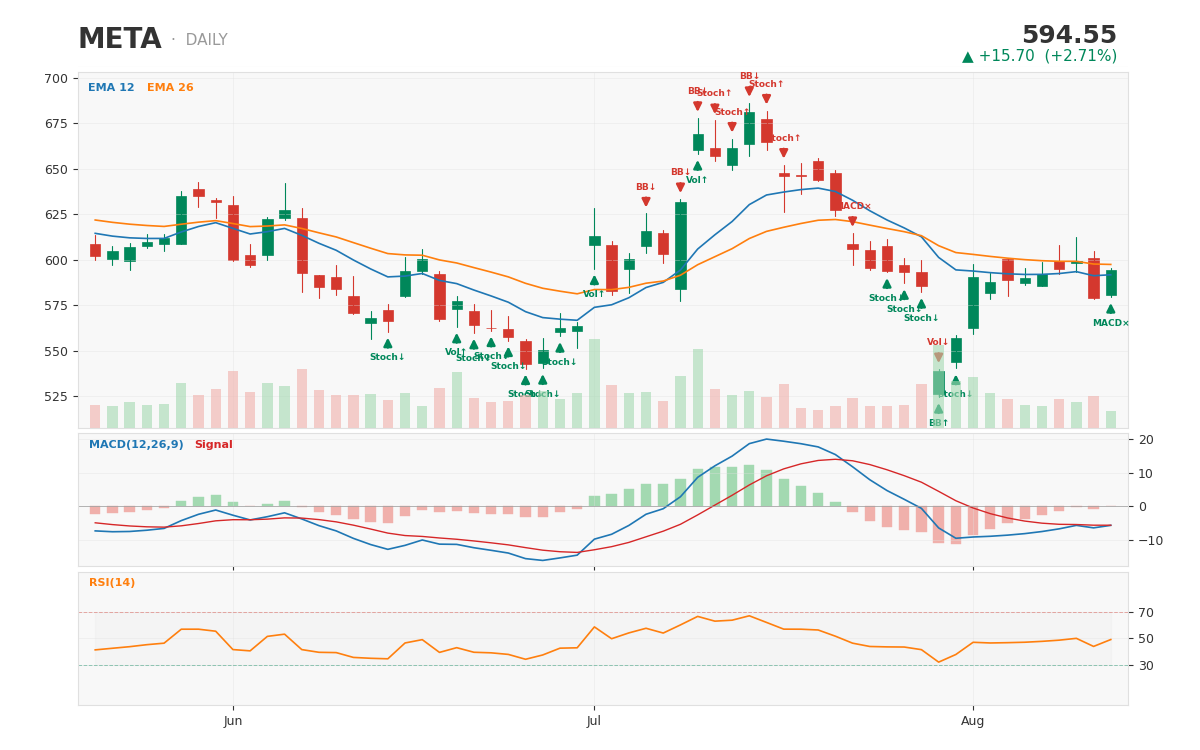 1-year daily chart with technical signals -- a genuinely mixed picture (6 bullish, 2 bearish, 1 overbought) as the stock stabilizes below its pre-earnings level
Navigating High Capex for Long-Term AI Dominance
Meta Platforms is at a critical juncture, navigating the immense capital requirements of its ambitious AI strategy while managing investor expectations. The release of Muse Glimmer is a clear signal of Meta's determination to compete in the open-source AI arena, a strategic necessity to secure developer mindshare. However, this commitment comes at a significant financial cost, as evidenced by the dramatic free cash flow collapse and negative net income growth despite robust revenue expansion. The tension between long-term strategic investment and short-term financial performance forms the core narrative for META stock today.
The stance here is constructively bullish, not neutral: the free-cash-flow collapse is real and likely to persist through 2027, but it reflects a strong ad franchise choosing to fund a race it cannot afford to sit out, not a broken business. The deep institutional conviction from top-tier gurus and a strong analyst "Buy" consensus, implying substantial upside, provides a strong vote of confidence in Meta's ability to eventually monetize its AI bets. For investors looking to build a position, an entry zone around the current market price of $594.29, extending down towards the analyst low target of $595.00, offers a reasonable risk/reward, particularly if technical support consolidates. This level also sits just above the stock's 52-week low of $520.26, which would serve as a critical invalidation level should the market lose confidence in Meta's ability to manage its capex and turn its AI investments into profit. The consensus 12-month price target of $723.69 implies substantial upside, reflecting the market's belief in the company's powerful ad-tech engine and the eventual payoff from its AI and metaverse endeavors, despite the current financial drag from massive investments. The path ahead will be defined by Meta's ability to demonstrate tangible returns from its AI investments, transforming capital expenditure into sustainable free cash flow growth.
Want deeper research on any stock? Try Kavout Pro for AI-powered analysis, smart signals, and more. Already a member? Add credits to run more research.