NVDA - The Data Center Grew 117%, and the Stock Still Fell

Key Takeaways
- NVIDIA's Q2 FY2027 delivered historic results: revenue surged 106% year-over-year to $96.2 billion, with its data center segment growing an astounding 117% to $89.0 billion (92.5% of total sales). The company also provided its first-ever full-year revenue guidance, projecting 70% growth compared to Wall Street's prior 45% model.
- Despite these stellar figures and an initial post-earnings rally, the stock fell 4.55% on Friday, August 28. This decline was driven by a confluence of distinct factors: a hawkish Federal Reserve speech, sector-wide cooling after Marvell's disappointing earnings, a paradoxical decline despite an expanded Amazon AWS deal, and an emerging bear thesis highlighting cash flow concerns and "balance sheet as a service" financing risks.
- Analyst consensus remains firmly bullish with substantial implied upside, and recent institutional 13F filings show net buying interest. However, fundamental valuation screens as deeply expensive, and shorter-term technical indicators flash caution, even as the longer-term underlying uptrend remains broadly intact.
Record Quarter, Historic Guidance — Yet a Market Retreat
NVIDIA Corporation (NVDA) reported a genuinely historic fiscal Q2 2027, with revenue reaching $96.2 billion, an impressive 106% increase year-over-year. Adjusted earnings per share came in at $2.22, both figures comfortably topping consensus expectations. The data center segment was a standout, with revenue skyrocketing 117% year-over-year to $89.0 billion, accounting for 92.5% of the company's total sales.
Looking ahead, NVIDIA guided for fiscal Q3 revenue to reach $108.0 billion. At its current mix, the data center segment is poised to cross the $100 billion quarterly milestone. Perhaps even more significant, NVIDIA issued its first-ever full-year forward revenue outlook, projecting 70% growth for fiscal 2028. This figure markedly surpasses the roughly 45% growth Wall Street had previously modeled, indicating a more accelerated trajectory than anticipated by the market. Some analysts suggest the underlying demand figure is even higher, with supply constraints implicitly limiting the official guide.
Following the earnings release after market close on Wednesday, August 26, the stock initially reacted positively, rising approximately 9% on Thursday, August 27. However, this optimism proved short-lived. By Friday, August 28, NVDA closed at $217.55, marking a decline of $10.36 or 4.55% on volume of 194.0 million shares, ending the week with a market capitalization of $5.27 trillion. This subsequent fall, despite the exceptional results and forward guidance, points to a confluence of external and internal pressures beyond a simple "sell the news" reaction.
Four Forces Fueled Friday's Retreat
The 4.55% decline in NVIDIA's stock on Friday, August 28, was not a singular event, but rather the culmination of four distinct, identifiable forces that weighed on market sentiment and specifically on the semiconductor giant. Understanding these separate dynamics is crucial to interpreting the stock's nuanced reaction to its otherwise blowout earnings.
First, a hawkish speech from Federal Reserve Chair Kevin Warsh at Jackson Hole on Friday morning signaled that the Fed still had "inflation work to do." This commentary heightened expectations for further rate hikes, turning a broadly positive market open into a widespread sell-off across various sectors, including technology.
Second, sector-specific sentiment cooled following disappointing earnings from Marvell Technology (MRVL) earlier the same week. Marvell's roughly 10% post-earnings decline, driven by guidance-timing disappointments, impacted sentiment across the semiconductor and AI infrastructure space.
Third, a genuinely counter-intuitive paradox unfolded. Amazon and NVIDIA jointly confirmed a sharply expanded infrastructure deal, with Amazon Web Services (AWS) committing to 2 million additional NVIDIA GPUs for 2027 and 2028, supplementing the more than 1 million already committed. While Amazon's stock rose 4% on this positive news, NVIDIA's stock paradoxically fell by a similar amount the very same day. This divergence suggests the market was either already pricing in such significant deals or was focusing on other, more immediate concerns.
Finally, a fresh, substantive bear thesis began to emerge and gain traction. This included specific, quantified concerns about NVIDIA's financial structure and cash flow, which contributed significantly to the cautious sentiment. These specific points are detailed further in the following section.
The Bear Thesis: Cash Flow Concerns and "Balance Sheet as a Service"
While NVIDIA's top-line growth is undeniably impressive, a growing chorus of bearish arguments has begun to scrutinize the underlying financial mechanisms supporting this expansion. A recent sell rating, published today (August 29, 2026), highlights concerns that NVIDIA's guidance is "underpinned by circular financing," suggesting a quarter of next year's business relies on financing arrangements within its ecosystem.
Specific financial concerns were raised regarding a projected decline in gross margins, expected to settle in the 71-73% range, down from the current 74.7%. Additionally, a report from yesterday, August 28, explicitly pointed to a "missing" $27 billion in free cash flow despite the blowout revenue print, raising questions about balance sheet changes.
Multiple independent sources are converging on a theme described as NVIDIA's "balance sheet as a service," with the company being referred to as the "central bank of artificial intelligence." This refers to NVIDIA's practice of financing much of its own customer ecosystem. Concrete figures underscore this strategy: NVIDIA reportedly held approximately $21 billion in SpaceX shares as of the recent quarter-end. Separately, the company is reported to be paying roughly $12.9 billion for Hugging Face, an open-source AI model repository, at a valuation of about 80 times its annualized revenue of approximately $150 million—a multiple that would raise eyebrows in almost any other context.
Amidst these aggressive investments, there are also signs of strategic recalibration. NVIDIA is reportedly "re-thinking a portion of a grand plan to aid smaller AI cloud firms in funding huge GPU buys," indicating a genuine pullback on some of its riskier AI cloud financing strategies. This suggests an acknowledgment of inherent risks in acting as both a primary supplier and a financier.
Valuation Remains Stretched Despite Accelerating Growth
Despite the market's enthusiasm for NVIDIA's growth story, its fundamental valuation metrics reveal a stock that screens as deeply expensive by conventional trailing multiples. The price-to-earnings (P/E) ratio sits around 28 times, while the price-to-sales (P/S) ratio is approximately 18 times. Other metrics, such as price-to-book (P/B) at nearly 24 times and enterprise value to EBITDA (EV/EBITDA) at around 23 times, reinforce the picture of a premium valuation. The price-to-free cash flow (P/FCF) multiple, at over 42 times, is particularly noteworthy given the recent concerns about cash flow generation.
On the profitability front, NVIDIA boasts exceptionally high margins, with gross margin at 74.7%, operating margin at 65.2%, and net margin at 63.7%. Return on equity (ROE) is an outstanding 110.1%, with return on assets (ROA) at 60.2% and return on invested capital (ROIC) at 59.5%, reflecting highly efficient capital deployment. The current ratio stands strong at 4.59, indicating robust liquidity.
It is crucial to distinguish between trailing-twelve-month (TTM) growth rates and the accelerating pace seen in the most recent quarter. While the TTM revenue growth rate stands at 65.5%, blending in slower prior quarters, the most recent quarter's 106% year-over-year revenue growth and the 117% surge in the data center segment highlight a significant acceleration. Even with this accelerated growth, NVIDIA screens as expensive across its proprietary value-composite ranking measures, consistently confirming its premium valuation from a quantitative factor perspective. NVIDIA remains the world's largest company by market capitalization, currently at $5.27 trillion.
Wall Street Remains Bullish, Smart Money Shows Mixed Flow
Wall Street analysts continue to hold a firmly bullish stance on NVIDIA, even after Friday's market-driven pullback. The consensus analyst rating is a "Buy," stemming from a strong majority of ratings (58 Buy, 2 Strong Buy) against a smaller contingent of Holds (16) and Sells (3). The average analyst price target stands at $345.21, with a median of $322.50. Even the lowest target of $270.00 sits well above the current price of $217.55, implying significant upside of approximately 58.7%. This strong conviction is further evidenced by recent updates, such as Wedbush lifting its price target to $345 (Outperform), citing precisely NVIDIA's first-ever full-year guidance as the catalyst.
The "smart money" picture, encompassing institutional gurus, insider activity, and congressional filings, shows a generally positive, albeit nuanced, flow. Guru holdings are substantial, with 30 named institutional holders, including major players like T. Rowe Price Equity Income (370.1 million shares), Ken Fisher (88.6 million shares), and Ken Griffin (66.9 million shares). No insider filings were reported in the current data. Congressional filings, though present (5 filings in the $1,001-$15,000 range), are too small and mixed across buys and sells (Rep. Tracey Mann with one buy and one sell; Rep. Michael Rulli with two buys and one sell) to indicate any discernible pattern.
More recent institutional activity, based on 13F filings dated today, August 29, 2026, presents a mixed but predominantly positive signal. Churchill Financial Advisors LLC notably increased its holdings by 19.5%, adding 3,220 shares to reach a stake of 19,744 shares valued at approximately $3.95 million. Essential Investment Partners LLC also boosted its position by 27.0%, adding 3,031 shares to hold 14,259 shares (NVIDIA is 2.3% of their fund). Brookstone Capital Management added 79,288 shares, increasing its stake by 8.8% to 981,311 shares. However, Altrafin AG executed a sharp, near-total exit, decreasing its holdings by 99.6% down to just 200 shares after selling 46,739. This significant divestment stands as a notable counter-example amidst an otherwise buying-skewed flow, highlighting differing institutional perspectives on NVIDIA's current valuation or risk profile.
Explore this yourself: See live 13F, guru, and insider flow on Kavout Smart Money
Technicals Signal Intact Uptrend Amidst Short-Term Caution
The technical picture for NVIDIA presents a compelling divergence between its underlying trend strength and shorter-term price action. On one hand, several key indicators confirm an intact uptrend. A curated list of technical signals shows that the stock is in an uptrend, outperforming the broader market, with rising on-balance volume (OBV), and holding above its volume-weighted average price (VWAP). This view is strongly corroborated by its high moving average score of 83, indicating that the stock's price remains well-supported by its longer-term averages. An earlier report from August 28 even noted that NVIDIA had broken out above its 20-day moving average, a bullish signal preceding Friday's decline.
On the other hand, a broader scan of technical detectors reveals a more cautious, if not outright bearish, short-term outlook. While some signals lean bullish, a comprehensive scan, run on August 29, painted a starkly different picture, with a significant majority of indicators flashing sell signals. This short-term caution is further reflected in a notably lower oscillator score (37), which contrasts sharply with the strong moving average score (83).
This divergence suggests a nuanced technical interpretation: the fundamental, longer-term uptrend for NVIDIA remains robust and intact, supported by strong price action relative to its moving averages and market performance. However, the immediate post-earnings price action, particularly Friday's decline, has triggered a multitude of shorter-term indicators signaling overbought conditions or a temporary loss of momentum. This indicates that while the overall trajectory is still upward, the stock is likely to experience near-term volatility and consolidation as these short-term pressures work through the system.
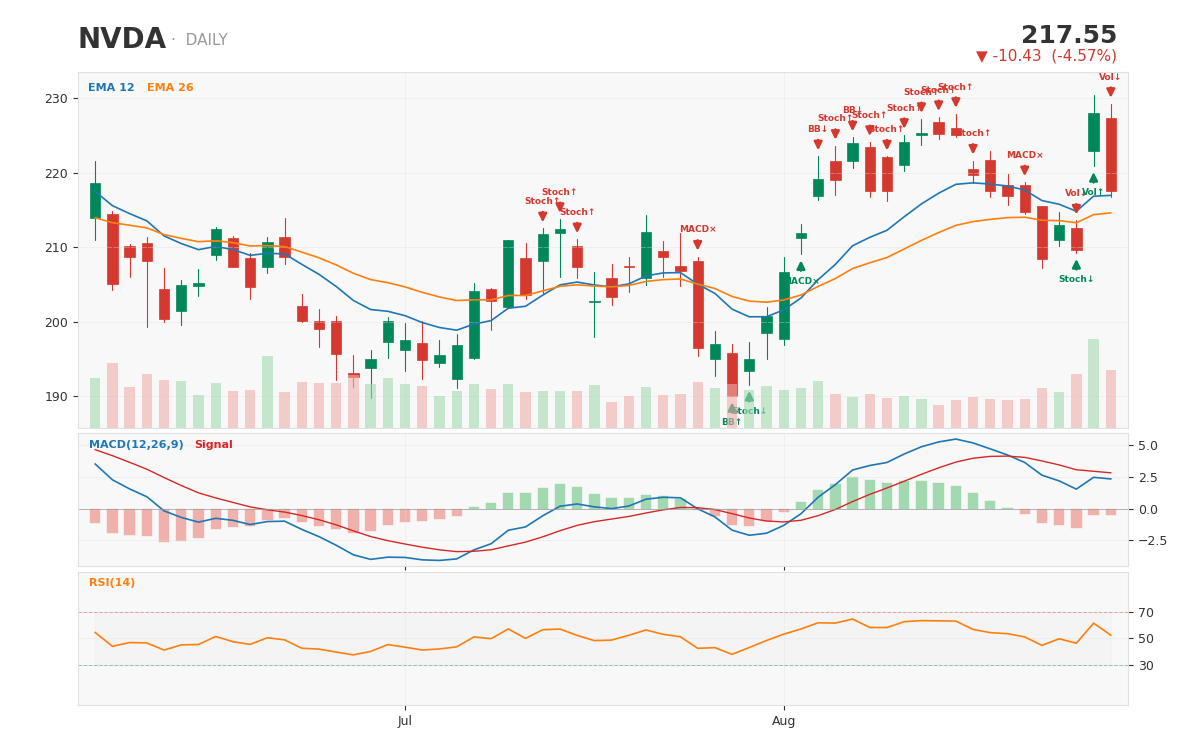 Nvidia 1-year daily chart with technical signals -- an intact uptrend with a moving-average score of 83, alongside a broader 17-of-22 sell-skewed signal scan following the post-earnings Friday decline
Verdict: Growth Conviction Amidst Valuation Scrutiny
NVIDIA's fiscal Q2 2027 results mark a truly historic moment, with its data center segment's 117% year-over-year growth and the company's unprecedented full-year guidance. While the immediate market reaction, culminating in Friday's 4.55% decline, was complex and driven by multiple factors, the long-term fundamental thesis for NVIDIA remains exceptionally strong. Analyst conviction is high, and institutional interest, despite one notable exit, largely points to continued accumulation.
NVIDIA remains a conviction buy for long-term investors seeking exposure to the exponential growth of artificial intelligence infrastructure. While the stock faces near-term volatility due to market-wide shifts and specific valuation concerns, its unparalleled market position and accelerating fundamental performance underpin its continued potential.
Stance: Long-term bullish. The recent pullback offers a potential opportunity to initiate or add to positions.
Price Point for Reassessment: A sustained close below the $205.00 level would warrant a reassessment of the immediate-term technical outlook and could signal a deeper re-evaluation of market sentiment, though it would not necessarily invalidate the long-term fundamental thesis.
Want deeper research on any stock? Try Kavout Pro for AI-powered analysis, smart signals, and more. Already a member? Add credits to run more research.