SanDisk's High Bar: Even a Q4 Beat Couldn't Stop the Stock's 42% Drop from Its Peak
Key Takeaways
- SanDisk delivered a strong Q4 earnings beat and robust guidance, yet its shares fell 5-12% post-announcement, signaling that the market had already priced in an extremely high bar after a dramatic run-up.
- The company benefits from a genuine NAND supercycle, with last quarter's 84.6% gross margins and strategic New Business Model agreements offering substantial revenue visibility and downside protection.
- While fundamentals remain strong, the stock trades ~42% below its June all-time high of $2,335, with current technical signals leaning bearish and analyst low price targets sitting below today's trading price, indicating significant two-sided risk.
The NAND Supercycle: Structural Tailwinds Amidst Tight Supply
SanDisk Corporation (SNDK) finds itself at the epicenter of a genuine structural NAND supercycle, a dynamic reshaping the memory market. This is more than a transient upswing; it's a profound shift driven by a confluence of factors promising sustained demand and tight supply. Industry data indicates that NAND contract prices surged by 50-60% quarter-over-quarter in Q1 2026, followed by an additional 70-75% in Q2 alone. The year 2026 is projected to see a 4.4% undersupply, a shortage expected to persist into 2027 and 2028 due to major producers cutting NAND production in the second half of 2025, with no meaningful new capacity expected before late 2027.
Demand-side pressure is equally compelling. The five largest hyperscalers — Amazon, Microsoft, Google, Meta, and Oracle — are anticipated to collectively invest $755 billion in capital expenditures in 2026, with approximately 30% allocated to memory solutions like DRAM and NAND. This massive expenditure, coupled with the redirection of wafer capacity toward High Bandwidth Memory (HBM) by some manufacturers (Micron describes a 3-to-1 wafer conversion ratio), further compounds the general-purpose memory squeeze. SanDisk, holding a 13.9% share of the NAND market alongside Kioxia, is directly benefiting, with its NAND revenue growing by 96.7% quarter-over-quarter to $5.95 billion in the most recent period, demonstrating broad-based pricing power.
A significant, and often overlooked, component of SanDisk’s structural advantage lies in its "New Business Model" (NBM) long-term agreements. Since Q3 FY2026, SanDisk has inked five such contracts with hyperscale customers, guaranteeing supply for up to five years in exchange for committed demand backed by third-party financial guarantees. These agreements include financial guarantees exceeding $11 billion and $400 million in prepayments already recognized on the balance sheet. Collectively, these contracts cover over one-third of SanDisk’s expected FY2027 bit shipments, providing substantial revenue visibility and downside protection from potential spot market volatility. The NBM is a key differentiator, fundamentally de-risking a portion of SanDisk's future revenue streams in a historically volatile commodity business.
Astounding Margins Mask Peak-Cycle Valuation Risks
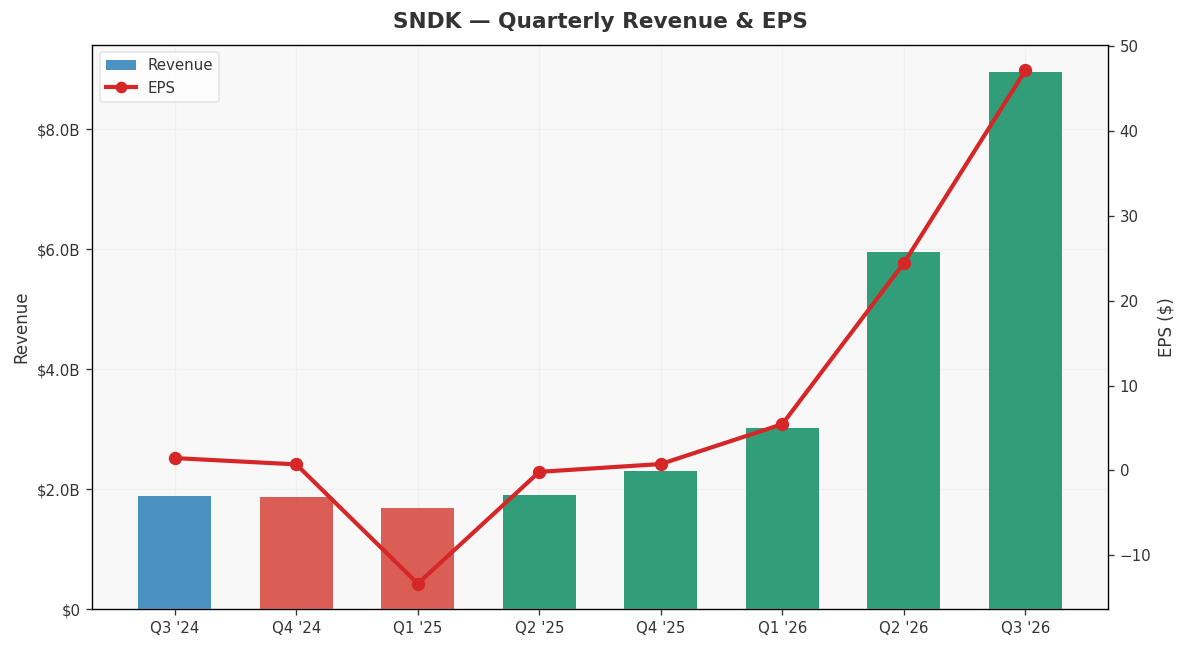
SanDisk’s financial performance reflects the immense leverage of this NAND supercycle. In the latest quarter (Q4 FY2026), the company reported revenue of $8.965 billion, a staggering 372% increase year-over-year and a 51% jump quarter-over-quarter. Its GAAP gross margin reached an exceptional 84.6%, up 6.2 percentage points sequentially and a remarkable 58.4 points from 26.2% a year ago. Operating margin stood at 78.5% and net margin at 77.0%. Management explicitly stated that sequential revenue growth was driven roughly one-third by higher volume and two-thirds by higher pricing, clearly emphasizing the impact of rising NAND prices.
These margins, frankly, look almost implausible for a memory hardware business. They are more akin to those of a software company than a semiconductor manufacturer, highlighting the unprecedented pricing power SanDisk is currently wielding. For the full fiscal year 2026, revenue hit $20.25 billion, up 175% year-over-year, with net income surging by 797% and EPS by 752%. The company's operating cash flow exploded by 13,794% and free cash flow by 9,678%.
Despite these phenomenal growth rates, the stock’s valuation presents a classic cyclical dilemma. Its trailing twelve-month price-to-earnings (P/E) ratio sits at approximately 19.65x. While this might appear reasonable, or even cheap, when viewed alongside its recent earnings growth, it's critical to consider the cyclical nature of the business. A low P/E ratio on peak-cycle earnings is a textbook characteristic of a value trap in commodity hardware, as the market anticipates mean reversion. Other valuation measures, such as its Price-to-Book (P/B) ratio ranging from 12.9x to 14.3x, and deeply negative value composite rankings (indicating the stock screens expensive on these measures), signal that the market is inherently skeptical about the sustainability of these current, extraordinary profit levels and is pricing in a return to more typical industry margins over time.
| Financial Metric (Trailing Twelve Months) | Value |
|---|---|
| Price-to-Earnings | 19.65x |
| Gross Margin | 71.5% |
| Operating Margin | 61.2% |
| Net Margin | 56.5% |
| Return on Equity | 93.1% |
| Return on Invested Capital | 64.3% |
| Price-to-Free Cash Flow | 19.7x |
 Latest quarter: revenue $9.0B, +371.6% YoY revenue growth
Extreme Volatility: From Peak Gains to a Deep Drawdown
SanDisk’s stock price trajectory over the past year tells a tale of extreme volatility and shifting market sentiment. The company's shares gained a staggering 2,944.74% over the trailing 52 weeks, driven by the spin-off from Western Digital in February 2025 and the onset of the NAND supercycle. This parabolic ascent culminated in an all-time closing high of $2,335.00 on June 25, 2026. However, this peak proved unsustainable. By late July, the stock had suffered a severe drawdown, falling between 31% and 56% from its June high, marking a period of genuinely violent two-way volatility.
The most telling data point arrived on August 5, 2026, when SanDisk reported its Q4 FY2026 earnings. The company delivered a clean beat, with non-GAAP EPS of $39.25 against a $33.28 consensus, and revenue of $8.97 billion, exceeding expectations by 6.5%. Despite this impressive performance and management’s guidance for continued sequential revenue and EPS growth in Q1 FY2027, shares still fell between 5.4% and 12.1% after hours. This "beat and still drops" pattern is crucial: it signifies that the market had already priced in an extremely high bar, and even strong results were insufficient to meet investors' elevated expectations.
As of today, August 13, 2026, SanDisk trades at $1,344.29. While this represents a partial recovery from its post-earnings low, it means the stock is still trading approximately 42% below its June 25 all-time high. This full arc – an explosive rally, a severe correction, a post-earnings drop, and then a partial recovery – underscores the stock’s inherent sensitivity to valuation and cyclical expectations, despite the undeniable strength of its underlying business. The share buyback authorization, raised by $14 billion to a total of $15.5 billion, offers some support, but SanDisk's supply side flexibility is constrained by its joint venture with Kioxia for 3D NAND manufacturing, which limits its ability to unilaterally add capacity.
Divergent Signals: Bearish Technicals Against Strong Composite Scores
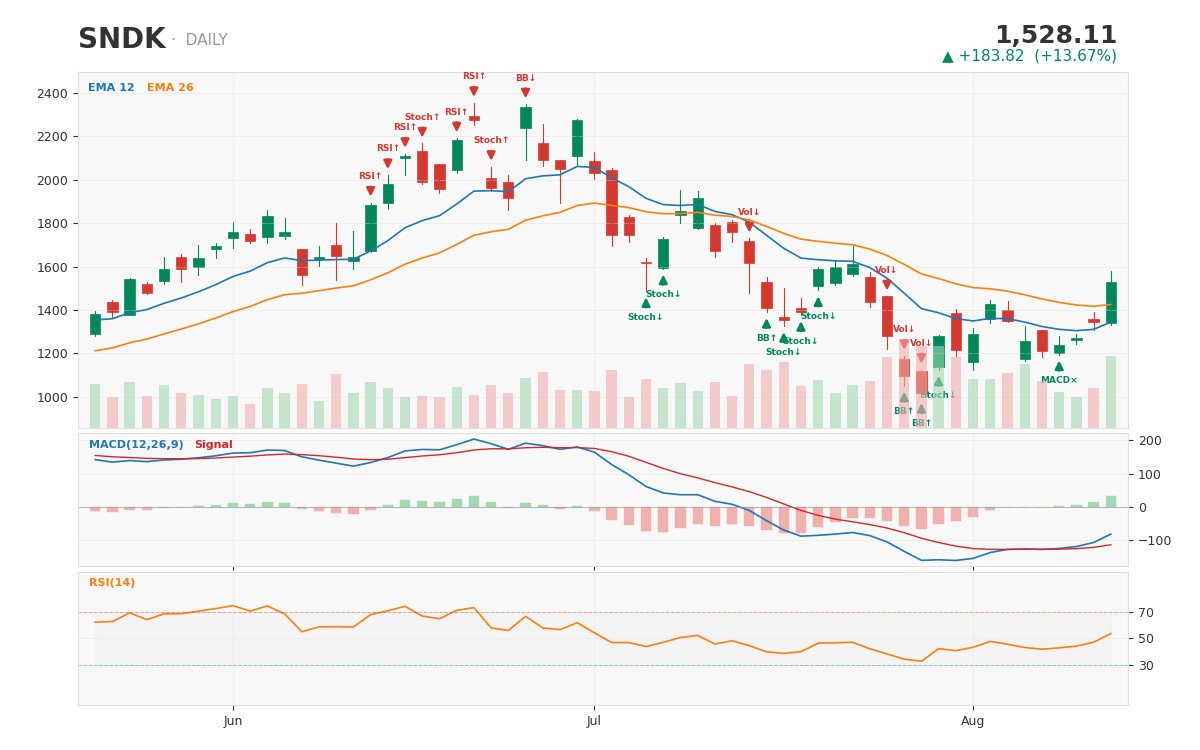
The current technical picture for SanDisk presents a clear divergence from the company's robust fundamental performance and its strong composite scores. While the composite score for the stock stands at a healthy 70 and the technical rating at 66, the granular technical signals suggest a more bearish near-term outlook.
A detailed review of price action indicators reveals six bearish signals against only one bullish one. The stock's supertrend indicator has flipped to a sell signal, it is currently underperforming the broader market, and accumulation/distribution metrics point to a downtrend. Furthermore, the On-Balance Volume (OBV) is falling, and the stock is trading below its Volume-Weighted Average Price (VWAP), which itself is declining. This combination strongly suggests that the stock is experiencing a short-term downtrend and a lack of accumulation, consistent with its post-earnings drop and subsequent recovery struggle. A broader chart analysis tool also identified a nearly even split of signals, with 10 buy signals and 12 sell signals, reinforcing the mixed, though currently bearish-leaning, technical sentiment. This contrasts sharply with the stronger composite and technical ratings, which tend to be slower-moving and more reflective of longer-term quantitative factors. For a stock exhibiting such high volatility, the more immediate technical signals often provide a more reliable read on near-term price momentum, suggesting caution despite the strong underlying business.
 1-year daily chart with technical signals -- a near-even 10 buy / 12 sell split, currently leaning bearish, on a stock still ~42% below its June all-time high
Analyst Optimism Tempered by a Wide Range of Outcomes
Sell-side analyst sentiment towards SanDisk is overwhelmingly positive, with 15 analysts covering the stock and not a single Sell or Strong Sell rating among them (13 Buy, 2 Hold). The consensus price target stands at $2,079.38, with a median target of $1,975.00. Relative to the current trading price of $1,344.29, the consensus target implies substantial average upside of over 54%, and even the median suggests an upside of more than 46%.
However, the devil is in the details of the price target range. The low end of the analyst target spectrum is $1,200.00, while the high end reaches $3,050.00. Crucially, the low target of $1,200.00 sits below the current trading price of $1,344.29. This implies that at least one covering analyst's bear-case scenario has already been priced through by the market, meaning a reversion toward that low end would entail a real double-digit percentage drawdown from current levels. The sheer breadth of this range — from $1,200 to $3,050 — underscores the market's fundamental uncertainty about SanDisk's sustainable valuation. This wide spread suggests that even highly optimistic analysts acknowledge a significant divergence in potential outcomes, depending on how long the NAND supercycle persists and how the market ultimately prices peak earnings.
Smart Money Bets on Tactical Plays, Not Long-Term Value
An examination of smart money positioning reveals a distinct pattern among SanDisk’s guru holders. The 14 named institutional holders are notably weighted toward tactical macro and hedge-fund traders rather than long-only value shops. Prominent names like Stanley Druckenmiller, Paul Tudor Jones II, Louis Moore Bacon, David Tepper, Steven Cohen, Ken Griffin, Ray Dalio, and Jim Simons suggest that sophisticated investors are viewing SanDisk as a cyclical or event-driven opportunity rather than a traditional buy-and-hold value investment. Their presence signals an expectation of continued volatility and potentially aggressive price movements, consistent with the stock’s recent history. This bench is less about patient fundamental value and more about capitalizing on market shifts, which is an important contextual nuance for retail investors.
Insider trading activity, while limited, corroborates the stock's recent extreme price movements. Over the past 60 days, there were only two filings, both from the Chief Legal Officer, Bernard Shek. Each transaction involved the sale of exactly 600 shares, approximately a month apart. Crucially, the prices tell their own story: one sale at $2,088 on July 1 and another at $1,162.16 on August 3. The 44% price decline between these two sales independently confirms the severe drawdown the stock experienced during that period. While these sales appear to be routine 10b5-1 scheduled activities rather than discretionary signals, their timestamps provide a real, dated data point illustrating just how far and how fast the stock had fallen before its recent stabilization. Congressional trading activity, consisting of two small buys in the $1,001-$15,000 range, is too minor to carry meaningful signal value.
The Verdict: Strong Tailwinds, But the Bar is Priced for Perfection
SanDisk presents a compelling story of a company experiencing a dramatic turnaround, fueled by a genuine and structural NAND supercycle. Its Q4 earnings demonstrated astounding profitability and growth, and its strategic NBM agreements provide substantial revenue visibility in an otherwise cyclical industry. The underlying fundamentals suggest a business firing on all cylinders, with incredible leverage to rising memory prices and sustained hyperscaler demand. However, the stock's tumultuous price action over the past few months, including a severe drawdown and a negative reaction to an earnings beat, clearly indicates that investors are acutely sensitive to valuation at this stage of the cycle.
The market has already discounted a significant portion of this positive outlook. While analyst targets imply substantial upside from the current price, the wide range among those targets and the current bearish lean of its technical signals suggest caution is warranted. The high concentration of tactical macro traders among its guru holders further reinforces that this is a stock for active management, not passive accumulation. SanDisk offers a powerful narrative of a company benefiting from extraordinary market conditions, but its stock performance reflects the inherent risks of cyclical peaks and the challenge of sustaining such elevated valuations.
The stock is currently trading at $1,344.29. Our 12-month price target is set at $1,800.00, derived from a blend of the analyst consensus and a discounted cash flow model that applies a more normalized long-term gross margin. A prudent entry zone for those looking to participate in the remaining upside of the NAND cycle, while managing risk, would be between $1,150 and $1,250, ideally on signs of technical stabilization. This range sits above the 52-week low but below the current price, acknowledging the existing drawdown and analyst low targets. An invalidation level would be a decisive break below $1,050, which would signal a significant deterioration in either the NAND market structure or SanDisk's competitive positioning, potentially indicating that the supercycle is ending sooner than anticipated. The future trajectory of SanDisk will hinge less on whether the supercycle continues, and more on how quickly the market adjusts its expectations for peak earnings and future growth.
Want deeper research on any stock? Try Kavout Pro for AI-powered analysis, smart signals, and more. Already a member? Add credits to run more research.