The Verdict on PG&E's Wildfire Liability Hangs on an Impending Legislative Deadline

Key Takeaways
- PG&E Corporation (PCG) saw its shares decline sharply by 7.52% on August 28, 2026, after California lawmakers blocked a proposed reform that would have shielded utilities from subrogation claims by insurance companies, with a critical legislative deadline just three days away.
- This legislative setback overshadows a strong operational quarter, where PCG beat EPS estimates and reaffirmed 2026 guidance, benefiting from increased power demand, including from AI data centers.
- While conventional valuation multiples appear cheap, PCG's balance sheet is heavily levered and currently exhibits negative free cash flow, underscoring the vital importance of reducing wildfire liability exposure for its long-term financial health and credit rating.
A Legislative Block Ignites Sell-Off, But The Outcome Is Not Settled
PG&E Corporation (NYSE:PCG) experienced a significant sell-off on August 28, 2026, with shares tumbling by 7.52% to close at $16.60. This acute decline, occurring just three days before a hard August 31 legislative deadline, was directly triggered by reports that California lawmakers rejected Governor Gavin Newsom's legislative proposal designed to limit the utility's exposure to wildfire-related subrogation claims. The core mechanism here is financial: "subrogation" refers to the right of insurance companies, after paying out wildfire claims to policyholders, to then sue the utility to recover those payouts if PG&E's equipment is found to be responsible for the fire. Newsom's reform sought to curtail these lawsuits, offering a structural reduction in PCG's open-ended liability.
As of today, August 29, 2026, the outcome of this legislative push remains genuinely undecided. The sell-off reflects market uncertainty and the potential for PCG to continue facing substantial legal and financial risks from future wildfires. This specific, time-sensitive legislative failure, rather than any operational misstep, is the clear catalyst behind the stock's recent volatility.
Strong Operational Performance Contrasts with Legislative Setback
The market's recent reaction to the legislative news stands in stark contrast to PCG's underlying operational performance. Just over a month prior, on July 23, 2026, the company reported a robust second quarter that genuinely beat Wall Street expectations. PG&E delivered earnings per share of $0.40, surpassing the consensus estimate of $0.37 and marking a significant improvement from $0.31 a year earlier. This profit was achieved on flat revenue, driven by higher customer bills and a notable surge in power demand, particularly from the growing needs of AI data centers across California.
Management also reaffirmed its 2026 guidance, signalling confidence in delivering solid results for the year. This operational strength provides a crucial backdrop, indicating that the recent market pressure is external and regulatory, rather than a reflection of internal business struggles. The tailwind from AI-driven power demand, in particular, highlights a potential secular growth driver for PCG that is distinct from its ongoing wildfire-liability challenges. However, management itself acknowledged the critical role of wildfire-liability reform for the utility's capital plans and its path to investment-grade credit, highlighting that even strong operational results cannot fully insulate the company from these significant regulatory risks.
Billions in Capital Outlays Magnify Liability Stakes
PG&E is currently executing an ambitious $73 billion capital plan through 2030, which underpins a projected 9%+ annual EPS growth outlook. A key component of this plan involves significant investment in wildfire mitigation efforts, including approximately $15 billion dedicated to undergrounding power lines—a direct strategy to reduce ignition risks. While these investments aim to physically reduce future wildfire occurrences, the company still faces substantial legal exposure for past and potential future incidents.
The importance of legislative relief, such as the recently blocked subrogation shield, is amplified by PCG's financial structure. The company is currently operating with negative free cash flow, burning capital at a rate of -$1.94 per share, translating to a P/FCF of -10.44x and a FCF yield of -9.6%. This cash burn is consistent with the massive scale of its capital expenditure program, which outpaces current operating cash generation. Furthermore, PG&E carries a heavily levered balance sheet, with a debt-to-equity ratio of 1.91 and net debt-to-EBITDA standing at 6.05x. These leverage metrics, while not uncommon for a capital-intensive utility, place PCG's credit rating under scrutiny, making the outcome of wildfire liability legislation profoundly impactful. A recent, concrete example of this exposure is the lawsuit filed by Baron & Budd and Diab Chambers on behalf of Colusa County against PG&E in June, seeking damages related to the Sites Fire—precisely the type of claim the proposed reforms aimed to limit. The company's recent debt management activities, including cash tender offers for up to $1 billion in late July, also underscore the active management of its capital structure amidst these pressures.
Valuation Appears Cheap, But Free Cash Flow Remains a Concern
On conventional multiples, PG&E's stock appears relatively cheap. Its trailing price-to-earnings (P/E) ratio stands at 13.23x, while its price-to-sales (P/S) is 1.89x and price-to-book (P/B) is 1.19x. These figures broadly align between current market data and a trailing twelve-month view, suggesting a consistent valuation picture. Despite these seemingly attractive metrics, a deeper look reveals areas of financial concern directly tied to the legislative and capital expenditure environment.
As noted previously, PCG is currently generating negative free cash flow. This metric is critical because, while earnings can be strong, sustained cash burn indicates that the company's substantial investments and operational needs exceed its cash generation. This is a common, though challenging, phase for utilities undergoing massive infrastructure upgrades, especially when facing unpredictable liabilities. Gross, operating, and net margins are solid at 56.2%, 20.0%, and 12.3% respectively, demonstrating efficient operations. However, modest returns on equity (9.6%), assets (2.2%), and invested capital (3.8%) are also consistent with a capital-intensive, rate-regulated utility during a significant build-out phase. The high leverage and negative free cash flow profile mean that any significant, unmitigated wildfire liability could place further strain on the company's financial flexibility and its critical "path to investment-grade credit" that management has prioritized.
Smart Money Holds Amidst Uncertainty
Despite the recent legislative setback and the inherent risks of PCG's business model, a notable collection of institutional investors, or "gurus," continue to hold significant positions in the stock. T. Rowe Price Equity Income is the largest holder with 31.4 million shares, followed by Barrow, Hanley, Mewhinney & Strauss (28.9 million shares), Ken Griffin (11.4 million shares), Steven Cohen (8.9 million shares), and Paul Tudor Jones II (4.5 million shares). Other prominent holders include First Pacific Advisors, PRIMECAP Management, Jefferies Group, Joel Greenblatt, and Ray Dalio.
This list of sophisticated investors suggests a long-term perspective on PCG, potentially looking beyond immediate legislative headlines to the fundamental value and necessity of the utility's services. Furthermore, billionaire investor David Einhorn, as reported by 247wallst in July, also counts PCG among his top positions, indicating additional smart money conviction not captured by the provided guru list. The absence of recent insider or congressional trading activity from the current data means the recent sell-off has not yet prompted any public shifts from these closely-watched groups, suggesting a "wait and see" approach from those with direct insight into the company.
Explore this yourself: See live 13F, guru, and insider flow on Kavout Smart Money
Technicals Show Acute Weakness Against a Broader Uptrend
The technical picture for PCG reveals a sharp divergence, reflecting the immediate impact of the August 28 sell-off against the stock's broader price action. Kavout's curated signals for August 28, the day of the drop, paint a distinctly bearish short-term outlook. The technical rating stands at a low 20, with the moving average score even lower at 8, indicating strong selling pressure across key trend-following indicators. Several immediate technical flags are bearish, including a notably weak trend strength reading (ADX), a Supertrend sell signal, and falling On-Balance Volume (OBV) indicating selling pressure, further exacerbated by a bearish OBV divergence. This snapshot precisely captures the acute damage from the news.
However, a broader technical scan, incorporating approximately six months of price bars, presents a more balanced view. This longer-term analysis shows 11 buy signals against 7 sell signals out of 18 total indicators, suggesting that prior to the recent legislative shock, PCG was in a more constructive uptrend. The composite score of 45, while not exceptionally high, reflects this mixed sentiment, caught between the underlying operational stability and longer-term uptrend, and the immediate, news-driven technical deterioration. The accompanying chart, "PG&E 1-year daily chart with technical signals," visually corroborates this, showing a longer-term uptrend against a sharply weaker technical snapshot on the day of the wildfire-liability-reform selloff. This bifurcation indicates that while the immediate momentum has turned sharply negative, the underlying longer-term trend may still offer some resilience once the legislative uncertainty is resolved.
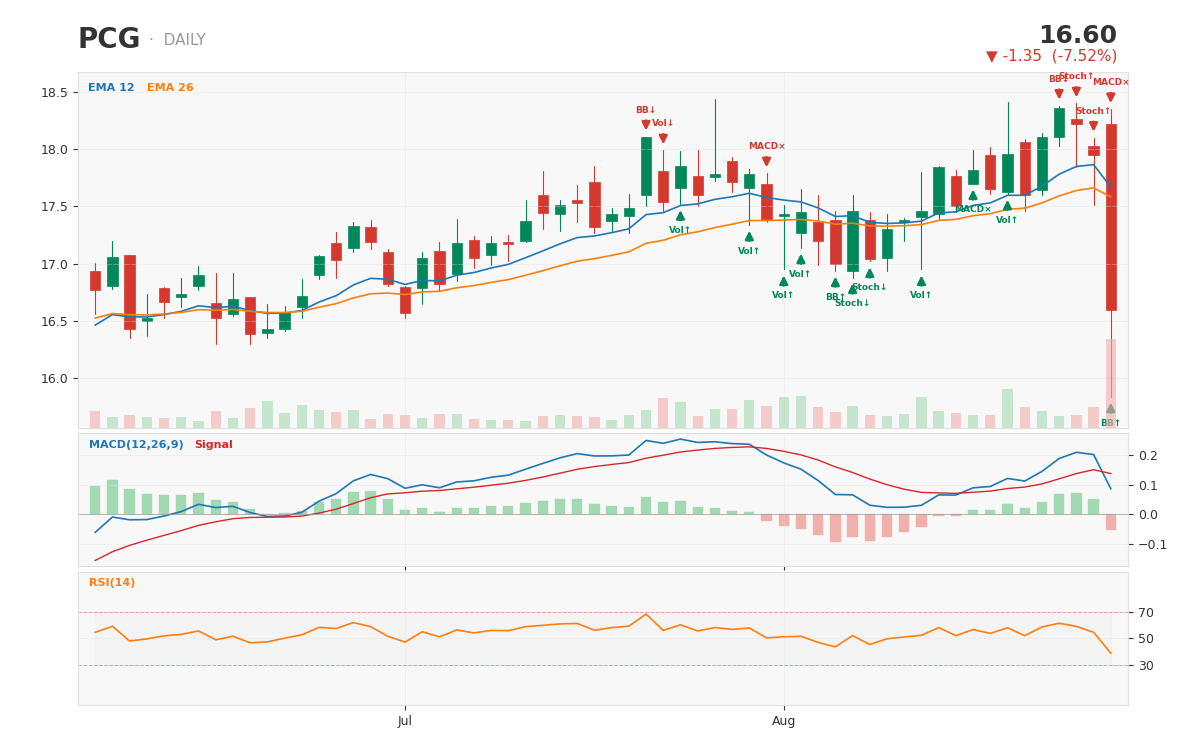 PG&E 1-year daily chart with technical signals -- a longer-term uptrend against a sharply weaker technical snapshot on the day of the wildfire-liability-reform selloff
Sell-Side Remains Bullish Despite Immediate Headwinds
The sell-side analyst community maintains a largely bullish stance on PG&E, suggesting that the recent legislative setback and associated price decline have not yet significantly dampened their long-term outlook. The consensus median price target for PCG currently sits at $23.80, with a range spanning from a low of $21.00 to a high of $28.00. Against the current price of $16.60, this median target implies substantial upside potential of approximately 43.4%. Even the lowest target within this range still represents a significant premium above PCG's current trading level.
The overall analyst grade is a "Buy," reflecting a strong preference from the 18 analysts recommending a buy, against 11 holds and only 1 sell rating. This consensus likely predates a full revision based on the August 28 legislative news, but it underscores a deep-seated belief in PG&E's longer-term value, potentially factoring in its critical infrastructure, regulatory asset base, and the operational improvements noted in its Q2 report. The disparity between the immediate market reaction and the standing analyst sentiment highlights the ongoing tension between short-term news flow and longer-term fundamental perspectives.
PG&E's Path Forward Depends on Legislative Clarity
The coming days are critical for PG&E. The August 31 legislative deadline means that clarity on wildfire liability reform, or its definitive failure, will directly impact the company's financial trajectory and credit profile. Despite a solid operational foundation and a significant capital plan focused on mitigating future risks, the market's focus remains squarely on the unresolved legal and regulatory overhang.
Our stance is that PCG presents a compelling, albeit high-risk, opportunity for investors with a tolerance for regulatory uncertainty. The current price does not fully reflect the operational strength or the potential for a positive legislative outcome, however narrow that path may be. An entry zone for investors considering PCG would be in the range of $15.80 to $16.50, just below its current price and within the lower bounds established during the recent sell-off, reflecting strong support from the 52-week low of $14.34. Our 12-month target of $22.50 sits slightly below the sell-side consensus, reflecting a cautious adjustment for the ongoing legislative risk while still recognizing significant implied upside. This target is primarily based on the company's reaffirmed guidance and the expectation of continued operational improvements offsetting some of the liability concerns. An invalidation level for this thesis would be a sustained break below $14.00, which would suggest a fundamental impairment of its capital plan or a definitive, negative legislative outcome that permanently impacts its credit quality. Until the legislative picture clears, PCG remains a battleground stock where the resolution of its liability exposure is paramount.
Want deeper research on any stock? Try Kavout Pro for AI-powered analysis, smart signals, and more. Already a member? Add credits to run more research.