


Kavout

MarketLens

Log in

Clean Energy Boom: Top Stock Picks for the $2.2 Trillion Revolution

Sep 09, 2025
SHARE THIS ON:

2025090901.jpg

As artificial intelligence drives unprecedented power demand and global investment in clean energy hits record highs, savvy investors are positioning for a generational wealth-building opportunity. Here are the stocks leading the charge.

The energy transition just shifted into overdrive. With $2.2 trillion flooding into clean energy technologies in 2025 --- double what's going to fossil fuels --- we're witnessing the most dramatic reallocation of capital in energy history. This isn't about politics or climate activism anymore. It's about cold, hard economics and explosive growth opportunities.

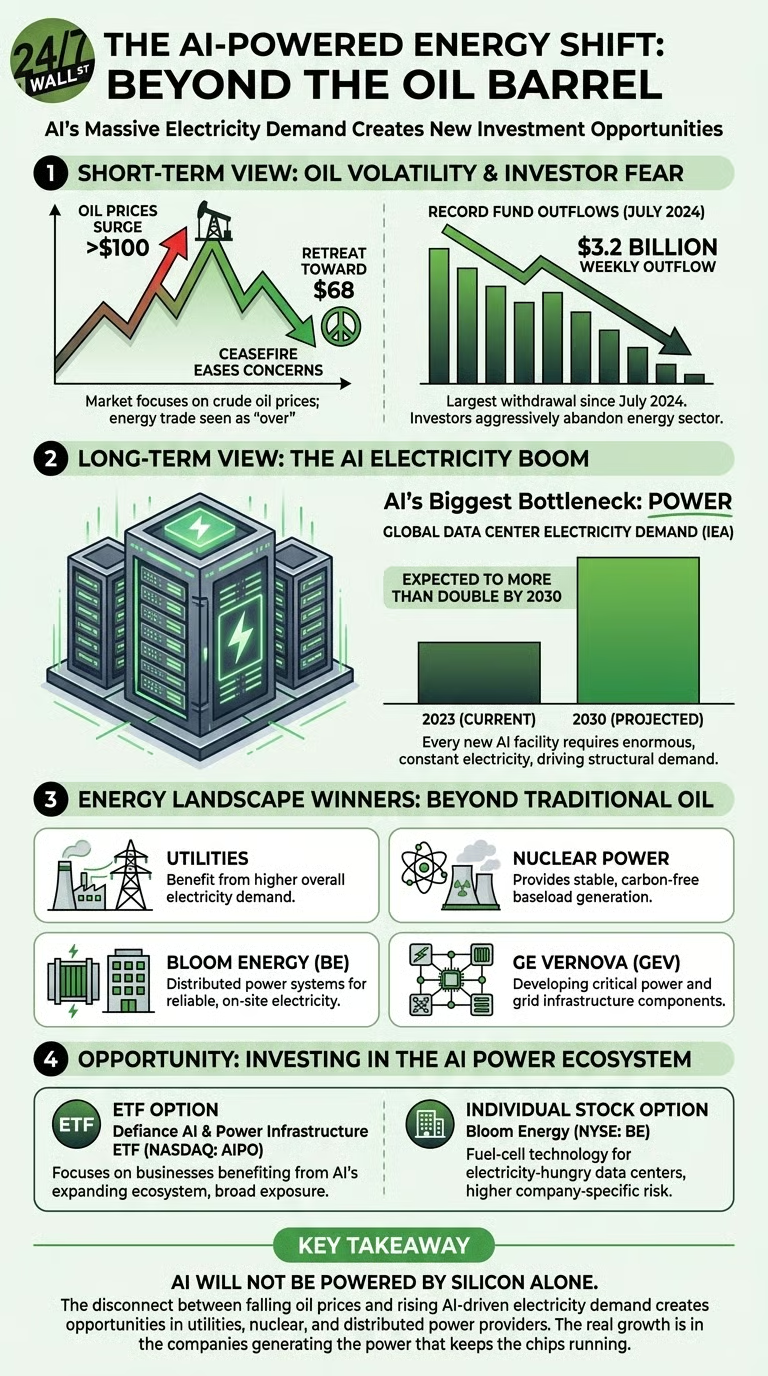
The game-changer? Artificial intelligence. Data centers are set to consume 945 terawatt-hours of electricity by 2030, roughly equivalent to Japan's entire power consumption today. In the United States alone, data centers will account for nearly half of all electricity demand growth through 2030. Tech giants aren't waiting around --- they're signing massive power deals and even reviving nuclear plants to secure reliable, round-the-clock clean energy.

Key Investment Metrics at a Glance

Metric2025 ProjectionGrowth Driver
Global Clean Energy Investment$2.2 Trillion2x fossil fuel investment
Solar Investment$450 BillionLargest single clean energy category
Data Center Power Demand by 2030945 TWhAI-driven, equals Japan's total consumption
U.S. Battery Storage Additions19.6 GWRecord capacity growth expected

This creates an unprecedented opportunity for investors who know where to look. Let's identify the companies best positioned to capitalize on this $2.2 trillion megatrend.

Solar Dominance: Following the Smart Money

Solar leads the pack with $450 billion in global investment for 2025, and the winners are already separating from the losers. Chinese oversupply has crushed module prices, creating a brutal environment for commodity manufacturers but a goldmine for differentiated players.

First Solar (FSLR) exemplifies how to win in this environment. The company's Q2 2025 results tell the story: $3.18 EPS on $1.1 billion in revenue, handily beating expectations. What sets FSLR apart isn't just its numbers --- it's the company's strategic positioning. Their proprietary thin-film technology sidesteps the silicon supply chain entirely, providing both technological differentiation and geopolitical insulation.

Trading around $200, FSLR commands a $18.7 billion market cap with a fortress balance sheet and years of order visibility. The risk is clear: heavy dependence on U.S. policy support through the Inflation Reduction Act. But with 54 analysts rating it a "Buy" and manufacturing capacity booked solid through 2026, the smart money sees more upside than downside.

Enphase Energy (ENPH) takes the opposite approach --- forget making panels, own the intelligence layer. At $363.2 million in Q2 revenue with $0.28 GAAP EPS, Enphase might look like it's struggling. But that's missing the forest for the trees. The company's microinverters and energy management systems create recurring revenue streams and customer lock-in that commodity manufacturers can only dream about.

Solar Sector Performance Snapshot

CompanyTickerQ2 2025 RevenueQ2 2025 EPSMarket CapKey Advantage
First SolarFSLR$1.1B$3.18$18.7BThin-film technology
Enphase EnergyENPH$363.2M$0.28$5.2BMicroinverter dominance

With aggressive expansion into Europe and the solar-plus-storage trend accelerating, ENPH is positioned for a sharp rebound as interest rates stabilize and residential solar recovers. The stock's been beaten down, creating an attractive entry point for contrarians.

Power Infrastructure: The Picks and Shovels Play

While everyone obsesses over solar panels and wind turbines, the real money might be in the infrastructure connecting it all. Enter GE Vernova (GEV), the $150 billion energy giant that's perfectly positioned for the AI power surge.

GE Vernova's Q2 2025 numbers reveal the opportunity: $9.1 billion in revenue (up 12% year-over-year) with orders hitting $12.4 billion. The company isn't just riding one trend --- it's surfing all of them simultaneously. Its gas turbine division is printing money from AI-driven baseload power demand. Its grid solutions business stands at the center of the massive infrastructure buildout. And despite challenges in offshore wind, the overall portfolio is firing on all cylinders.

GE Vernova Segment Performance

SegmentQ2 2025 RevenueGrowthEBITDA MarginOutlook
Power$4.8B+9%16.4%Strong gas turbine demand
Wind$2.2B+9%-7.3%Improving despite losses
Electrification$2.2B+20%14.6%Grid modernization boom

At current levels, GEV offers something rare: diversified exposure to the entire energy transition with the financial strength to weather any storm. The company raised full-year guidance across the board, targeting 8-9% adjusted EBITDA margins and $3.0-3.5 billion in free cash flow. With analysts targeting $500+, there's meaningful upside from here.

Energy Storage: The Multiplier Effect

Battery storage isn't optional anymore --- it's the technology that makes everything else work. The U.S. market alone is projected to explode from current levels to over 30 GW of capacity, with developers planning to add a record 19.6 GW in 2025 alone.

The investment landscape here splits into two camps: the infrastructure builders and the intelligence providers.

Stem Inc. (STEM) represents the software play. Instead of manufacturing batteries, Stem provides the AI-powered optimization layer that maximizes returns from energy assets. With $38.4 million in Q2 revenue, the company isn't profitable yet. But as deployment accelerates and the grid becomes increasingly complex, Stem's Athena platform becomes more valuable.

This is a high-risk, high-reward bet on the digitalization of the energy grid. If Stem can achieve profitability while maintaining its technology edge, the stock could deliver multibagger returns.

For those seeking even more upside, QuantumScape (QS) offers a moonshot opportunity. The company's solid-state battery technology could revolutionize everything from EVs to grid storage. With Volkswagen's backing and B-sample cells now shipping to automakers, QS has moved from science project to potential commercial reality.

Energy Storage Investment Landscape

CompanyTickerTechnology FocusRevenue StageRisk LevelUpside Potential
StemSTEMAI SoftwareEarly RevenueHigh5-10x
QuantumScapeQSSolid-State BatteriesPre-RevenueVery High10x+
Fluence EnergyFLNCGrid-Scale StorageGrowing RevenueMedium3-5x

The stock remains highly speculative --- the company has no revenue and burns over $100 million quarterly. But if solid-state batteries deliver on their promise, early investors could see life-changing returns.

The Hydrogen Wild Card

Green hydrogen remains the biggest question mark in the clean energy transition. The technology works, but economics remain challenging, with production costs up 35% over the past two years.

Plug Power (PLUG) is making the boldest bet in the space, building a vertically integrated hydrogen ecosystem from production to consumption. With $174 million in Q2 revenue (up 21%) but losses of $228 million, the company epitomizes the high-risk, high-reward nature of hydrogen investing.

The bull case: Plug has secured a $1.6 billion DOE loan guarantee and established itself as the largest U.S. green hydrogen producer. The bear case: the company burns cash at an alarming rate and depends entirely on continued government support. Size positions accordingly.

Infrastructure for the EV Revolution

The EV charging infrastructure market is set to reach $31 billion by 2025, growing at over 20% annually. But picking winners is tricky as the industry consolidates around standards and sustainable business models.

ChargePoint (CHPT) leads in Level 2 charging with a capital-light, subscription-focused model. Q2 revenue of $98.6 million disappointed, but the company's pivot toward recurring revenue and path to EBITDA profitability could reward patient investors.

The key catalyst: Tesla's charging standard (NACS) becoming the industry norm actually helps ChargePoint by eliminating format wars. Watch for improving utilization rates and unit economics as the network scales.

Strategic Portfolio Construction

Given the diverse risk profiles, here's how to structure your clean energy allocation:

CategoryAllocationStock PicksTarget Returns
Core Holdings60-70%FSLR, GEV, ENPH20-50%
Growth Positions20-30%STEM, CHPT, FLNC50-200%
Speculative Bets10% maxQS, PLUG200%+

Timing the Entry

Three factors will determine the next leg higher:

Immediate Catalyst: Fourth-quarter 2024 earnings season revealed strong execution despite market challenges. Q1 2025 results will show whether momentum is building or stalling.

Policy Clarity: The IRA's future remains the biggest variable. Any resolution --- positive or negative --- removes uncertainty and could trigger sharp moves.

Rate Environment: The Fed's next moves matter enormously for capital-intensive clean energy projects. Lower rates directly improve project economics and investor sentiment.

The Bigger Picture

We're not just witnessing an energy transition --- we're seeing the birth of an entirely new energy economy. The convergence of AI-driven power demand, energy security concerns, and improving clean energy economics creates a perfect storm for growth.

Global Clean Energy Investment Leaders

Region2025 InvestmentShare of GlobalKey Focus Areas
China~$730B33%Solar, Wind, EVs
United States$400B18%Grid, Storage, Solar
European Union$385B17%Offshore Wind, Grid
Rest of World$685B32%Distributed Solar

China leads with one-third of global clean energy investment, but the U.S. is catching up fast with $400 billion in clean technology investment vastly outpacing the $187 billion going to fossil fuels. Europe continues aggressive deployment, while emerging markets from India to Brazil are accelerating adoption.

The numbers are staggering: 620 GW of new solar and wind capacity added in 2024 alone, equivalent to the entire power systems of India, Pakistan, and Bangladesh combined. This isn't a bubble --- it's a fundamental restructuring of how humanity produces and consumes energy.

Position Now or Regret Later

The clean energy sector stands at an inflection point. With $2.2 trillion in annual investment, AI driving insatiable power demand, and costs continuing to plummet, the growth trajectory is clear. But this isn't a rising-tide-lifts-all-boats scenario. Winners will be those with technological moats, strategic positioning, and paths to profitability.

Start building positions in First Solar and GE Vernova for stability. Add Enphase on weakness for technology exposure. Sprinkle in speculative positions like Stem or QuantumScape for potential home runs. Most importantly, don't wait for perfect clarity --- by then, the biggest gains will be gone.

The last energy transition took us from wood to coal to oil over centuries. This one will happen in decades, with the biggest value creation concentrated in the next few years. The companies that dominate the new energy economy are being determined right now. Make sure you own them.

Ready to dive deeper into complex investment analysis like this? Discover how Kaout Pro's financial research agents can automate sophisticated market comparisons, company valuations, and strategic assessments. Our AI-powered platform transforms hours of manual research into comprehensive, data-driven insights in minutes. Subscribe to Kaout Pro today and elevate your investment research with the power of automated financial intelligence.

SHARE THIS ON:

Related Articles

Category

You may also like

No related articles available

Breaking News

View All →

No topics available at the moment