Key Takeaways
- Senator Jerry Moran's sale of Alphabet (GOOGL) stock in late May 2026, just before the market reacted to the company's massive $80 billion AI equity raise, highlights a divergence in investor sentiment regarding the immediate capital costs of AI.
- The record-setting $80 billion equity offering, anchored by a $10 billion investment from Berkshire Hathaway, signals Alphabet's aggressive confidence in meeting overwhelming demand for its AI solutions, particularly within Google Cloud.
- While significant capital expenditures and potential dilution present short-term headwinds, a strong Q1 2026 performance, a $460 billion Cloud backlog, and a consensus "Moderate Buy" analyst rating underscore a bullish long-term outlook for Alphabet's AI-driven future.
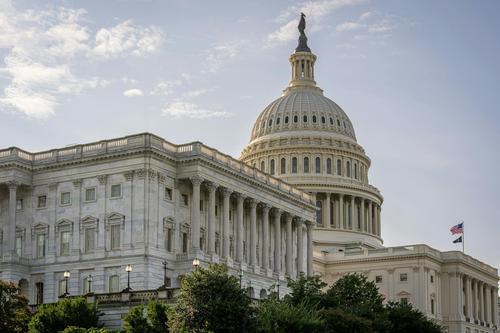
Alphabet Inc. (GOOGL), a titan of the digital economy, finds itself at a fascinating crossroads, reflected not just in its financials but in the very halls of Congress. On July 10, 2026, GOOGL shares trade at $357.18, down slightly on the day, but still well within its 52-week range of $176.48 to $408.61. The company's colossal $4.32 trillion market capitalization underscores its systemic importance. However, recent Congressional stock trades reveal a split opinion on the tech giant's immediate trajectory, particularly in the wake of its unprecedented $80 billion equity offering to fuel its artificial intelligence ambitions.
Senator Jerry Moran, a Republican from Kansas, executed a sale of Alphabet stock on May 27, 2026, offloading between $1,001 and $15,000 worth of shares at a price of $384.83 per share. This move proved notably prescient, as it occurred just days before Alphabet announced its colossal equity raise, which sent shares tumbling. In contrast, Senator John Fetterman, a Democrat from Pennsylvania, made a purchase of GOOGL stock in May, around the same time his committee heard from AI industry leaders. This divergence in timing and action by lawmakers, both sitting on the influential Commerce, Science, and Transportation Committee, encapsulates the ongoing debate: Is Alphabet's aggressive AI investment a sign of strength or a looming capital crunch?
Alphabet's AI Ambition: A Record $80 Billion Bet
In early June 2026, Alphabet made headlines with its announcement to raise an unprecedented $80 billion through stock sales, marking the largest equity issuance in history. This move, designed to fund its rapidly expanding investments in AI data centers and infrastructure, immediately sent a ripple through the market. Shares fell 3.9% on June 1st, 2026, breaking below a key short-term support level near $382, as investors grappled with the implications of such a massive capital infusion.
The offering comprises two mechanisms: a $40 billion direct placement to institutional investors and a $40 billion at-the-market program. A significant endorsement came from Berkshire Hathaway, which committed $10 billion as an anchor investor in the direct placement. This commitment followed Berkshire's decision to triple its Alphabet stake in Q1 2026 under new CEO Greg Abel, signaling strong long-term confidence from one of the world's most respected capital allocators. Alphabet's rationale for the raise was clear: demand for its AI solutions from enterprises and consumers is currently exceeding available compute supply. The capital infusion is explicitly intended to close that gap, enabling the company to build out the infrastructure necessary to meet burgeoning demand.
The bullish argument for this capital raise is compelling. Companies typically do not raise such substantial equity if they are uncertain about future demand. Instead, it suggests a scenario where contracted revenue outstrips existing infrastructure capacity. Supporting this view is Google Cloud's impressive backlog, which stands at over $460 billion, providing years of locked-in revenue visibility. In Q1 2026, Google Cloud delivered its strongest quarterly result in company history, growing 63% year-over-year. This robust performance, coupled with a trailing 12-month operating cash flow of $174 billion, suggests that Alphabet is investing from a position of strength, not desperation.
The Capital Intensity Conundrum
Despite the bullish narrative surrounding Alphabet's AI ambitions, the record $80 billion equity raise and its associated capital expenditures present a significant bear case. The immediate market reaction, with shares dipping after the announcement, underscored investor concerns about potential dilution. At a market capitalization of nearly $4.5 trillion, $80 billion represents approximately 1.8% dilution, a figure that, while not alarming, is certainly not trivial. This comes on top of a debt load that has already exceeded $100 billion, following over $85 billion in debt issuance across six currencies over the past year.
The company's capital expenditure guidance further fuels these concerns. Alphabet's CapEx hit $35.67 billion in Q1 2026, a staggering 107.4% increase year-over-year. For the full year 2026, management has guided for CapEx between $180 billion and $190 billion, with signals of further increases in 2027. This aggressive capital intensity cycle is compressing near-term free cash flow, which fell 46.6% in Q1. Investors who bought GOOGL for its historical capital efficiency and clean balance sheet have a legitimate point in pushing back against this shift. Anthony Gutman, co-chief executive officer at Goldman Sachs International, remarked to CNBC on June 3, 2026, that Alphabet's plan to sell $80 billion in shares leaves markets in "unprecedented territory."
Beyond financial metrics, regulatory pressures continue to loom. The European Commission imposed a $3.5 billion fine last fall, and UK regulators are currently consulting on loosening app-store payment restrictions, which could impact Google's app marketplace economics. Competition in the generative AI space also remains fierce, with rivals like OpenAI and Perplexity constantly innovating. While Google's Search business saw 19% growth, the Google Network revenue declined to $6.97 billion, raising questions about diversification. Even insider activity has shown some caution, with Director John L. Hennessy selling 1,050 shares on May 15, 2026, at $393.26, and billionaire Bill Ackman's Pershing Square fund reducing its Alphabet exposure by 95% in Q1 2026, opting to redeploy funds into Microsoft.
Behind the Bullish Bets: Google's Enduring Moat
Despite the capital intensity and dilution concerns, the bullish case for Alphabet remains robust, rooted in its dominant market position and relentless innovation in AI. The company's Q1 2026 earnings beat Wall Street estimates, posting $5.11 EPS and $109.9 billion in revenue, representing a 21.8% year-over-year increase. This performance was largely driven by the exceptional growth in Google Cloud, which continues to be a key differentiator. The massive $460 billion Cloud backlog provides a strong foundation for future revenue, de-risking the growth story for years to come.
Alphabet is not just spending on AI; it is actively deploying new, more efficient models. The recent launch of Nano Banana 2 Lite and Gemini Omni, described as cheaper and faster AI image/video models, is expected to strengthen its AI product lineup and improve adoption across its ecosystem. Strategic partnerships further validate Google Cloud's enterprise AI push; FactSet, for instance, announced a collaboration with Google Cloud to build AI-powered financial intelligence tools. In the digital payments space, Visa and Google have signed on to use OpenUSD for money movement, suggesting additional ecosystem relevance and infrastructure integration.
The company's core Search business, despite the rise of generative AI competitors, continues to accelerate, with AI Overviews driving 19% growth. Queries hit all-time highs, undermining the disruption thesis often put forth by bears. Furthermore, Alphabet's "Other Bets" are showing promise, with Waymo providing 500,000 rides per week and the company boasting 350 million paid subscriptions across its various services. These diverse revenue streams and continuous innovation reinforce Alphabet's competitive moat, suggesting that the current heavy investment in AI is a necessary step to capture a monumental future opportunity, rather than a sign of fundamental weakness.
Congressional Crossroads: The Political Pulse on GOOGL
The conflicting stock trades by Senators Moran and Fetterman offer a unique lens into the broader political and economic sentiment surrounding Alphabet, particularly concerning AI. Both senators sit on the Commerce, Science, and Transportation Committee, a body with direct oversight over the technology sector, including critical areas like data privacy, telecommunications, media, and innovation. Their positions give them unique insights into the legislative landscape that could shape the future of tech giants like Alphabet.
Senator Moran's sale of GOOGL on May 27, 2026, at $384.83, just prior to the market's negative reaction to the $80 billion equity raise, could be interpreted as a cautious stance on the immediate capital demands of the AI race. Moran has been active in technology-related legislation, including cosponsoring S 3916, S 4211, S 4264, and S 4349 in the technology sector between March and April 2026. He also joined colleagues in introducing the Digital Trade Promotion Act in December 2025, stating, "This legislation allows for greater executive authority to promote trade deals involving digital products and services, reducing digital trade barriers while allowing Congress to exercise necessary oversight." While not directly about AI, it underscores his engagement with the regulatory environment impacting tech.
Conversely, Senator Fetterman's purchase of GOOGL stock in May 2026, around the time the Senate Commerce Committee held a hearing on artificial intelligence and innovation, suggests a more optimistic long-term view. At that May 8th hearing, OpenAI CEO Sam Altman notably testified that AI regulation could be "disastrous" to the United States' lead against China. The Senate was, at the time, considering a 10-year moratorium on AI regulations, which major tech companies, including Google, reportedly lobbied for. This context suggests that Fetterman's purchase might reflect confidence in the industry's ability to navigate regulatory challenges or even benefit from a favorable legislative environment.
Beyond these two, Congressional trading activity in Alphabet has been mixed. Several other senators, including John, Shelley, Katie, and Markwayne, made purchases of GOOGL in 2025 and 2026. However, other senators like Katie and Tommy, along with House members such as Matt, Gilbert, David, Ro, and Lizzie, also executed sales during the same period. This diverse activity underscores that while individual lawmakers may hold strong convictions, there is no monolithic "Congressional view" on Alphabet's prospects, mirroring the broader market's ongoing debate.
Analyst Outlook: Wall Street's View on Alphabet's AI Future
Wall Street analysts largely maintain a constructive view on Alphabet, despite the recent capital raise and its implications. According to MarketBeat, based on 54 analyst ratings, Alphabet currently holds a "Moderate Buy" consensus rating. The average twelve-month stock price forecast for GOOGL is $413.92, implying a 15.89% upside from the current price of $357.18. Individual targets range widely, from a low of $220.00 to a high of $515.00, reflecting the diverse interpretations of Alphabet's future trajectory. A significant majority of analysts, 49 out of 54, rate the stock a "Buy," with 5 assigning a "Hold" rating and zero "Sell" recommendations.
Public.com's analysis, based on 8 analysts, also shows a "Buy" consensus rating for Alphabet, with 50% recommending a "Strong Buy" and 38% a "Buy." Their aggregated price target stands at $399.38. This strong analyst sentiment is often attributed to Alphabet's robust financial performance, its dominant position in digital advertising, and its aggressive investments in AI technology. Analysts frequently highlight the company's strategic initiatives and solid financials as key drivers for long-term growth, positioning it as a top player in the evolving AI industry.
For instance, 24/7 Wall St. maintains a "Buy" rating on GOOGL with a price target of $445, implying a 20% upside. This target is predicated on the stock trading at a forward P/E of 26 despite delivering 63% Cloud growth and 21.8% top-line growth. They emphasize the $460 billion Cloud backlog as a de-risking factor for the revenue story for years to come. While some analysts acknowledge the challenges, such as slower growth in core advertising and increased expenses in areas like cloud security, the prevailing sentiment is that Alphabet's strategic pivot to AI, backed by substantial investment and a strong market position, will ultimately drive superior returns.
The Verdict: Navigating the AI Investment Divide
Alphabet (GOOGL) stands at a pivotal juncture, where its bold, record-setting $80 billion equity raise for AI infrastructure has created a clear divide in investor sentiment. On one side are those, like Senator Jerry Moran, whose timely sale of GOOGL shares in late May 2026, just before the market reacted to the dilution news, suggests a cautious view on the immediate capital intensity of the AI build-out. This perspective acknowledges the significant CapEx, potential for near-term free cash flow compression, and the lingering regulatory scrutiny that could impact profitability.
On the other side are those, like Senator John Fetterman and institutional investors such as Berkshire Hathaway, who see Alphabet's massive investment as a statement of confidence in an AI-driven future. Their bullish stance is supported by Google Cloud's explosive 63% growth and its $460 billion backlog, indicating that demand for AI solutions is outstripping supply. The company's strong Q1 2026 earnings, continuous AI product innovation, and strategic partnerships further bolster the view that Alphabet is investing from a position of strength to capture a generational opportunity.
For investors, the current landscape presents a nuanced opportunity. While the short-term could see volatility as the market digests the implications of such large-scale capital deployment, the long-term narrative for Alphabet remains compelling. The company's foundational strength in Search, coupled with its aggressive and well-funded push into AI and Cloud, positions it to maintain its leadership in the evolving digital economy.
Entry Zone: Investors looking to initiate or add to positions should consider an entry zone between $345 and $355, capitalizing on any further short-term dips related to capital expenditure concerns.
12-Month Target: Based on the strong analyst consensus and the long-term growth potential of its AI and Cloud segments, a 12-month price target of $420 appears achievable.
Invalidation Level: The bullish thesis would be invalidated if GOOGL shares consistently trade below $320, indicating a significant deterioration in either AI monetization, Cloud growth, or a more severe impact from capital intensity than currently anticipated.
Alphabet's journey through the AI revolution is a story of immense ambition and equally immense capital. While the path may be bumpy, the underlying fundamentals and strategic vision suggest that the company is building for a future where its dominance could be further cemented.
Want deeper research on any stock? Try Kavout Pro for AI-powered analysis, smart signals, and more. Already a member? Add credits to run more research.