MarketLens

Log in

GameStop's Billion-Dollar Pivot: From Meme Stock to M&A Machine

3 hours ago
SHARE THIS ON:

GameStop's Billion-Dollar Pivot: From Meme Stock to M&A Machine

Key Takeaways

  • GameStop has amassed a formidable $9 billion cash reserve, signaling a strategic pivot from a struggling retailer to a potential M&A-driven holding company.
  • CEO Ryan Cohen’s ambitious compensation package, tied to achieving a $100 billion market cap and $10 billion EBITDA, underscores the high-stakes nature of this transformation.
  • While a major acquisition could unlock significant value and redefine GameStop's future, the strategy carries substantial risks, including integration challenges and the potential for overpaying.

GameStop's Billion-Dollar Pivot: From Meme Stock to M&A Machine?

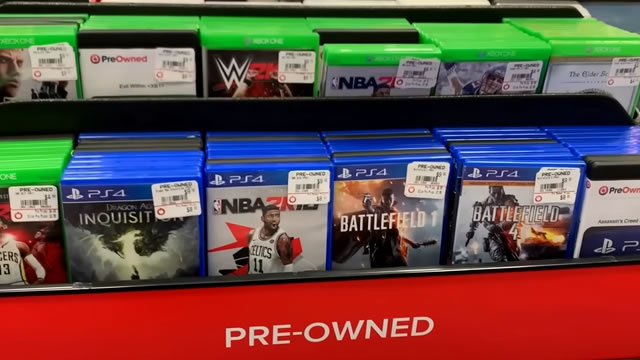
GameStop Corp. (NYSE: GME) finds itself at a pivotal juncture, far removed from its meme stock origins yet still deeply influenced by that legacy. The company, once teetering on the brink, has engineered a remarkable financial turnaround, accumulating a staggering $9 billion in cash and marketable securities. This war chest isn't merely a buffer against bankruptcy; it's the foundation for CEO Ryan Cohen's audacious plan to transform GameStop into a diversified holding company, potentially reshaping its entire business model. The market, currently valuing GME at $9.99 billion with shares trading around $22.27, is keenly watching how this capital will be deployed.

This isn't just about survival anymore; it's about a radical reinvention. Cohen has openly expressed his intent to utilize this substantial liquidity for a "very, very, very big" acquisition, likely targeting a publicly traded consumer or retail company. The goal is to move beyond its declining physical media business and establish new, higher-margin revenue streams. This strategic shift has captivated investors, turning GameStop into a high-stakes play on capital allocation and Cohen’s execution capabilities, rather than a traditional retail story.

The narrative has effectively shifted from a short-squeeze battleground to a "Berkshire Hathaway of Retail" thesis. Investors are no longer solely focused on quarterly video game sales, which continue to face headwinds from digital downloads. Instead, the spotlight is on Cohen's ability to identify and integrate a "high quality, durable, scalable with growth prospects" business, ideally one with a "sleepy management team" that GameStop can revitalize. This vision, if successful, promises a dramatic re-rating of the stock, but the path is fraught with challenges and high expectations.

The market's current premium valuation, reflected in a P/E ratio of 23.82 compared to sector medians, suggests that investors are already pricing in a degree of confidence in this transformative strategy. However, this premium also means that any misstep or delay in capital deployment could lead to a sharp re-evaluation. The coming months will be critical in determining whether GameStop can truly shed its legacy image and emerge as a diversified powerhouse, or if the "holding company" dream remains just that.

How Did GameStop Amass a $9 Billion War Chest?

GameStop’s impressive cash pile, totaling approximately $9.01 billion in cash, equivalents, and marketable securities, is not a result of booming retail sales but rather a shrewd capitalization on its meme stock phenomenon. The company strategically leveraged its inflated stock price during periods of extreme retail investor enthusiasm, conducting at-the-market equity offerings to raise substantial capital. This influx of funds, including $4.2 billion from zero-coupon convertible notes issued in fiscal year 2025, dramatically bolstered its balance sheet, nearly doubling its liquidity from $4.77 billion a year prior.

While the core retail business continues to face secular declines, with net revenue from continuing operations down 4.5% in Q2 FY2025 and a 34.5% drop over the last five years, GameStop has simultaneously focused on cost control and operational efficiency. This leaner approach, combined with growth in its collectibles segment, has allowed the company to generate positive operating cash flow and net earnings. For instance, the company delivered $597.3 million in free cash flow for the full year, demonstrating an organic replenishment mechanism for its war chest beyond debt financing.

The shift in sales mix is also notable; collectibles grew significantly, making up nearly 28% of total revenue for the first three quarters of 2025 and becoming a high-margin pillar. This focus on higher-margin products, coupled with aggressive store closures (over 470 locations in early 2026 alone), has improved the company's overall profitability despite shrinking top-line revenue. GameStop reported a net income of $418.4 million for the full year, a significant jump from $131.3 million previously, with basic earnings per share from continuing operations at $0.93 versus $0.33.

However, it's crucial to note that GameStop's operational health isn't the primary driver of this cash accumulation. The company’s Q1 2024 cash from operations was negative at -$11 million, indicating that the core business still burns cash. The cash pile is largely a product of financial engineering and market timing, providing the "latitude to pursue acquisitions or expand into new sectors," as management has stated. This robust balance sheet offers a significant buffer against operational weaknesses and provides the necessary firepower for Cohen's ambitious M&A strategy.

Ryan Cohen's High-Stakes Vision: The $100 Billion Bet

Ryan Cohen, GameStop's billionaire chairman and CEO, isn't just managing a turnaround; he's orchestrating a complete metamorphosis. His vision is to transform GameStop from a struggling video game retailer into a multi-billion-dollar holding company, akin to a "Berkshire Hathaway of Retail." This audacious plan is not merely speculative; it's explicitly tied to a new, performance-based compensation package that could see Cohen receive up to $35 billion in stock options. The catch? He only gets paid if GameStop reaches a colossal $100 billion market capitalization and generates $10 billion in cumulative EBITDA. The initial vesting milestone requires achieving $20 billion in market value and $2 billion in EBITDA.

This incentive structure makes Cohen's personal financial success inextricably linked to the company's ability to execute a truly "transformational" acquisition. He has openly acknowledged the binary nature of this bet, stating, "It's ultimately either going to be genius or totally, totally foolish." This isn't a gradual evolution; it's a high-stakes gamble on a "very, very, very big" deal that he believes could redefine capital markets. Cohen's track record with Chewy, which he co-founded and built into a successful online pet retailer before selling it, lends some credibility to his strategic acumen in the consumer space.

Cohen's strategy involves identifying undervalued, high-quality, durable, and scalable consumer companies with "sleepy management teams" that GameStop can acquire and revitalize. He sees "a lot of diamonds in the rough" and believes GameStop possesses the "governance structure, the capital, [and] the operational expertise" to make such an acquisition work. This approach suggests a focus on operational efficiency and value creation post-acquisition, leveraging his experience in streamlining businesses and improving profitability.

The market's response to this vision has been mixed but largely positive, with the stock trading at a premium multiple that reflects investor confidence in Cohen's capital allocation talents. Legendary investor Michael Burry, known for "The Big Short," has even re-entered GME, endorsing Cohen's strategy to use the "meme stock" cash pile to acquire a "real growing cash cow business." This endorsement from a prominent value investor adds another layer of intrigue to GameStop's high-stakes transformation.

What Are the Most Likely Acquisition Targets for GameStop?

Ryan Cohen has made it clear he’s hunting for a publicly traded consumer or retail company, larger than GameStop itself, with a "sleepy management team" and strong underlying fundamentals. This profile, combined with GameStop's $9 billion cash war chest, has fueled intense speculation about potential targets. While Cohen has remained tight-lipped, several names have emerged in market rumors and analyst discussions, each offering a distinct strategic fit for GameStop's transformation into a holding company.

One prominent rumor centers on eBay (NASDAQ: EBAY). With a market cap of approximately $39.9 billion and $11.1 billion in trailing revenue, eBay represents a significant, established e-commerce platform. GameStop's cash position covers roughly a fifth of eBay's current market value, meaning any deal would require a combination of debt, equity, and convertible instruments. An eBay acquisition could instantly pivot GameStop into a diversified online marketplace, leveraging its existing customer base and potentially revitalizing a platform that some perceive as under-managed. This move would align with Cohen's history in e-commerce and his stated desire for a "transformational" deal.

Another intriguing possibility is Discord, a popular communication platform in the gaming community. While Discord is privately held and its valuation is less public, estimates have ranged from $5 billion to $8 billion. Acquiring Discord would instantly give GameStop a massive digital services footprint, deeply integrating it into the online gaming ecosystem and providing a direct channel to millions of users. This could offer high-margin revenue streams through subscriptions, premium features, or even a digital storefront, moving GameStop away from physical retail entirely.

Beyond these, other names like Bitcoin miner Marathon Digital or even a traditional retailer like Kohl's Corp. (NYSE: KSS) have been floated. A move into Bitcoin mining, as suggested by some, would transform GameStop into a crypto producer, leveraging its existing Bitcoin treasury (which generated a $151 million loss in Q4) and tying its fortunes more closely to the volatile crypto market. A traditional retailer like Kohl's, while seemingly counter-intuitive, could offer a massive physical footprint and a brand ripe for a digital overhaul, allowing Cohen to apply his Chewy-esque operational efficiencies to a larger, undervalued enterprise. Ultimately, the chosen target will reveal the true direction of Cohen's "monumental" plan.

The Bull Case vs. The Bear Case: A Binary Outcome

GameStop's current trajectory presents a starkly binary investment proposition, defined by the potential success or failure of Ryan Cohen's transformative M&A strategy. The bull case hinges on the effective deployment of its $9 billion cash war chest to acquire a high-quality, undervalued consumer business. If Cohen can identify and integrate a "cash cow" company, applying his operational expertise to unlock significant value, GameStop could indeed evolve into a diversified holding company with substantially higher, more stable earnings. This would justify the current premium valuation, which sees the stock trading at a P/E of 23.82 and an EV/EBITDA of 26.33, well above sector medians.

A successful acquisition could diversify GameStop away from its declining physical media business, providing new revenue streams and improved margins. The company has already demonstrated an ability to improve profitability and cash flow through cost controls and growth in collectibles, with net income soaring 218.7% and FCF up 360.9% year-over-year in FY2025. A well-executed deal could accelerate this trend, leading to sustained EBITDA growth and a re-rating of the stock towards Cohen's ambitious $100 billion market cap target. The potential for a "short squeeze" on news of a major acquisition also remains a powerful, albeit speculative, catalyst.

However, the bear case is equally compelling and fraught with significant risks. The primary concern is the potential for overpayment or integration challenges with a large acquisition. Cohen himself has acknowledged the high-stakes nature, stating it could be "totally, totally foolish" if it fails. Acquiring a company "far larger" than GameStop (current market cap $9.99 billion) would be an immense undertaking, requiring complex financing and flawless execution. Wall Street analysts remain skeptical, with some investment bankers questioning the feasibility of such a dramatic value increase in the consumer sector.

Furthermore, the "holding company" thesis places immense pressure on Cohen to deliver. If M&A activity cools, or if the chosen acquisition underperforms, the $9 billion cash pile could become a drag, capping upside if it remains idle or is deployed inefficiently. The stock's negative beta of -1.21 amplifies volatility, meaning any misstep could trigger sharp price swings and a significant compression of its premium multiple. The dwindling legacy retail footprint and the opaque earnings visibility also mean that expectations continue to run ahead of actual results, making GameStop a high-risk, high-reward proposition.

Investor Implications: Navigating GameStop's Next Chapter

For investors, GameStop's current narrative is less about fundamental retail performance and more about a speculative bet on Ryan Cohen's capital allocation prowess. The company's robust balance sheet, boasting $9 billion in cash and equivalents, provides a substantial floor, offering some downside protection compared to many retail peers. However, the stock's valuation, trading at a P/E of 23.82 and a P/S of 2.75, reflects a significant premium that prices in much of the anticipated M&A success. This means investors are essentially paying for future potential, not current operational strength.

Those who believe in the "holding company" thesis and Cohen's ability to execute a transformative acquisition might consider a small, speculative position within a diversified portfolio. The potential for a massive rally upon a successful deal announcement is a clear upside catalyst. However, a high tolerance for volatility and risk is essential, as execution could take longer than the market anticipates, and the outcome is far from guaranteed. Keep a close eye on any official announcements regarding acquisition targets, deal size, and funding mix, as these will be critical price drivers.

Conversely, investors seeking clearer fundamentals and more stable cash flow might find it prudent to wait. The lack of formal analyst projections and the opaque earnings visibility make traditional valuation challenging. It would be wise to observe for tangible signs of accretive deals, sustainable EBITDA enhancement, and a clear roadmap for the integration of any acquired businesses. GameStop's stock has shown a 30-day return of 18.9% but a 4.2% decline over the past year, highlighting its sensitivity to news and speculation rather than consistent operational results.

Ultimately, the focus for all GameStop investors should be on three key areas: the deployment of its cash, the trajectory of its profitability, and the degree to which management's moves align with the long-term targets outlined in Cohen's incentive plan. The stock's path is now tied to a single, high-stakes flow: the timing and scale of Cohen's first major equity purchase. Until that capital is deployed, the price will trade on speculation. Once a deal is announced, the flow of cash out of GameStop's balance sheet will become the dominant force, dictating whether the stock moves toward or away from the $100 billion target.


GameStop stands at a crossroads, poised for either a monumental transformation or a spectacular misstep. Ryan Cohen's vision, backed by a $9 billion war chest and a high-stakes incentive plan, promises a dramatic redefinition of the company. For investors, the coming months will be a test of patience and conviction, as the market awaits the decisive move that will determine if GameStop truly becomes the "Berkshire of Retail" or remains a volatile meme stock.


Want deeper research on any stock? Try Kavout Pro for AI-powered analysis, smart signals, and more. Already a member? Add credits to run more research.

SHARE THIS ON:

Related Articles

Category

You may also like

Stock News2 weeks ago

GameStop's Second Act: A Stroke of Luck & a Hoard of Cash

GameStop has accumulated a $9 billion cash hoard, positioning the company for a potential "second act." This massive liquidity reserve provides a significant buffer for future strategic pivots or acqu...
Stock News1 months ago

MARA Holdings: The Exaion Acquisition Transforms It Into An AI Cloud

MARA Holdings pivots from crypto mining to AI/HPC cloud services following the Exaion acquisition. A partnership with MPLX secures low-cost, scalable natural gas power. This positions MARA to compete ...
Stock News1 months ago

Michael Burry Betting GameStop (GME) Will Level Up

Famed investor Michael Burry took a significant position in GameStop (GME), a stock known for its meme-stock history. This move signals a notable shift in sentiment from a high-profile investor.
Stock News2 months ago

GameStop Wants To Buy Its Way To $100 Billion: Marathon Digital Could Do The Trick

GameStop shares trade 81% below the $121 peak reached in 2021, based on Wall Street Journal data.

Breaking News

View All →

Top Headlines

View More →
Stock News20 minutes ago

Can Dynamics 365 Growth Unlock Further Upside for Microsoft Stock?

Stock News26 minutes ago

Why Nvidia stock is surging over 3% today

Stock News35 minutes ago

4 Cloud Computing Stocks to Buy Amid Heightened Market Volatility

Stock News39 minutes ago

Why I'm Staying Cautious on NVIDIA—and the Stocks I Prefer Instead

Stock News40 minutes ago

Amazon Stock Is Priced For A Crisis — But Is It 2008 All Over Again?