MarketLens

Log in

Is Bitcoin's Liquidity Trade Permanently Broken

3 hours ago
SHARE THIS ON:

Is Bitcoin's Liquidity Trade Permanently Broken

Key Takeaways

  • Bitcoin is currently trading at $68,449.51, a staggering $67,550 below its M2 money supply-implied fair value of $136,000, signaling a profound disconnect in the "liquidity trade."
  • The primary driver of this divergence is the Federal Reserve's restrictive monetary policy, with quantitative tightening and elevated real interest rates diverting capital from non-yielding risk assets like Bitcoin.
  • While institutional spot Bitcoin ETF inflows have provided a crucial price floor, they have not yet overcome the macro headwinds, leading to a prolonged consolidation phase and a crisis of confidence among investors.

Is Bitcoin's Liquidity Trade Permanently Broken?

Bitcoin is currently navigating an unprecedented divergence from its historical relationship with global liquidity, trading at $68,449.51 against a model-implied fair value of $136,000. This creates a substantial gap of approximately $67,550, representing one of the most significant dislocations ever recorded between the digital asset and the M2 money supply, a key proxy for global liquidity. Since mid-2025, global M2 has expanded by roughly 12%, yet Bitcoin’s price has paradoxically declined by about 35% over the same period, shattering the long-held thesis that expanding money supply directly fuels crypto rallies.

This isn't just a minor blip; it's a fundamental fracture in a relationship that has historically been quite reliable. For years, Bitcoin's high beta to liquidity meant it often overshot in both directions, but price consistently reverted toward its M2-implied fair value over multi-quarter horizons. The current situation, however, sees Bitcoin alone moving in the opposite direction of expanding liquidity, while traditional assets like gold and global equities have responded in textbook fashion, gaining 89% and 21% respectively since early 2025. This stark contrast suggests that the usual transmission mechanism for liquidity into Bitcoin is severely impaired.

The core problem isn't a lack of liquidity in the global financial system; rather, it's a blockage in the pipeline that traditionally channels that liquidity into risk assets like Bitcoin. Analysts at CF Benchmarks highlight that this gap, with Bitcoin's Z-score relative to M2 fair value swinging from a positive 1.48 in January 2025 to a negative 1.31 by February 2026, is one of the widest observed. This extreme undervaluation, if historical patterns hold, implies a massive catch-up potential, but the question remains: what will be the catalyst to close this chasm?

The market's current fragility is evident in Bitcoin's recent price action. After surging to an all-time high of around $124,000 in late 2025, supported by liquidity growth, the asset has entered a six-month phase of decline or sideways movement. This "decoupled" relationship, where rising M2 money supply (now at $22.45 trillion in the U.S.) fails to translate into Bitcoin appreciation, is a new and concerning dynamic for investors accustomed to previous cycles.

What's Driving the Disconnect? The Fed's Tight Grip on Liquidity

The primary force behind Bitcoin's unusual divergence from M2 growth is the Federal Reserve's restrictive monetary policy. While headline M2 figures show expansion, the crucial factor is the Fed's balance sheet reduction, or quantitative tightening (QT), which has been actively shrinking its holdings from a peak near $9 trillion to approximately $6.7 trillion as of early 2026. This absorption of base money directly impacts the "transmission channel" that historically linked broad money supply growth to Bitcoin's price.

High real interest rates further exacerbate the problem. When bonds and other traditional assets offer guaranteed, attractive returns, the incentive to chase risk in non-yielding, volatile assets like Bitcoin diminishes significantly. Capital simply doesn't need to flow into speculative assets when safer alternatives are paying out. This dynamic effectively "kills the case" for holding Bitcoin as a pure liquidity play, shifting its correlation more towards real rates and overall risk sentiment rather than the broader money supply.

Consider the stark contrast: gold, a traditional store of value, has seen its Z-score climb from 1.38 to 2.82 over the same period Bitcoin's has plummeted. This suggests gold has captured much of the liquidity-driven bid that historically flowed into Bitcoin, indicating a flight to perceived safety within the risk-off environment fostered by tight monetary policy. Global equities, too, have gained over 21% since early 2025, responding to liquidity in a "textbook fashion" that Bitcoin has failed to replicate.

This isn't to say global liquidity is irrelevant, but rather that its impact on Bitcoin is currently being overridden by the Fed's actions. The pipeline for capital flow into crypto is effectively blocked at the source. Until the Federal Reserve pivots away from its current stance of quantitative tightening and elevated rates, Bitcoin will likely remain a "real rates trade" rather than a "money supply trade," struggling to reconnect with its M2-implied fair value.

Institutional Flows vs. Macro Headwinds: A Tug-of-War

Despite the overarching macro headwinds, a powerful counterweight has emerged in the form of institutional capital flowing into U.S. spot Bitcoin ETFs. These funds recently logged their first five-day inflow streak of 2026, attracting approximately $767.32 million in a single week. This sustained institutional buying has provided a crucial price floor, helping Bitcoin stabilize and even stage tactical rallies, such as the recent move above $74,000. These inflows represent a tangible flow of capital that directly challenges the narrative of a complete liquidity vacuum in the crypto space.

However, these institutional inflows, while significant, have not yet been enough to reverse the longer-term downtrend or close the substantial fair value gap. Bitcoin remains approximately 44% below its 2025 cycle peak and is down about 9.85% from one year ago. This persistent underperformance highlights that while ETFs are attracting capital, the broader market structure remains weak, with tight financial conditions and elevated real rates continuing to restrict overall capital flows into risk assets. The institutionalization of crypto, while bringing legitimacy, also amplified the scale of the previous rally and made the subsequent decline more painful, as large capital is now exiting positions.

Recent price rallies have largely been characterized as "relief rallies" driven by short-covering and geopolitical catalysts, rather than fundamental shifts in liquidity or on-chain accumulation. For instance, a recent 3.29% daily gain was directly tied to geopolitical easing, triggering a broad risk-on reversal. Such moves are often amplified by derivatives leverage, with the market experiencing a $186 million short squeeze in liquidations within a 24-hour window during one such bounce. This mechanical volatility, driven by speculative positioning, underscores the asset's vulnerability to sentiment swings and its reliance on short-term factors rather than sustained capital accumulation.

The market is currently stuck in a prolonged accumulation and consolidation phase, with spot trading volumes across major venues about 25-30% below late-2025 levels. Futures open interest has also dropped sharply, as traders unwind leveraged positions. This thinner liquidity means even modest selling can trigger abrupt price swings, reinforcing the sideways market. Long-term holders and funds are reportedly selling into strength, preventing sustained breakouts and indicating a damaged retail confidence that will take time to rebuild.

Bitcoin's Valuation Conundrum: Beyond M2

Valuing Bitcoin remains a unique challenge, primarily because it lacks a universally accepted model akin to discounted cash flows for equities or supply-demand dynamics for traditional commodities. Unlike a company generating earnings or an asset producing yield, Bitcoin's intrinsic value is debated, leading investors to develop a range of unconventional frameworks to assess its worth. While the M2 relationship has historically been a strong indicator, its current breakdown forces a re-evaluation of these alternative approaches.

One common method is the "production cost" approach. Similar to gold, the cost of mining new Bitcoin can set a floor on its price. Historically, Bitcoin's price has tended to bottom out around its production cost, as seen in various bear markets. This provides a fundamental baseline, helping to determine if the asset is undervalued from a supply-side perspective. However, production costs alone cannot quantify the upside potential associated with Bitcoin's "monetary premium" or its role as an alternative monetary technology.

Another framework is the Total Addressable Market (TAM) approach. This method estimates Bitcoin's potential value by comparing it to existing markets it could disrupt or complement, such as gold, equities, or bonds. For example, if Bitcoin were to capture a certain percentage of gold's estimated $30 trillion market capitalization, its implied value per coin could be calculated by dividing that captured value by its fully diluted supply of 21 million units. This approach focuses on Bitcoin's potential as a store of value and its ability to absorb a portion of global wealth.

Network effects, often modeled by Metcalfe's Law, also play a role. This theory suggests that the value of a network is proportional to the square of its users. For Bitcoin, every new participant—whether a holder, transactor, miner, or developer—increases the usefulness and credibility of the asset. However, with the rise of liquid exchange-traded products, fewer investors are directly using Bitcoin wallets, which may weaken the network effect as measured by active wallets. This introduces a caveat to relying solely on network activity as a valuation metric.

Finally, a behavioral approach considers the conviction of Bitcoin holders. The share of long-term holders tends to increase during bear markets and decrease during bull markets. This suggests that Bitcoin may be overvalued when short-term speculators dominate the supply and undervalued when long-term holders prevail. While these methods may seem unconventional to those accustomed to traditional finance metrics, they offer diverse lenses through which to assess Bitcoin's complex valuation in a dynamic market.

What Does This Mean for Investors? Catalysts and Risks Ahead

The current divergence between Bitcoin's price and its M2-implied fair value presents a complex landscape for investors. On one hand, the historical tendency for this gap to close suggests a significant potential for mean reversion, implying Bitcoin is deeply undervalued at current levels. Gabe Selby, Head of Research at CF Benchmarks, notes that such gaps eventually close, and the current dislocation is wide enough to warrant attention from allocators who are either waiting on the sidelines or underweight. If history is any guide, the M2-Bitcoin relationship does not stay broken for long.

However, mean reversion is not guaranteed in any single episode, as evidenced by historical market shifts like the Nasdaq's 76.8% fall in 2000 despite ample liquidity. The key risk is that the investor base and narrative could shift permanently. For Bitcoin to reconnect with its M2 fair value, several catalysts are crucial. The most direct would be a pivot by the Federal Reserve back to balance sheet expansion. A return to net asset purchases, whether driven by financial stress or a deliberate policy shift, would inject base money directly into the system, historically the strongest accelerant for the M2-Bitcoin relationship.

Beyond a Fed pivot, investors should monitor for a sustained break above key technical resistance levels. While recent relief rallies have pushed Bitcoin above $74,000, a decisive move beyond this level is needed to signal a break from the longer-term downtrend and validate the support from ETF inflows. Without this, the asset remains vulnerable to mechanical pressures from derivatives liquidations and the persistent drag of tight monetary policy. The Bitcoin Fear & Greed Index currently sits at 23, indicating "Extreme Fear," which historically can precede reversals, but a shift to neutral sentiment is needed for confirmation.

Another critical factor is the easing of energy costs, which are currently squeezing miner margins and forcing them to liquidate inventory, adding structural sell pressure. A reduction in these input costs would alleviate some of the supply-side pressure. Ultimately, the path forward for Bitcoin hinges on a waiting game between these powerful forces: the gravitational pull of historical M2 correlation, the restrictive hand of the Fed, and the emerging institutional demand via ETFs. The long-term inflation hedge thesis still holds with global money supply growing at a 9.1% annual rate, but timing remains the key question.

The current market environment demands patience and a keen eye on macro policy shifts. While the $67,550 discount to fair value is compelling, a sustained recovery will likely require a clear signal from the Federal Reserve or a significant shift in broader market sentiment. Until then, Bitcoin may remain in a consolidation phase, subject to tactical bounces rather than a definitive reversal.


Want deeper research on any stock? Try Kavout Pro for AI-powered analysis, smart signals, and more. Already a member? Add credits to run more research.

SHARE THIS ON:

Related Articles

Category

You may also like

Crypto News2 days ago

Bitcoin Price Is Trading $66,000 Below Its M2 Fair Value — Is the Liquidity Trade Completely Broken?

Bitcoin is trading approximately $66,000 below its M2 money supply fair value, reflecting pressure from elevated energy costs and interest rates. This divergence suggests the prior liquidity-driven tr...
Crypto News1 months ago

Schiff vs. Saylor heats up again: Is Strategy's Bitcoin bet finally cracking?

Strategy's Bitcoin investment faces increased scrutiny as reported losses mount, prompting questions about the sustainability of its current strategy.
Crypto News1 months ago

Crypto's $19 billion '10/10' nightmare: Why everyone is blaming Binance for the bitcoin crash that won't end

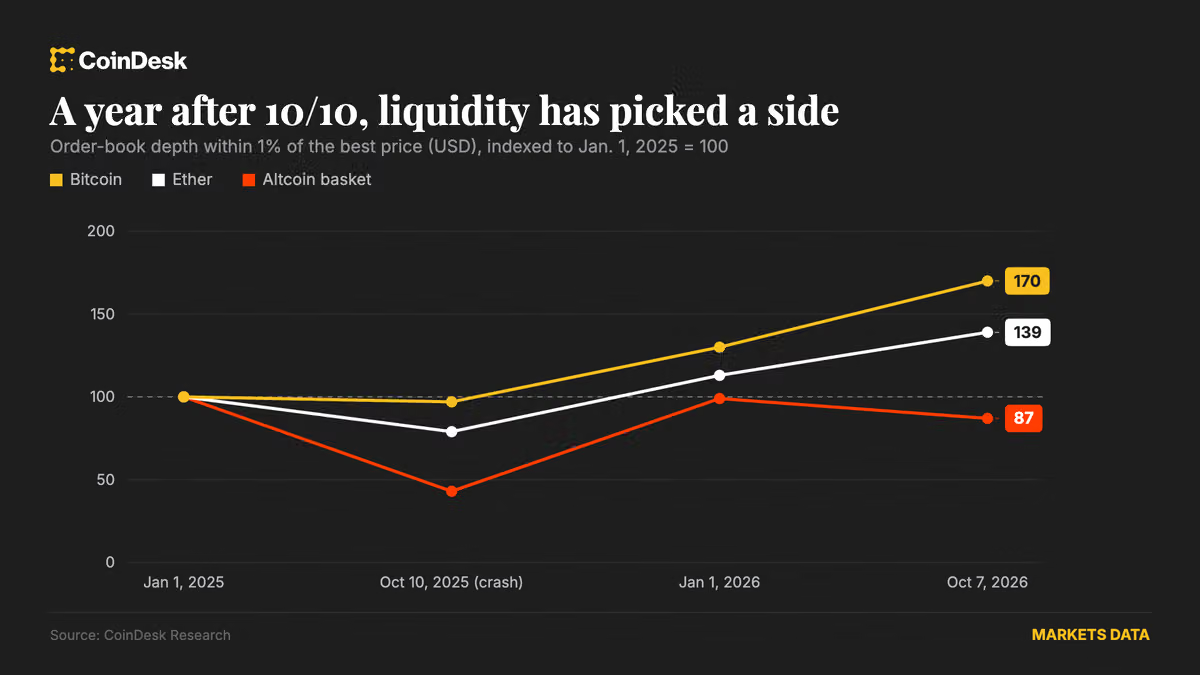
Market depth has not recovered months after the October 10 liquidation cascade, as traders debate Binance's role in the ongoing bitcoin crash.
Crypto News2 months ago

Is the Bitcoin Four-Year Cycle Broken After 2025's Unexpected Finish?

Bitcoin closed 2025 lower than it opened, a first for any post-halving year. This unexpected finish renews skepticism regarding the long-observed four-year market cycle.

Breaking News

View All →

Top Headlines

View More →
Stock News24 minutes ago

Musk says SpaceX and Tesla to build advanced chip factories in Austin

Stock News55 minutes ago

Oil Is Above $100 a Barrel for the First Time Since 2022. Here's Why Artificial Intelligence (AI) Investors Should Care.

Stock News1 hour ago

Why I'm Buying ServiceNow Stock While Everyone Else Is Panicking About AI Disruption

Stock News2 hours ago

Ripple Effects to Watch in META, YouTube & LVY Lawsuits

Stock News3 hours ago

Prediction: This Artificial Intelligence (AI) Stock Will Be Worth $5 Trillion by the End of 2026