MarketLens

Log in

Is Deere & Company Poised for a Rebound? Analyzing Q1 2026 Results and Upgraded Guidance

1 day ago
SHARE THIS ON:

Is Deere & Company Poised for a Rebound? Analyzing Q1 2026 Results and Upgraded Guidance

Key Takeaways

  • Deere & Company (DE) defied a challenging agricultural backdrop in Q1 2026, beating earnings and revenue estimates while raising its full-year net income guidance.
  • CEO John May's declaration that 2026 marks the "bottom of the current cycle" is supported by strong performance in Construction & Forestry and Small Agriculture segments, offsetting large ag weakness.
  • Despite a broader agricultural downturn characterized by low commodity prices and declining farm income, Deere's strategic diversification and focus on technology position it for a potential rebound in 2027 and beyond.

Is Deere & Company Poised for a Rebound? Analyzing Q1 2026 Results and Upgraded Guidance

Deere & Company (NYSE: DE) delivered a surprising beat in its first-quarter fiscal 2026 earnings, signaling a potential turning point for the agricultural and construction equipment giant. The company reported net income of $656 million, or $2.42 per diluted share, for the quarter ended February 1, 2026. This comfortably surpassed analyst estimates of $2.06 per share, even as it represented a decline from $869 million, or $3.19 per share, in the prior-year quarter.

The revenue picture was equally encouraging, with worldwide net sales and revenues climbing 13% year-over-year to $9.61 billion, significantly outperforming the consensus estimate of $7.69 billion. Net sales alone reached $8.00 billion, up from $6.81 billion in Q1 2025. This robust top-line performance, coupled with the earnings beat, sent Deere's shares soaring by as much as 13% on the news, reaching an all-time high of $662.00 and closing the day up 11.58%.

Perhaps the most impactful takeaway for investors was Deere's decision to raise its full-year fiscal 2026 net income guidance. The company now expects net income to fall between $4.5 billion and $5.0 billion, an increase from its previous outlook of $4.0 billion to $4.75 billion. This upward revision, coming amidst a widely acknowledged downturn in the large agriculture sector, suggests management sees clearer skies ahead. CEO John May explicitly stated, "These positive developments reinforce our belief that 2026 represents the bottom of the current cycle and provides us with a strong foundation for accelerated growth going forward."

This optimistic outlook from Deere's leadership, backed by solid Q1 performance and an improved forecast, stands in contrast to the more cautious stance taken by some rivals, like CNH Industrial NV, which anticipates a machinery sales rebound closer to 2027. Deere's ability to navigate current headwinds and project an improved financial trajectory has clearly resonated with the market, positioning the company as a bellwether for a potential broader recovery in its core industries.

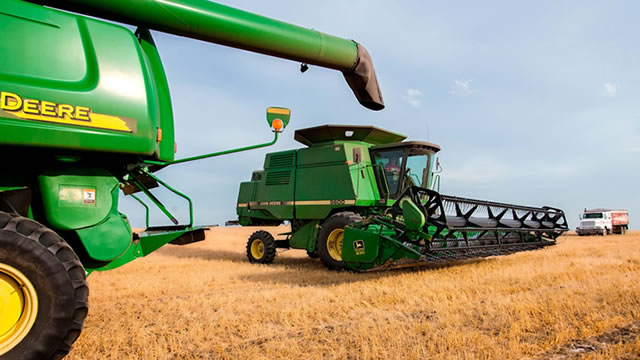
Deere's Q1 2026 results paint a nuanced picture of its diverse operations, highlighting the strategic importance of its multi-segment approach in mitigating cyclical downturns. While the "Production & Precision Agriculture" segment, which caters to large-scale farming, continued to face pressure with net sales expected to decrease 5% to 10% year-over-year for fiscal 2026, other segments are showing remarkable resilience and growth. This divergence underscores the company's ability to offset weakness in one area with strength in others.

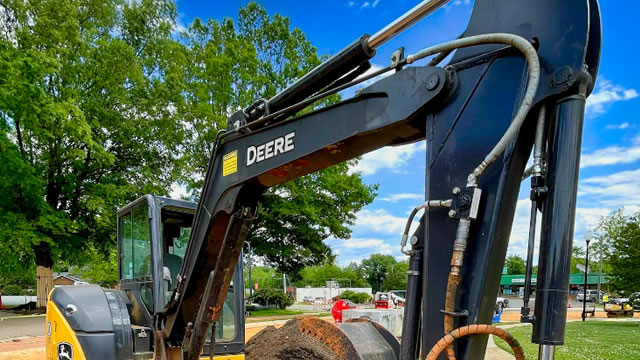
The "Small Agriculture & Turf" segment is projected to see net sales rise by approximately 15% in fiscal 2026, a significant boost driven by improving demand. Similarly, the "Construction & Forestry" segment is also forecasted for a robust 15% increase in net sales. These two segments are proving to be critical growth engines, with their strengthening order books and shipments running ahead of plan. This diversification allows Deere to maintain overall momentum even when its largest agricultural market faces headwinds.

The company's Financial Services segment is also contributing positively, with net income expected to reach approximately $840 million for fiscal 2026. This segment provides crucial support to equipment sales through financing, and its stable performance adds another layer of financial strength. The overall "better-than-expected sales and margins across all units on higher shipments as order books strengthened" noted by analysts, suggests that Deere's operational efficiency and market positioning are paying off.

CEO John May emphasized that "our sustained investment in research and development throughout the cycle is yielding measurable results as we move toward launching a wide range of innovative products and solutions across all business segments." This commitment to innovation, particularly in precision agriculture and sustainable forestry, positions Deere to capitalize on future demand. The acquisition of intellectual property for tree planting equipment from Risutec Oy, announced on February 17, 2026, further bolsters Deere's silviculture strategy, expanding its reach into sustainable forestry solutions and demonstrating a forward-looking approach to market opportunities.

Is the Agricultural Downturn Nearing its End, or Just Shifting?

The broader agricultural landscape presents a complex and challenging environment, making Deere's optimistic outlook particularly noteworthy. The USDA's latest forecast for 2026 projects net farm income at $153.4 billion, a 0.7% nominal decline from 2025, and a 2.6% real (inflation-adjusted) decrease. This follows a significant downward revision for 2025, where net farm income was cut by roughly $25 billion from earlier estimates, underscoring a more strained farm economy than previously believed.

A key driver of this downturn is the "Monster Harvest" of 2025, which has led to a substantial grain glut. December 2026 corn futures are projected around $4.64 per bushel, and wheat near $5.48 per bushel, prices that are at or below breakeven costs for many Midwestern producers. This low commodity price environment, coupled with persistently high production expenses (forecast to increase 1.0% nominally to $477.7 billion in 2026), is squeezing farmer profitability and leading to cautious spending.

The "2026 Ag Equipment Dealer Business Outlook & Trends Report" confirms this sentiment, with over 66% of dealers reporting declining new equipment revenue in 2025, and a significant percentage expecting further declines in 2026. Farmers are increasingly focused on value-driven purchasing and showing strong interest in used equipment, rather than investing in new, high-cost machinery. This shift in farmer behavior directly impacts companies like Deere, particularly in its large agriculture segment.

However, there are glimmers of hope and strategic pivots. The USDA projects a substantial increase in direct government payments to farmers, rising to $44.3 billion in 2026, a 45.2% jump from 2025. This influx of government support, along with potential tailwinds from anticipated clarity on US biofuels policy in 2026, could provide some liquidity and stimulate demand for feedstocks like corn and soybeans. The industry is also seeing a shift towards precision agriculture, where farmers use data to minimize input costs rather than solely maximize yields, a trend that plays directly into Deere's technological strengths.

Deere's recent stock surge to $662.00 has pushed its valuation metrics to levels that warrant careful consideration. The company's market capitalization now stands at a robust $179.45 billion. Looking at trailing twelve-month (TTM) fundamentals, Deere trades at a P/E ratio of 35.60, a P/S of 4.02, and an EV/EBITDA of 16.05. These figures are considerably higher than its historical averages and suggest that a significant amount of future growth is already priced into the stock.

For context, the TTM EPS is $18.60, and the net income margin is 11.3%. While these are healthy figures, the P/E multiple indicates that investors are betting heavily on the "bottom of the cycle" narrative translating into substantial earnings growth in the coming years. The company's dividend yield is 1.0% with a payout ratio of 34.2%, offering some income but not enough to justify the current valuation on yield alone.

Wall Street analysts, while acknowledging Deere's strong Q1 performance, maintain a relatively cautious stance. The consensus analyst rating for DE is "Hold," with 20 analysts recommending Hold, 19 recommending Buy, and 6 recommending Sell. Notably, there are no "Strong Buy" or "Strong Sell" ratings. The average price target is $529.50, with a median of $538.00. The highest price target is $612.00, which is still below the stock's current trading price of $662.00. This discrepancy suggests that the market's enthusiasm has outpaced analyst revisions, possibly indicating an overextended rally in the short term.

The agricultural equipment market itself is projected to experience an annual growth rate of 14.4% from 2026 to 2033, driven by increasing demand for precision farming and smart agricultural technologies. Deere, with its leadership in R&D and integration of IoT and AI, is well-positioned to capture this long-term growth. However, the immediate challenge lies in bridging the gap between current valuation and the anticipated recovery, especially given the ongoing pressures in the large agriculture segment and the cautious sentiment among dealers regarding new equipment sales.

What Are the Key Risks and Opportunities for Deere Investors Moving Forward?

Deere's path forward, despite its recent strong performance, is not without significant risks. The primary concern remains the prolonged downturn in the large agriculture sector. While CEO John May believes 2026 is the bottom, a slower-than-expected recovery in commodity prices or continued high input costs for farmers could delay the rebound in demand for high-margin large equipment. The "generational downturn" in farm income, as described by the American Farm Bureau Federation, suggests that farmers may prioritize cost-cutting and efficiency over new machinery purchases for longer than anticipated.

Furthermore, the current high valuation of Deere's stock, trading above analyst price targets, leaves little room for error. Any negative surprises in future earnings, or a re-evaluation of the agricultural outlook, could trigger a significant correction. The company's TTM P/E of 35.60 implies a robust growth trajectory that must be consistently delivered. Competition from rivals like CNH Industrial and AGCO, who are also investing in smart agriculture, adds pressure to maintain market share and technological leadership.

However, the opportunities for Deere are equally compelling. The company's diversification into Construction & Forestry and Small Agriculture & Turf is proving to be a crucial strength, providing revenue stability during the large ag slump. The global agriculture equipment market is projected to grow at a healthy CAGR of 6-8% through 2033, fueled by technological advancements like precision farming, autonomous machinery, and sustainable practices. Deere's consistent investment in R&D, as evidenced by its acquisition of Risutec Oy's tree planting technology, positions it at the forefront of these trends.

The aging US farm fleet also presents a significant replacement demand opportunity once farmer sentiment and profitability improve. As fundamentals stabilize and potential clarity on US biofuels policy emerges, farmers may be more inclined to upgrade their equipment. Deere's strong balance sheet, with $6.8 billion in cash and cash equivalents and a manageable debt-to-equity ratio of 0.55, provides the financial flexibility to continue investing in innovation, pursue strategic acquisitions, and navigate market cycles.

Deere & Company's Q1 2026 results and upgraded guidance offer a compelling narrative of resilience and strategic positioning amidst a challenging agricultural backdrop. While the stock's current valuation reflects significant optimism, the company's diversified growth engines and long-term commitment to innovation suggest it is well-prepared to capitalize on the eventual upturn. Investors should closely monitor commodity prices, farmer sentiment, and the execution of Deere's technology-driven growth strategy for signs of sustained momentum.


Want deeper research on any stock? Try Kavout Pro for AI-powered analysis, smart signals, and more. Already a member? Add credits to run more research.

SHARE THIS ON:

Related Articles

Category

You may also like

No related articles available

Breaking News

View All →

No topics available at the moment