MarketLens

Log in

Is Insider Selling a Red Flag for Lucid Group (LCID) Investors

2 hours ago
SHARE THIS ON:

Is Insider Selling a Red Flag for Lucid Group (LCID) Investors

Key Takeaways

  • Lucid Group (LCID) faces significant headwinds, including a recent $4 million stock sale by its former Chief Engineer, Eric Bach, and a 40% stock decline since November.
  • Despite record Q4 2025 revenue of $522.7 million, the company reported a GAAP diluted net loss of $(3.62) per share, highlighting persistent profitability challenges.
  • While production is ramping up with a 2026 guidance of 25,000-27,000 vehicles and new models like the Gravity SUV, concerns about cash burn and potential shareholder dilution remain.

Is Insider Selling a Red Flag for Lucid Group (LCID) Investors?

The recent news that Eric Bach, Lucid Group's former Senior Vice President of Product and Chief Engineer, sold $4 million worth of LCID stock has certainly raised eyebrows among investors. This isn't a small, routine transaction; it involved two significant sales, one for $2.8 million and another for nearly $1.2 million. While Bach's departure from the company last November provides a plausible reason for him to divest his holdings, the timing and scale of these sales, especially against a backdrop of a "very challenging 2026" for Lucid, warrant closer scrutiny.

Lucid's stock has been on a downward trajectory, plummeting roughly 40% since early November, coinciding with Bach's exit. The shares closed today at $10.00, down 5.57%, and are trading near their $9.12 52-week low. This price action, coupled with a high-profile insider sale, naturally fuels speculation about the company's near-term prospects and whether those closest to the operation see a tougher road ahead than public statements might suggest.

For retail investors, insider selling can often be a potent signal, suggesting that those with the most intimate knowledge of a company's inner workings might be losing confidence. While not always indicative of impending doom, it adds another layer of caution to an already complex investment thesis. In Lucid's case, where the company is still a money-losing startup attempting to scale in a fiercely competitive EV market, any hint of internal doubt can amplify existing anxieties.

The question isn't just why Bach sold, but what this implies for the broader investment narrative. Is it simply a former executive cashing out after years of service, or does it reflect a deeper concern about Lucid's ability to navigate its current financial and operational hurdles? This event, while not definitive on its own, certainly contributes to the prevailing negative sentiment surrounding LCID.

How Healthy Are Lucid's Financials Amidst Persistent Losses?

Lucid Group's financial health presents a mixed picture, characterized by impressive revenue growth but persistent, substantial losses. The company reported Q4 2025 revenue of $522.7 million, a remarkable 123% increase year-over-year, contributing to an annual revenue of $1.35 billion for 2025, up 68% from the previous year. These figures demonstrate a clear operational ramp-up and growing market acceptance for its luxury EVs.

However, the revenue growth comes at a steep cost. Lucid's GAAP diluted net loss per share for Q4 2025 was a staggering (3.62),missinganalystestimates.Forthefullyear2025,thecompanyrecordedanetlossof(3.62)**, missing analyst estimates. For the full year 2025, the company recorded a net loss of **2.7 billion, underscoring the immense capital required to build an EV business from the ground up. This heavy cash burn is a critical concern, with some analyses flagging "less than one year of cash runway" based on current spending rates.

To address these financial pressures and improve operational efficiency, Lucid recently announced a 12% workforce reduction, impacting over 800 non-manufacturing employees. This move aims to optimize resources and accelerate the path to profitability, even as production continues to scale. While cost-cutting is a necessary step, it also introduces execution risk, as it could potentially slow down critical engineering or software development at a crucial growth phase.

Lucid's liquidity position, bolstered by approximately $4.6 billion in total liquidity at the end of Q4 2025, is primarily thanks to the Public Investment Fund (PIF) of Saudi Arabia, which owns a substantial 58.42% of the company. This backing provides a vital lifeline, but the reliance on external funding raises questions about potential future shareholder dilution. Since going public, Lucid has increased its total shares outstanding by roughly 90%, a trend that could continue if profitability remains elusive.

Can Lucid's Production Ramp-Up Outpace Market Challenges?

Lucid's operational achievements in 2025 offer a glimmer of hope amidst its financial struggles. The company nearly doubled its production year-over-year, producing 18,378 vehicles and delivering 15,841 in 2025, representing a 55% increase in deliveries compared to 2024. This momentum is projected to continue into 2026, with guidance for 25,000-27,000 vehicles, signaling meaningful growth if execution holds.

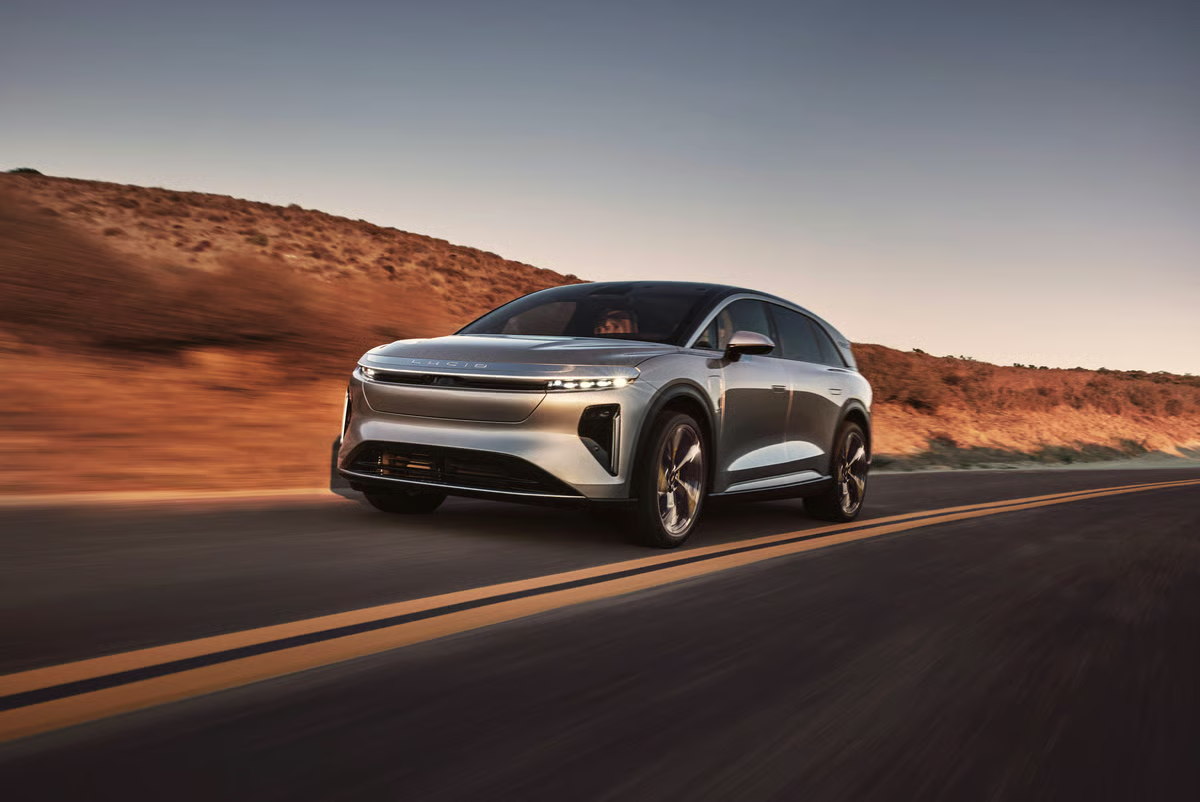
The bull case for Lucid hinges on its superior powertrain technology, vertical integration, and strategic expansion. The company is actively ramping up production of its Gravity SUV and plans to launch a new $50,000 mid-sized EV, aiming to broaden its market appeal beyond the ultra-luxury segment. Furthermore, Lucid is advancing its autonomy strategy, leveraging its technology and partnerships, including a potential robotaxi collaboration with Uber Nuro, to position itself as an early mover in emerging markets.

However, the bear case highlights significant hurdles. The luxury EV market faces increasing competition and potential demand shortfalls, making it difficult for Lucid to achieve the necessary sales volume for profitability. While the company's technology is impressive, scaling production and bringing more affordable models to market without further significant capital raises and dilution remains a formidable challenge. Competitors like Tesla and Rivian have demonstrated the difficulty of achieving mass scale and positive net profits in the EV space.

Lucid's current valuation also presents a point of contention. Despite a popular narrative suggesting it's undervalued, its price-to-sales (P/S) ratio of approximately 3x sits well above peers at 1.4x and the broader U.S. Auto industry at 0.6x. This high P/S ratio signals considerable valuation risk if growth expectations slip or profitability remains distant. The company's ability to translate its production gains into sustainable commercial traction and improved gross margins will be critical in altering this perception.

What Do Analysts Say About LCID's Future and Price Targets?

Wall Street analysts currently hold a "Hold" consensus rating for Lucid Group, reflecting a cautious optimism mixed with significant concerns. Out of 14 analysts, 9 recommend "Hold," with only 2 "Buy" ratings and 3 "Sell" ratings, indicating a lack of strong conviction in either direction. This sentiment underscores the company's high-risk, high-reward profile in the volatile EV sector.

The consensus price target for LCID stands at $14.40, with a median of $14.00. This implies a potential upside of around 44% from the current trading price of $10.00. The highest target reaches $21.00, suggesting a more bullish outlook based on successful execution of growth strategies, while the lowest target aligns with the current price at $10.00, indicating some analysts see limited near-term upside. Recent rating changes, such as Morgan Stanley downgrading LCID from "Equal Weight" to "Underweight" in December 2025, and Cantor Fitzgerald maintaining a "Neutral" rating in February 2026, further illustrate the divided opinions.

Analysts are closely watching Lucid's path to profitability. While the consensus revenue estimate for FY 2029 is $8.6 billion, with an EPS loss of 1.33,amoreoptimisticforecastforFY2030projectsrevenueof-1.33**, a more optimistic forecast for FY 2030 projects revenue of **12.1 billion and a positive EPS of $0.05. These long-term projections highlight the significant ramp-up in sales and margin improvement required for Lucid to achieve financial sustainability. The market is essentially pricing in a future where Lucid successfully navigates its scaling challenges and captures a meaningful share of the premium EV market.

The upcoming earnings report, scheduled for May 11, 2026, will be a crucial event. The last earnings report on February 24, 2026, saw an EPS miss of 3.62andrevenueof-3.62** and revenue of **0.5 billion, which contributed to the recent stock decline. Investors will be looking for clearer signs of margin improvement, progress on the Gravity SUV and mid-sized EV launches, and a more concrete timeline for reducing cash burn and achieving positive free cash flow.

Is Lucid's Saudi Backing a Double-Edged Sword for Minority Investors?

Lucid's relationship with Saudi Arabia's Public Investment Fund (PIF) is undeniably a cornerstone of its financial stability, yet it presents a nuanced dynamic for minority shareholders. The PIF's substantial ownership, holding 58.42% of the company, has provided critical capital, including the $4.6 billion in liquidity reported at the end of Q4 2025. This deep-pocketed backer has been instrumental in funding Lucid's ambitious manufacturing expansion, R&D, and global market entry, particularly in Saudi Arabia itself, where Lucid has a manufacturing facility.

However, this dominant ownership stake raises questions about alignment of interests. While the PIF's long-term vision for Lucid might align with its national economic diversification goals, it may not always perfectly coincide with the short-to-medium-term interests of minority investors. Decisions regarding capital raises, operational strategies, and even potential takeovers could be heavily influenced by the majority shareholder, potentially at the expense of maximizing per-share value for smaller stakeholders.

The concern about shareholder dilution, for instance, is amplified by the PIF's influence. If Lucid continues to require significant capital injections to fund its growth and achieve profitability, the PIF could participate in or orchestrate future funding rounds that might further dilute existing minority shareholders. Since its IPO, Lucid's shares outstanding have increased by approximately 90%, and while some dilution is expected in growth-stage companies, the pace and necessity of it remain a key risk.

Ultimately, the Saudi backing acts as both a safety net and a potential constraint. It provides the financial runway Lucid desperately needs to execute its ambitious plans, including the Gravity SUV and the upcoming $50,000 mid-sized EV. Yet, it also means that the company's strategic direction and financial decisions will always be viewed through the lens of its largest shareholder, which may prioritize long-term strategic objectives over immediate shareholder returns for minority investors.

The Road Ahead: Navigating Volatility and Proving the Model

Lucid Group remains a high-stakes bet on the future of luxury and advanced electric vehicles. The company's innovative technology and ambitious production targets offer a compelling vision, but its persistent losses and significant cash burn demand careful monitoring. Investors must weigh the potential for groundbreaking success against the very real risks of a challenging market and continued financial pressures.

The coming quarters will be pivotal for Lucid to demonstrate tangible progress towards profitability, not just increased production. Watch closely for improvements in gross margins, disciplined capital expenditure, and the successful launch and market acceptance of its new models. While the journey is fraught with uncertainty, Lucid's narrative is far from over.


Want deeper research on any stock? Try Kavout Pro for AI-powered analysis, smart signals, and more. Already a member? Add credits to run more research.

SHARE THIS ON:

Related Articles

Category

You may also like

Stock News8 hours ago

Lucid's Former Chief Engineer Sold $4 Million of LCID Stock

Lucid's former chief engineer sold $4M of LCID stock as shares fell 40% since November. The company faces a challenging 2026 outlook, reflecting persistent operational and market headwinds for the lux...
Stock News2 weeks ago

Is Tesla Stock Headed To $300?

Analyst sentiment on TSLA stock shifted to pessimistic, suggesting that a potential price target of $300 is not improbable, indicating a possible selling opportunity.
Stock News1 months ago

Why Lucid Group (LCID) Dipped More Than Broader Market Today

Lucid Group (LCID) stock closed at $10.94, marking a 2.84% drop from its previous session's closing price.
Stock News2 months ago

Monster Beverage Insider Sale Leads to Investor Scrutiny

Monster Beverage (MNST) stock faces scrutiny after its largest insider sale in a year occurred while shares traded near multi-year highs, coinciding with a lack of recent insider purchasing activity.

Breaking News

View All →

Top Headlines

View More →
Stock News47 minutes ago

2 Millionaire-Maker Artificial Intelligence (AI) Stocks

Stock News3 hours ago

Why March 9 Could Be a Huge Day for Tesla Investors

Stock News5 hours ago

2 No-Brainer Energy Stocks to Buy Right Now

Stock News5 hours ago

Amazon India slashes seller referral fees in retail growth push

Stock News5 hours ago

Amazon's cloud unit reports fire after objects hit UAE data center