MarketLens

Log in

Is Now the Time to Revisit Small-Cap Stocks

1 hour ago
SHARE THIS ON:

Is Now the Time to Revisit Small-Cap Stocks

Key Takeaways

  • Small-cap stocks, often overlooked by institutional analysts, are showing signs of a potential breakout year in 2026, driven by specific catalysts and technical setups.
  • Identifying valid breakouts requires a confluence of strong price action, significant volume spikes, and underlying fundamental improvements or news-driven catalysts.
  • Successful traders combine rigorous screening for liquidity, growth fundamentals, and institutional interest with real-time analysis of volume and order flow to confirm high-conviction opportunities.

Is Now the Time to Revisit Small-Cap Stocks?

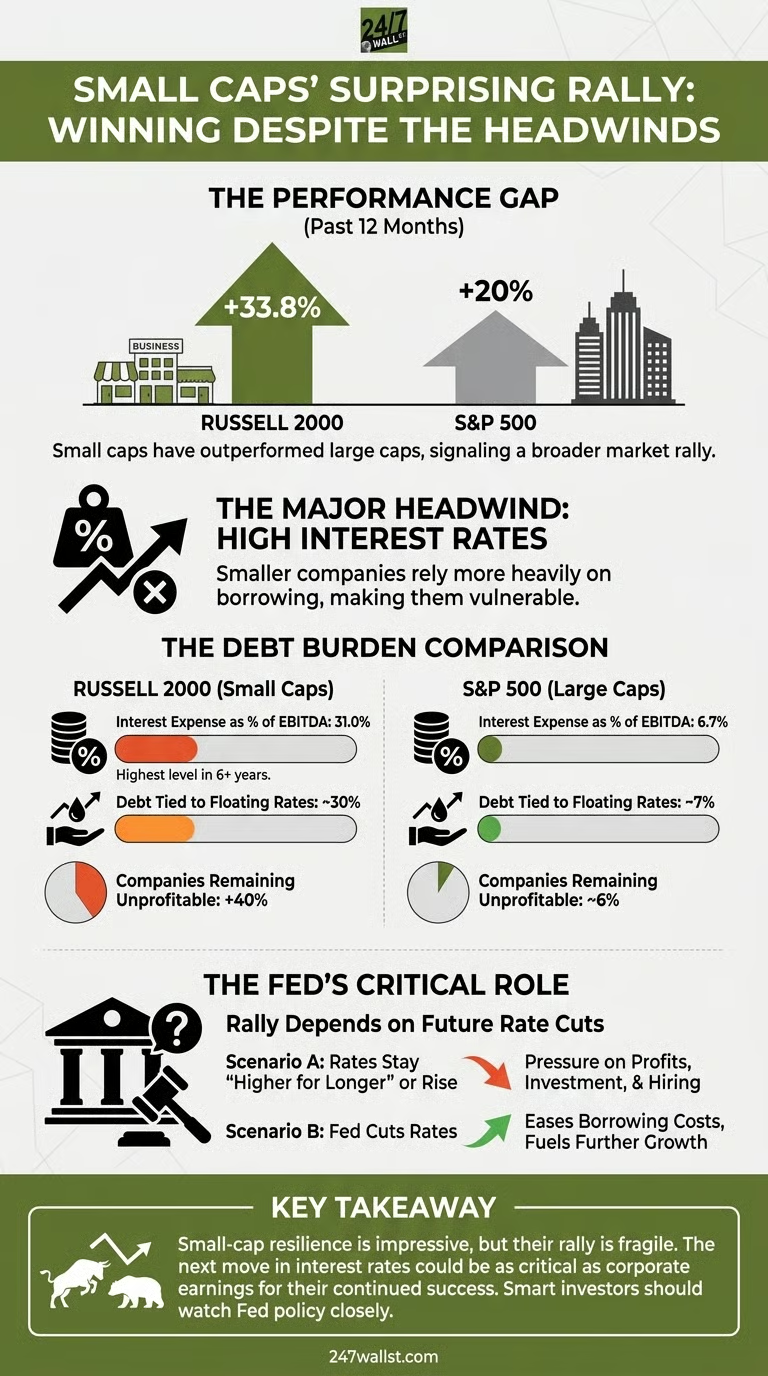
After years of underperformance, small-cap stocks are signaling a potential comeback, making them a compelling area for active traders and investors seeking outsized returns. While large-cap tech giants have dominated headlines, the less-covered small-cap universe often harbors mispriced gems with significant growth runways. This segment, typically defined as companies with market capitalizations between $300 million and $2 billion, has historically delivered outsized gains during strong economic expansions.

Indeed, market folklore suggests that January's performance can be a bellwether for the year, and the Russell 2000, a key small-cap index, has already risen 8% year-to-date in early 2026, significantly outpacing the Russell 1000 and S&P 500. This early strength comes despite institutional investors pulling some $12 billion from small-cap ETFs over the past year, according to State Street chief investment strategist Michael Arone, who predicts a "positive surprise" for small caps this year. Such a divergence between expert opinion and institutional flows often creates fertile ground for astute individual investors.

The appeal of small-caps lies in their inherent growth potential; it's simply easier for a smaller company to double its revenue from a lower base than for a multi-billion dollar behemoth. Furthermore, the limited analyst coverage in this segment means that fundamental improvements or emerging trends can go unnoticed by the broader market, creating opportunities for early movers. When these under-the-radar businesses start to gain traction, the price movements can be explosive, offering a unique avenue for portfolio amplification.

However, this high reward potential comes with increased volatility and risk. The key to navigating this landscape isn't just about identifying promising companies, but about spotting the precise moments when the market is finally "noticing" them. This involves a disciplined approach to identifying specific catalysts and confirming genuine breakouts, rather than chasing speculative moves. Understanding the interplay of news, volume, and price action becomes paramount for capitalizing on these dynamic opportunities.

What Defines a Valid Stock Breakout?

A valid stock breakout is far more than just a stock hitting a new high; it's a powerful signal that demand has decisively overwhelmed supply, often indicating that institutional money is accumulating shares. The most successful advances typically begin with a clear move above a key resistance level or consolidation area, but the conviction behind this move is what truly matters. Without proper confirmation, many apparent breakouts can quickly fizzle out, trapping unsuspecting traders.

The most critical confirmation signal is a significant surge in trading volume. A breakout is considered robust when volume increases by 50% or more above the average daily volume, ideally even higher. This isn't just about more shares changing hands; it signifies that large, informed players are stepping in with conviction, providing the "fuel" necessary to sustain the upward momentum. Conversely, a breakout on weak volume often suggests a lack of institutional interest, making it prone to failure.

Beyond volume, the quality of the price action itself is crucial. A strong breakout sees the stock closing in the upper portion of its daily range, ideally with a Daily Closing Range above 50%, and even better, above 70%. This demonstrates sustained buying pressure throughout the trading session, rather than a brief spike that fades by the close. Multiple days of closing in the upper range further reinforce this sustained demand, indicating a genuine shift in market sentiment.

Finally, a stock demonstrating strong relative strength versus the overall market is another key characteristic of a high-quality breakout. Even the best individual setups can struggle in a weak market, so identifying stocks that are outperforming their peers and the major indices provides an added layer of confidence. This combination of breaking resistance, surging volume, strong daily closes, and superior relative strength forms the bedrock of identifying truly powerful price movements that can lead to significant gains.

How Do News Catalysts Drive Small-Cap Momentum?

News often serves as the primary trigger for explosive price movements and breakouts in the small-cap arena, acting as the fundamental fuel for technical setups. Unlike large-cap stocks that might absorb news with less volatility due to their sheer size and broad analyst coverage, small-caps can react sharply and immediately to significant announcements. This makes tracking key market catalysts an essential strategy for identifying high-potential momentum plays.

Consider the biotech sector, a prime example where news-driven catalysts frequently dictate stock performance. An announcement of FDA approval for a new drug, such as the potential approval for Denali Therapeutics' tividenofusp alfa for Hunter syndrome or Vanda Pharmaceuticals' imsidolimab for generalized pustular psoriasis, can lead to sudden and massive spikes in buying interest. These regulatory milestones can unlock significant shareholder value, transforming a development-stage company into a commercial success overnight. Similarly, positive early data readouts from clinical trials, like those seen with Catalyst Pharmaceuticals' Agamree, can ignite investor enthusiasm.

Beyond biotech, other news events like significant contract wins, unexpected earnings surprises, or strategic mergers and acquisitions can similarly propel a small-cap stock into a breakout. For instance, a small tech firm securing a major partnership or a manufacturing company landing a lucrative government contract can dramatically alter its growth trajectory and perceived value. These events often precede or coincide with the volume spikes and aggressive buying activity that confirm a valid technical breakout.

The impact of these catalysts is amplified in small-cap stocks because their lower liquidity means that even a moderate increase in demand can lead to substantial price appreciation. Traders who stay abreast of company announcements, insider activities, and analyst upgrades – often by setting up real-time alerts – gain a significant edge. Catching these early signals of momentum, before the broader market fully digests the implications of the news, is crucial for maximizing reward potential in these dynamic, catalyst-driven opportunities.

What Are the Best Strategies for Screening Breakout Candidates?

Effectively screening for breakout candidates in the small-cap space requires a systematic approach that combines both fundamental strength and technical indicators. The goal is to filter out the noise and pinpoint high-quality stocks with the underlying power and momentum to sustain major advances. This isn't about guesswork; it's about data-backed decisions.

First, establish essential universal screening criteria to ensure liquidity and viability. Focus on stocks trading above $12.50 per share, with a market capitalization greater than $1 billion, and an average daily dollar volume exceeding $20 million. These filters help avoid illiquid, highly speculative penny stocks that are difficult to trade efficiently. Additionally, look for a Relative Strength (RS) Rating above 85, indicating the stock is outperforming 85% of all other stocks in the market.

Next, integrate robust fundamental growth criteria. The strongest breakouts are often backed by exceptional earnings and sales growth. Screen for companies with last quarter EPS growth greater than 25% year-over-year and last quarter sales growth exceeding 20% year-over-year. Further refine this by looking for earnings acceleration, where current quarter growth surpasses the previous quarter, and an EPS Rating greater than 80. Positive earnings in the last four consecutive quarters are also a strong indicator of financial health.

Finally, consider institutional sponsorship and the broader market environment. Major moves require institutional buying power, so look for institutional ownership between 15% and 75%, with an increasing number of institutional owners quarter-over-quarter. An "Accumulation Rating" showing net institutional buying is also a positive sign. Crucially, only run breakout screens and take positions during confirmed market uptrends. This means major indices like the S&P 500 should be trading above its 50-day moving average, and the NASDAQ above its 21-day exponential moving average, with a low distribution day count. Approximately 75% of stocks follow the general market direction, so trading with the tide significantly increases success rates.

How Can Traders Confirm Breakouts and Manage Risk?

Confirming a breakout and effectively managing risk are paramount, especially when dealing with the inherent volatility of small-cap stocks. A "breakout" can quickly turn into a "fakeout" if not properly validated, leading to significant losses. Therefore, traders must employ a multi-faceted approach to ensure they are entering high-probability trades and protecting their capital.

Visual chart validation is the first step. After a screener identifies potential candidates, always examine the chart to confirm the pattern structure, volume behavior, and proper entry points. Look for the stock moving above a clear resistance level, ideally on volume that is significantly higher than average, and closing near its daily highs. The combination of increasing volume on up days and decreasing volume on down days is a hallmark of institutional accumulation, signaling genuine interest.

For active traders, real-time order flow analysis provides an even deeper layer of confirmation. Tools that visualize the order book and liquidity can show whether aggressive buyers are actively stepping in and clearing sell orders at resistance levels. When liquidity on the ask side begins to thin out and market orders are consistently clearing the order book, it strongly suggests that a breakout has real momentum behind it. Conversely, if a stock is struggling to clear resistance despite high volume, or if large sell orders are consistently appearing, it might indicate a false move.

Risk management is non-negotiable. For any breakout trade, immediately place a stop-loss order slightly below the breakout level. For example, if a stock breaks out at $25, a trader might set a stop-loss at $24.80. This minimizes potential losses if the move fails and the stock reverses. The goal is to enter early, when risk is manageable, and avoid chasing moves after they've already made significant advances. By combining visual confirmation, order flow insights, and disciplined stop-loss placement, traders can navigate the high-reward, high-risk world of small-cap breakouts with greater confidence.

What Small-Cap Sectors and Stocks Are Showing Promise?

While the broader small-cap market offers opportunities, certain sectors and individual stocks are currently exhibiting characteristics that align with breakout potential. The biotech sector, as highlighted earlier, continues to be a hotbed for catalyst-driven moves, with companies like Denali Therapeutics (DNLI), Nuvalent, Inc. (NUVL), and Vanda Pharmaceuticals (VNDA) poised for significant regulatory milestones in 2026. Their pipelines and potential drug approvals could unlock substantial value.

Beyond biotech, other small-cap companies are also on the radar. CBIZ (CBZ), a financial and advisory services firm with a market cap of $1.41 billion, has shown outstanding annual revenue growth of 31.7% over the past two years and massively outperformed peers in EPS. Trading at 8.4x forward P/E, it presents a compelling case for a growth-at-a-reasonable-price opportunity. Similarly, innovative companies like Serve Robotics (SERV), a food delivery robot maker spun off from Uber, are showing rapid revenue growth (37% in Q2 2025) and expanding into new markets, representing the kind of disruptive potential small-caps are known for.

Other names like Magnite (MGNI) in media and Amplitude (AMPL) in software, both around the $1-2 billion market cap range, are also worth watching for technical breakouts backed by solid fundamentals. These examples underscore the diversity of opportunities within the small-cap universe, extending beyond just the most obvious growth sectors. The key is to apply the rigorous screening and confirmation strategies discussed, rather than simply following a list of names.

The current market environment, with experts calling for small-cap outperformance and institutional money potentially rotating back into the segment, sets the stage for exciting opportunities. However, the onus remains on individual investors to conduct their due diligence, focusing on companies with strong fundamentals, clear catalysts, and confirmed technical breakouts.

The small-cap universe remains a fertile hunting ground for outsized returns, provided investors approach it with a disciplined strategy focused on identifying genuine catalysts and confirming strong technical breakouts. By combining fundamental analysis with real-time volume and price action, traders can position themselves to capitalize on the next wave of market leaders. Stay vigilant, screen wisely, and always prioritize risk management to navigate this dynamic segment successfully.


Want deeper research on any stock? Try Kavout Pro for AI-powered analysis, smart signals, and more. Already a member? Add credits to run more research.

SHARE THIS ON:

Related Articles

Category

You may also like

Stock News4 days ago

Should JPMorgan Diversified Return U.S. Small Cap Equity ETF (JPSE) Be on Your Investing Radar?

The JPMorgan Diversified Return U.S. Small Cap Equity ETF (JPSE) launched November 15, 2016, offering passive exposure to the Small Cap Blend segment of the US equity market.
Stock News1 week ago

Should Investors Get Rid of Schneider Stock Despite Its Lower Valuation?

Schneider Electric (SNDR) shares are moving north, prompting an assessment of the stock's current positioning to determine its investment viability at this time.
Stock News1 months ago

Small-Cap Investing: Time for a Fundamental Approach?

Small-cap stocks may present significant investment opportunities for 2026, despite uncertain macroeconomic conditions for that year. Advisors should consider small-caps as potential outperformers rel...
Stock News1 months ago

Are Sub-$10 Energy Stocks Attractive With Oil Near $60?

Sub-$10 energy stocks WTI, RES, and OIS are gaining investor attention because crude oil prices are near the $60 mark, suggesting potential opportunities.

Breaking News

View All →

Top Headlines

View More →
Stock News3 hours ago

Prediction: Nvidia (NVDA) Will Be Worth More Than Alphabet, Apple, Amazon, Tesla, Meta, and Microsoft Combined by 2030

Stock News3 hours ago

Meta Creates New AI Unit to Accelerate Model Development

Stock News4 hours ago

Nvidia Expands Telecom Push With AI-Native 6G Initiative

Stock News5 hours ago

Nvidia, Amazon temporarily close Dubai offices, Google employees stranded amid U.S.-Iran war

Stock News5 hours ago

Facebook Outage Reports Surge As Website Experiences Issues