MarketLens
Is Serve Robotics (SERV) Poised for a Breakout After Strong Q4 and Uber Deal

Key Takeaways
- Serve Robotics (SERV) recently reported strong Q4 2025 results, exceeding revenue and EPS estimates, and significantly raised its 2026 revenue guidance to $26 million.
- Despite a technical "death cross" and current trading below its 50-day SMA of $11.25, the company's strategic partnerships with Uber Eats and DoorDash, alongside key acquisitions, are building a formidable "autonomy moat."
- SERV presents a high-risk, high-reward opportunity in the nascent autonomous delivery sector, balancing rapid growth and strategic expansion against substantial losses and a high Price-to-Sales valuation.
Is Serve Robotics (SERV) Poised for a Breakout After Strong Q4 and Uber Deal?
Serve Robotics Inc. (NASDAQ: SERV) has been a name buzzing in the autonomous delivery space, particularly with its deep ties to Uber and recent operational milestones. The company's latest fourth-quarter and full-year 2025 results, announced on March 11, 2026, painted a picture of accelerating growth and strategic expansion, yet the stock's recent performance, including a 9.81% drop on the day of this analysis, suggests a complex narrative. Investors are left to weigh impressive top-line growth and ambitious forecasts against a backdrop of significant losses and a challenging technical chart.
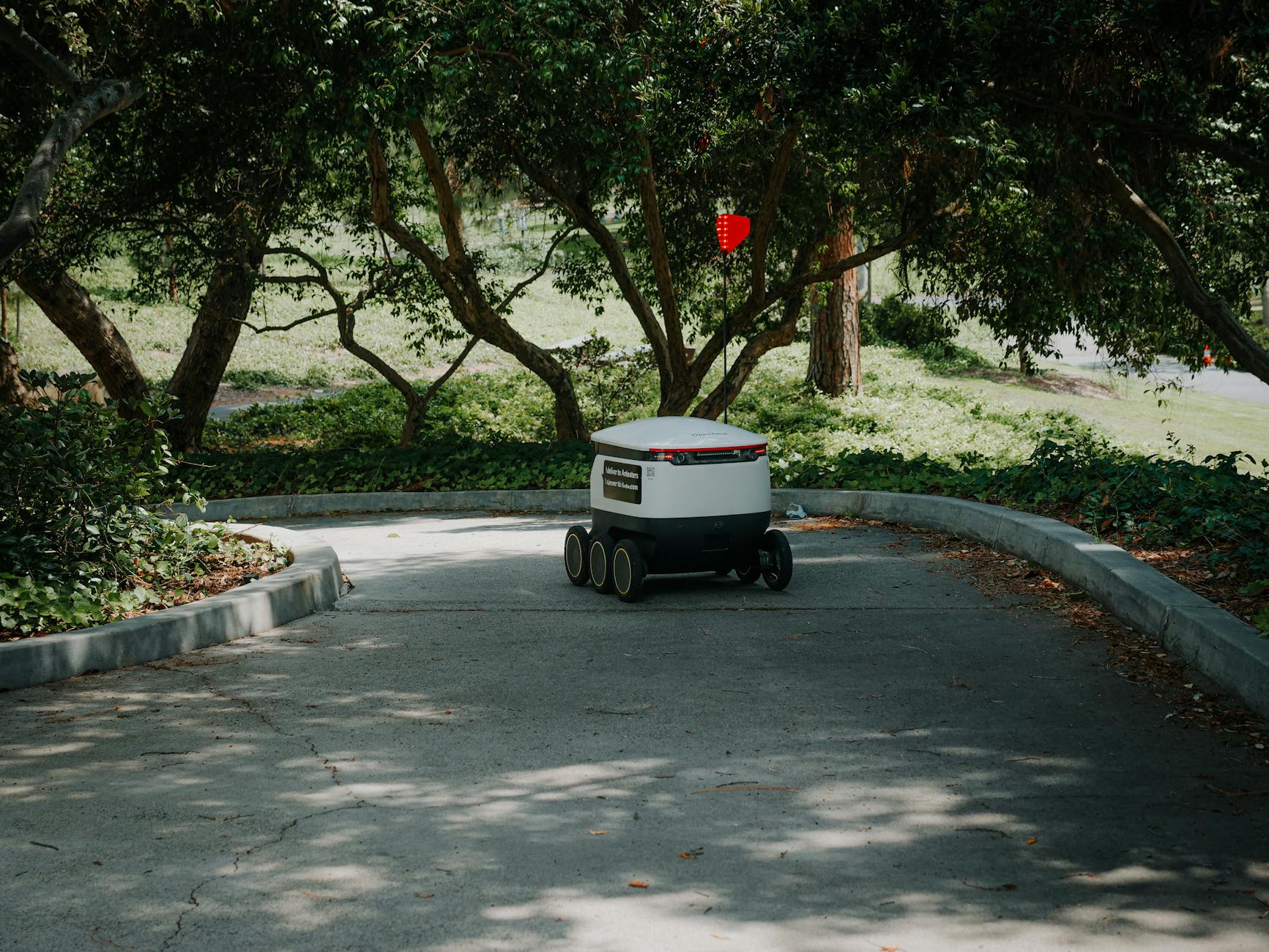
The core of Serve's story lies in its mission to revolutionize last-mile logistics with autonomous sidewalk robots. Spun off from Uber in 2021, Serve has rapidly scaled its operations, deploying 2,000 robots by the end of 2025 across 20 cities and 6 major metro areas. This expansion, coupled with a growing network of over 4,500 merchant partners including White Castle and Shake Shack, demonstrates a clear intent to capture a significant share of the burgeoning autonomous delivery market. The question now is whether this operational momentum can translate into sustained shareholder value, especially as the stock navigates critical technical levels.
The recent earnings report highlighted a 400% year-over-year revenue increase for Q4 2025, reaching $0.88 million, comfortably beating analyst estimates. Full-year revenue for 2025 also surpassed guidance, hitting $2.7 million. More importantly, management raised its 2026 revenue outlook to approximately $26 million, a nearly tenfold increase from the previous year, largely driven by continued delivery growth and strategic acquisitions like Diligent Robotics. This aggressive forecast, if realized, could be a game-changer for a company still in its early growth stages, but the market's initial reaction suggests caution remains.
While the fundamental story appears compelling, the stock's technical posture tells a different tale. Currently trading at $9.61, SERV is below its 50-day simple moving average (SMA) of $11.25. A sustained move above this key technical indicator would typically signal bullish momentum, but the current price action suggests a struggle. This divergence between strong fundamental news and technical weakness creates a fascinating dilemma for investors, prompting a deeper dive into the company's financials, strategic positioning, and market sentiment.
What Do Serve Robotics' Q4 2025 Financials and 2026 Outlook Reveal?
Serve Robotics' latest financial disclosures for the fourth quarter and full year 2025 offer a mixed but largely positive view of its operational progress, tempered by the realities of scaling an innovative, capital-intensive business. The company reported Q4 2025 revenue of $0.88 million, a remarkable 390% increase year-over-year, and notably surpassed the Zacks Consensus Estimate of $0.76 million. This strong top-line performance was echoed in the full-year figures, with $2.7 million in revenue, exceeding the prior guidance of $2.5 million.
Digging deeper, the revenue breakdown shows fleet services contributing $0.65 million in Q4, outperforming estimates of $0.59 million, while software services brought in $0.23 million, also above the $0.16 million anticipated. This indicates robust demand for both its physical delivery services and the underlying AI platform. The company's fleet expansion to 2,000 deployed robots by year-end 2025, operating across 20 cities and 6 major metro areas, underscores this growth, maintaining an impressive 99.8% delivery completion rate.
Despite these revenue achievements, profitability remains a distant goal. Serve Robotics reported a Q4 2025 net loss of -$0.46 per share, though this still beat analyst estimates of a -$0.54 loss. For the full year 2025, the net loss widened significantly to -$101.36 million, compared to -$39.19 million in 2024. Operating expenses surged to $97.39 million for the full year, reflecting heavy investment in R&D, operations, and general administration necessary for scaling. This burn rate is substantial, but the company reported $210 million in cash on hand as of September 30, 2025, providing a cushion for continued operations.
The most compelling aspect of the earnings report is the raised 2026 revenue outlook to approximately $26 million. This ambitious target, nearly a tenfold increase from 2025, is primarily driven by continued delivery growth and the strategic acquisition of Diligent Robotics. Management projects $25 million in capital expenditures for fleet expansion and anticipates $160 million to $170 million in non-GAAP operating expenses for 2026. While these figures highlight the significant investment required, the expectation of sequential improvement in adjusted EBITDA margins throughout 2026 suggests a pathway, albeit a long one, toward financial sustainability.
How Are Strategic Partnerships and Acquisitions Building Serve's Autonomy Moat?
Serve Robotics is not just deploying robots; it's strategically constructing an "autonomy moat" through a series of key partnerships and acquisitions designed to deepen its technological capabilities and expand its market reach. The company's origin as an Uber spin-off in 2021 immediately granted it a powerful ally, with Uber remaining a significant shareholder and a crucial commercial partner through Uber Eats. This relationship provides Serve with access to a vast delivery network and invaluable operational data, accelerating its learning curve in complex urban environments.
The partnership ecosystem expanded significantly in 2025 with the addition of DoorDash, covering over 80% of the U.S. food delivery market. This multi-platform approach, alongside collaborations with major brands like White Castle, Shake Shack, and Little Caesars, not only diversifies Serve's revenue streams but also enhances its data density. More miles driven and more deliveries completed across varied environments mean richer data for its AI models, leading to improved autonomy and reduced human intervention. This virtuous cycle is fundamental to building a sustainable competitive advantage in robotics.
Beyond partnerships, Serve has been aggressive on the acquisition front, strategically acquiring four companies to bolster its "physical AI flywheel." The January 2026 acquisition of Diligent Robotics for $25 million stands out, expanding Serve's operations beyond sidewalk delivery into indoor service robots for hospitals. Diligent's Moxi robots, already deployed in over 25 hospitals with 1.25 million deliveries, bring established recurring revenue (projected $7 million in healthcare revenue for 2026) and a proven autonomy stack for indoor environments. This move broadens Serve's total addressable market and diversifies its revenue base.
Other strategic acquisitions include Vayu Robotics for foundation models in physical AI, Phantom Auto for low-latency teleoperation connectivity, and Vebu for kitchen automation. Each acquisition targets a specific component of Serve's technology stack, from enhancing AI capabilities to improving remote control and integration with merchant operations. These moves are designed to lower unit costs, improve robot performance (e.g., the Gen3 robot's 65% cost reduction), and accelerate the development of a robust, scalable autonomy platform. This comprehensive strategy aims to create a defensible position against larger competitors like Amazon, which also invests heavily in robotics and last-mile automation.
What Do Technical Indicators Say About SERV's Current Trend?
Serve Robotics' stock performance has been a rollercoaster, and its current technical indicators present a mixed, yet cautiously optimistic, picture for investors. As of March 12, 2026, SERV is trading at $9.61, down significantly from its previous close of $10.65. This recent dip has pushed the stock below a critical technical threshold: its 50-day Simple Moving Average (SMA). The 50-day SMA currently stands at $11.25, meaning SERV is trading below this short-term trend indicator, which often signals a bearish sentiment in the near term.
A deeper look at moving averages reveals a more concerning "death cross" scenario. The 50-day moving average of $10.3 (from a slightly older data point, but still relevant for trend) is below its 200-day moving average of $11.7. This configuration typically indicates a bearish trend, suggesting that the stock has been losing momentum over the short term compared to its longer-term trajectory. For many technical analysts, a "death cross" is a significant warning sign, implying potential further downside or prolonged consolidation.
However, not all indicators are flashing red. The Relative Strength Index (RSI) is at 46.1, indicating neutral conditions. This suggests the stock is neither overbought nor oversold, leaving room for movement in either direction without immediate pressure for a reversal. Furthermore, the Moving Average Convergence Divergence (MACD) line is currently above its signal line, which is generally considered a bullish momentum signal. This suggests that despite the recent price drop and the "death cross" pattern, there might be underlying buying interest or a potential for upward momentum to reassert itself.
The stock's 52-week range of $4.66 to $18.64 highlights its inherent volatility. The current price of $9.61 sits roughly in the middle of this range, far from its highs but also well above its lows. Key support levels are identified around $8.93, while resistance is seen at $17.68. A decisive break above the 50-day SMA of $11.25 would be a crucial bullish signal, potentially invalidating the bearish implications of the "death cross" and the developing head and shoulders formation. Conversely, a fall below support at $9.30 (or the stronger $8.00 level for the head and shoulders formation) could trigger further selling pressure. The high trading volume of 5,910,664 today, while the stock is down, indicates significant market activity and a battle between buyers and sellers at this price point.
Serve Robotics: The Bull Case vs. Bear Case for Investors
Investing in Serve Robotics is a classic high-risk, high-reward proposition, embodying the speculative nature of early-stage technology companies. The bull case rests on the company's aggressive growth trajectory, strategic market positioning, and the immense potential of the autonomous delivery market. Serve's ability to exceed 2025 revenue guidance and raise its 2026 outlook to $26 million is a powerful testament to its operational execution. This nearly tenfold revenue increase, driven by fleet expansion to 2,000 robots and key acquisitions, suggests an inflection point where pilot programs transition to scaled commercialization.
The "autonomy moat" Serve is building through its partnerships with Uber Eats and DoorDash, covering over 80% of the U.S. food delivery market, provides a strong network effect. More deliveries mean more data, which in turn improves the AI's autonomy, leading to lower costs and better performance. Acquisitions like Diligent Robotics not only diversify revenue into the healthcare sector but also extend Serve's autonomy stack to indoor environments, broadening its total addressable market. Analysts have taken notice, with a median price target of $20.0, implying significant upside from current levels. If autonomous delivery truly becomes a $450 billion opportunity by 2030, as some projections suggest, Serve, as a first-mover with a vertically integrated platform, could be a major beneficiary.
However, the bear case for Serve Robotics is equally compelling and centers on its substantial losses, high valuation, and inherent execution risks. Despite impressive revenue growth, Serve remains deeply unprofitable, reporting a -$101.36 million net loss for 2025. The projected $160 million to $170 million in non-GAAP operating expenses for 2026 indicates that profitability is still years away, requiring continuous capital infusion. While the company has $210 million in cash, a prolonged period of losses could necessitate future equity raises, leading to shareholder dilution.
The stock's valuation is another major concern. Trading at a forward 12-month price-to-sales (P/S) multiple of 35.05x (and a historical P/S of 392x based on 2025 revenue), Serve is priced for aggressive growth and long-term dominance. This is significantly higher than industry averages and even other high-growth tech companies. Any slowdown in revenue growth or unexpected operational hurdles could lead to a sharp re-evaluation of its stock price. Furthermore, the technical "death cross" and the developing head and shoulders formation on its chart signal potential bearish pressure. Competition from tech giants like Amazon, with their vast resources and logistics networks, also poses a long-term threat.
What Does This Mean for Investors and What Should They Watch Next?
For investors considering Serve Robotics, the current landscape presents a classic dilemma: a disruptive technology company with immense potential but significant near-term risks. The recent Q4 2025 earnings report, with its strong revenue beats and an ambitious 2026 revenue outlook of $26 million, provides a compelling fundamental argument for long-term growth. The strategic acquisitions and expanding partnerships with industry giants like Uber and DoorDash are clearly building a formidable competitive moat in the nascent autonomous delivery sector.
However, the market's reaction, including the stock trading below its 50-day SMA of $11.25 and the presence of a "death cross," suggests that technical headwinds and valuation concerns are weighing heavily. The company's substantial losses and high Price-to-Sales ratio mean that any investment today is a bet on future execution and market expansion, not current profitability. This makes Serve a highly speculative play, suitable for investors with a high-risk tolerance and a long-term investment horizon.
Looking ahead, investors should closely monitor several key factors. First, watch for continued progress on the 2026 revenue target of $26 million and any signs of improving adjusted EBITDA margins, which would indicate a more efficient path to profitability. Second, track the activation and utilization rates of its 2,000-robot fleet, as operational efficiency is crucial for scaling. Third, observe the integration of recent acquisitions, particularly Diligent Robotics, and its contribution to diversified revenue streams. Finally, keep an eye on the stock's technical levels, especially a sustained break above the 50-day SMA and the $13.00 resistance level, which could signal a shift in market sentiment.
Serve Robotics is navigating the challenging but potentially lucrative frontier of autonomous delivery. While the company is making significant strides in scaling its operations and building a robust technological platform, the path to sustained profitability and market leadership is fraught with challenges. For those willing to embrace the volatility and long-term vision, Serve offers exposure to a transformative industry, but caution and thorough due diligence are paramount.
Serve Robotics stands at a pivotal juncture, balancing rapid expansion with the inherent costs of innovation. Its future hinges on flawless execution of its ambitious growth plans and a continued ability to leverage strategic partnerships to solidify its market position. Investors should remain vigilant, recognizing that while the potential rewards are substantial, so too are the risks in this evolving autonomous landscape.
Want deeper research on any stock? Try Kavout Pro for AI-powered analysis, smart signals, and more. Already a member? Add credits to run more research.
Related Articles
Category
You may also like


Is UBER's Cheap Valuation Reason Enough to Invest in the Stock?

Serve Robotics to Report Q4 Earnings: Buy Now or Wait for Results?

Will EverQuote's Beat Streak Continue This Earnings Season?
Breaking News
View All →Featured Articles
Top Headlines

Stryker flags disruption to orders, manufacturing a day after cyberattack

If I Had $5,000 to Invest in Artificial Intelligence (AI), I'd Put It in This Stock

Apollo Global Management (APO) Faces Securities Class Action Amid Questions Related to Business with Epstein - Hagens Berman

APO Investors Have Opportunity to Lead Apollo Global Management, Inc. Securities Fraud Lawsuit Filed by The Rosen Law Firm