MarketLens
What Does Paloma Partners' Divestment Mean for Core Scientific

Key Takeaways
- Paloma Partners' significant reduction in Core Scientific (CORZ) holdings signals caution regarding the operational complexities and capital intensity of the Bitcoin mining sector, despite the company's strategic pivot.
- Core Scientific is aggressively transitioning from volatile Bitcoin self-mining to high-performance computing (HPC) and AI colocation, aiming for more stable, higher-margin revenue streams, exemplified by its $10 billion, 12-year contract with CoreWeave.
- While CORZ's stock has surged 39.1% over the past year, its financial health remains challenged by persistent net losses and significant debt, making execution of the AI pivot critical for long-term profitability and investor confidence.
What Does Paloma Partners' Divestment Mean for Core Scientific?
Paloma Partners Management Co.'s recent decision to drastically reduce its stake in Core Scientific (CORZ) sends a clear signal to the market: even as the crypto landscape evolves, institutional investors are scrutinizing the underlying economics of digital asset miners. The hedge fund offloaded a substantial 2.547 million shares, an estimated transaction value of $44.41 million, slashing its position from 8.1% to a mere 0.49% of its reportable U.S. equity assets. This move, detailed in a February 17, 2026 SEC filing, suggests a re-evaluation of Core Scientific's role within a diversified portfolio, shifting it from a significant holding to a negligible one.
This isn't just about a single fund trimming a position; it reflects a broader institutional wariness regarding the capital-intensive and often volatile nature of the Bitcoin mining business. While Core Scientific's stock has seen a robust 39.1% increase over the past year, outperforming the S&P 500 by 25.81 percentage points, Paloma's action highlights that market sentiment alone isn't enough. Sophisticated investors like Paloma Partners are keenly focused on operational efficiency, power costs, and the long-term profitability trajectory—metrics where Bitcoin mining companies often face structural headwinds.
The divestment also underscores the ongoing transformation within the digital asset mining industry. As Bitcoin mining becomes increasingly competitive and susceptible to price swings and halving events, companies like Core Scientific are forced to adapt or face obsolescence. Paloma's reduced exposure could be interpreted as a bet against the pure-play Bitcoin mining model, even as Core Scientific attempts to pivot towards more stable revenue streams. It raises questions about the perceived risks and rewards of this transition, especially given the company's historical financial challenges.
Ultimately, Paloma Partners' move serves as a cautionary tale, urging investors to look beyond headline stock performance and delve into the fundamental shifts impacting Core Scientific. It suggests that while the company's strategic pivot is underway, the path to sustained profitability and institutional endorsement remains fraught with execution risks and market uncertainties. The significant reduction in holdings by a prominent hedge fund demands that investors carefully consider the implications for CORZ's future trajectory and valuation.
How is Core Scientific Pivoting from Bitcoin Mining to AI/HPC?
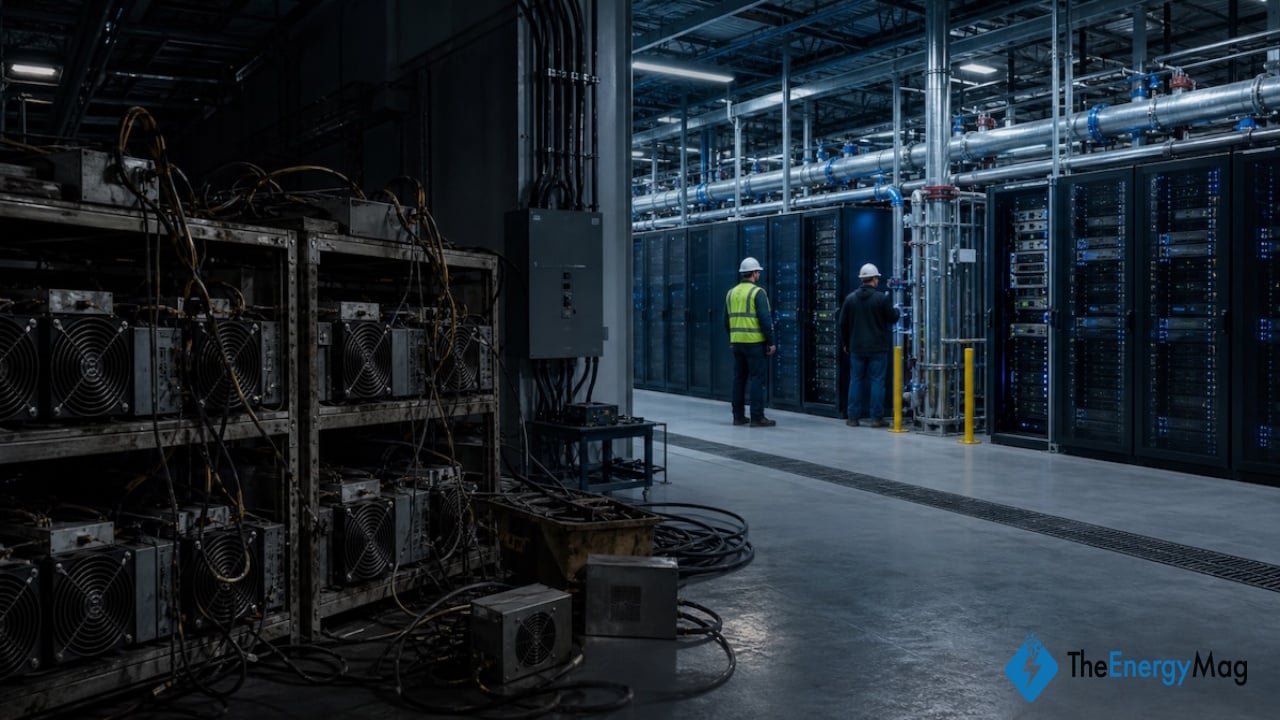
Core Scientific is aggressively executing a strategic pivot from its traditional Bitcoin self-mining operations towards high-performance computing (HPC) and AI colocation services, a move designed to stabilize revenue and tap into the booming demand for AI infrastructure. This transformation is not merely an incremental adjustment; it involves retrofitting existing data centers, which boast 724 megawatts of power capacity across five U.S. states, to host energy-intensive GPU clusters for AI and scientific applications. The company’s Q3 2025 results already show this shift in action, with high-density colocation revenue jumping to $15.0 million, a 45% increase from $10.3 million in Q3 2024, even as total revenue declined.
The cornerstone of this pivot is a massive 12-year contract with AI hyperscaler CoreWeave, valued at over $10 billion in projected revenue. This partnership is expected to deliver 250 MW of billable capacity to CoreWeave by the end of 2025, with anticipated profit margins in the 75% to 80% range for the colocation business. Such a long-term, high-margin agreement offers a stark contrast to the volatile and often compressed margins of Bitcoin mining, where the average cash cost to produce one Bitcoin among publicly listed miners is projected to hit $74,600 in Q4 2025. This contract alone is projected by analysts to potentially push Core Scientific's net profit margin from its current negative territory to 23.0% within three years.
This strategic reorientation aligns perfectly with broader industry trends. The AI boom has created a voracious demand for energy, with Morgan Stanley reporting a potential 20% electricity shortfall in the U.S. by 2028 due to AI data center consumption. Bitcoin miners, with their ready-made power infrastructure and large-scale data centers, are uniquely positioned to meet this demand. By leveraging its existing assets, Core Scientific aims to diversify its revenue streams, mitigate risks associated with cryptocurrency market volatility, and secure a more predictable, higher-margin income profile.
However, the pivot is not without its challenges. While the CoreWeave contract is a significant win, the company's long-term success hinges on expanding its customer base beyond this single major client and demonstrating consistent execution. The transition requires substantial capital expenditure for retrofitting and upgrading infrastructure, and analysts remain divided on revenue visibility and unproven profitability. Despite these hurdles, the shift towards AI/HPC colocation represents a critical evolution for Core Scientific, positioning it to compete in the rapidly expanding high-performance computing market.
What Are Core Scientific's Current Financial Health and Key Challenges?
Core Scientific's financial health presents a complex picture, marked by a strategic pivot aimed at long-term stability but currently navigating significant headwinds. The company reported a total revenue of $81.1 million for Q3 2025, a 15% decline from $95.4 million in Q3 2024. This drop is largely attributed to a decrease in its digital asset self-mining segment, which still constitutes approximately 70.8% of total Q3 2025 revenue, highlighting the ongoing reliance on a business model it is actively trying to de-emphasize. The company continues to grapple with persistent net losses, recording a substantial $146.7 million net loss in Q3 2025, alongside a negative Adjusted EBITDA of $(2.4) million.
Profitability metrics remain concerning, with a TTM Gross Margin of 6.5%, Operating Margin of -52.1%, and a Net Margin of -229.9%. These figures underscore the high fixed costs of operating large-scale data centers and the impact of Bitcoin price volatility and mining difficulty on its traditional revenue streams. The company's P/E ratio stands at -7.17, P/S at 16.05, and EV/EBITDA at -15.58, all reflecting its current unprofitability and the market's forward-looking valuation based on the AI pivot. Core Scientific's EPS for the trailing twelve months (TTM) was -$2.41, further illustrating its struggle to generate positive earnings.
On the balance sheet, Core Scientific carries a substantial debt load, with total long-term notes payable around $1.06 billion as of September 30, 2025. The company's equity is negative, with a stockholders' deficit of ($1.13 billion), which complicates traditional debt-to-equity ratio analysis. However, management has been proactive in addressing this, including a mandatory debt-to-equity conversion in July 2024 that exchanged $260 million of convertible debt for approximately 45 million shares. Additionally, the company raised $625 million through a 0% interest convertible note and executed earlier offerings of $550 million and $400 million in convertible senior notes in late and mid-2024, respectively, to fund its HPC/AI pivot.
Despite these challenges, Core Scientific maintains a strong liquidity position, reporting $694.8 million in total liquidity as of Q3 2025, including $453.4 million in cash. This provides a crucial runway for executing its strategic transition. However, the success of this pivot hinges on demonstrating tangible improvements in revenue and profitability from its high-density colocation services, moving beyond the current reliance on self-mining and overcoming the significant financial hurdles that have plagued its operations.
What Do Broader Bitcoin Mining Trends Signal for Core Scientific?
The broader Bitcoin mining landscape is undergoing a profound transformation, driven by efficiency competition, power cost dynamics, and a sector-wide pivot towards AI/HPC, all of which have significant implications for Core Scientific. The April 2024 halving event, coupled with Bitcoin reaching an all-time high of $126,000 in October 2025 before a hash price plummet in December, intensified economic pressures on miners. This volatility, alongside surging network hashrate and record-high difficulty levels, has made pure-play Bitcoin mining increasingly challenging, pushing companies to seek more stable revenue streams.
One of the most critical trends is the accelerating retirement of legacy mining equipment. The harsh reality is that older machines are economically unsustainable unless electricity costs are below 3 cents per kilowatt-hour. This forces miners to continuously upgrade their ASIC fleets, incurring substantial capital expenditures, or face being squeezed out. For Core Scientific, which operates a dual-segment model of self-mining and hosting, maintaining a competitive and efficient mining fleet is paramount, even as it shifts focus. The U.S. market offers some relief, with 2026 tax laws allowing full depreciation of mining equipment, improving post-tax cash flows from hardware investments.
The AI/HPC pivot wave is perhaps the most defining trend. The insatiable demand for energy from AI data centers has created a unique opportunity for Bitcoin miners, who possess ready-made infrastructure and power contracts. Companies are increasingly gutting existing air-cooled data halls to install liquid-cooled GPU clusters, a clear sign of the industry's strategic reallocation of power capacity. Core Scientific's $10 billion CoreWeave contract is a prime example of this trend, positioning it at the forefront of this shift. This diversification is not just about revenue; it's about stabilizing cash flows and escaping the compressed margins of pure Bitcoin mining, which has become a necessity rather than an option.
Furthermore, the financialization of Bitcoin mining is gaining traction. Hashrate, mining equipment, and facilities are evolving from mere production tools into tradable, financeable assets. This mirrors the traditional mining industry, where future output is hedged and revenues securitized. For Core Scientific, this could mean new avenues for capital raising and risk management, potentially leveraging its extensive infrastructure as a financial asset. These overarching trends suggest that while Bitcoin mining remains a core component, the future success of companies like Core Scientific lies in their ability to adapt, diversify, and integrate into the broader digital infrastructure ecosystem.
What is the Current Analyst Sentiment and Valuation Outlook for CORZ?
Analyst sentiment for Core Scientific (CORZ) is largely positive, reflecting optimism about its strategic pivot to AI/HPC colocation, despite the company's current financial challenges. Based on short-term price targets from 17 analysts, the average price target for CORZ stands at $26.56, representing a significant 53.53% upside from its current price of $17.30. Forecasts range from a low of $17.00 to a high of $40.00, indicating a wide divergence in expectations but a clear bullish lean. The average brokerage recommendation (ABR) is 1.35 on a scale of 1 to 5 (Strong Buy to Strong Sell), with 50% of analysts recommending a Strong Buy and 38% a Buy, while only 13% suggest holding.
This positive outlook is largely driven by the potential of Core Scientific's high-performance computing (HPC) contracts, particularly the substantial $10 billion, 12-year agreement with CoreWeave. Analysts like Keefe Bruyette have raised their price target to $25 from $19 with an Outperform rating, noting that the company is executing a full pivot from Bitcoin mining to HPC leasing. They see an attractive setup ahead of expected pipeline updates and new deals, suggesting that the market is increasingly valuing CORZ based on its future AI infrastructure potential rather than its traditional crypto mining operations. BTIG analyst Gregory Lewis also upgraded CORZ to Buy with a $23 price target, expecting the company to secure additional HPC colocation contracts in 2026.
However, the valuation picture is not without its complexities. While the stock has seen a 39.1% rise over the past year, its TTM P/S ratio of 16.05 is quite high for a company with declining revenue and persistent net losses. The market capitalization of $5.36 billion reflects significant future growth expectations, but the company's negative TTM P/E ratio of -7.17 and negative Book Value per share of -$3.54 highlight the current lack of profitability. This suggests that the stock's current valuation is heavily reliant on the successful execution of its strategic pivot and the realization of projected high-margin colocation revenues.
The mixed institutional interest, with Paloma Partners reducing its stake while others like Oaktree, Oasis Management, and Helix Partners have increased theirs, further complicates the valuation narrative. Oaktree added 1.95 million shares, and Oasis Management acquired 2.64 million shares worth $38.49 million, signaling belief in the AI/HPC transition. This divergence indicates that while many institutions see the long-term potential, some remain cautious about the execution risks and the inherent volatility of the underlying crypto market, which still influences a significant portion of Core Scientific's current revenue.
What Does This Mean for Investors and What Should They Watch?
For investors, Core Scientific (CORZ) represents a high-stakes play on the convergence of digital asset infrastructure and the burgeoning AI/HPC market. The company is in the midst of a critical transformation, attempting to shed the volatility of pure-play Bitcoin mining for the more stable, higher-margin world of AI data center colocation. This strategic pivot, anchored by the substantial CoreWeave contract, offers a compelling narrative for long-term growth, but it comes with significant execution risks and a currently challenged financial profile.
Investors should closely monitor Core Scientific's progress in two key areas: the continued growth and profitability of its high-density colocation segment, and its ability to de-risk its balance sheet. The increase in colocation revenue from $10.3 million to $15.0 million in Q3 2025 is a positive sign, but the company needs to demonstrate consistent expansion beyond its primary CoreWeave client. Furthermore, while the company has taken steps to manage its $1.06 billion debt load and maintains $694.8 million in liquidity, sustained profitability is essential to convert its negative equity into a healthier financial structure.
The divergence in institutional investor sentiment—Paloma Partners reducing its stake while others like Oaktree and Oasis Management are increasing theirs—underscores the speculative nature of CORZ. This stock is not for the faint of heart; its high beta of 6.88 indicates extreme sensitivity to market movements. While the average analyst price target suggests substantial upside, investors must weigh this against the company's current unprofitability and the inherent uncertainties of a major business model shift.
Core Scientific's journey from a Bitcoin miner to an AI infrastructure provider is a compelling story, but its success hinges on flawless execution and favorable market conditions. The company's ability to leverage its existing power infrastructure for high-value computing, expand its customer base, and ultimately achieve consistent profitability will determine whether it can deliver on its ambitious promises. This is a long-term play that demands patience and a keen eye on operational metrics and financial health.
Core Scientific is at a pivotal juncture, offering a high-risk, high-reward proposition in the evolving digital infrastructure landscape. Its successful transition to AI/HPC colocation could unlock significant value, but investors must remain vigilant, focusing on tangible improvements in profitability and disciplined capital management to navigate this complex transformation. The coming quarters will be crucial in determining if Core Scientific can truly deliver on its strategic vision.
Want deeper research on any stock? Try Kavout Pro for AI-powered analysis, smart signals, and more. Already a member? Add credits to run more research.
Related Articles
Category
You may also like


Armada Hoffler's Portfolio Overhaul: What The 2026 Transition Means For Investors

COIN to Buy Clearing Company: Is it Raising Prediction Market Stake?

Chainlink Whales in Sell-off Mode, Here's Impact on LINK Price
Breaking News
View All →Featured Articles
Top Headlines

2 stocks to avoid this week as Iran strikes instensifies

Microsoft Technical Analysis: Top Decile Ranking Vs. Key Resistance

Coherent Stock, Lumentum Soar on Nvidia Deals. Here's What to Know.

Amazon Pledges Nearly $40 Billion to Expand AI Data-Center Infrastructure in Spain