MarketLens
What's Behind Goldman Sachs' Stark Warning to Tech Workers

Key Takeaways
- Goldman Sachs warns laid-off tech workers face longer job searches and potential earnings loss, signaling a structural shift in the labor market driven by AI.
- The tech sector is experiencing a "frontloading" of AI displacement, with specific roles and younger workers disproportionately affected, even as overall tech employment is projected to grow.
- While GDP growth remains resilient, a widening asymmetry exists where capital gains from AI accrue quickly, but labor market deterioration, particularly in the service sector, lags by several quarters.
What's Behind Goldman Sachs' Stark Warning to Tech Workers?
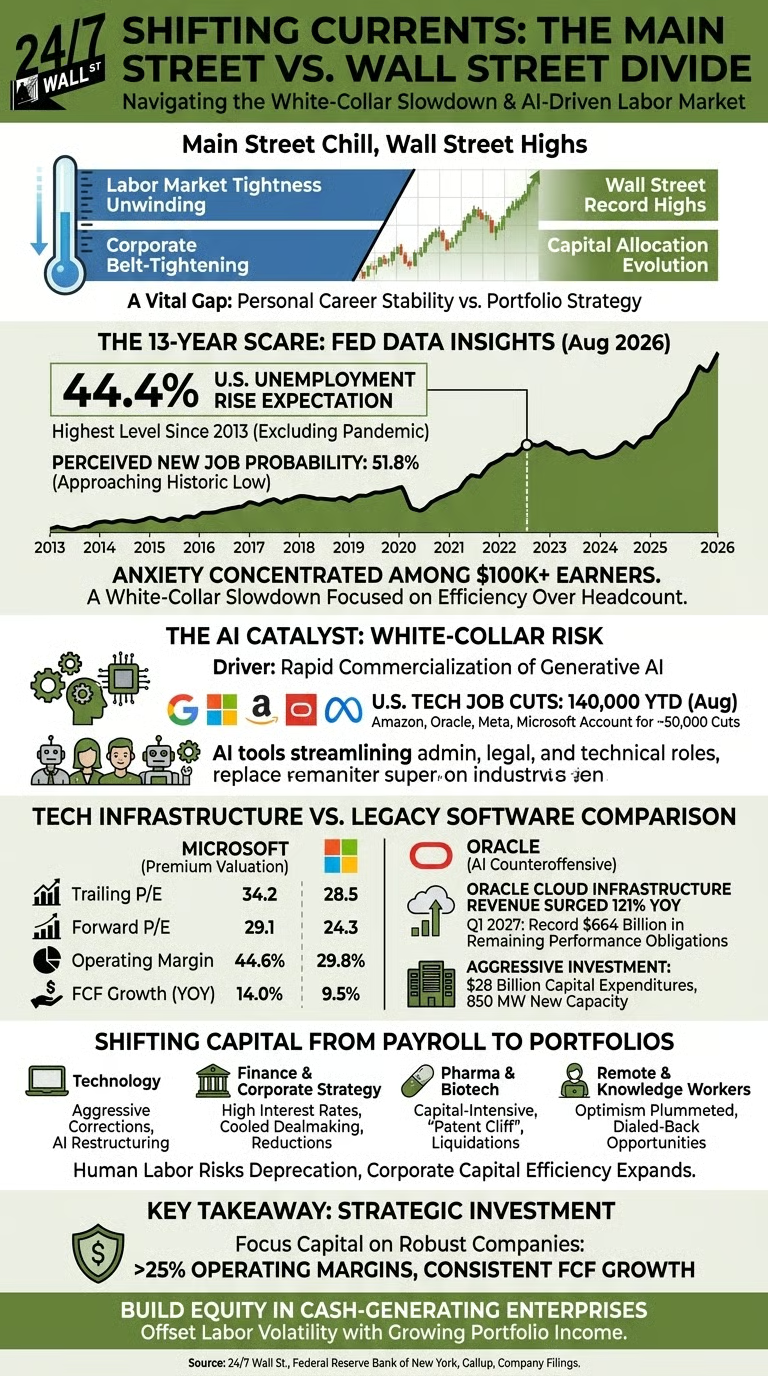
Goldman Sachs recently delivered a blunt message to laid-off tech workers: expect a protracted job search and a likely pay cut in your next role. This isn't just a casual observation; it's a significant pronouncement from a major financial institution, signaling a deeper, more structural shift underway in the labor market, particularly within the tech sector. The firm's analysis underscores a growing disconnect between robust economic indicators and the lived experience of many professionals.
This warning comes amidst a backdrop of persistent tech layoffs that have stretched longer than many anticipated. Major tech giants, once symbols of unbridled growth, have been shedding thousands of jobs. Companies like Meta, Microsoft, Amazon, and Salesforce have all conducted significant workforce reductions, with many explicitly or implicitly linking these cuts to increased efficiency driven by AI and automation.
The core of Goldman's concern lies in the "frontloading problem" of AI displacement. While long-term projections suggest AI will displace 6-7% of the U.S. workforce over a decade, with only a 0.6 percentage point increase in unemployment, the reality appears to be accelerating. Joseph Briggs, co-lead of Goldman's global economics team, highlighted that if job losses are "more frontloaded, the impacts on the economy are much larger." This accelerated displacement is already evident, particularly among entry-level tech workers.
Unemployment among 20-to-30-year-olds in tech-exposed roles jumped 3 percentage points in a single year during 2025, a rate Goldman economists called "much larger than we've seen in the tech sector more broadly." This demographic is bearing the brunt of early AI adoption, challenging the optimistic long-term view of gradual adaptation. The implication is clear: the transition period for AI integration into the workforce is proving to be far more disruptive in the near term than initially modeled.
Is AI the Primary Driver of Tech Job Displacement, or Just a Convenient Excuse?
The question of whether AI is genuinely driving current tech layoffs or merely serving as a convenient corporate narrative is a complex one, with evidence pointing in both directions. While some companies explicitly attribute job cuts to AI, others might be using "AI efficiency" as a palatable reason for broader restructuring or correcting for past overhiring. This distinction matters significantly for investors trying to gauge the true impact on the labor market and future productivity.
Companies like Meta, for instance, have been remarkably transparent, linking 16,000 job cuts in March 2026 directly to a $600 billion capital expenditure plan for AI infrastructure. Meta's internal AI utilization dashboards reportedly quantify roles where AI adoption exceeds productivity thresholds, effectively identifying redundancies. This level of transparency sets a precedent, allowing competitors to evaluate similar AI-driven workforce optimizations. Block, the payment services company, also reduced its workforce by 50%, from 10,000 to 6,000, explicitly citing AI's capability in automating fraud detection, risk assessment, and customer support.
However, a LinkedIn post by Rob Friday highlighted that while Goldman Sachs' mid-January report showed minimal AI-impacted layoffs, companies like Amazon, Pinterest, and Dow subsequently blamed AI for their cuts. Pinterest, at least, was candid about letting people go to hire more AI talent. The broader sentiment is that "AI efficiency" often sounds better in a press release than "we overhired" or "we're cutting costs." This creates an incentive for companies to spin layoffs as AI-driven, especially since such announcements can often lead to a positive stock reaction.
Goldman Sachs Research itself found no significant statistical correlation between AI exposure and broad economic measures like job growth or unemployment rates to date. Yet, they acknowledge early signs of disruption in specific industries, including marketing consulting, graphic design, office administration, and telephone call centers, where employment growth has fallen below trend due to AI-related efficiency gains. The reality is likely a blend: AI is undoubtedly enabling some displacement, but it's also a convenient narrative for companies undergoing broader strategic shifts in a volatile economic climate.
How Is the Broader Tech Labor Market Responding to These Shifts?
The broader tech labor market is navigating a period of significant recalibration, marked by both contraction in certain areas and projected growth in others. After a modest dip in 2025, with net tech employment in the U.S. falling by 0.3% (roughly 33,600 fewer workers), the sector is expected to expand again in 2026. Projections indicate net tech employment will grow by 1.9%, reaching approximately 9.8 million workers, with tech roles across all industries forecast to grow by 2.2%, adding roughly 128,000 additional tech jobs in a single year.
Despite this projected growth, the market remains tight for many. More than 178,000 tech employees were laid off in 2025, with an estimated 211,000 expected by year-end. Over 600 rounds of tech layoffs occurred in 2025, affecting nearly 600 people per day. The trend continued into 2026, with 45,000 tech jobs cut globally by March, approximately 9,200 (20%) explicitly attributed to AI. This persistent churn creates significant financial uncertainty for tech workers, as high salaries no longer guarantee job security.
The impact is particularly acute for new graduates and entry-level professionals. Recent computer engineering graduates face an unemployment rate of 7.5%, while computer science graduates see 6.1%, significantly higher than the overall U.S. unemployment rate of 3.6%. This demographic is often the "casualty" of AI-driven efficiency, as AI coding tools and automation can replace entry-level iteration work, QA, and content moderation. Roles like junior software engineers, QA testers, and customer support (tier 1) are identified as having 80-95% AI exposure and severe vulnerability.
However, the picture isn't uniformly bleak. Demand is rising for specialized skills in AI, cybersecurity, data, and cloud infrastructure. AI/ML engineers and data engineers are among the most in-demand tech roles, with companies willing to pay more for these critical skills. The market is tightening, but it's also redistributing opportunity, creating new roles for those who can integrate, supervise, deploy, secure, and commercialize AI systems. The challenge for many is acquiring these new, in-demand skills quickly enough to adapt to the evolving landscape.
What Are the Macroeconomic Implications of a Shifting Tech Workforce?
The shifting tech workforce carries significant macroeconomic implications, creating a complex picture where headline GDP growth can mask underlying labor market deterioration. The U.S. economy is projected to post 2.25–2.6% real GDP growth through 2026, primarily driven by massive capital investment in AI infrastructure, estimated at around $660 billion. This includes substantial spending on data center construction, chip purchases, and cloud infrastructure, which creates demand for materials, construction labor, and semiconductor manufacturing. This capital expenditure effectively offsets tech employment losses in macroeconomic aggregates, creating a paradox of "jobless growth."
However, this GDP resilience masks a critical "asymmetric timing problem." Capital captures gains within 2-3 quarters, flowing to corporate profits and shareholder wealth. In contrast, labor absorbs losses on a 2-4 quarter lag. This creates a 6-12 month window where the economy appears robust, but displaced tech workers are still in the severance or job search phase, and unemployment statistics lag reality. The unemployment rate is expected to rise to 4.5–4.8% through 2026, reflecting these tech cuts and broader service-sector weakness.
The most concerning macroeconomic implication is the service sector multiplier effect. For every tech job lost, an estimated 3-5 service jobs are at risk, affecting local economies in areas like restaurants, transportation, childcare, and retail. This multiplier effect cascades through regional economies, with an estimated 40,000 Bay Area tech workers displaced in 2025 potentially affecting 120,000–200,000 workers across all sectors by 2027. This cumulative labor market shock will become visible in regional fiscal stress, airline capacity utilization, and real estate vacancy rates in late 2026 and early 2027.
Goldman Sachs' Chief Economist, Joseph Briggs, explicitly stated that if AI-driven job losses are "pulled forward," it "sets the stage for potential underperformance relative to our forecast, and that may lead the Federal Reserve to cut rates." A Fed rate cut in response to AI-driven job losses would be a powerful macroeconomic signal that the more disruptive "frontloading" scenario is indeed playing out, rather than the gradual 10-year adaptation. This potential monetary policy response highlights the growing recognition of AI's immediate impact on the labor market.
What Does This Mean for Goldman Sachs (GS) and the Financial Sector?
For Goldman Sachs, the institution issuing these warnings, the evolving labor market dynamics present both challenges and opportunities, reflecting broader trends across the financial sector. Goldman Sachs Group, Inc. (NYSE: GS) is currently trading at $866.05, up 0.35% from its previous close, with a robust market capitalization of $257.00 billion. The stock has seen a significant range over the past year, from a low of $439.38 to a high of $984.70, indicating investor confidence in its resilience and strategic positioning.
Goldman Sachs itself is not immune to workforce adjustments, though its approach is evolving. The firm is pivoting away from its traditional large, annual "Strategic Resource Assessment" (SRA) — which historically trimmed up to 5% of its global workforce — towards a series of smaller, rolling, performance-focused layoffs. The first round of these cuts was expected in April 2026, with additional reductions continuing through the summer. This shift gives divisional leaders more control over timing and reflects a broader trend across Wall Street to prioritize efficiency and strategic alignment, often leveraging technology.
The financial sector, much like tech, is increasingly focusing on efficiency and technology adoption, including AI. While Goldman's most recent earnings report for 2025 showed full-year revenue of over $58 billion, up 9% from the prior year, strong revenue no longer automatically translates to workforce expansion. Banks are actively exploring how AI can automate tasks, from risk assessment to customer service, leading to a "limited reduction in roles" as part of their "One Goldman Sachs" strategy. This means that even within financial services, professionals who can leverage AI tools will be more valuable.
The macroeconomic implications of AI-driven job displacement, particularly the potential for a Fed rate cut due to labor market weakness, could significantly impact Goldman Sachs' core businesses. Lower interest rates could affect net interest margins, while broader economic uncertainty might dampen M&A activity or capital markets. However, Goldman's diversified business model, spanning investment banking, asset management, and wealth management, provides some insulation. The firm is also likely to benefit from the massive capital flows into AI infrastructure, advising on deals and financing for the companies driving this technological revolution.
What Should Investors and Tech Professionals Watch For Next?
For investors, the key is to monitor the "frontloading" of AI's impact on employment and its subsequent macroeconomic signals. Watch for the Federal Reserve's rhetoric and any potential rate cuts explicitly linked to AI-driven job losses, as this would confirm a more accelerated displacement scenario. Also, keep an eye on regional economic data, particularly in tech hubs, for signs of the service sector multiplier effect cascading through local economies, which could impact consumer spending and real estate.
Tech professionals, especially those in vulnerable roles, must prioritize upskilling and reskilling. The half-life of technology skills is now as short as 2.5 years, making continuous learning imperative. Focus on acquiring specialized skills in AI integration, cybersecurity, data science, and cloud infrastructure, as these areas continue to see strong demand and higher wages. Building a targeted professional profile with clear proof of current, valuable skills and project impact is crucial for navigating a slower, more selective hiring market.
The current environment is a recalibration, not an annihilation, of opportunity. While automation compresses some job categories, new roles are emerging for those who can complement AI systems. The market is tightening, but the talent shortage for in-demand AI-related skills remains real.
Want deeper research on any stock? Try Kavout Pro for AI-powered analysis, smart signals, and more. Already a member? Add credits to run more research.
Related Articles
Why is Goldman Sachs so Bullish on Gold
Category
You may also like


Tether Cuts Ex HSBC Gold Traders

Here is What to Know Beyond Why The Goldman Sachs Group, Inc. (GS) is a Trending Stock

Goldman Sachs to drop DEI board standards as Trump's anti-woke campaign spreads across corporate America
Breaking News
View All →Featured Articles
Top Headlines

Intel joins Musk's Terafab project as Tesla, SpaceX, and xAI push to produce their own chips.

Tesla Stock: It's Cheap Again (Rating Upgrade)

Broadcom Surges 6% as AI Deals With Google and Anthropic Supercharge Revenue Visibility

S&P 500 Index: US Stocks Struggle As Trump Deadline Looms And Oil Surges