AAPL - A Congressman Sold in January, Disclosed It in August, and Then Apple Named a New CEO on September 1
Key Takeaways
- Apple (AAPL) stock surged by approximately 2.6-3% on September 1, 2026, marking a significant divergence from a broader market that experienced declines amid macroeconomic pressures.
- While long-term trend indicators for Apple are maximally strong, an array of short-term technical signals points to overbought conditions and potential near-term exhaustion following today's sharp price jump.
- The transition to new CEO John Ternus brings both high expectations, following Tim Cook's era of over 2,200% stock appreciation, and immediate challenges including persistent memory chip shortages, tightening margins, and intensifying competition in the artificial intelligence sector.
The New Era at Apple: A Measured Optimism Amidst Change
Today, September 1, 2026, marks the official conclusion of Tim Cook's remarkable 15-year tenure as Apple's Chief Executive Officer, a period during which the company's shares gained approximately 2,258%, or nearly 2,300% by some accounts, cementing its status as an iconic global brand and expanding its valuation to roughly $4.6 trillion. John Ternus, a 25-year Apple veteran and former Senior Vice President of Hardware Engineering, officially takes the helm, with Cook transitioning to an executive chair board role, remaining within the company's leadership.
The market's immediate reaction to this historic leadership change was notably positive. Apple's stock climbed to $325.13, closing up $8.28, a gain of 2.61%. This rise occurred even as the broader market, including the NASDAQ, experienced a general slide, with market commentators attributing Apple's resilience to its robust balance sheet and strong market position amidst macroeconomic headwinds like U.S.-Iran tension and bond market instability. This divergence underscores Apple's capacity to command investor attention even when larger market sentiment falters.
Against this backdrop of transformative leadership and immediate market strength, an eight-month-old congressional trade provides a useful lens for assessing how much has shifted for Apple. On January 9, 2026, Representative Shri Thanedar (D-MI13) sold Apple shares valued between $100,001 and $250,000, a transaction publicly disclosed on August 14. This trade, routine under STOCK Act disclosures, was a decision made long before today's CEO transition and its disclosure preceded the announcement of Ternus's effective start date. While other members of Congress have also reported routine Apple trades recently – including purchases by Rep. Ed Case and sales by Rep. Rich McCormick – Thanedar's sale serves as a chronological marker, highlighting the dynamic environment surrounding Apple that a forward-looking investor must consider.
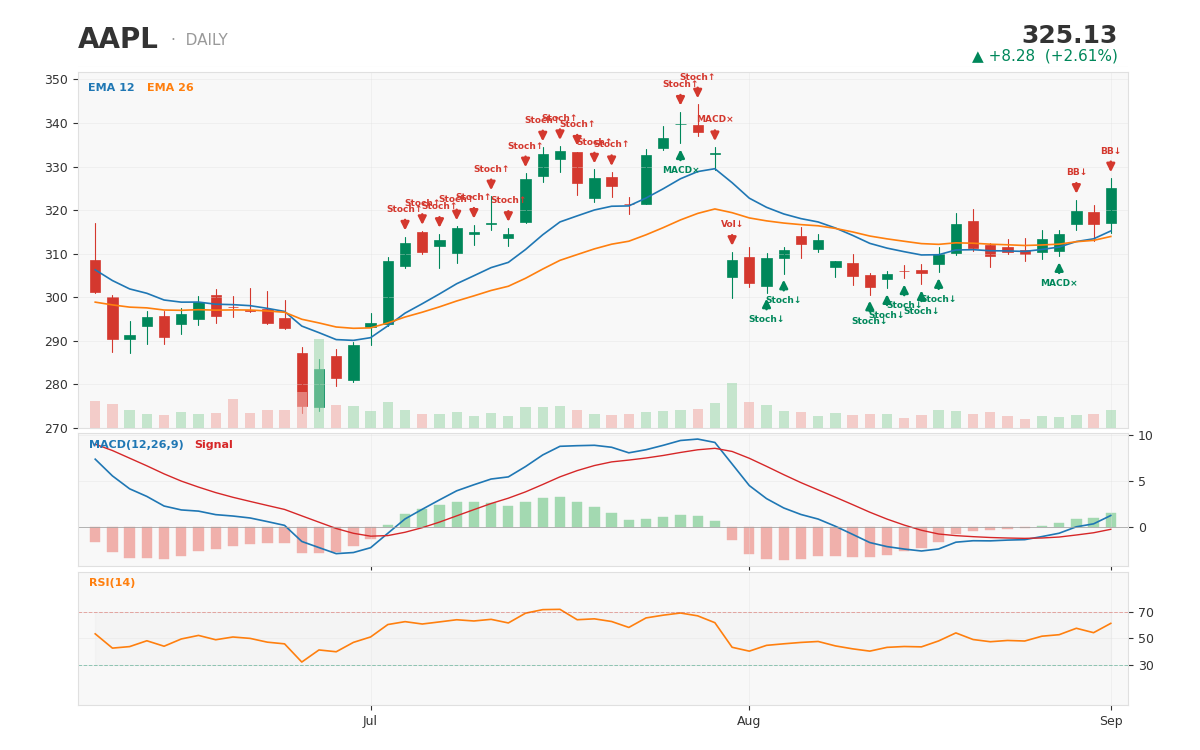 AAPL 1-year daily chart with technical signals -- captured on the day Apple completed a 15-year CEO transition from Tim Cook to John Ternus, with shares rising even as the broader market fell
A Technical Picture Showing Exhaustion Amidst Strength
Apple's current technical landscape presents a compelling dichotomy: indicators reflecting long-term strength are maximal, yet a majority of shorter-term signals are flashing caution, suggesting the stock may be entering overbought territory after today's significant move. An AI-driven composite score stands at 64, while the technical rating and moving average score are both maxed out at 100. These readings underscore Apple's entrenched, multi-year uptrend and the consistent positioning of its price above key moving averages.
However, a closer look at a more granular set of technical flags reveals a counter-narrative. The oscillator score, which measures momentum and overbought/oversold conditions, sits at 62, below the maximal trend scores. A curated set of specific technical signals predominantly indicates bearish or overbought conditions, with three bullish signals (Uptrend, Accumulation/Distribution Uptrend, Price Above Volume-Weighted Average Price) confirming the existing upward trajectory. In contrast, nine bearish or overbought signals point to potential exhaustion:
- PSAR Sell, Supertrend Sell: Indicators suggesting a potential reversal or weakening of the uptrend.
- DMI Bearish Cross, CMO Bearish Cross: Momentum oscillators signaling declining bullish momentum.
- Stoch RSI Overbought: Indicates the stock is in overbought territory, signaling a potential pullback.
- Underperforming Market: Suggests relative weakness against the broader market over some period, despite today's outperformance.
- ATR Expansion Sell, OBV Falling, Volume Spike Sell: Flags often seen at turning points after sharp moves, indicating selling pressure or lack of sustained accumulation.
Overall, a broader scan of 28 technical signals shows 19 registered as 'sell' and 9 as 'buy' readings. This divergence between robust trend scores and numerous bearish short-term flags suggests that while Apple’s long-term trajectory remains strong, its immediate upside may be capped as it digests today's significant gains.
Operational Headwinds and Strategic Imperatives for Ternus
John Ternus, while a seasoned Apple veteran, steps into the CEO role facing immediate and well-documented operational challenges. A critical concern highlighted by analysts is the persistent memory chip shortage, a problem that Tim Cook himself warned would not improve anytime soon. This shortage directly impacts Apple's margins, which are projected to decline to 46.5% in the current quarter. While Apple has responded by adjusting device prices and exploring new memory suppliers, the path to restoring prior margin levels appears challenging in the near term.
Beyond supply chain issues, intensifying competition in artificial intelligence presents a significant strategic imperative for the new CEO. The "brain drain" of talent from Apple to competitors in the AI space is a concern, demanding Ternus prioritize innovation and retention to maintain Apple's competitive edge. The company is also currently embroiled in an ongoing legal dispute with OpenAI, alleging trade-secret theft. This unresolved matter adds another layer of complexity, particularly as the industry races to integrate advanced AI capabilities across hardware and software.
The choice of Ternus, a hardware engineering leader, as CEO also reinforces Apple's foundational business mix, with approximately 72% of its sales remaining tied to hardware. This focus sets the stage for a critical product launch next week, widely anticipated to be Apple's first foldable iPhone, expected to carry a price tag exceeding $2,000. While a successful launch could ignite excitement, it also places immense pressure on Ternus to deliver groundbreaking hardware innovation that justifies premium pricing and sustains growth in a competitive market. Analysts describe this as "the victim of Tim Cook's success," setting a high bar for the new CEO to clear.
Strong Fundamentals and Exceptional Return on Equity
Apple's fundamentals reveal a strong financial position, exhibiting consistent growth and exceptional profitability on a trailing twelve-month (TTM) basis. The company's market capitalization stands at a staggering $4.78 trillion, supported by positive TTM year-over-year revenue growth of 6.4%, net income growth of 19.5%, and EPS growth of 22.7%. Unlike some other companies experiencing sharp divergences between recent quarters and TTM figures, Apple's growth metrics have remained broadly consistent.
Profitability ratios are equally impressive, with a gross margin of 48.7%, operating margin of 33.2%, and net margin of 27.6%. These figures highlight Apple's strong pricing power and efficient operations. Valuation multiples, such as a P/E of 37.12, P/S of 10.23, and P/FCF of 34.94, reflect the market's high regard for Apple's earnings quality and growth prospects, positioning it as a premium-valued technology leader.
One particularly striking figure is Apple's TTM Return on Equity (ROE) of 137.2%. This exceptionally high ROE is not an anomaly but a structural characteristic of Apple's long-term capital allocation strategy. The company has engaged in aggressive and sustained share buyback programs over many years, significantly reducing its equity base (reflected in a modest book value per share of $7.32). This strategy amplifies ROE by decreasing the denominator in the calculation, effectively returning substantial value to shareholders and maintaining a highly efficient capital structure. The debt-to-equity ratio of 0.78 and a current ratio of 1.00 further attest to a well-managed balance sheet despite its aggressive capital returns.
Broad Institutional Endorsement and Analyst Conviction
Apple benefits from an unusually broad and deeply invested institutional base, featuring the largest roster of prominent guru investors among the stocks reviewed in this session. Warren Buffett’s Berkshire Hathaway remains the single largest named guru holder with 227.9 million shares, underscoring significant, long-term conviction. Other notable institutional figures and firms holding Apple include Ken Fisher, Ken Griffin, Jim Simons, Ray Dalio, George Soros, and Paul Tudor Jones II, among many others. This widespread endorsement from some of the most respected names in finance signals confidence in Apple's enduring value and growth trajectory.
Insider trading activity, in contrast, appears routine and non-signal-bearing. Recent disclosures show General Counsel Jennifer Newstead executing three sales of identical share counts (1,439 shares each) at regular biweekly intervals throughout August 2026, totaling approximately $1.33 million. This pattern is characteristic of pre-scheduled divestitures for compensation or portfolio rebalancing rather than discretionary sales driven by new information.
Analyst consensus, drawing from a substantial coverage universe of 112 rated analysts, remains broadly bullish. The median price target stands at $360.00, with a consensus average of $340.72. Both figures imply upside potential ranging from approximately 5% to 11% from today's closing price of $325.13. The overall grade is a "Buy," with 70 analysts recommending a buy, 32 a hold, and only 9 a sell. While Bank of America reiterated a "Buy" rating with an optimistic $380 target, suggesting nearly 20% upside, it is important to note the contrast presented by Rosenblatt. Even on the day of the CEO transition, Rosenblatt maintained a "Neutral" rating, raising its target only modestly from $300 to $303. This nuanced perspective highlights that while optimism is prevalent, not all analysts are uniformly convinced of substantial immediate upside.
Outlook: A New CEO Navigates High Expectations and Mixed Signals
Apple's transition to John Ternus as CEO ushers in a new era for a company that has consistently delivered strong performance under Tim Cook's leadership. The immediate market reaction to this change—a significant stock price increase amidst broader market declines—underscores investor confidence in Apple's enduring strength and its relatively insulated position from market volatility. However, a deeper look at the technical signals reveals a more complex picture, suggesting that while the long-term trend remains powerfully bullish, short-term overbought conditions may temper immediate further gains. The new CEO faces a challenging landscape of persistent supply chain issues, margin pressures, and the imperative to innovate aggressively in the rapidly evolving AI space, all while navigating a high bar set by his predecessor.
Given this blend of long-term strength and short-term exhaustion, a cautious approach is warranted.
Entry Zone: A comfortable entry zone for long-term investors would be in the range of $310 to $315, aligning with previous support levels and allowing for some consolidation after today's sharp advance.
12-Month Target: Based on the strong, broad analyst consensus, a 12-month price target of $360.00 appears reasonable, reflecting the company's robust fundamentals and expected continued innovation.
Invalidation Level: A decisive break and sustained trading below the $300 psychological support level would challenge the bullish thesis, warranting a reassessment of the stock's trajectory.
Apple remains a formidable force in the technology sector, but the success of the Ternus era will hinge on its ability to sustain innovation and manage operational challenges against a backdrop of increasing competition and a demanding legacy.
Want deeper research on any stock? Try Kavout Pro for AI-powered analysis, smart signals, and more. Already a member? Add credits to run more research.