Accenture’s AI Safety Deal: A New Infrastructure Layer at 14.8x Earnings

Key Takeaways
- Anthropic selected Accenture as its first embedded AI evaluator, with each company committing at least $1 billion over five years — a partnership that transforms a consulting firm into a geopolitical checkpoint for frontier model safety, with no disclosed revenue today but a potential new industry vertical tomorrow.
- The stock trades at 14.8 times trailing earnings with an 11% free cash flow yield and a 3.5% dividend, a value multiple that suggests the market has not priced in any AI safety premium, yet every technical trend signal remains bearish despite a 52% rebound from June lows.
- Three U.S. congressmen bought Accenture stock in July and August in the same $1,001–$15,000 range, providing a small but unusual signal of political insider confidence, while Guggenheim downgraded the stock just before the partnership announcement, citing no improvement in demand.
Anthropic’s Choice: A Consulting Firm as an AI Safety Gatekeeper
When Anthropic published Dario Amodei’s three-step plan to slow the pace of AI development, the industry took notice. The first step required embedded evaluators — people inside the model developer’s walls who would red-team frontier systems before deployment. The question was who would do it. The answer landed on Accenture, the world’s largest IT consulting firm, and on September 18 the two companies announced a five-year partnership with each side committing at least $1 billion. Accenture employees will embed inside Anthropic to test model safety. The deal is not a traditional consulting contract; it is a safety infrastructure investment. The revenue model for evaluation services is still prospective, but the signal is unmistakable: when a frontier AI lab picks a partner to police its models, AI safety becomes an industrial-scale business.
The market’s initial reaction was muted. Accenture shares fell 4.73% to $181.29 on September 18, the same day Guggenheim downgraded the stock. Then the partnership news broke, and the stock bounced 3.22% to close at $187.13 on September 21. The net verdict over two sessions was roughly flat — a market unsure whether the AI safety role moves the revenue needle anytime soon.
The Bear Case That Hasn’t Changed
Guggenheim’s downgrade on September 18 was blunt: the firm removed its price target and moved to Neutral because channel checks had not identified any corresponding improvement in demand, despite Accenture’s shares rebounding 52% from June lows. The stock had rallied from around $118 to $181 before the downgrade, but the fundamental improvement the market was pricing in had not materialized. The technical signals tell the same story. Every trend indicator the market data tracks is currently bearish:
| Indicator | Status |
|---|---|
| Trend strength (ADX) | Bearish |
| Supertrend | Sell |
| Relative performance | Underperforming market |
| Volume trend (OBV) | Falling |
| Price vs. VWAP | Below VWAP, VWAP falling |
| Bollinger Bands | Midline breakdown |
| Accumulation/distribution | Downtrend |
| Stochastic/RSI | Overbought |
These flags are all red despite the 3.22% bounce on the Anthropic news. The price action says the market sold the stock into the announcement or used it to exit. The ADX reading indicates the downtrend still has strength, and the OBV trend shows distribution — investors are selling into strength, not accumulating. The Guggenheim downgrade, with its evidence of no demand improvement, gives that technical picture a fundamental anchor.
The partnership could change the demand narrative over time — if embedding evaluators becomes a new recurring revenue stream for Accenture. But the data today says the improvement has not shown up yet. The bear case is not invalidated by the Anthropic deal; it is simply qualified by a new long-term opportunity.
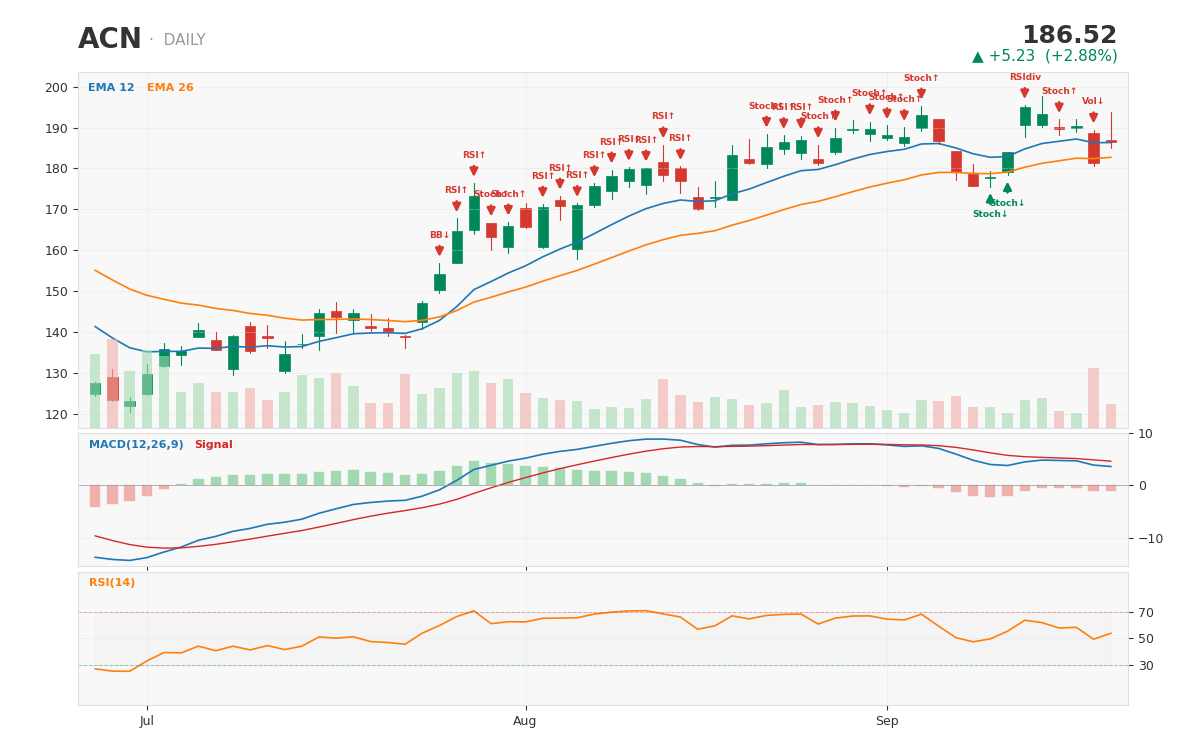 ACN daily chart with technical signals -- captured at $187.13 after Anthropic selected Accenture as its first embedded AI evaluator, with every trend flag still red despite a 3.2% bounce
Value at a Crossroads: Cheap Earnings, Expensive Trend
Accenture’s valuation is striking for a company that just became an AI safety partner. The stock trades at 14.8 times trailing earnings, with an 11% free cash flow yield and a 3.5% dividend yield — a payout ratio of 50%. These are not growth stock multiples; they are the kind of numbers that attract deep value investors. Jeremy Grantham holds 3.9 million shares, Bill Nygren 2.89 million, and Richard Pzena 2.41 million. These are classic bargain hunters, not momentum players.
The stock has rebounded 52% from its 52-week low of $118.15, but it still sits 36% below the $291.09 high. The rebound itself is a double-edged signal: it recovered from a deeply oversold condition, but it did not carry through to new highs, and the technical trend did not flip bullish. The market is pricing the company as if its best days are behind it — a possible structural decline in IT consulting as AI automates services — yet the Anthropic deal positions it as uniquely relevant to the industry’s most urgent problem.
The tension here is that the value case is strong, but the trend is against it. A cheap stock can get cheaper if the fundamental headwinds persist. The Guggenheim downgrade highlights exactly that risk: the demand recovery the market already paid for (via the 52% bounce) has not arrived. The partnership adds a new option on future revenue, but it does not fix the current consulting pipeline.
Three Congressmen, One Bet
Between July and August, three U.S. representatives each bought Accenture stock in the $1,001–$15,000 range. Representative Gilbert Cisneros (CA-31) purchased on July 17, Representative Ro Khanna (CA-17) on August 10, and Representative Scott Franklin (FL-18) on August 26. The purchases are small in dollar terms, but three separate lawmakers buying the same stock within six weeks is unusual. The filings carry no stated rationale, but the timing is notable: all three purchases occurred before the Anthropic partnership announcement and before the Guggenheim downgrade. They bought at prices likely below $180, given the stock’s trajectory from June to August.
This is not a signal of material nonpublic information — the amounts are too small for that. But it is a signal of conviction among a group that has access to policy discussions around AI regulation. Accenture’s role in AI safety aligns directly with the policy agenda these lawmakers work on. Whether they bought for that reason or a broader value thesis, the signal is worth noting. Combined with the guru holdings, it points to informed money taking a position while the technical trends are bearish — the exact opposite of a momentum chase.
Where the Signals Agree and Disagree
The independent lenses on Accenture tell a story that no single lens states alone. The technical signals all agree: the stock is in a downtrend, distribution is ongoing, and the trend strength supports selling. The analyst consensus is split: 34 buy, 18 hold, 1 sell, with a median price target of $194 — just 4% above the current $186.19. The Street is constructive but not enthusiastic. The valuation factors scream cheap: historically low P/E, high FCF yield, and strong cash flow generation. The catalyst — the Anthropic partnership — is a genuine structural change, but its revenue impact is zero until the evaluation services are commercially offered.
The disagreement is between the trend and the value. Where they agree is on the uncertainty: both the bearish trend and the cheap multiple reflect a lack of conviction that the business has turned a corner. The Guggenheim downgrade and the technical red flags both say the recovery is not here yet. The guru holdings and the congressional buying both say the long-term value is compelling. The partnership is the swing factor — it could become the catalyst that reconciles the two sides if it produces a new revenue stream.
The most honest reading is that Accenture is a deep value play on the AI safety infrastructure theme, but it requires time and patience. The market is pricing it as a consulting firm facing headwinds; the partnership introduces a new vertical that does not yet exist on the income statement.
Verdict: Buy on Weakness, Respect the Trends
Stance: long-term bullish on the AI safety infrastructure thesis, but short-term cautious given the bearish technical picture and the Guggenheim warning. The entry zone is near $180–182, the area of the post-Guggenheim low and the level where value buyers have stepped in before. That level lines up with the lower end of the analyst consensus and represents a 3% discount to the current price. The 12-month target is $210, near the upper end of the analyst range and implying a 13% upside, based on a potential re-rating as the partnership begins to contribute to revenue expectations in fiscal 2027. The invalidation level is $180 — a close below that would break the support that held through the downgrade and the partnership announcement, suggesting that the fundamental demand headwinds outweigh the long-term opportunity. A break below $180 would lead to a retest of the $145–150 area, where the stock traded before the 52% rebound. The partnership changes the narrative, but it does not change the current quarter’s consulting pipeline. The data says wait for the trend to catch up to the value, or buy the value and hold through the trend.
Want deeper research on any stock? Try Kavout Pro for AI-powered analysis, smart signals, and more. Already a member? Add credits to run more research.