An Informed Seller Casts a Shadow Over ILMN’s S&P 500 Promotion

Key Takeaways
- Illumina earned its S&P 500 inclusion on a genuine Q2 beat and an AI-biology narrative, but the stock already trades above both the consensus and median analyst price target.
- Director Keith Meister (Corvex founder) sold approximately $288 million in nine consecutive filings over twelve sessions, including three tranches directly in the inclusion-announcement window — the heaviest single-director liquidation this data set has tracked.
- The quant models are internally split: a strong long-term trend (MA score 91) versus a fully overbought short-term oscillator set (score 37) and a bearish curated technical read, setting up a classic digestion phase.
The Core Tension — Inclusion Catalyst Versus Informed Distribution
Illumina earned its S&P 500 promotion the old-fashioned way. The sequencing genomics leader delivered a second-quarter beat-and-raise in July — revenue of $1.16 billion was up 9.5% from the prior year, non-GAAP EPS of $1.31 cleared the $1.23 consensus, and management raised full-year guidance on both the top and bottom lines. The stock climbed into the summer, hitting a 52-week high before the index inclusion announcement on Sept 4.
Then the insider trading data hit the tape. Director Keith Meister — the founder of activist fund Corvex Management — sold an astonishing $288 million worth of stock in nine consecutive filings between Aug 19 and Sept 4. Three of those tranches landed squarely in the window surrounding the S&P 500 news, including sales on Sept 2, 3, and 4.
This is not a garden-variety insider profit-taking calendar. It is a large, deliberate reduction by a director who sits on the board, executed with mechanical consistency into a known positive catalyst. The ratio of buying to selling across all insiders this quarter is the most skewed toward distribution this data set has tracked for any stock: fifty-seven sales against zero purchases, a net sell ratio of 0.04.
The question the data forces is straightforward: if inclusion is such a clear positive, why is the most informed person in the room reducing exposure at this specific speed and scale?
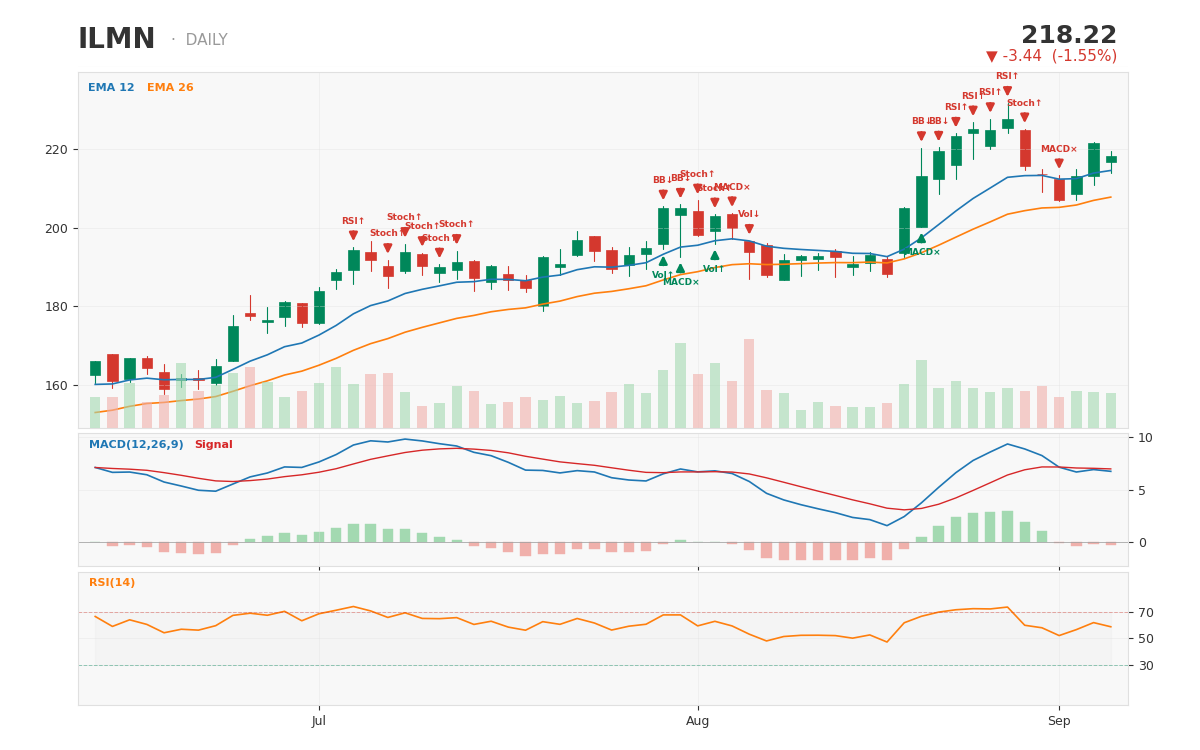 ILMN 1-year daily chart with technical signals -- captured in the S&P 500 inclusion-announcement window, during which director Keith Meister's nine sale filings totaled ~288 million
The Bull Case — Why ILMN Deserves the Index Slot
The conventional read on Illumina is well-supported by the numbers that landed it in the S&P 500. Revenue inflected back to growth, operating margins expanded to 21.1% on a GAAP basis, and the company raised its full-year guidance. The consensus upgrade followed — Zacks moved the stock to a Strong Buy in early August, and the price action accelerated into the 52-week high.
The secondary narrative is what gives the stock its multiple. Traditional sequencing is a replacement-cycle business. The AI biology layer — Illumina's Billion Cell Atlas expansion — repositions the company as the data-owner and systems-of-record provider for a new generation of AI-native drug developers. A recent market commentary described Illumina as "the company that owns the industry's data," and that framing is what justifies a P/E of 40.3 and an EV/EBITDA of 25.3. The stock is not just a sequencing hardware play; it is priced as a toll booth on the AI-driven drug discovery pipeline.
The S&P 500 inclusion on Sept 21, coinciding with the quarterly rebalance, adds a structural demand component. Index funds tracking the benchmark will be forced buyers between now and the effective date. That passive inflow is a known near-term bid that does not depend on any fundamental view.
The Insider Signal — What a $288 Million Sale Actually Means
Meister's selling pattern is unusually specific. Across twelve sessions he filed nine sales, starting at $202 and continuing up through the $218 range where the stock trades today. The tranches are methodical: roughly 95,000 to 299,000 shares per filing, with no attempt to hide the scale of the reduction. The total of approximately 1.32 million shares represents a meaningful fraction of his disclosed holdings.
The timing matters. The first sale came on Aug 19, before the inclusion was public. The last three came on Sept 2 through Sept 4, the exact days of the announcement and the immediate market reaction. Selling of this size into a known catalyst is mechanically distinct from selling that happens before or after an event in isolation. It suggests a predetermined plan executed with full awareness of the timeline.
Meister is not a passive director. He founded Corvex Management, an activist fund with a long track record of identifying operational improvements and pushing for change. When an activist-grounded director sells at this scale, the default reading is not that he needs cash. It is that he sees the current valuation as fully reflecting the visible upside, and that the risk-reward from here is less attractive than whoever is buying on the other side of his trades.
The absence of any insider purchases in the same period reinforces the message. Zero buys against fifty-seven sells is a signal set that the standard fundamental bull case has to work hard to explain away.
The Quant Disagreement — Strong Trend, Exhausted Momentum
The AI-powered composite score for Illumina is 62 out of 100, a moderately positive reading that does not capture the full tension inside the model. The moving average convergence score sits at 91, reflecting a powerful long-term uptrend that has held for months. The oscillator composite, however, is at 37 — a reading that flags short-term momentum exhaustion.
The curated technical signals are uniformly negative: the stock is flashing a bearish Ichimoku setup, a supertrend sell signal, an overbought stochastic RSI reading, and declining on-balance volume. Price closed at $218.22 on Sept 4, below the volume-weighted average price for the session, and the session itself was a -1.55% decline on higher relative volume — a distribution day in a stock that just received a major positive announcement.
This internal divergence — a strong trend frame with exhausted momentum — is the classic quant fingerprint of a stock that has pulled forward its returns into a widely-telegraphed catalyst. The trend will eventually resolve either by digesting sideways or correcting; the data favors the former, but the risk of the latter is real.
The AI composite score of 62 sits well below the peak readings typically seen in high-conviction quant longs. It is a tepid endorsement at a time when the conventional narrative is most enthusiastic. That gap between the narrative and the model is where the interesting analysis lives.
The Consensus Trap — Above the Target, Below the Confidence
Analyst consensus on Illumina sits at $204.50 per share, with a median target of $212.50. The current price of $218.22 is above both. That matters because it means the stock has already done what the sell-side expected it to do before the inclusion announcement added a new variable.
The distribution of ratings is also worth reading carefully. Twenty-five analysts rate the stock a buy, eighteen hold it at neutral, and six rate it a sell. A six-sell minority is a real fringe for an S&P 500 constituent — it confirms that the skeptics have a seat at the table, even if they are outvoted.
The fundamentals support the bull case on an operational level but do not obviously justify a further multiple expansion from here. Gross margins of 66.8% and a return on equity of 31.1% are excellent, but revenue growth for the trailing fiscal year was still slightly negative before the Q2 inflection. The EPS growth of 170.9% is largely a recovery from a depressed base, not a steady-state growth rate. The company is healthy, but the easy comps are behind it.
A stock trading above the average analyst target with an insider selling at an extreme rate and a mixed quant read is a stock that needs to deliver immediate earnings upside to justify its price. The next quarterly report will either validate the promotion or create a sharp re-pricing opportunity for the bears.
Synthesis and Verdict — The Informed Money Versus the Passive Bid
Illumina's inclusion in the S&P 500 is a deserved milestone that creates a near-term structural bid. Index funds must buy before Sept 21, and that passive demand provides a floor under the stock through the effective date. The fundamental story — a return to revenue growth, expanding margins, and a credible AI biology narrative — is intact and supports a higher valuation over a multi-year horizon.
The counterweight is unusually specific and unusually heavy. Director Keith Meister sold approximately $288 million into this window, and he did so with a consistency that suggests conviction, not convenience. The technical models confirm that the stock is overbought on short-term measures, with declining volume and an oscillator reading that points to exhaustion rather than acceleration. The analyst community has already been surpassed by the price, leaving limited room for a rating upgrade cycle to drive further gains.
The most coherent read is that the stock consolidates in a range between $195 and $220 through the inclusion date and into the next earnings cycle. The passive buying absorbs the insider selling overhang, but the technical digestion keeps the price from breaking meaningfully higher in the near term. A twelve-month target of $240 is achievable if the AI biology narrative continues to drive multiple expansion and the revenue inflection sustains, but this is not a stock to chase at $218.
The entry zone that makes sense is $190 to $200, a level that aligns with the consensus median target and the pre-rally basing pattern. The invalidation level is a close below $160, which would break the long-term trend structure and suggest the insider selling was a leading indicator of deteriorating fundamentals. The passive money is buying; the informed money is selling. In a genuine two-sider, the size of the insider signal demands at least as much respect as the index promotion.
Want deeper research on any stock? Try Kavout Pro for AI-powered analysis, smart signals, and more. Already a member? Add credits to run more research.