Berkshire After the Gavel: The Handover Was the Non-Event — Abel's Deployment Is the Real Story

Key Takeaways
- Berkshire's signal mix is modestly bullish — composite 54, trend up, volume confirming — but the stock sits 9.9% above its 52-week low near record highs, which is exactly where the market's priced-in verdict lives.
- The handover itself was a non-event: new chairman, same Abel-led operating machine, and a 0.11% drift to a near-record close. The real signal question was never succession — it's whether Abel's Q2 net $19.8B equity deployment marks the start of a multi-year capital-cycle turn.
- At 12.8x trailing earnings, Berkshire is priced as a slow-growth financial hold, not a catalyst stock — so the upside case rests entirely on whether the new CEO's first major capital decision was the signal it looks like.
The Last Chair Was the Easy Call
On September 18, Warren Buffett stepped down as Berkshire Hathaway's chairman after 56 years, becoming chairman emeritus. His son Howard — a director since 1993 — took the chairman's seat with a stated mandate to safeguard the culture, while Greg Abel, CEO for nine months, continues to run the operating company. The stock closed up 0.11% at $509.77, near record highs.
That 0.11% is the entire story in miniature. Since Abel's CEO appointment was announced in May of last year and the market has had sixteen months to process the eventual handover, the actual industrial logic of this company — the one that produces $13B of operating earnings and buys back $4.5B of its own stock in a single quarter — was going to keep working whether the chairman's title went to Howard Buffett, a ceremonial placeholder, or a bronze statue. The market was not wrong to yawn. It was correctly telling you that the gavel itself was never where the value was.
The more interesting signal is what the data actually shows beneath that calm surface. The technical composite sits at 54 — modestly constructive, not euphoric — with an uptrend in place, a bullish moving-average cross, and volume confirming the price action. Yet the same read flags a sell signal from the supertrend indicator, the kind of tension you see when a stock grinds to records on low volatility rather than surging on news. That's the difference between a stock that's going up because it's being bought and a stock that's going up because nobody can be bothered to sell. Berkshire is closer to the second, and that distinction matters for entry timing.
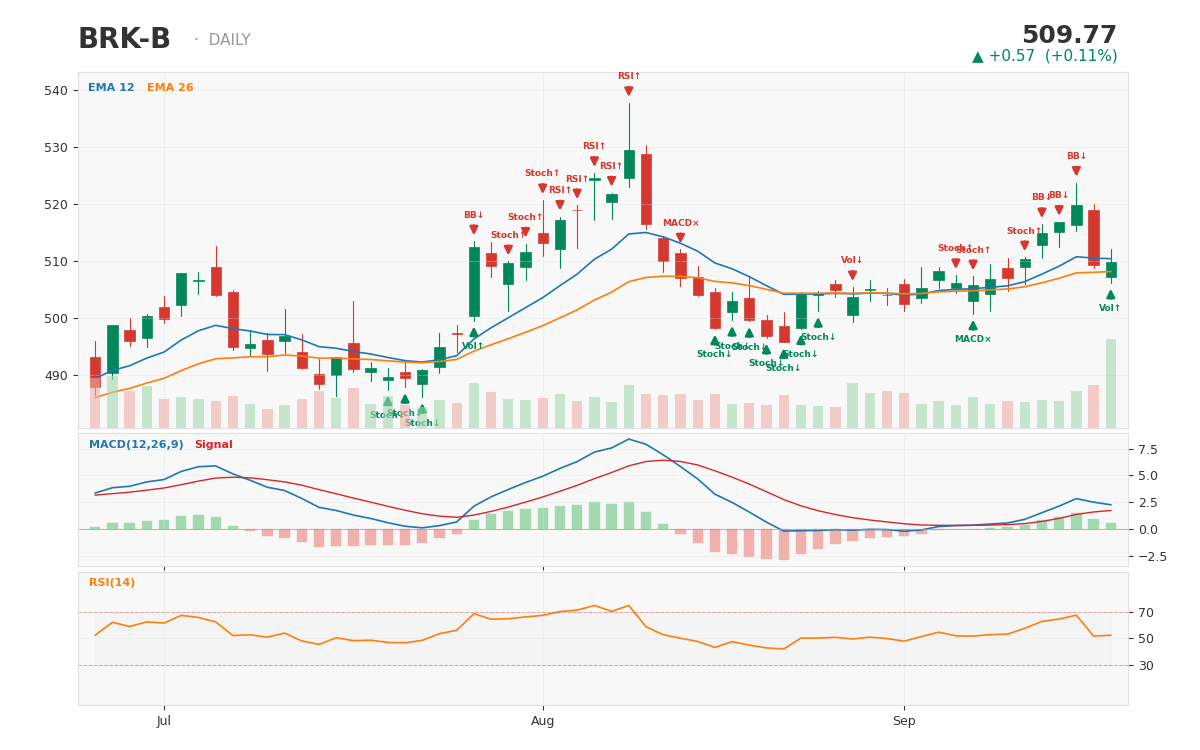 BRK-B 1-year daily chart with technical signals — captured at $509.77 near record highs on the day Warren Buffett formally handed the chairman's role to his son Howard, with Greg Abel's CEO tenure nine months old
The Quarter Abel Just Delivered
The same day the market shrugged at the handover, the Q2 numbers that Abel actually controls were already public: operating earnings of $12.98B, up 16% from $11.16B a year earlier, on revenue that was roughly flat. Net earnings came in around $25.7B, but that figure includes investment gains and therefore swings with the portfolio's marks — a reminder that Berkshire's GAAP net is a portfolio-driven number, not a pure reflection of the operating franchise.
Two details within the quarter matter more than the headline. First, Abel put $4.5B into buybacks — less than prior quarters' pace but still a meaningful signal that management views its own stock as undervalued at these levels. Second, and far more significantly, Abel's Q2 2026 equity deployment was net positive — $19.8B into stocks, per FT — ending a three-plus-year stretch of net selling that had defined the post-peak Buffett era. This is the first major capital-allocation decision of the Abel era in which his judgment diverged from the prior regime's playbook, and it was a decision to deploy, not to hoard.
That's the signal that matters. The record cash pile — roughly $397B at Q1 — has been a double-edged sword for years: a fortress balance sheet that earns nothing and a problem Abel must eventually solve. The shift from net seller to net buyer in Q2 is the first concrete evidence that the answer is neither. It's a turn, and it happened in the same quarter that Abel took over as CEO. That is not a coincidence.
Tension at the Margins: The Super-Trend Sell Signal
The composite tells you the base case — slow, steady, grinding higher. The supertrend sell signal is the loaded footnote to that case.
A composite of 54 with a bullish MACD cross, rising volume confirmation, and price above its VWAP is, on its face, a constructive setup. The supertrend signal cuts the other way. Supertrend is a lagging volatility channel; when price is making near-record highs but the trailing channel that follows price momentum has yet to turn up, it suggests that position is stretched short-term even within a longer uptrend. In plain terms: the trend is up, but the recent path higher has been so slow and steady that the supertrend hasn't yet confirmed what price already did. It's an exhaustion flag, not a reversal signal.
For a trader this is a classic "higher time-frame uptrend, lower time-frame overextension" setup. The stock at $509 is 9.9% above its 52-week low of $464.01 and only 5.2% below its 52-week high of $537.74. That's a narrow range for a stock grinding near its peak — the market's tolerance for bad news is the only real risk, and with Berkshire trading at 12.8x trailing earnings, the earnings beat needed to justify the current price is either already in the numbers or close to it.
The Stewardship Question No Signal Can Measure
The quantitative picture — composite 54, uptrend, buybacks, and a $19.8B net equity purchase — is the easy part. The harder read is what Abel's deployment actually signals about the next decade of capital allocation.
For 56 years, Berkshire's record high was a function of two things: the operating earnings power of its companies and the market's willingness to pay a premium for the optionality of Buffett's capital allocation. The first remains intact; the second is gone. What replaced it is Greg Abel's track record as an operator — and the data that matters is the $19.8B net equity purchase in Q2.
The bull case is that Abel is doing what Buffett did in past crisis periods: deploying cash when the equity risk premium is attractive, buying high-quality businesses at reasonable prices, and letting time work the magic. The bear case is that Q2's deployment was not a signal but a consequence — an attempt to put a $400B cash pile to work before the market punished the company for hoarding it. The two look identical at the moment of purchase; they diverge based on what Abel buys, at what price, and with what discipline.
The market's reaction — a rounding error in a stock near record highs — tells you that the market has not yet decided. That's the opportunity. The question is whether the Q2 deployment was the beginning of a new capital-allocation era or a one-quarter blip.
Gurus, Gates, and the Continuity Play
The institutional ownership data is unusually broad for a company that's still run like a family business. Bill Gates holds 17.05M B-shares — a legacy position from his years on the board, not a fresh vote of confidence in Howard Buffett's chairmanship, but still a substantial stake held through the transition. T. Rowe Price holds 9.82M, Duan Yongping 9.15M, Tom Gayner 1.53M, Diamond Hill 1.27M, Ken Griffin 1.19M, Thomas Russo 1.11M, and Barrow Hanley a smaller position.
That's a lot of independent conviction for a company whose CEO has been in office for nine months. Gurus do not all agree on a thesis by accident. Gates and Yongping are classic Buffett-style value investors; Griffin is a market-maker more likely to trade around the position; Gayner and Russo are long-duration compounders. The fact that all of them hold — and the fact that the street consensus is a Hold with a single $604 target and only 4 of 10 analysts at Buy — suggests the market is treating Berkshire as a good business with an uncertain catalyst, not as a broken one.
Congress has skin in the game, however small: Rep. Maria Elvira Salazar (FL-27) bought $1,001-$15,000 on Aug 7, disclosed Sept 10. That's a rounding error in a $500 stock but a legitimate data point that even paid attention to the handover.
The Standard That Separates This From Every Other $500 Stock
At 12.8x trailing earnings, Berkshire is not expensive — but it's not obviously cheap either. A P/E of 12.8 against a net margin above 22% is a quality financial trading at a fair multiple. The buyback helps: $4.5B in Q2 is enough to matter but not enough to move the needle on its own. The real question — the one that determines whether this is an entry or a trap — is what Abel does with the $400B cash pile next.
Berkshire's comparable — if you can call it one — is not another insurance complex. It's a closed-end fund with a perpetual float, which is why it trades at a premium to book value that most closed-end vehicles would envy. The 1.46x price-to-book at a 12.8x P/E is not just reasonable; it's the kind of multiple that historically has worked for long-horizon owner-operators. The market gives you that optionality for free if Abel executes.
The counter-case is that the record cash pile, the end of the selling streak, and the handover itself were all scheduled at a time when the market was at record highs. Abel bought $19.8B in Q2 at 1.1x book, with the S&P 500 at record highs. The risk isn't that Berkshire is a bad company; it's that the new CEO's first act will look, in retrospect, like the top-tick of a five-year bull market. That's a real concern. The rebuttal is that the same criticism applied to every period when Buffett deployed cash historically — and the market's 0.11% reaction to the handover suggests it is not pricing in a decade of Abel, either way.
Where I Land: A Missed Catalyst, Not a Missed Company
The knee-jerk read of this signal set is that the handover is a news event with no trading consequence, and on the daily timeframe that's roughly right: the stock's +0.11% move on the announcement is evidence that the market absorbed the transition years ago. But the data I'd put in front of a trader is the combination that generalists overlook — the composite at 54 with a bullish trend, a near-record high stock, a fresh $19.8B equities deployment from a CEO nine months in, and a single $604 Street target implying 18% upside.
There's a case that the stock is priced for no new news — and "priced for no new news" at 12.8x earnings has historically been a poor forecast for a company like this.
Position: Long BRK-B (add on any pullback toward the $490 area, roughly the 20-day and the upper end of recent value support; limit risk if the stock closes below $464, the 52-week low).
12-month target: $604, the consensus figure, which at 12.8x trailing earnings implies either a modest de-rating to 12x or a 5%+ earnings beat and 15% price appreciation. Either way, the direction of travel is up, not sideways.
The bet you're making is not that Abel will be a better capital allocator than Buffett. It's that the market — working from a single Hold-rated target and a $1.1 trillion market cap — is still discounting the certainty of the operating machine for the hypothetical of the transition. That's a mispricing I'd own, with a stop that says otherwise.
One-sentence stance: The gavel has passed; the cash machine prints on — and for the first time in a decade, the market's level of indifference to Berkshire's own future is itself the mispricing, because Howard's ceremonial chair or Greg's operating one, the bet on Abel deploying $19.8B a quarter beats the Street's recollection of five Hold ratings and one lonely target.
Want deeper research on any stock? Try Kavout Pro for AI-powered analysis, smart signals, and more. Already a member? Add credits to run more research.