Berkshire’s $212 Million Lennar Bet Faces a Cheap-Stock Test

Key Takeaways
- Berkshire Hathaway bought 2,743,529 Lennar shares for approximately $212.4 million across September 17, 18, and 21, with the largest purchase made at the lowest transaction price.
- Berkshire’s buying conflicts with a weak market backdrop: the technical rating is 25 out of 100, the moving-average score is zero, and the analyst consensus target is below the current price despite a majority of buy ratings.
- LEN looks inexpensive at 0.85 times book value, but the evidence supports a speculative long-term value case—not a confirmed bottom or a reason to chase the disclosure rally.
Berkshire Bought Into Weakness
The important fact is not only the size of Berkshire Hathaway’s Lennar purchase. It is the timing. Berkshire added shares during three sessions in which Lennar was under pressure, then all three transactions appeared in filings on September 21.
The purchases were:
| Trade date | Shares bought | Purchase price | Approximate value |
|---|---|---|---|
| September 17 | 695,014 | $78.98 | $54.9 million |
| September 18 | 1,381,397 | $76.48 | $105.6 million |
| September 21 | 667,118 | $77.74 | $51.9 million |
| Total | 2,743,529 | — | Approximately $212.4 million |
The largest single purchase came on September 18, when Berkshire bought 1,381,397 shares at $76.48. That was also the lowest price among the three transactions. Berkshire therefore committed nearly half of the new capital at the cheapest disclosed price, rather than waiting for the subsequent news-driven rebound.
The initial beneficial-ownership statement identifies Berkshire Hathaway Inc. as a 10-percent owner of Lennar’s Class A shares. That qualification is essential. It does not mean Berkshire owns 10 percent of the entire company. It means the filing places Berkshire at the 10-percent ownership threshold for that share class.
The new purchases also came on top of an approximately $1.2 billion pre-existing Lennar stake. This was not a starter position or a one-day experiment. Berkshire was adding to an established commitment while the stock remained far below its high.
That makes the transaction meaningful, but not conclusive. Berkshire’s buying establishes that a large, patient investor considers Lennar attractive at these prices. It does not establish that the housing slowdown has ended, that the company’s earnings have bottomed, or that the new purchases will be profitable.
The Disclosure Lifted the Stock, but the Trend Is Not Repaired
The disclosure produced a sharp market reaction. The dossier records a September 22 close of $82.65, up 5.85 percent. A later live quote showed LEN at $81.56, up $3.48, or 4.45 percent from the previous close. The difference reflects the timing of the market data, but both figures show that investors initially rewarded the news.
That reaction did not erase the broader decline. The live data places Lennar’s 52-week range at $75.70 to $133.76. At $81.56, the stock remained roughly 39 percent below its high and much closer to the low than to the top of the range.
The recent trading record shows the weakness beneath the headline. LEN closed at $80.76 on September 9, fell to $77.90 on September 10, recovered briefly toward $80, and then closed at $76.43 on September 18. It closed at $78.08 on September 21 before the September 22 rebound.
The technical evidence remains unfavorable. The dossier describes a downtrend, a bearish trend-strength reading, a sell signal from the trend-following measure, weakness relative to the broader market, falling accumulation and distribution, declining on-balance volume, and a stock trading below a falling volume-weighted average price. Those signals do not prove that LEN must fall further, but they do show that the price has not confirmed a reversal.
The one counter-signal is an oversold Williams reading. Oversold is not the same as bullish. It means recent selling may have become stretched and that a rebound is possible. It does not show that the rebound will hold.
That distinction matters after a news-driven jump. The stock can rise sharply because the disclosure changes sentiment while still remaining inside a larger downtrend. Investors treating the announcement as a bottom signal would be making a stronger claim than the data supports.
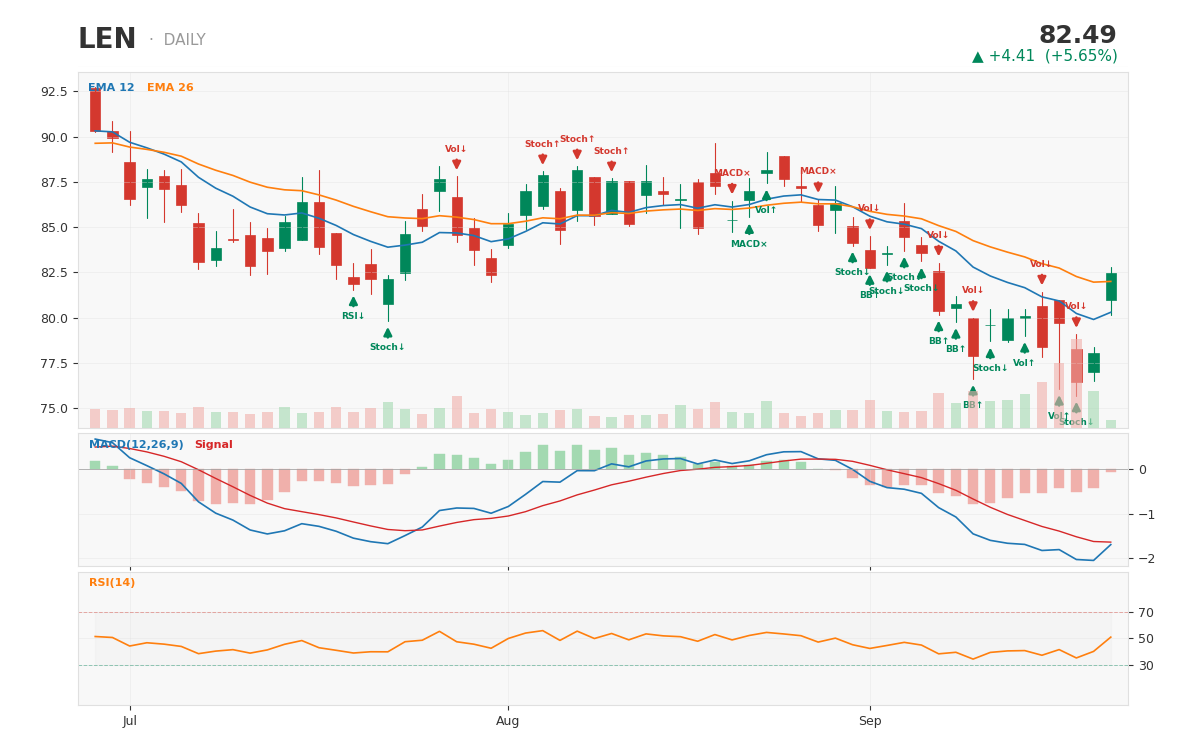 LEN daily chart with technical signals -- captured at $82.65 after a 5.9% jump on Berkshire's $212 million three-day buying burst, with every trend flag still red
Buy Ratings Do Not Match the Price Targets
Analyst sentiment contains a similar contradiction. There are 23 buy ratings, 18 holds, and 9 sells. On the surface, that is a favorable rating mix. But the price-target data is less encouraging: the consensus target is $79.86 and the median target is $75, both below the dossier’s $82.65 close.
The consensus is therefore approximately $2.79 below that close, or about 3 percent lower. The median is approximately $7.65 below it, or about 9 percent lower. The target range runs from $63 to $108, showing substantial disagreement about Lennar’s earnings and housing outlook.
The combination deserves more attention than the rating label alone. A buy rating can reflect a view that a cyclical stock will ultimately recover, even when the analyst’s stated target does not imply near-term upside from the current price. In LEN’s case, the majority of ratings are positive while the central price targets remain below the market.
That is not a direct criticism of the analysts, and it is not proof that Berkshire is wrong. It does show that the market’s stated expectations are unsettled. Investors are being asked to distinguish between a long-term valuation opinion and a near-term price forecast.
Berkshire’s purchases also should not be treated as a target price. The disclosed transactions occurred between $76.48 and $78.98. They show where Berkshire added this week, not the value it assigns to the full company or the price at which it expects to sell.
The practical conclusion is unfavorable for a short-term chase. The stock has already moved above the consensus and median targets supplied in the dossier, while the technical evidence remains weak. A buyer at the current price needs a stronger thesis than simply following the filing.
Cheap Valuation Does Not Remove Housing Risk
LEN has a credible value argument. The shares trade at 0.85 times book value, 14.6 times earnings, and 0.60 times sales. The dividend yield is 2.59 percent. A price-to-book ratio below one means the market price is below the company’s reported accounting book value, which helps explain why a value-oriented investor might be willing to buy during a selloff.
But below-book valuation is not a guaranteed floor. The market can assign a discount to book value when it expects the assets to produce weak returns or when it questions the earnings that those assets can generate. Cheapness is useful only if the underlying business can defend its capital base.
Lennar’s reported return on equity was 6.0 percent. That is an important qualification to the value case. The stock is inexpensive on several standard ratios, but the company is not currently producing a level of return that forces investors to pay a premium for the equity.
The balance sheet provides context rather than a complete answer. Cash was $1.15 billion against $4.30 billion of total debt. Those figures do not by themselves establish financial distress, but they show why the investment case cannot rest solely on a low price-to-book ratio.
The valuation signals are most persuasive if earnings stabilize. They are less persuasive if the reported book value is paired with declining profitability for an extended period. Berkshire appears willing to underwrite that possibility. Retail investors should not assume they have the same tolerance for a prolonged cycle.
Operating Weakness Is the Bear Case
The bear case is not merely technical. Third-quarter revenue was $8.05 billion, earnings per share fell 48 percent year over year, and delivery guidance was cut. Those facts explain why Lennar can look cheap while continuing to trade weakly.
The market may be discounting a deterioration in earnings rather than overlooking an obvious bargain. A lower P/E ratio is not automatically attractive when the earnings denominator is under pressure. Similarly, a price below book value can remain below book if returns stay low or if investors expect the operating environment to weaken further.
This is the strongest counterargument to Berkshire’s purchase. Berkshire may be identifying a temporary housing-cycle discount, but the supplied operating figures do not yet demonstrate that the discount is temporary. They show revenue, earnings, and guidance moving in an unfavorable direction.
That does not make the value thesis invalid. It changes what would be required to validate it. Lennar would need to stop worsening on the operating measures that caused the discount in the first place. A lower share price alone would not provide that confirmation.
The evidence therefore points to two different time frames. Berkshire is acting as a long-term owner that can add during weakness. The current price and earnings data still describe a company whose near-term results are under pressure. Those positions can both be rational, but they are not the same trade.
Volume Does Not Confirm the Rebound
The volume record reinforces the need for caution. Trading volume rose to 6.16 million shares on September 16, 8.65 million on September 17, and 11.85 million on September 18, while the stock moved through a sharp decline. The September 22 session opened at $81 and reached $82.87, with approximately 1.84 million shares recorded by the quoted time.
The rebound was therefore accompanied by less volume than the heaviest sessions of the selloff, at least at the time of the live quote. That does not prove that sellers controlled the rally, and it cannot identify whether the earlier volume represented distribution, forced repositioning, or other trading activity. It does mean that the available data had not yet demonstrated sustained demand.
The technical conclusion should remain modest: price rose on the ownership disclosure, but follow-through was not established. A durable reversal would require the stock to maintain higher prices and improve the volume-based readings that remain bearish.
This is where Berkshire’s transaction prices matter. The purchases at $76.48 and $77.74 provide observable reference points, but they do not automatically create support. Support is confirmed by later trading behavior, not by the reputation of the buyer who purchased there.
The Decision: Speculative Value, Not a Confirmed Buy
The article’s evidence supports a specific conclusion. LEN is a speculative long-term accumulation candidate for an investor who accepts housing-cycle risk, but it is not a confirmed technical buy after the Berkshire disclosure.
The bullish case has substance. Berkshire added 2.74 million shares for approximately $212.4 million, increased an already substantial position, bought the most shares at the lowest disclosed price, and did so while Lennar traded below book value. The rating count also leans positive.
The bearish case is more immediate. Earnings per share fell 48 percent year over year, delivery guidance was cut, the technical rating is 25 out of 100, the moving-average score is zero, and both the consensus and median analyst targets are below the dossier’s close. The share price remains roughly 39 percent below its 52-week high.
For a retail investor, that balance argues against buying solely because Berkshire bought. Berkshire’s action is evidence of conviction, not evidence of timing. It may be early, and the stock may revisit the disclosed purchase prices or fall below them.
The relevant test is whether the operating deterioration stops and whether the price can hold the area where Berkshire accumulated shares. If both occur, the below-book valuation becomes more credible as a recovery opportunity. If neither occurs, the purchase may prove to be an example of averaging down before the cycle turned.
Wait for Confirmation Rather Than Chase the Filing
The final stance is to avoid chasing LEN at the post-disclosure price. The stock is worth monitoring as a long-term, speculative value idea, but the evidence does not justify treating the filing as a confirmed bottom.
The most defensible reference area is the disclosed purchase range of $76.48 to $78.98, alongside the recent low of $75.70. Those are observed transaction and market levels, not guaranteed support. A successful retest would improve the case that Berkshire’s buying coincided with a durable floor. A break below the recent low would weaken that interpretation.
The valuation case also needs an operating confirmation. Stabilizing deliveries, more reliable guidance, and an end to the sharp earnings decline would make the 0.85 price-to-book ratio more meaningful. Continued deterioration would support the alternative explanation: the stock is cheap because investors expect its returns and earnings to remain weak.
That is the level of conviction the evidence supports today. Berkshire has made a large and unusually visible bet on Lennar, but its filing has not settled the disagreement between value and momentum. Until the price and operating data confirm the same direction, LEN is a watchlist accumulation candidate—not a stock to buy simply because Berkshire bought it.
Want deeper research on any stock? Try Kavout Pro for AI-powered analysis, smart signals, and more. Already a member? Add credits to run more research.