D.E. Shaw's Q2 13F Shows a Real AI-Infrastructure Rotation: In to SpaceX, Out of Broadcom
Key Takeaways
- D.E. Shaw's Q2 2026 13F filing, a snapshot from June 30, revealed a new $912.4 million stake in SpaceX (SPCX) — the quant fund's first opportunity to disclose a position following the company's June IPO — alongside a 58.3% reduction in its Broadcom (AVGO) holding.
- This rotation anticipates emerging competitive and financial pressures for Broadcom, including Alphabet's expanded partnership with Marvell Technology, and Broadcom's own subsequent plan to raise $60-100 billion in debt for AI chip financing, neither of which were public at the time of D.E. Shaw's trade.
- SpaceX, while trading at extreme early-stage multiples and lacking a meaningful technical signal history, is increasingly framed by analysts as an emerging AI infrastructure play, anchored by a significant partnership with Nvidia and new government directives for commercial space launches.
D.E. Shaw's Strategic Pivot: A Nuanced Look at Q2 Positioning
The second quarter of 2026 saw D.E. Shaw & Co., a prominent quantitative hedge fund, make a significant shift within the artificial intelligence infrastructure landscape. According to its Form 13F-HR filed on August 14, 2026, for the period ending June 30, the firm established a substantial new position in Space Exploration Technologies Corp. (SPCX), valued at $912.4 million. In the same reporting period, D.E. Shaw concurrently trimmed its stake in Broadcom Inc. (AVGO) by 58.3%. This move suggests a calculated rotation, redirecting capital from an established semiconductor giant to a newly public, high-growth space and infrastructure innovator now increasingly associated with the burgeoning AI ecosystem.
It is crucial to frame this disclosure with an understanding of the 13F reporting lag. The positions reflect D.E. Shaw's holdings as of June 30, 2026, with the filing itself becoming public over six weeks later on August 14. For SpaceX, this is a truly "brand new" position; the company completed its initial public offering only in June 2026, making this D.E. Shaw's first opportunity to report a stake. However, the Broadcom reduction predates a wave of company-specific news that emerged in the subsequent weeks of mid-to-late August, including competitive threats from Google's expanded partnership with Marvell Technology and Broadcom's own massive debt-financing initiatives. Therefore, D.E. Shaw's decision on Broadcom should be understood as having anticipated, rather than reacted to, these later developments.
SpaceX: High-Flying Ambition Meets IPO Volatility
SpaceX, having completed its IPO in June 2026 with a record-setting $75 billion flotation (the size of the public offering), currently commands a market capitalization of $1.79 trillion based on its public float. The company's governance structure, however, is heavily concentrated; Elon Musk retains a 48.4% ownership stake and exercises voting power exceeding 80% through super-voting Class B shares. This arrangement gives public shareholders limited influence over strategic decisions, regardless of the economic ownership spread.
The stock has experienced significant volatility since its public debut. Despite being up approximately 32% since August 1, SpaceX currently trades near its IPO price after substantial swings, well off an earlier high near $200. This volatility was exacerbated by a second lockup expiration event on August 21, 2026, which saw another tranche of 319 million shares held by insiders become available for trading. Concerns about similar lockup events have impacted trading, with some analysts noting that while previous fears proved "overblown," the latest expiration could present a different challenge.
The bull case for SpaceX has recently broadened beyond its traditional space launch and Starlink satellite internet services, embracing an emerging AI infrastructure angle. A reported exclusive partnership with Nvidia aims to build out a 10 GW data center, a project estimated to drive between $120 billion and $230 billion in incremental revenue for Nvidia. Furthermore, regulatory tailwinds arrived on August 21, 2026, when President Trump signed a memo directing federal agencies to target 1,000 commercial rocket launches and re-entries per year by 2030, roughly five times today's pace. Adding to its vertical integration strategy, SpaceX and Tesla are jointly developing a $16.8 billion "Terafab" chip factory to mitigate supply chain risks. Despite this optimism, a concrete bear case exists, with DZ Bank initiating coverage on August 21, 2026, with a Sell rating and a $100 price target, notably below the current market price of $136.97 and the analyst consensus.
Broadcom: Established Leader Navigates Mounting Headwinds
Broadcom, a cornerstone of the semiconductor industry, has recently faced considerable pressure, seeing its stock decline by approximately 24% from its record closing high in early June 2026. A significant factor driving this weakness, which materialized after D.E. Shaw's June 30 reporting date, is Alphabet/Google's expanded partnership with Marvell Technology for custom AI chip development. This move is widely interpreted as a direct competitive challenge to Broadcom's own custom silicon business with Google, one of its largest AI customers. Additional pressures cited include VMware vulnerability disclosures and a Bank of America downgrade, both contributing to the recent selloff.
Adding another layer of complexity, and again subsequent to D.E. Shaw's Q2 positioning, Broadcom is reportedly in talks to raise a substantial $60 billion to $100 billion in debt. This massive financing deal is intended to fund AI chip supplies for companies like Anthropic, an ambition explicitly compared in scale to Nvidia's own ~$500 billion AI infrastructure financing push. This development materially alters Broadcom's financial risk profile, adding a significant leverage component that was not fully apparent during D.E. Shaw's Q2 decision-making window.
Despite these headwinds, bullish analyst commentary persists. BMO Capital initiated coverage with an Outperform rating and a $455 price target on August 21, 2026. Some analysts frame the post-selloff setup as offering 25% upside potential, citing a forward PEG ratio of 0.66x and a projected FY3 price-to-earnings ratio under 14x, suggesting the stock may be undervalued given its AI-driven growth. Broadcom reported Q2 quarterly AI bookings of $30 billion, with management targeting over $100 billion in AI sales by 2027. This conflicting narrative underscores a genuinely two-sided story for Broadcom, where established strengths are now being tested by fresh competitive and financial challenges.
A Stark Contrast in Financial Stages and Valuation
Comparing SpaceX and Broadcom reveals two companies operating at fundamentally different stages of their business lifecycles, making a direct side-by-side valuation a challenge. SpaceX currently trades at valuation multiples that are extreme even for high-growth enterprises, with a price-to-sales ratio exceeding 100x and an enterprise value-to-EBITDA approaching 400x. These figures reflect a relatively young, pre-scale public company still heavily investing in its infrastructure, resulting in negative operating and net margins. However, SpaceX's balance sheet remains robust, evidenced by a strong current ratio of 5.12 and a low debt-to-equity ratio of 0.31, alongside genuine revenue growth of 33.2% year-over-year on a trailing basis. The company has experienced a meaningful deepening of its net loss year-over-year, which is characteristic of its aggressive investment phase.
Broadcom, in contrast, is a mature, highly profitable operator. It boasts impressive margins, including a 67.0% gross margin, 43.7% operating margin, and 38.8% net margin, coupled with a robust 19.5% return on invested capital. The company exhibits substantial growth of its own, with trailing twelve-month net income up 292.3% year-over-year and earnings per share increasing by 287.8% year-over-year. While its valuation multiples are still rich, with a price-to-sales ratio of 23.2x and an EV/EBITDA of 42.8x, they are far more conventional than SpaceX's, reflecting its established market position and consistent profitability. Its debt-to-equity ratio stands at a manageable 0.74, though it is poised for a significant increase given its planned debt issuance.
| Metric | SpaceX (SPCX) | Broadcom (AVGO) |
|---|---|---|
| P/E | -86.5x to -88.9x | 59.5x |
| P/S | 105.1x to 108.1x | 23.2x |
| EV/EBITDA | 411.4x to 416.8x | 42.8x |
| Gross Margin | 52.7% | 67.0% |
| Operating Margin | -12.4% | 43.7% |
| Net Margin | -32.2% | 38.8% |
| Current Ratio | 5.12 | 2.24 |
| Debt/Equity | 0.31 | 0.74 |
| ROIC | -1.2% | 19.5% |
Analyst consensus further highlights these valuation differences. SpaceX's current price of $136.97 implies approximately 51% upside to its median target of $206.96, but the target range is notably wide ($75.00 to $450.00), underscoring significant uncertainty. This wide spread is further evidenced by DZ Bank's recent $100 Sell-rated target. Broadcom, at $368.45, implies around 36.6% upside to its median target of $503.07, with a much tighter and more confident consensus (51 buy ratings against only 8 hold ratings, with no sell ratings), reflecting its maturity and clearer operational profile.
Technicals: Limited Visibility for SpaceX, Conflicting Signals for Broadcom
For SpaceX, the technical picture remains largely undefined due to its recent June 2026 IPO. With only 49 daily trading bars available and standard indicator warm-up periods consuming most of this limited history, a meaningful technical signal analysis is currently not feasible. The available price history, as depicted in the chart below, visually confirms the stock's post-IPO volatility and recent movements following lockup expirations, but without any discernible signal overlays to guide trend or momentum judgments. Investors seeking technical confirmation for SpaceX will need to wait for a more extended trading history to develop.
For Broadcom, the technical signals present a more complex and somewhat contradictory picture. The raw daily signal set exhibits a heavily bullish bias, showing strong short-term momentum with indicators like a confirmed uptrend, a Supertrend buy signal, and a bullish Aroon crossover. The stock also shows signs of outperforming the broader market, with expanding average true range and rising on-balance volume. However, this robust bullish daily signal set is juxtaposed against surprisingly low composite technical scores: a technical rating of 22 and a moving average score of 0. This substantial disconnect suggests that while immediate price action may be positive, longer-horizon moving averages, which often carry greater weight in composite scores, may not yet be confirming the uptrend. This internal inconsistency highlights a genuine tension within Broadcom's technical outlook.
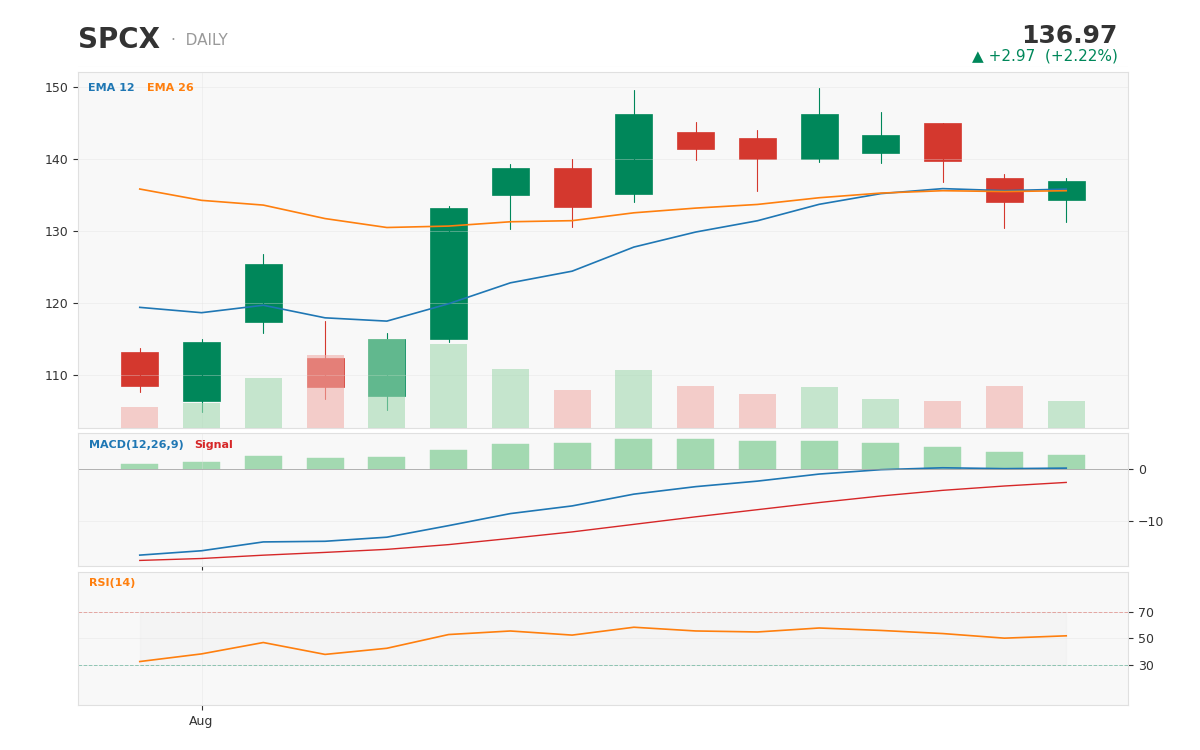 SpaceX price history since its June 2026 IPO -- too little trading history yet for a meaningful technical signal read
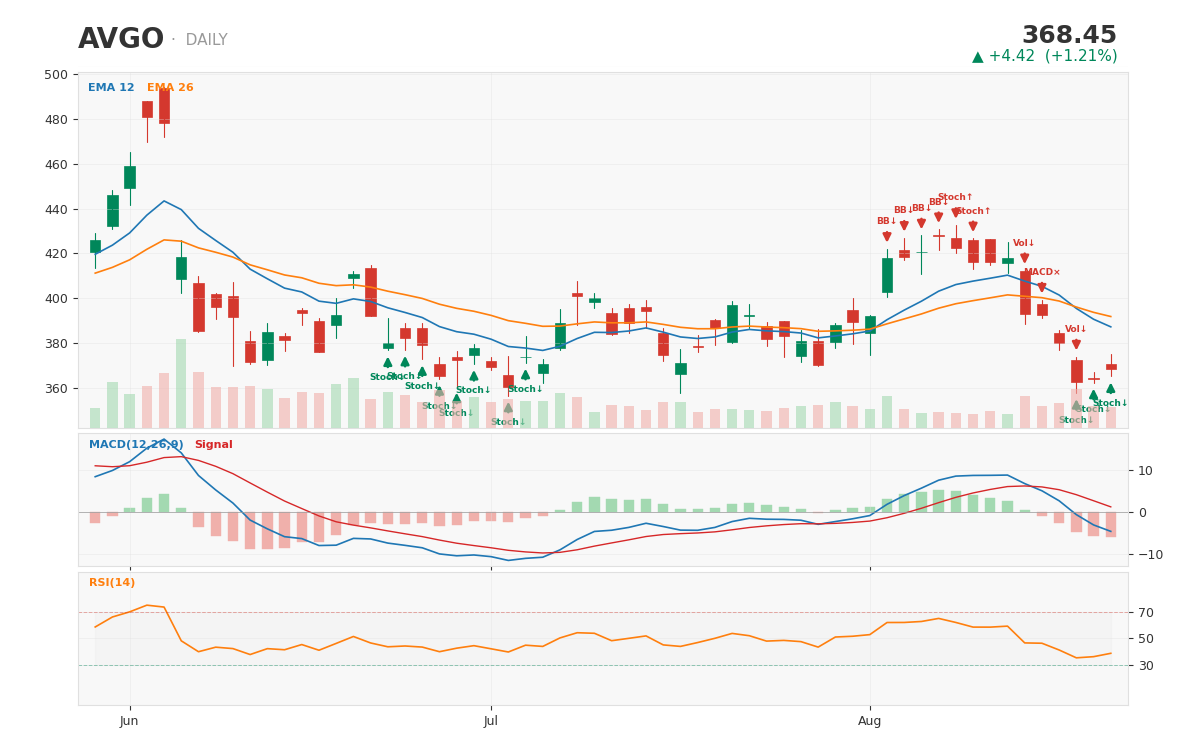 Broadcom 1-year daily chart with technical signals -- a heavily bullish daily signal set (11 buy vs. 9 sell) despite a surprisingly low technical rating and moving-average score
The Smart Money's Shifting Sands
The 13F filing from D.E. Shaw & Co. serves as the primary "smart money" signal for SpaceX, given the current data-coverage gap for other institutional investors. As of August 22, 2026, guru-holdings data returns an empty entry for SPCX, a common artifact for newly public companies until the first full 13F cycle catches up with their disclosures. Similarly, there are no notable insider filings to establish a pattern, and congressional trading shows only a single, small purchase from Rep. Jared Moskowitz, insufficient to indicate broader interest. Thus, D.E. Shaw's new $912.4 million stake stands out as the most significant institutional validation for SpaceX, representing a conviction bet on its future.
For Broadcom, the institutional landscape is far more established and diverse. Despite D.E. Shaw's significant 58.3% reduction, Broadcom continues to attract a broad and diverse roster of prominent guru investors. T. Rowe Price Equity Income holds the largest reported stake, followed by substantial positions from Ken Fisher, Ken Griffin, Philippe Laffont, and many other notable names across various investment styles, including Stanley Druckenmiller, George Soros, and Cathie Wood. This extensive institutional presence suggests that while D.E. Shaw made a specific tactical decision, a wide array of other sophisticated investors maintain significant exposure to Broadcom. There are no recent insider filings for Broadcom, and congressional trading activity remains minimal, with three small buys that do not indicate a material trend. The divergence in D.E. Shaw's actions against the backdrop of Broadcom's otherwise broad guru support underscores the specific, nuanced nature of the quant fund's rotation.
Explore this yourself: See live insider, congress, and guru activity on any stock
The AI-Infrastructure Shift: A Calculated Rebalancing
D.E. Shaw's Q2 2026 13F filing offers a compelling look at how a sophisticated quant fund is navigating the evolving AI infrastructure landscape. Their strategic rotation—establishing a significant new stake in SpaceX while substantially reducing their Broadcom exposure—signals a proactive bet on emergent, high-growth plays even as an established leader faces new, significant headwinds. This is not a simple "SpaceX beats Broadcom" narrative, but rather a calculated pivot reflecting divergent risk-reward profiles and the critical timing of market events. While Broadcom remains a highly profitable giant with strong analyst consensus, the firm now contends with fresh competitive threats and a massive debt issuance that were not fully public at the time of D.E. Shaw's trade. Conversely, SpaceX, despite its extreme valuation multiples and nascent public trading history, is cementing its position as a next-generation AI infrastructure provider through strategic partnerships and a growing ecosystem.
The D.E. Shaw rotation suggests a conviction in the shifting tides of AI infrastructure, favoring new frontiers over established, albeit challenged, incumbents. This move reflects a rebalancing of exposure toward a nascent company with significant growth potential and a direct connection to the expanding AI ecosystem, even as it entails higher volatility and an unproven public market track record. For investors, this highlights the ongoing dynamic of capital allocation within the AI space, where growth opportunities are being sought in innovative, earlier-stage companies alongside existing, but increasingly pressured, market leaders.
Want deeper research on any stock? Try Kavout Pro for AI-powered analysis, smart signals, and more. Already a member? Add credits to run more research.