DKS - Four Directors Bought $3.7M Right After the Worst Day Ever
Key Takeaways
- DICK'S Sporting Goods experienced a record 30.7% one-day stock decline on August 25, 2026, primarily due to profitability concerns linked to its recently acquired Foot Locker segment, while its core business showed healthy comparable sales growth.
- Immediately following the crash, four distinct directors made five separate purchases totaling approximately $3.7 million in DKS stock, signaling strong conviction by insiders at the lower price points.
- The stock has since rebounded by about 8.7% off its crash low, and short-term technical indicators show a robust bounce; however, longer-term moving averages still reflect significant damage, and several oscillators point to overbought conditions in the near term.
A Historic Crash with a Pinpointed Cause
DICK'S Sporting Goods (DKS) endured its steepest single-day decline on record on Tuesday, August 25, 2026, with shares plummeting 30.7% to $124.31. This sharp selloff followed the company's Q2 FY2026 earnings report, which posted adjusted EPS of $3.53, missing the $3.78 consensus, and revenue of $5.59 billion, slightly below expectations. Management subsequently cut its full-year operating-income guidance "by more than two dollars per share," fueling investor concern.
Crucially, the market's reaction stemmed from a specific segment rather than a collapse in DICK'S entire enterprise. The company's core, legacy business demonstrated resilience, achieving 4.9% comparable-sales growth and maintaining a healthy operating margin of approximately 12.6%. The primary drag on profitability and the catalyst for the guidance cut stemmed entirely from the Foot Locker business, which DKS acquired for $2.4 billion. Foot Locker's pro forma comparable sales fell 3.6%, and management explicitly projected a $40-80 million operating-income drag from this segment. This sector faces industry-wide promotional pressures and footwear discounts, compressing margins across the athletic footwear market. The abruptness of this reversal is notable: DKS had raised its Foot Locker outlook just a quarter prior, only to significantly reduce its operating income guidance on the same day it reported the 3.6% comparable sales decline for that segment. A flurry of boilerplate securities fraud investigation notices from law firms followed the stock's plunge, a standard occurrence after large, rapid declines, which does not, in itself, signal confirmed wrongdoing.
Insider Conviction Emerges from the Rubble
In a powerful display of confidence, four separate directors of DICK'S Sporting Goods collectively purchased approximately $3.7 million worth of the company's stock within 48 hours of the record-setting crash. On August 26, Sandeep Mathrani acquired 1,550 shares at $128.89, Robert W. Eddy bought 4,000 shares at $128.69, and William J. Colombo purchased 5,000 shares at $128.72. Colombo followed up with another purchase of 1,100 shares at $129.00 on August 27, the same day Mark J. Barrenechea made a substantial investment of 17,000 shares at $130.72.
These purchases were all executed at prices ranging between $128.69 and $130.72. Considering DKS's closing price of $135.09 on August 28, every one of these insider buys is already showing an unrealized gain, suggesting a timely opportunistic entry. This cluster of buying from four distinct individuals, rather than a single opportunistic buyer, points to a shared belief in the company's underlying value following the sharp selloff. Beyond these direct insider actions, institutional conviction also appears to be present, though it predates the crash: Atreides Management LP, for instance, established a new $85.08 million stake of 375,118 shares in DKS during Q2, as revealed in a 13F filing. This represents a significant, pre-existing institutional position, distinct from the recent director purchases that specifically reacted to the price decline.
Foot Locker Deal: Revenue Growth at a Profitability Cost
The financial impact of the Foot Locker acquisition is clearly visible in DICK'S trailing twelve-month (TTM) growth figures, offering quantifiable corroboration of the qualitative news story. Over the TTM, revenue surged by 28.1% year-over-year. This top-line expansion, however, masks a significant contraction in profitability: net income declined by 27.1%, and earnings per share (EPS) fell by 29.0% over the same period. This indicates that while the acquisition substantially boosted revenue through consolidation, it has been genuinely dilutive to the company's earnings power.
This acquisition-driven dilution is further underscored by the company's leverage profile. DKS currently carries a debt-to-equity ratio of 1.39 and a net debt-to-EBITDA ratio of 4.19x. These figures highlight the real financial commitment DKS undertook to fund the $2.4 billion Foot Locker deal, increasing the stakes for a successful turnaround of the acquired segment. The challenge now lies in integrating Foot Locker effectively and navigating the promotional landscape to restore its profitability without further eroding DKS's overall earnings.
A Bifurcated Valuation Picture: Cheap Earnings, Pricey Free Cash Flow
DKS's valuation multiples pull in two different directions, reflecting the current fundamental tensions within the company.
| Metric | Value |
|---|---|
| Trailing P/E | 14.18x |
| Price/Sales | 0.54x |
| Price/Book | 2.09x |
| EV/EBITDA | 11.05x |
| Price/Free Cash Flow | 48.21x |
| Gross Margin | 32.1% |
| Operating Margin | 6.8% |
| Net Margin | 4.0% |
| Current Ratio | 1.48 |
| Dividend Yield | 3.66% |
| Return on Equity (ROE) | 15.0% |
The trailing price-to-earnings (P/E) ratio stands at 14.18x, which appears relatively cheap, especially compared against the even lower forward P/E of 10.8x for fiscal year 2026, as cited by Seeking Alpha, coupled with a compelling 4% dividend yield. This makes the stock appear attractive on an earnings basis, particularly after the recent decline. However, a significant divergence emerges when examining the price-to-free cash flow (P/FCF) multiple, which sits at a notably rich 48.21x. This stark difference directly correlates with the profitability issues identified earlier: the Foot Locker segment's drag has compressed TTM free cash flow, making the stock appear expensive on this metric despite its seemingly low P/E. Despite these challenges, the company still maintains a strong return on equity (ROE) of 15.0%, indicating its ability to generate profits from shareholders' equity, even with the recent net income decline.
Explore this yourself: See live 13F, guru, and insider flow on Kavout Smart Money
Analysts Maintain a Bullish Skew Amidst Wide Disagreement
The current sell-side analyst consensus for DKS presents a genuinely split picture, rather than a unanimous endorsement, despite a net bullish lean. The median price target is $150.00, with a consensus grade of "Buy," based on 39 buy ratings and 25 hold ratings. No analysts have an outright "Sell" recommendation, and there are no strong sell ratings. The current price of $135.09 implies approximately 15.8% upside to the median target.
However, the wide range of price targets—from a low of $99.00 to a high of $205.00—underscores the significant disagreement among analysts regarding DKS's post-crash prospects. The $99 low target suggests some analysts foresee a deeper decline or prolonged struggle for the Foot Locker segment, sitting close to a real bear-case scenario. Conversely, the $205 high target implies that others view the selloff as an exaggerated reaction, presenting a clear buying opportunity. This broad divergence in projections aligns with 247wallst's observation that the fiscal Q2 report "split its audience into four camps," reflecting the genuine uncertainty surrounding DKS's near-term trajectory and the success of its turnaround efforts for the Foot Locker business.
Short-Term Technical Strength Meets Longer-Term Headwinds
The technical picture for DKS shows a clear V-shaped bounce from its August 25 low, indicating a strong short-term recovery, yet simultaneously reveals deeper, unresolved damage. The stock closed at $135.09 on August 28, representing an approximate 8.7% rebound from its crash-day low of $124.31. This snapback is supported by several bullish short-term signals, including a parabolic SAR buy signal, an established short-term uptrend, outperformance against the broader market, an accumulation/distribution uptrend, and rising On-Balance Volume confirming the price move. A broader scan of technical indicators further corroborates this, with 27 out of 33 signals registering as "buy."
Despite this recent strength, the longer-term technical landscape remains challenging. The moving average score is 0, which reflects that DKS is still trading significantly below its longer-term moving averages after the severe 30%+ single-day drop. This suggests that while the immediate price action has been positive, the stock has not yet recovered from the structural technical damage inflicted by the crash. Furthermore, the sharp snapback has led to stretched short-term conditions, with four simultaneous overbought oscillator flags: Stochastic RSI, Williams %R, CCI, and a Bollinger Band rejection. This combination implies that while the underlying bounce is robust, the stock may be due for a pause or consolidation in the very near term before attempting further sustained gains.
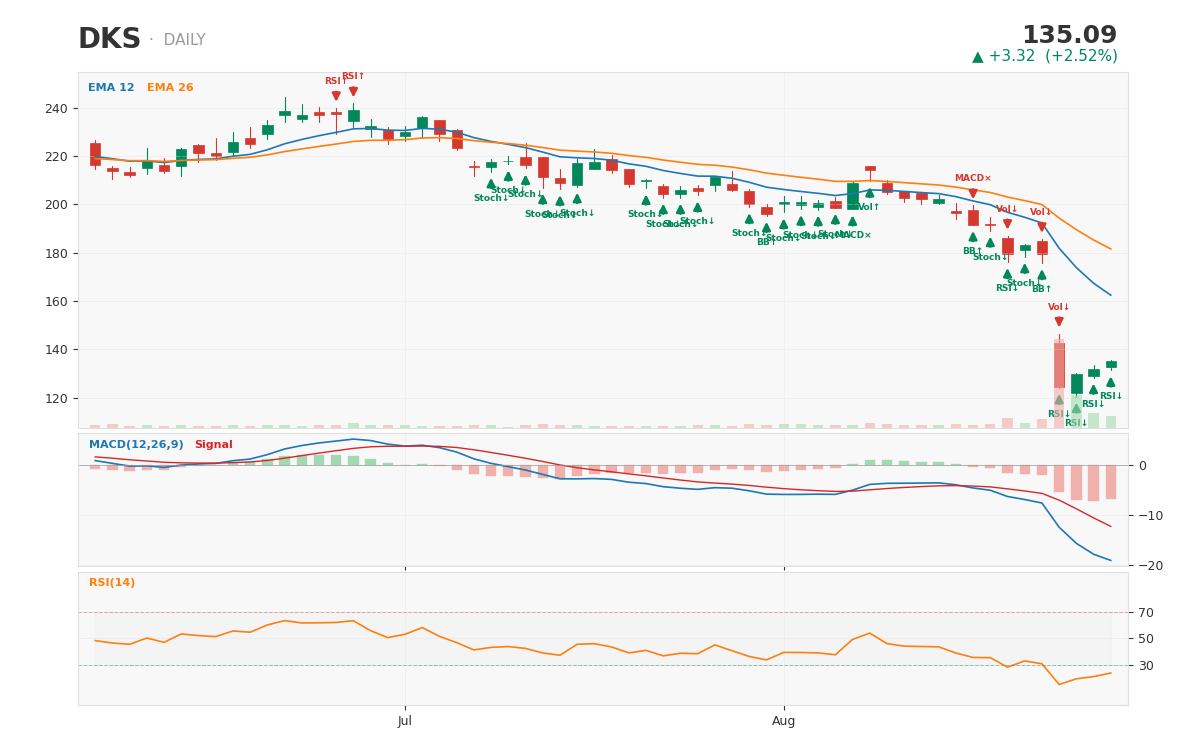 DICK'S Sporting Goods 1-year daily chart with technical signals -- a sharp V-shaped bounce off the record one-day-crash low, with several overbought oscillator flags alongside a still-damaged longer-term moving-average score
A Catalyst-Driven Opportunity with Defined Risk
DKS presents a compelling opportunity following its recent single-segment-driven crash and the subsequent strong insider buying. The core business remains sound, overshadowing the identifiable issues within the Foot Locker acquisition. The market's initial overreaction has been partially corrected by a strong bounce, validated by significant insider conviction.
For investors considering DKS, the insider buying between $128.69 and $130.72 provides a strong conviction signal, representing a significant entry point for those directors. With the stock now trading above those levels, the directors are already showing unrealized gains. This reinforces the idea that the stock was undervalued at those lower prices.
Our 12-month target is set at $160. This represents a conservative view relative to the median analyst target of $150 and acknowledges the current profitability pressures, allowing for some multiple expansion back towards historical averages as the earnings picture stabilizes through a gradual recovery in the Foot Locker segment over the next year.
The invalidation level for this thesis would be a sustained break below $120.40, the 52-week low. A move below this critical technical support, which aligns closely with the crash-day lows and the lower bound of recent trading, would suggest that the Foot Locker issues are more entrenched or that the market is assigning a permanently lower valuation multiple to the entire enterprise, negating the thesis of an overreaction.
Want deeper research on any stock? Try Kavout Pro for AI-powered analysis, smart signals, and more. Already a member? Add credits to run more research.