Eli Lilly at 39x Earnings: Why Weekly Insulin Is Moat Defense, Not a Valuation Driver

Key Takeaways
- Eli Lilly's FDA clearance for once-weekly insulin Onswik solidifies its legacy diabetes franchise but does not generate the exponential volume needed to expand multiples.
- Trading at 39.6x trailing twelve-month earnings with an $1114.8B market capitalization, the equity is priced almost entirely on cardiometabolic dominance rather than basal insulin gains.
- The company's exceptional 83.4% gross margin gives management rare breathing room, yet the narrow spread to median Wall Street targets limits risk-adjusted upside.
On September 24, 2026, the Food and Drug Administration cleared Eli Lilly's once-weekly basal insulin Onswik, marking a technical milestone in daily diabetes maintenance. Yet the capital markets met the milestone with cold arithmetic: the approval defends legacy turf rather than unlocking the rapid acceleration already priced into an elite multiple.
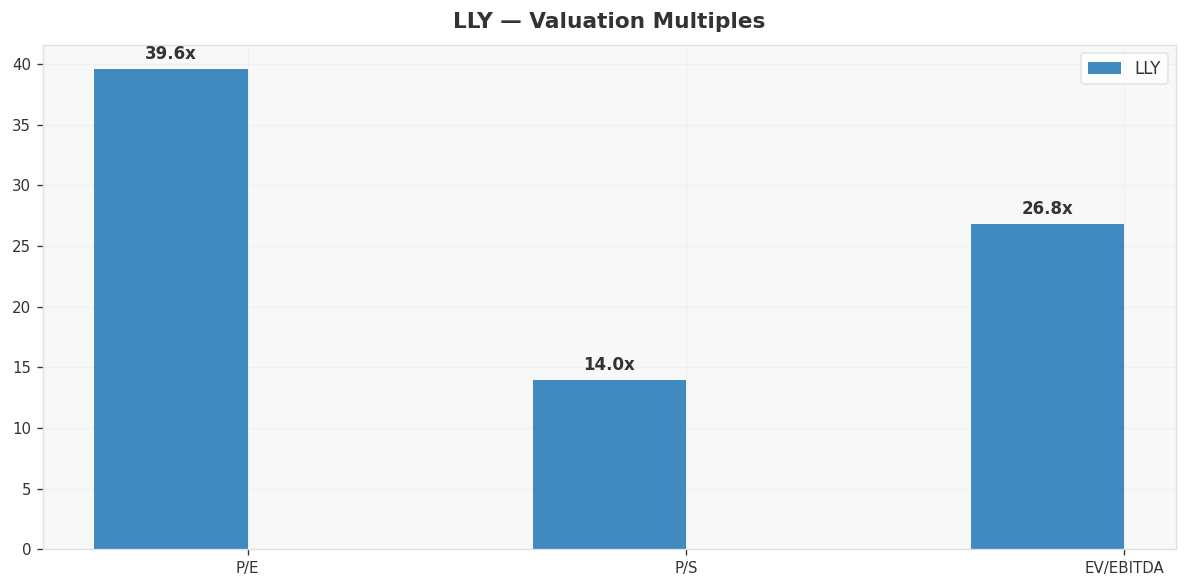
LLY valuation: P/E 39.6x, P/S 14.0x, EV/EBITDA 26.8x.
The multiple compression from peak levels demonstrates that investors now treat regular product expansions as mandatory upkeep rather than catalysts for rerating.
Trading at $1183.72 with an $1114.8B market value, Lilly occupies rare territory as the only pure-play pharmaceutical firm commanding a trillion-dollar valuation. While the equity has gained roughly 60% over the trailing twelve months, it sits below its 52-week peak of $1292.65. The commercial arrival of Onswik gives patients a single weekly injection in place of seven daily doses, but the market is already paying for near-flawless execution across every therapeutic channel.
The Margin Engine and the Earnings Beat
The justification for a Big Pharma stock trading at a tech-like 39.6x trailing earnings rests entirely on operating leverage and cash conversion. On August 5, 2026, Lilly reported quarterly results that silenced skeptics, outperforming Street revenue expectations by more than two billion dollars.
| Metric | Reported Value | Benchmark / Consensus | Variance |
|---|---|---|---|
| Quarterly Revenue | $22.97B | $20.82B | +$2.15B |
| Quarterly Diluted EPS | $8.38 | $6.40 | +$1.98 |
| Gross Margin (TTM) | 83.4% | Sector Avg ~68% | +15.4 pts |
| Net Profit Margin (TTM) | 33.5% | Sector Avg ~15% | +18.5 pts |
| Price-to-Sales (TTM) | 14.0x | Large Pharma ~4.5x | +9.5 pts |
The top-line beat of $22.97B against the $20.82B projection underscores the unprecedented demand for the company's metabolic portfolio. With earnings per share reaching $8.38 against consensus expectations of $6.40, Lilly demonstrated that manufacturing scale is finally catching up with commercial appetite.

Latest quarter: revenue $23.0B, EPS $7.96. YoY revenue growth: +47.7%.
The growing spread between reported earnings and consensus estimates reveals why pullbacks remain shallow, though top-line growth must sustain this cadence to prevent multiple erosion.
What separates Lilly from its global peers is an 83.4% gross margin that rivals software platforms. That pricing power translates down the income statement, yielding a 33.5% net profit margin. Every incremental dollar in metabolic therapies drops directly into operating profit, generating the self-funding cash flow necessary to build manufacturing facilities worldwide without balance-sheet strain.
The Strategic Purpose of Weekly Insulin
Understanding Onswik requires separating medical convenience from economic transformation. Basal insulin is a mature, price-regulated category characterized by mandatory rebate concessions and public scrutiny over access. Turning insulin into a once-weekly injection protects existing patient share against competitors like Novo Nordisk, but it cannot duplicate the explosive uptake of incretin mimetics.
The true commercial value of Onswik is franchise retention. By providing a weekly basal option alongside incretin therapies, Lilly can lock prescribers and payers into a single cardiometabolic ecosystem. Rather than generating fresh multi-billion-dollar profit streams out of thin air, the therapy prevents legacy revenue decay while preserving Lilly's shelf space in primary care networks.

LLY's 85.8% gross margin with a 31.6-point drop to 54.2% at the operating level reflects heavy R&D and SG&A investment typical of an integrated pharma model, yet still signals exceptional pricing power in its incretin franchise. The 23.3-point gap between operating and net margin (30.9%) suggests meaningful below-the-line charges, likely taxes and collaboration costs, worth monitoring. Strategically, these margins support the article's thesis: high profitability lets Lilly defend legacy cardiometabolic revenue cheaply, converting ecosystem lock-in into durable rather than incremental cash flow.
Sustaining a net margin above 33% depends on high-margin biologics absorbing the lower margin realized on regulated maintenance therapies like basal insulin.
The regulatory momentum extended into adjacent categories the day following the insulin nod. On September 25, 2026, the FDA approved Olumiant for pediatric patients twelve and older with severe alopecia areata. Adrienne Brown, executive vice president and president of Lilly Immunology, noted in the company's release that the decision "marks an important milestone for young people living with severe alopecia areata and their families, who have had limited treatment options to date." The immunology pipeline offers diversification away from metabolic concentration, but it remains a secondary pillar compared to the GLP-1 franchise.
Multi-Franchise Capital Allocation and Pipeline Velocity
Lilly is allocating capital at a pace unmatched in modern biopharma history. Because the company generated $22.97B in quarterly sales, operating cash flow has been redirected into aggressive domestic manufacturing expansion and proprietary delivery device development.
Incretin Infrastructure and Supply Dominance
The bottleneck for metabolic therapies has long been fill-finish capacity rather than clinical demand. By deploying billions into sterile manufacturing hubs, Lilly is converting manufacturing capacity into an unassailable economic moat. A competitor cannot seize market share if its pens are backordered, giving Lilly's logistical scale an enduring commercial advantage.
Immunology and Neurodegeneration Ballast
While the market obsesses over metabolic therapies, Lilly's immunology segment and Alzheimer's pipeline provide optionality that standard pharmaceutical models rarely possess. The expansion of Olumiant into pediatric indications proves that label expansion remains a high-return, low-capital strategy. These supplementary franchises generate steady operating income that cushions the corporate bottom line during supply disruptions.
The Bear Case: Multiple Compression and Legislative Ceilings
The primary risk confronting Lilly shareholders is not clinical failure, but multiple fragility. At 39.6x trailing earnings, the stock trades at nearly three times the valuation multiple of traditional pharmaceutical conglomerates. Any deceleration in metabolic volume forces an immediate reckoning between growth-stock pricing and mature industrial reality.
Pricing legislation represents a persistent headwind. Basal insulins face strict regulatory price caps and aggressive pharmacy benefit manager negotiations in the United States. Even with an advanced formulation like Onswik, Lilly operates within an environment where insulin price hikes trigger political blowback. If payers refuse to grant premium reimbursement status to weekly insulin over dirt-cheap daily generics, commercial adoption will crawl.
Finally, supply normalization among competing drugmakers threatens volume velocity. As competitive capacity ramps across the sector, the supply deficit that allowed Lilly to beat quarterly revenue projections by $2.15B will inevitably balance out. When supply meets demand, gross margins of 83.4% face natural friction.
Wall Street Consensus and Price Target Distribution
Sell-side sentiment remains lopsidedly constructive, though price targets imply that the easiest segment of the equity rally has concluded. Out of 45 tracked analysts, 33 maintain Buy recommendations, 9 advocate Hold, and 3 recommend Sell.
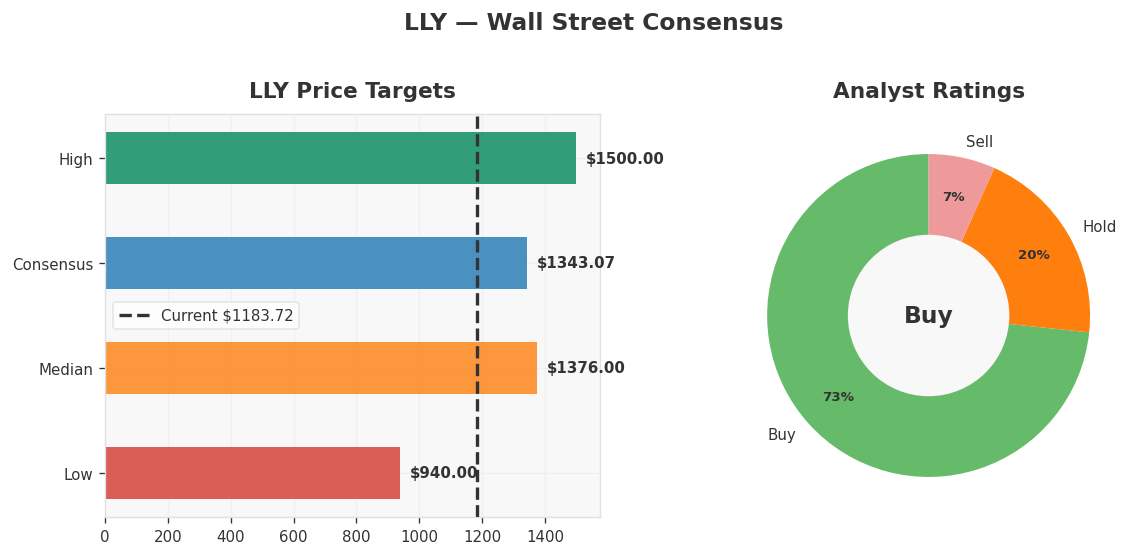
Analyst sentiment on LLY is firmly bullish, with 33 of 45 analysts at Buy, 9 Hold, and none at Strong Buy, implying broad but not unanimous conviction. The consensus target of $1343.07 suggests 13.5% upside from the current $1183.72, while the $940–$1500 range signals meaningful divergence on valuation risk. The absence of Strong Buy ratings alongside zero Strong Sells points to a constructive but cautious street stance.
The convergence of the current share price toward consensus highlights a shrinking margin of safety, leaving little room for quarterly top-line misses.
| Target Metric | Price Level | Implied Return from $1183.72 |
|---|---|---|
| Consensus Target | $1343.07 | +13.5% |
| Median Target | $1376.00 | +16.2% |
| Street High | $1500.00 | +26.7% |
| Street Low | $940.00 | -20.6% |
The median price target of $1376.00 points to roughly 16% upside over the next twelve months. While positive, a mid-teens expected return provides limited insulation against a stock carrying a 14.0x price-to-sales multiple. The Street's high target of $1500.00 relies on flawless international penetration, while the low target of $940.00 reflects the downside if operating margins contract back toward historical healthcare norms.
The Verdict
Eli Lilly remains the premier growth franchise in global healthcare, but investors buying the Onswik approval at current levels are confusing regulatory defense with multiple expansion. Weekly insulin protects a foundational business; it does not justify an expanded terminal multiple for a firm that already commands an $1114.8B market valuation.
Patient investors should wait for tactical pullbacks rather than chasing rallies near psychological milestones:
- Entry Zone: Accumulate between $1020.00 and $1060.00, where trailing earnings multiples drop toward 34x and supply-chain capex is better absorbed.
- 12-Month Target: $1350.00, representing roughly 14% upside, aligned with earnings expansion rather than multiple inflation.
- Invalidation Level: A decisive break below $980.00, which would signal structural pricing erosion across both metabolic and basal insulin channels.
Lilly has engineered the most formidable portfolio in modern medicine, but even exceptional science must submit to the gravity of a 39x multiple.
Want deeper research on any stock? Try Kavout Pro for AI-powered analysis, smart signals, and more.