Eli Lilly Is Suing to Protect a Drug It Hasn't Even Launched Yet

Key Takeaways
- Eli Lilly is aggressively defending its future obesity drug, retatrutide, by filing six new lawsuits against black-market sellers ahead of its planned Q1 2027 FDA approval filing.
- The company reported a blowout second quarter, with revenue soaring 48% year-over-year and non-GAAP EPS significantly beating estimates, propelling its market capitalization above $1 trillion.
- While fundamentals show high profitability and strong growth at a premium valuation, technical signals suggest the stock's recent strong rally may be due for a short-term pause, despite broad institutional conviction.
Lilly's Aggressive Defense of Future Blockbuster Retatrutide
Eli Lilly (LLY) is taking proactive measures to safeguard the intellectual property of retatrutide, its next-generation obesity drug. Despite the drug remaining in late-stage trials and not yet FDA-approved, the company filed six new lawsuits on August 12, 2026, against U.S. pharmacies and peptide vendors for illegally selling black-market versions. This assertive legal action, announced via a company press release, highlights Eli Lilly's commitment to patient safety and protecting the future exclusivity of a drug widely seen as a significant growth driver.
This legal offensive comes as retatrutide progresses toward a Biologics License Application (BLA) submission planned for Q1 2027. Early trial data, including the TRIUMPH-2 and TRIUMPH-3 studies, have shown promising efficacy, leading some analysts to call it a potential "gold standard" in the burgeoning obesity market. Eli Lilly also granted a limited number of patients early access to retatrutide on August 3, 2026, underscoring the drug's anticipated market impact.
It is important to note that this action against illicit sales is separate from an ongoing legal dispute where competitor Novo Nordisk has sued Eli Lilly over weight-loss drug advertising claims. While both companies are intensely vying for leadership in the lucrative obesity market, Lilly's current lawsuits demonstrate a clear intent to protect its market integrity long before retatrutide's anticipated commercial launch. This two-front legal battle signals the immense value the company places on its pipeline, particularly amidst escalating competition with Novo Nordisk.
Record-Breaking Q2 Earnings Power a Trillion-Dollar Valuation
Eli Lilly delivered a blowout second-quarter 2026 earnings report on August 5, 2026, significantly surpassing analyst expectations. The company reported $23.0 billion in revenue, marking a 48% increase year-over-year, primarily fueled by strong volume growth in its diabetes treatment Mounjaro and weight-loss drug Zepbound. Non-GAAP earnings per share (EPS) surged 33% year-over-year to $8.38, far exceeding the consensus estimate of $6.01—one of the largest beats observed across the sector.
Following these strong results, Eli Lilly raised its full-year 2026 revenue guidance to a range of $85 billion to $87 billion. The market reacted swiftly, with shares jumping approximately 7% intraday on the day of the announcement. This performance propelled Eli Lilly's market capitalization above $1 trillion, making it the only pharmaceutical company to achieve this milestone.
Beyond its blockbuster obesity and diabetes franchises, other segments of Eli Lilly's pipeline also showed strength. Jaypirca, a cancer drug, generated $192 million in Q2 sales, up 56.4% year-over-year, despite competitive pressures. Additionally, EBGLYSS achieved 131% year-over-year sales growth, securing a maintenance-label expansion, and Olomorasib, a KRAS G12C inhibitor for advanced pancreatic cancer, received FDA Breakthrough Therapy designation on August 3, 2026. These diversified wins highlight the company's broader pipeline strength, extending beyond its highly anticipated obesity franchise.
High Profitability Drives Premium Valuation
Eli Lilly's financial structure demonstrates strong operational efficiency and market leadership, particularly evident in its consistently high margins and aggressive growth rates. The company reports an 84.0% gross margin, a 43.9% operating margin, and a 33.5% net margin. These figures are genuinely exceptional, reflecting a powerful ability to translate revenue into profit. Its return on equity stands at 92.6%, showcasing highly effective capital deployment without the use of excessive leverage or negative equity.
This level of profitability has fueled significant growth across key metrics. Trailing twelve-month (TTM) revenue climbed 44.7% year-over-year, while net income surged 94.9% year-over-year. EPS also experienced robust growth, rising 96.0% over the past year. Furthermore, the company's free cash flow saw dramatic expansion. These growth figures are not a one-quarter anomaly but are supported by a multi-year trajectory, with cumulative net income growth per share over three years nearing 250%.
However, such strong performance commands a premium valuation. At 39.5 times earnings, 33.0 times EV/EBITDA, and nearly 14 times sales, Eli Lilly is priced for sustained, blockbuster growth. These multiples position the stock as genuinely expensive relative to the broader market, reflecting strong investor confidence in its future pipeline and market leadership. The table below illustrates some of these key valuation and profitability metrics:
| Metric | Value |
|---|---|
| P/E Ratio | 39.5x |
| P/S Ratio | 13.9x |
| P/FCF Ratio | 55.4x |
| EV/EBITDA | 33.0x |
| Gross Margin | 84.0% |
| Operating Margin | 43.9% |
| Net Margin | 33.5% |
| Return on Equity | 92.6% |
Widespread Institutional Conviction Despite Insider Sales
Institutional investors show unusually broad and diverse conviction in Eli Lilly, with a substantial bench of 20 named guru holders. This impressive list spans a wide range of investment philosophies, from classic value-oriented firms like Dodge & Cox and Ken Fisher, to macro and trend followers such as Paul Tudor Jones II and Ray Dalio, sophisticated quant funds like Jim Simons' Renaissance Technologies, and growth and innovation specialists including Cathie Wood and Sands Capital. This diverse group of significant holders signals broad institutional belief in Eli Lilly's long-term prospects, transcending any single investment camp.
Analyst sentiment further supports this positive outlook. The median twelve-month price target for Eli Lilly stands at $1,341.63, suggesting approximately 13.7% upside from its current price. With 33 "buy" ratings, 9 "hold" ratings, and only 3 "sell" ratings out of 45 covering analysts, the consensus is decidedly bullish. Even the low end of the analyst target range, at $1,135.00, sits just below the current price, indicating that even the most conservative estimates see the stock as fairly valued or slightly rich, rather than overvalued.
Recent insider activity, while present, does not appear to signal any broader concern. Following the strong post-earnings rally, two officers executed sales: the EVP, General Counsel & Secretary sold 5,000 shares for approximately $5.95 million on August 7, and the SVP Finance & Chief Accounting Officer sold 2,000 shares for approximately $2.37 million on August 10. These sales occurred near the stock's post-earnings highs and are more likely reflective of routine monetization by executives after significant price appreciation, rather than a bearish signal on the company's fundamental health. Congressional trading activity in the stock has been light and mixed, offering no clear directional insight.
Explore this yourself: See live insider, congress, and guru activity on any stock
Technical Signals Hint at Short-Term Consolidation
While Eli Lilly’s fundamental story remains compelling, the technical picture suggests a period of potential consolidation or a near-term pause in its recent strong rally. The stock maintains an intact primary uptrend, continues to outperform the broader market, and is trading above its volume-weighted average price (VWAP). This aligns with the powerful momentum generated by its Q2 earnings and positive catalysts surrounding its pipeline.
However, a closer look at the broader technical signal set reveals a divergence that warrants attention. Out of a wider scan of 153 detectors, only 6 currently register "buy" signals compared to 16 "sell" signals. Both the core symbol-level signals and the broader scan agree on one critical flag: an on-balance volume (OBV) bearish divergence. This occurs when the stock's price makes new highs, but the cumulative trading volume fails to confirm the ascent, often indicating thinning conviction behind the rally. The chart (Eli Lilly 1-year daily chart with technical signals) further highlights this tension, showing an intact primary uptrend against a broader signal scan skewing bearish.
This technical tension is also reflected in the composite scores. While the overall composite score stands at 62, the technical rating is meaningfully lower at 45. This gap suggests that although the fundamental and overall outlook remains robust, the near-term price action may be stretched. The stock had run from approximately $1,020 pre-earnings to intraday highs above $1,199 before pulling back. This combination of an intact primary trend with short-term exhaustion signals suggests that any further upside may face resistance, and profit-taking could lead to some consolidation in the immediate future.
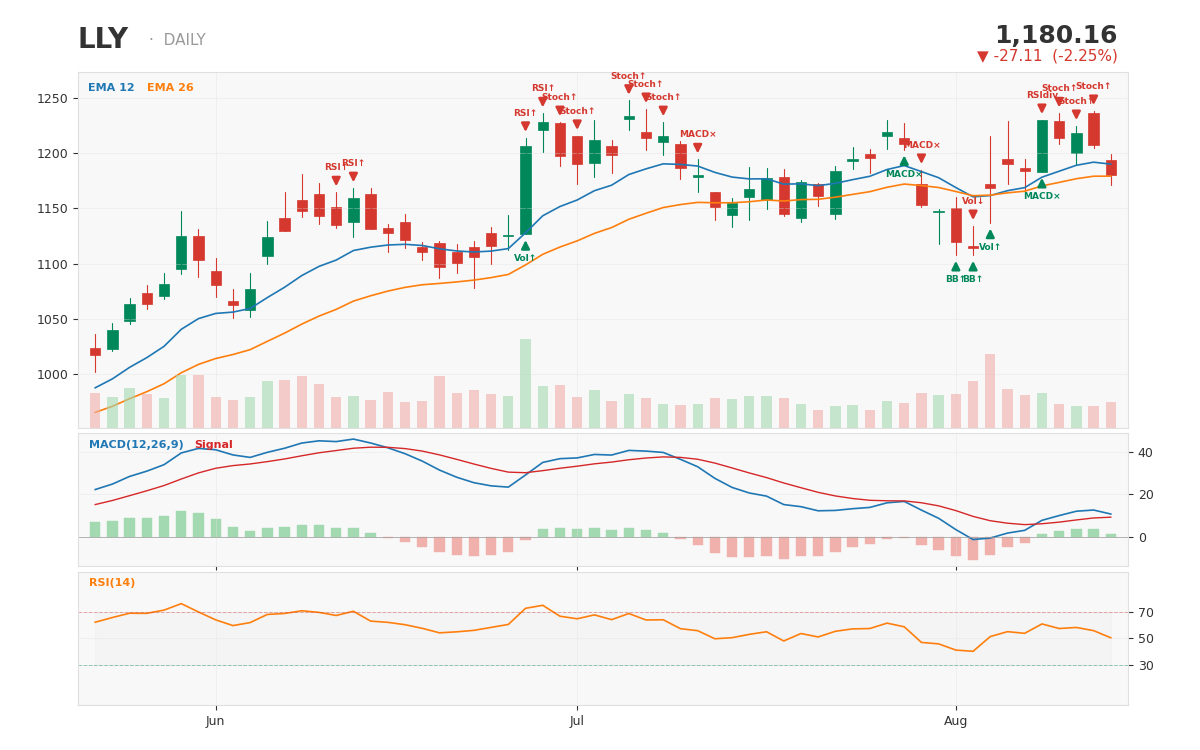 Eli Lilly 1-year daily chart with technical signals -- an intact primary uptrend against a broader signal scan skewing bearish, 6 buy vs. 16 sell, with a shared on-balance-volume divergence flag
Outlook: Sustained Leadership with Anticipated Near-Term Volatility
Eli Lilly is firmly establishing its leadership in the pharmaceutical industry, particularly within the burgeoning obesity market. The company's proactive legal defense of its future drug, retatrutide, coupled with a standout Q2 earnings report, highlights its robust pipeline and strong financial health. While the stock's premium valuation is justified by its high profitability and growth trajectory, the current technical setup suggests the potential for near-term consolidation after a significant run.
Our stance is Bullish on Eli Lilly's long-term prospects, driven by its innovative pipeline, market dominance, and aggressive protection of its future revenue streams. However, we anticipate a period of technical consolidation or increased volatility in the near term.
A potential entry zone for long-term investors would be a pullback into the $1,140 to $1,160 range. This would represent a retest of previous consolidation levels after its strong post-earnings rally, offering a more attractive risk-reward profile.
The 12-month target is set at $1,340. This aligns closely with the consensus median analyst target of $1,341.63, reflecting continued confidence in the company's ability to execute on its pipeline and maintain its market-leading position.
An invalidation level for this thesis would be a sustained break below $1,020. Such a move would negate the significant post-earnings gains and signal a more fundamental shift in market sentiment or company prospects, prompting a re-evaluation. Eli Lilly remains a top-tier pharmaceutical innovator with substantial growth drivers ahead, making any short-term pullback an opportunity for long-term positioning.
Want deeper research on any stock? Try Kavout Pro for AI-powered analysis, smart signals, and more. Already a member? Add credits to run more research.