FNKO - The Turnaround Was Real, the Stock Doubled, and the Executives Kept Selling

Key Takeaways
- Funko's Q2 showed genuine operational improvement — net sales up 7%, gross margin nearly doubling to 56.6%, and FY26 EBITDA guidance raised to $105 million — making any Chapter 11 concern a misreading of the current business.
- Through that rally, four insiders sold a combined ~$2 million, with the CEO cutting his personal stake by 65%, at prices ranging from ~$7.00 down to $5.76 — and the stock now trades below the CEO's own sale prices.
- The composite score sits at 48 on a 0-100 scale, and the price has given back the entire post-earnings gain, leaving the stock in a zone where the insider exodus carries more signal weight than the fundamental improvement.
The Turnaround Is Real — Margins Nearly Doubled and EBITDA Guidance Was Raised
Let's clear one thing up immediately: Funko is not a distressed story. The Q2 2026 numbers put that idea to rest. Net sales rose 7% to $207.7 million. Gross profit jumped from $62.0 million (32.1% margin) to $117.6 million (56.6% margin) — a margin expansion that is striking in any sector, but particularly for a company that spent the past two years fighting excess inventory and tariff headwinds. Management responded by raising full-year adjusted EBITDA guidance to $105 million, nearly three times the previous year's level.
The improvement is operational, not financial engineering. Operating cash flow turned positive. Debt has been reduced. The "Make Culture POP!" strategy is gaining traction across product categories, from core Pop! vinyl to newer lines like KPop Demon Hunters and Pop! Yourself. The company brought in a new chief commercial officer from Crunchyroll in August. These are the actions of a business that has found its footing.
But the stock has already priced in a large portion of that success. Over the past twelve months, shares gained 114%. The current price of $5.68 is roughly 5.4x forward EV/EBITDA — not obviously expensive, but also not the deep value zone it occupied at $2.72 a year ago. The fundamental case is real, but it is no longer hidden.
Four Insiders Sold a Combined $2 Million Through the Rally
The real tension in this story is not the turnaround — it is what executives did while the turnaround was unfolding. From early August through September 3, four different insiders sold shares. The CEO, Josh Simon, led the way with two large sales on September 3 at $5.76 and $5.87, reducing his position by roughly 65%, from ~433,000 to ~151,000 shares, for proceeds of about $1.05 million. He also exercised and converted options on September 1, which preceded the sales. That pattern — exercise and immediate sell — is a standard way to capture option value, but the magnitude is unusual for a CEO who has just delivered a strong quarter.
The CFO, Yves Le Pendeven, sold in five separate tranches between August 7 and September 1, totaling approximately $409,000. A director, Charles Denson, sold $500,000 worth on August 24. The chief product officer sold twice in mid-August for about $53,000. Combined, the insider cash-out comes to roughly $2.05 million.
| Insider | Role | Sales Period | Shares Sold | Approx. Proceeds |
|---|---|---|---|---|
| Josh Simon | CEO | Sep 3 | 181,893 | $1,053,131 |
| Yves Le Pendeven | CFO | Aug 7–Sep 1 | 60,924 | $408,630 |
| Charles D. Denson | Director | Aug 24 | 72,992 | $499,995 |
| Husnal Shah | CPO | Aug 11–12 | 9,000 | $53,528 |
The declining price across the window is notable: the CFO's earliest sales were around $7.00, the CEO sold at $5.76–5.87, and the stock now trades at $5.68. Insiders were selling as the stock was falling, not just at the top.
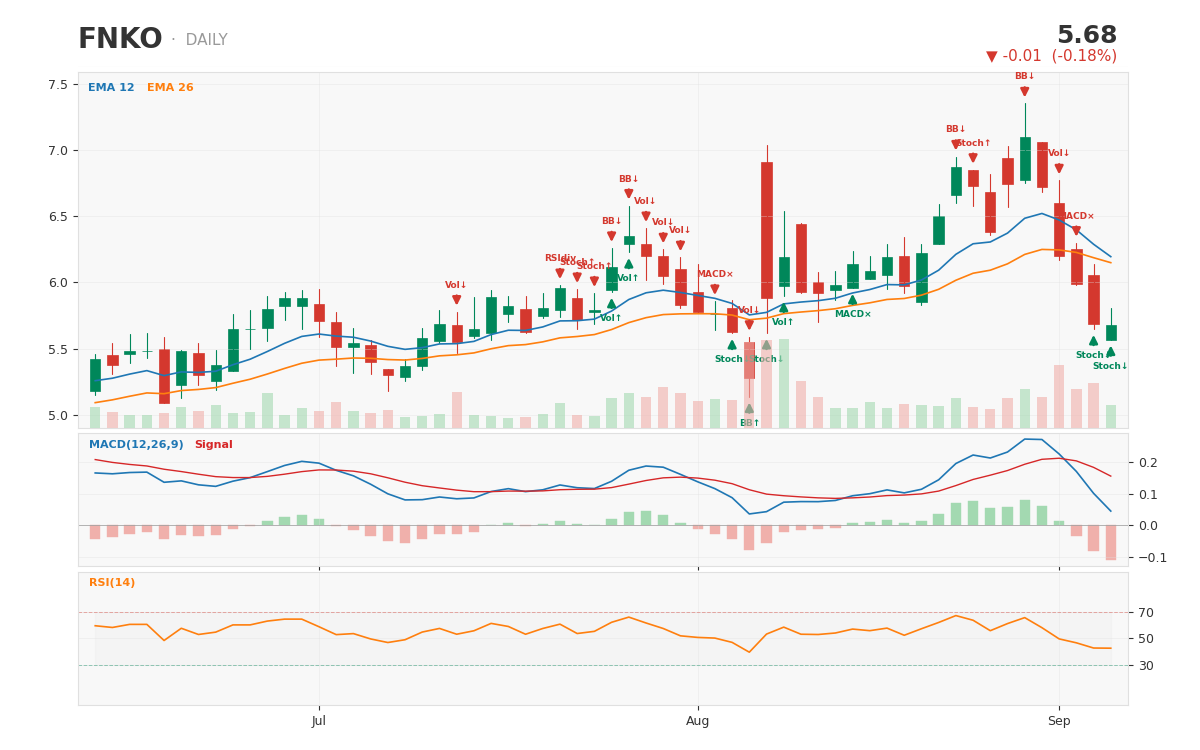 FNKO 1-year daily chart with technical signals -- captured below the CEO's recent sale prices, after a +114% one-year run on a genuine margin-and-EBITDA turnaround during which four insiders sold a combined ~2 million
The Stock Has Already Round-Tripped the Post-Earnings Gains — Now Below the CEO's Sale Prices
The price chart tells a clean story: Funko peaked at $7.35 on August 28, then reversed sharply. Over the next five trading sessions, the stock dropped to $5.68, wiping out the entire post-earnings pop. Volume was heavy on the down days — September 1 saw 2.36 million shares trade, nearly triple the average, and the following three days each exceeded 1.4 million. That volume pattern suggests distribution, not a brief shakeout.
The quant readings — a composite of trend strength, momentum, volume, and moving-average signals — puts the stock at 48 out of 100, a neutral-to-slightly-bearish level. The trend and momentum measures are weaker, and the moving-average group is the lowest of the three. Together they point to a stock that is not attracting buying interest. Price has slipped below its key moving averages, volume is confirming the selling rather than supporting a bounce, and the trend-strength reading has turned bearish.
Most telling: the market now values the company below the price where the CEO sold 65% of his position. An executive with the best internal view of operations chose to exit at $5.87, and the public market has since marked the stock lower. That is not proof of trouble — the CEO may simply have personal diversification needs — but it is a data point that should give any buyer pause.
Analysts See $6.50 to $8, but the Consensus Is a Hold-Heavy Split
Analyst coverage is mixed. Of the fourteen ratings tracked, six are buys and eight are holds — no sells. The price target range runs from $6.50 to $8.00, with a median of $7.375. That median implies roughly 30% upside from the current $5.68. On the surface, that looks like an attractive return.
But a hold-heavy consensus on a stock that has already doubled is its own kind of warning. Holds are typically neutral: the analyst sees fair value near the current price. The median target being $7.375 means the average analyst expects about $1.70 of upside over twelve months — not bad, but also not the kind of conviction that drives large active bets. And the fact that no analyst is outright bearish is interesting; either all of them think the turnaround is still underappreciated, or the sell-side has been slow to downgrade after the run. Given the insider selling cluster, the latter feels more likely.
The Balance Sheet Still Carries Scars
For all the operational improvement, Funko is not yet a clean balance sheet story. Trailing twelve-month revenue is still down 13.5% from the prior year. Net margin is barely positive at -0.2%. Free cash flow turned negative year-over-year. The debt-to-equity ratio sits at 1.39, and net debt to EBITDA is 2.58 — manageable but not pristine. The EBITDA guidance raise was helped by tariff benefits, which are a one-time tailwind, not a structural change.
This is not a case where the turnaround is complete; it is a case where the turnaround has started to work, and the market has already rewarded it. The hard part — sustaining margin expansion, growing revenue, generating free cash flow — still lies ahead. The insider selling cluster suggests that the people closest to the business may see the easy wins as fully priced in.
Why the Insider Exodus Matters More Than the Earnings Beat
There is no way to know exactly why four insiders sold a combined $2 million over a five-week window. Diversification, tax planning, and option exercise are all legitimate reasons. But the size, the coordination, and the timing create a pattern that the fundamental strength alone cannot explain away.
When a stock doubles on a real earnings inflection, one insider selling for personal reasons is noise. Four insiders selling — including the CEO cutting two-thirds of his holdings — is a signal. It is the strongest signal in the dossier, because it directly connects the people who know the business best to the stock they are selling. The composite picture from trend, volume, and moving-average measures confirms that the market is not disagreeing with their prioritization; the stock is falling.
The fundamental improvement is real. The insider selling is real. The market is now trading at a level that accommodates both readings — better operations, but lower conviction from the people who run them.
The Argument for Caution Is Stronger Than the Argument for Conviction
The bull case — rapidly improving margins, raised guidance, cheap on forward EBITDA — is a genuine argument. The bear case — insider exodus, price breakdown, hold-heavy analyst consensus — is equally genuine. The resolution to that tension comes from the price itself: the stock is now lower than any insider sale in the window, and the technical signals are weakening. That combination tips the risk/reward toward caution.
Rather than calling a precise entry, the honest observation is that the stock has lost all of its post-earnings gain and is testing levels that would bring it back toward the $4.50–$5.10 area where it traded before the Q2 release. A break below $4.50 would mean the stock has lost most of its 2026 gains and is testing new lows — a level that would confirm that the turnaround thesis has been fully unwound, something that would require a fundamental setback, not just profit-taking. The lower end of the analyst range, $6.50, represents a reasonable recovery target if buying conviction returns, but the insider activity and volume patterns do not support counting on that today.
The story here is not that Funko is broken. It is that the people who fixed it are cashing out, and the market has started to listen to them. Until the insiders stop selling or the stock stops falling, the risk is not worth the paper upside. Let the insider queue clear and the price find its floor before stepping in.
Want deeper research on any stock? Try Kavout Pro for AI-powered analysis, smart signals, and more. Already a member? Add credits to run more research.