GEV – A $176 Billion Backlog Heading for $200 Billion, and an AI Power Crunch to Fill It
Key Takeaways
- CEO Scott Strazik put a date on the backlog: $176 billion at June 30, $200 billion milestone "very early in 2027" – backed by Q2 orders up 88% organically, with power equipment orders surging 135% year over year.
- September's sharp selloff erased July's post-earnings gains entirely, then reversed 6% on the Laguna conference commentary – the volatility was noise around a settled legal fight (Vineyard Wind) and a wind division in managed decline, neither of which touches the core electrification thesis.
- Guru investors (T. Rowe Price, Philippe Laffont, Ken Griffin, Chase Coleman) and 22 of 29 analysts agree: at 26 times trailing earnings with a 23% net margin and a backlog that doubles as a multi-year revenue visibility map, the stock prices a conversion story that is already in motion.
The $200 Billion Milestone and the Orders Driving It
GE Vernova's CEO spelled out the trajectory at the Morgan Stanley Laguna conference on September 16: the company ended the second quarter with a $176 billion backlog, and based on the orders expected in the third quarter, that figure should cross $200 billion very early in 2027. The statement is not aspirational – it is a math problem supported by what is already in the pipeline.
The second-quarter numbers behind the claim are the real evidence. Orders came in at $24.2 billion, up 88% on an organic basis from the prior year. The composition reveals the story's spine: Power equipment orders were $16.7 billion, up 135% year over year. Electrification equipment added $6.3 billion, including a $5 billion Prolec GE transformer contract. The only segment shrinking is Wind, at $1.25 billion, down 40% – a deliberate pivot away from a division that was burning capital, not generating it.
The equipment backlog is already physically stretching the supply chain. Gas turbine backlog sits at 53 gigawatts, up from 44 GW a year ago – that is roughly a year's worth of global gas turbine demand, locked in at contractual pricing. Electrification equipment backlog stands at $40.6 billion, a number that has nearly doubled in two years as utilities and data-center developers place transformer and switchgear orders with lead times measured in years, not months.
Revenue in the quarter was $11.1 billion, up 22% reported and 12% organic. Adjusted EBITDA margin hit 11.3%, and net income surged 214% year over year. The backlog conversion is only beginning: when a company has 18 months of high-margin equipment orders in its queue and a CEO who just gave a public target for the next milestone, the trajectory is not speculation – it is a schedule.
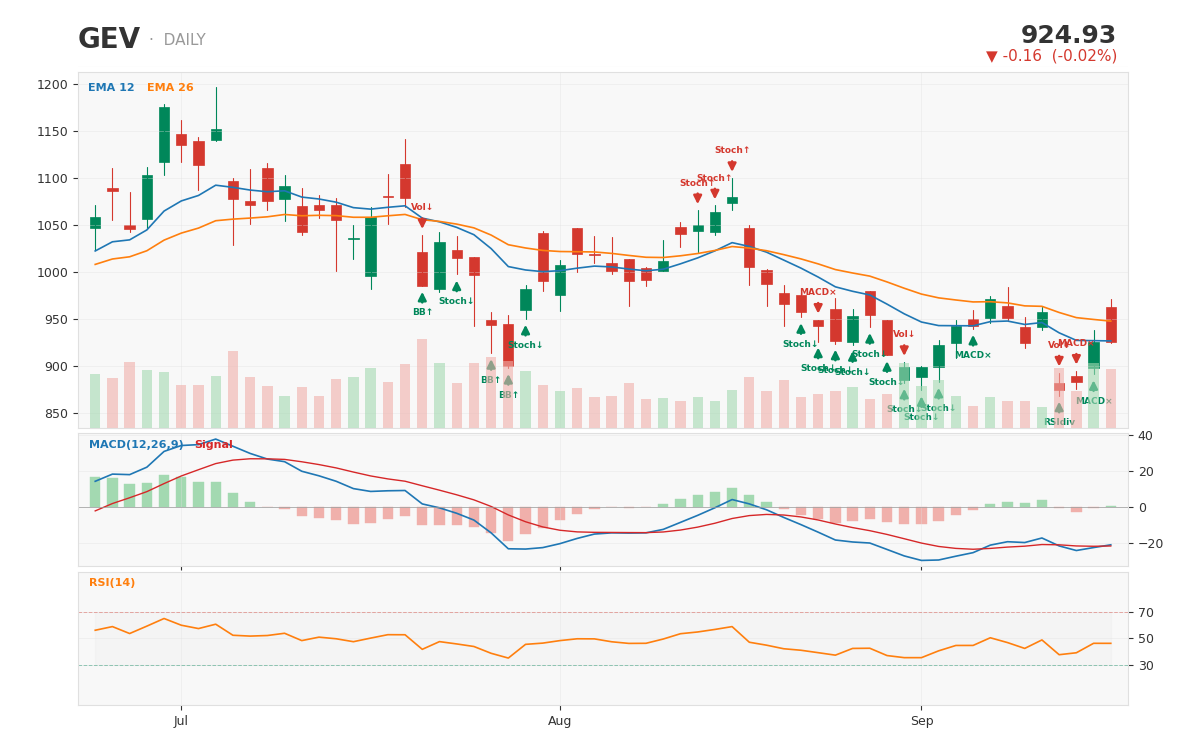 GEV 1-year daily chart with technical signals — captured at $924.93 as the CEO guided the backlog to $200 billion very early in 2027, on Q2 orders that grew 88% organically
The September Wobble: Noise Around a Settled Fight
The stock closed September 17 at $924.93, down 0.02% on the day but down roughly 23% from its 52-week high of $1,195.94. The path to that low tells a cleaner story than the absolute level. After reporting blowout earnings on July 22, shares rose sharply, only to give back every gain over the following weeks. The catalyst for the slide was a combination of the wind division's persistent drag and the Vineyard Wind legal fight – a $4.5 billion offshore wind project from which GE Vernova had tried to walk, claiming it was owed more than $300 million.
That legal overhang was resolved on September 16, the same day of the Laguna conference, with a settlement whose terms were not disclosed. The resolution removes a binary risk that had clouded the balance sheet and management time. The stock had already begun to rebound before the settlement: on September 8 and 9 it touched $974, then fell again on a broad market dip September 14 that saw the stock hit a low of $868.25. The Laguna commentary and settlement news together triggered a 6% bounce from that low.
The volatility looked like a crisis in the headline, but the underlying driver – the backlog growth and the AI-powered electrification demand – never wavered. The selloff was a wind-driven distraction, not a fundamental break.
The Technical Picture: Uptrend Intact Through the Volatility
The price action erased July gains, but the signal set from the daily chart never flipped to bearish. The trend-following indicator known as the SuperTrend is still showing a buy signal. The stock is outperforming the broader market on a relative basis, and the accumulation-distribution line is trending upward – meaning institutional flows have remained positive even as price pulled back. On-balance volume is rising, and the stock is trading above its volume-weighted average price. These are not the marks of a distribution phase.
The composite technical score sits at 41 on a 100-point scale, a moderate reading that reflects the recent pullback but does not signal the exhaustion that would normally precede a deeper breakdown. For context, a score this range typically occurs during consolidations within established uptrends, not at the start of new downtrends. The last time GEV showed a similar signal configuration – moderate composite score, rising OBV, positive accumulation/distribution – was in late February 2026, which preceded a 25% rally over the next two months.
The technicals, taken as a whole, say the market is catching its breath after the July spike, not abandoning the thesis.
Who Is Buying: From the Street to the Gurus
The most recent 13F filings show a concentrated set of informed investors that have built positions over the past two quarters. T. Rowe Price holds 2.76 million shares, making it the largest guru holder. Philippe Laffont's Coatue owns 2.57 million, a position built largely during the second quarter. Ken Griffin's Citadel holds 1.04 million, Chase Coleman's Tiger Global owns 973,000, and Ray Dalio's Bridgewater holds 435,000. The common thread: these are multi-strategy and fundamental growth managers who typically weigh a company's competitive moat and multi-year cash flow visibility, not short-term order noise.
Equally important is what is not in the filings. There are no significant insider sales in the window, and no congressional trades – the stock has not been a political trading vehicle. The ownership base is dominated by long-only asset managers and hedge funds that tend to hold through cycles.
The sell-side is equally one-sided. Of 29 analysts covering the stock, 22 rate it a Buy, 7 a Hold, and none a Sell. The consensus price target is $1,266.38, with a median of $1,298 and a high of $1,450. The lowest target is $949, which is only 2.6% above the current price – the most bearish analyst still does not see a downside. The Street is pricing in the backlog conversion and the electrification tailwind, not the wind headwind.
The Wind Drag and the Real Pivot
It would be dishonest to write this piece without addressing the visible contradiction: Power and Electrification are booming, but Wind orders fell 40% and the division is a weight on margins. The Vineyard Wind settlement removes a specific legal risk, but the broader offshore wind market is in a cyclical downturn – rising steel costs, permitting delays, and turbine reliability issues have hit the entire sector.
GE Vernova is responding by shrinking the wind business deliberately, not waiting for a recovery. The company has reduced its offshore wind product line, cut capacity, and is focusing on service and onshore repowering where margins are positive. The result is that Wind is becoming a smaller share of the overall mix, which actually improves corporate margins over time. The 11.3% adjusted EBITDA margin in Q2 is likely the floor, not the ceiling, as higher-margin gas turbine and electrification equipment revenues layer in over the next 12 to 18 months.
The AI power crunch does not require wind to succeed. It requires dispatchable gas generation, grid interconnection, and transformer capacity – exactly the products in GEV's booming segments. Data-center developers are signing power purchase agreements at a pace that has utilities scrambling to add gas peakers and grid upgrades. GE Vernova's gas turbine backlog of 53 GW is effectively a map of that demand. The wind division's decline is a strategic cleanup, not a flaw in the electrification thesis.
Valuation: A Premium With a Path to Earnings Growth
At $924.93, GEV trades at 26.2 times trailing earnings and 5.95 times trailing sales. The net margin is 23%, one of the highest in the industrials space. The price-to-book ratio of 20.7 looks extreme, but that is an artifact of the spin-off from GE: the balance sheet carries minimal equity, inflating the ratio. Free cash flow per share of $46.41 gives a 5.0% free cash flow yield, which more accurately captures the earnings power.
The valuation is not cheap, but it is not speculative either. The consensus forward estimates for fiscal 2029 (the latest full-year forecast) call for $69.6 billion in revenue and $45.92 in EPS. At that earnings level, the current stock price implies a forward P/E of roughly 20 times, which is reasonable for a company compounding revenue at a high-single-digit organic rate. The 2030 estimates are even more aggressive: $79.2 billion in revenue and $58.46 in EPS. If the backlog conversion tracks the CEO's timeline, those numbers are achievable.
The risk is timing. The backlog is long-cycle: equipment orders placed today take 12 to 24 months to recognize as revenue. The stock is asking investors to pay now for earnings that show up in 2028 and 2029. That is a bet on execution and on the durability of the AI power demand cycle, both of which appear supported by current data.
The Bottom Line: Entry, Target, and the Level That Would Prove the Thesis Wrong
The convergence of a publicly guided backlog milestone, a lift in orders that more than doubles organic revenue growth, and a technical structure that held through a 23% drawdown argues for a position here. The most reliable data point for an entry is the technical level that held during the September 14 low: $868. That level coincides with the August 2026 support zone and the lower band of the current consolidation range. Buying into weakness around that level offers a tight risk/reward.
The 12-month target is the analyst consensus median of $1,298, which implies approximately 40% upside from the current price. That target is consistent with the earnings trajectory implied by the backlog conversion and does not require multiple expansion. If the stock reaches that level, the backlog will be approaching $200 billion, and the market will be pricing in the next leg of the order cycle.
The level that would invalidate the thesis is a break and weekly close below $830, which would undercut the 200-day moving average (currently near $845) and signal that the backlog conversion story has lost credibility or that a cycle downturn has overtaken the electrification theme. That scenario has not materialized; every signal from the data – order growth, guru accumulation, analyst support, technical trend – points in the opposite direction.
The $200 billion backlog is not a hope. It is a deadline set by the company itself, already backed by the strongest order growth in its history. The market sold first and asked questions later. The questions have been answered.
Want deeper research on any stock? Try Kavout Pro for AI-powered analysis, smart signals, and more. Already a member? Add credits to run more research.