GOOGL - A Judge Called It a Monopoly and Refused to Break It Up Anyway

Key Takeaways
- A federal judge confirmed Google holds illegal monopolies in ad tech but declined to order a breakup, removing the single biggest overhang and triggering a technical breakout that ended a four-month losing streak.
- Google Cloud’s 82% revenue growth and a $200B capex raise signal that the AI infrastructure bet is paying off, with Berkshire Hathaway now holding Alphabet as its fourth-largest position.
- At 17x trailing earnings with 15% revenue growth, the stock is cheap relative to its own growth, but an adjusted P/E above the 15-year average and paused buybacks are honest flags against the bull case.
The Ruling That Changed Nothing – and Everything
On Wednesday a federal judge did what antitrust enforcers have sought for years: he confirmed that Google operates illegal monopolies in two ad-tech markets. Then he declined to order a breakup. Instead of forcing a sale of AdX or other ad-tech assets, the judge accepted a set of behavioral remedies – changes to how Google runs its ad business, not a dismantling of it. Critics called the outcome “Olympic level of mental gymnastics,” and the stock rose 1.59% on the day, to $342.48.
The irony is that the business the case was fought over – Google Network, the ad-tech intermediary unit – is the only Alphabet revenue line that shrank last quarter. The ruling protects a declining asset. That does not make it irrelevant: a forced sale would have created years of operational uncertainty and set a precedent for further breakups. By removing that binary risk, the judge gave investors the one thing a mega-cap stock like this most needs: clarity. The question now is whether the market will reward that clarity with sustained buying, or whether the ad-tech distraction masks bigger challenges.
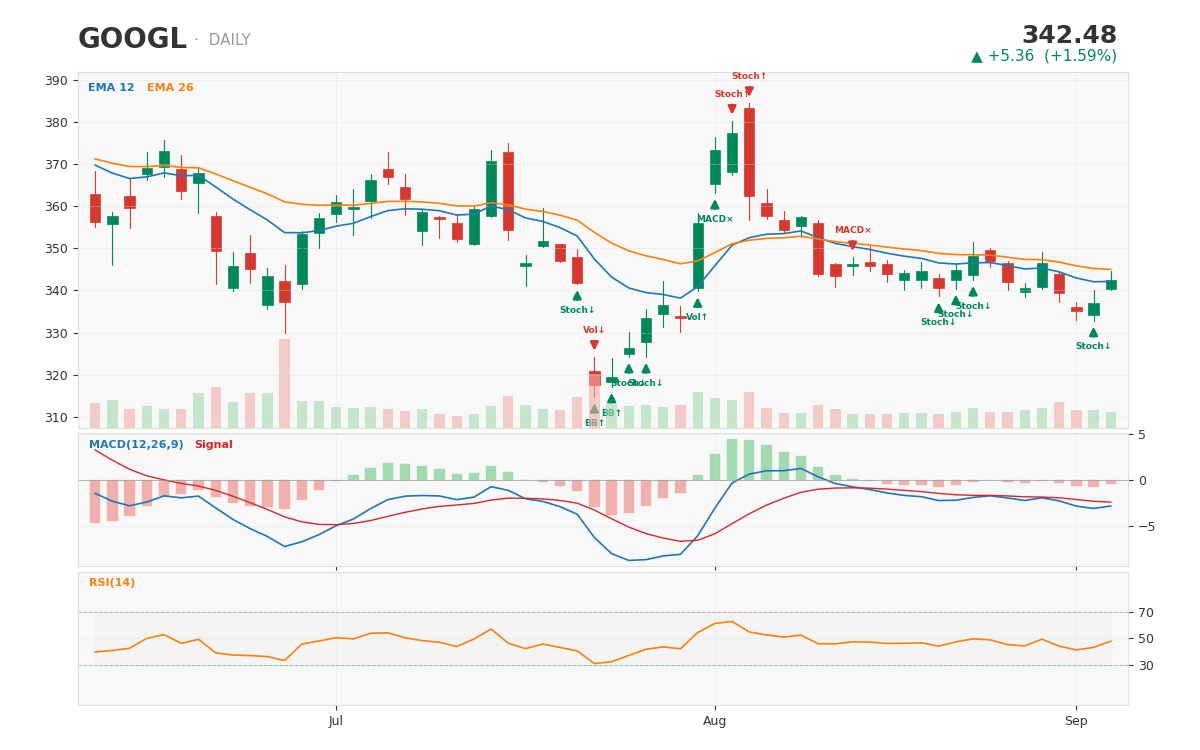 GOOGL 1-year daily chart with technical signals -- captured after a federal judge declined to break up Google's ad-tech business despite confirming illegal monopolies
A Four-Month Losing Streak Breaks – What the Technicals Say
Before the ruling, Google shares had been in a four-month slide – the longest losing streak since 2015. The catalyst that finally snapped it was a combination of the legal win and the long-awaited launch of Gemini 3.8 Flash, which shipped after public criticism over missed deadlines. The stock broke its downtrend on volume, and the technical picture today is strongly constructive.
Ten bullish signals are flashing against just two overbought readings. Trend strength is bullish, the directional movement index confirms the trend, and volume is rising to support the move. Price is above the volume-weighted average price, and the stock is outperforming the broader market. The composite score sits at 59, with the technical component at 52 – both neutral-to-bullish territory but notably improved from the depths of the losing streak. The oscillator reading of 54 suggests there is room to run before the stock becomes extended.
The chart shows a clean break of the downtrend line that had held since May, with volume expanding on the breakout day. That is the kind of price action that attracts momentum-driven money, and it aligns with the improving sentiment from the fundamental side.
Google Cloud’s 82% Growth Underwrites a $200B Bet
The bull case for Alphabet today rests on one number: 82%. That is the year-over-year growth rate for Google Cloud, a business that is now adding more dollar revenue each quarter than AWS. Management responded by raising 2026 capital expenditure from a $185B midpoint to $200B – and said the number would be higher next year.
This is not blind spending. The company is building a structural cost advantage through proprietary Apollo optical switches, a custom TPU cadence, and a power-usage effectiveness of 1.09 – among the best in the industry. Analysts expect the capex to generate a return on invested capital above 20% as cloud workloads scale. The bet is that Google’s AI infrastructure will be the foundation for enterprise adoption of Gemini and other models, and that the cloud revenue growth will sustain its trajectory.
Warren Buffett’s Berkshire Hathaway agrees. Alphabet is now Berkshire’s fourth-largest holding, and CEO Greg Abel cited the AI position as a “fundamental” reason. That endorsement matters for a stock that has been out of favor: it signals that value-oriented capital sees the earnings power under the surface.
The Fundamentals: Cheap Earnings, Expensive History
At $342.48, Alphabet trades at 17 times trailing earnings, with an EV/EBITDA of 12.86 and a price-to-sales ratio of 9.30. Gross margin is 60.9%, operating margin 33.1%, and net margin 54.8%. Return on equity is a staggering 50.8%, and return on invested capital is 15.1%. Revenue grew 15.1% over the trailing twelve months, while net income expanded 32% and EPS rose 34.5%.
That looks cheap. A stock with 15% top-line growth, 32% earnings growth, and a fortress balance sheet – current ratio 2.72, debt-to-equity 0.18 – does not often sell for 17 times earnings. The analyst consensus median target of $425 implies 24% upside, and even the lowest target of $350 sits above the current price.
But the headline multiple is misleading. On an adjusted basis – stripping out the one-time tax benefits and the impact of equity issuance – Alphabet trades at 27 to 29 times earnings, above its 15-year average. Buybacks, a traditional source of per-share growth, have been paused in favor of significant equity and debt issuance to fund the capex push. The company is reinvesting aggressively, and the market is being asked to trust that the ROIC will materialize. That trust has historically been rewarded, but the multiple expansion means the stock is no longer a clear bargain by its own history.
Smart Money Is In – But Not All of It
The guru ownership list reads like a who’s who of long-term capital: T. Rowe Price holds 80.5 million shares, Berkshire Hathaway 54.2 million, and other prominent names like Ken Fisher, PRIMECAP, Chase Coleman, Dodge & Cox, and Bill Nygren all have positions. That is a level of institutional conviction that does not appear overnight.
Insider activity is noise: one director sold 82 shares worth $27,700, a transaction too small to read anything into. Congressional trading in the most recent batch shows two buys and two sells. Representative David Taylor bought stock in the $1,001-$15,000 range on August 11, and Representative William Keating bought a corporate bond in the same range on the same day. On the sell side, Representative Thomas Kean sold stock in the $1,001-$15,000 range on July 22, and Representative Michael Rulli sold $50,001-$100,000 worth on August 24. The dollar amounts are modest, and the split is balanced – no strong signal either way. The real smart-money vote is the guru bench, and it is overwhelmingly long.
What Could Go Wrong
The most immediate risk is that the behavioral remedies imposed by the judge turn out to be more costly than expected. Google will have to adjust how it operates its ad-tech business, and those changes could pressure margins in a unit that is already shrinking.
There is also an ongoing securities-fraud investigation announced by Glancy Prongay Wolke & Rotter LLP, which is still in the notice stage – not a filed suit, but a legal overhang that could generate headlines. The investigation is not yet a material event, but it is a reminder that regulatory scrutiny does not end with the antitrust ruling.
The biggest risk is the valuation argument. If the adjusted P/E of 27-29x does not compress as earnings catch up, the stock will need continued growth acceleration to justify the multiple. The capex raise is a bet on that acceleration, but if Google Cloud’s growth decelerates or the AI investment takes longer to pay off, the market could re-rate the stock lower. The pause in buybacks removes a support mechanism that has historically boosted returns.
Finally, the four-month losing streak was a reminder that sentiment can shift quickly. The breakout is fresh, and it is not yet confirmed by a sustained move above the prior range. A failure to hold above the low analyst target of $350 would put the technical recovery in doubt.
The Verdict: Buy the Breakout, Watch the Risks
The antitrust ruling removed the single biggest overhang on the stock. The technical breakout is genuine, backed by volume and a catalyst that changes the narrative. The fundamental story – cloud growth, AI infrastructure, Berkshire endorsement – is stronger than it has been in years. At 17x trailing earnings, the stock is not expensive relative to its own growth, and the analyst consensus target of $425 offers a clear 24% upside.
The current price of $342.48 is near the breakout level. The low analyst target of $350 provides a floor, and the median target of $425 is grounded in consensus expectations for cloud growth and margin stability. If the capex begins to generate visible ROIC, upside toward the high target of $475 is plausible.
A close below $350 would negate the bullish signal structure and suggest the losing streak may be resuming. That level represents the top of the prior downtrend and a break below it would indicate that the ruling rally was a one-day event, not a trend change.
The ruling gave Google clarity. The technicals gave it momentum. The fundamentals give it a margin of safety. The real test is whether the market can look past the adjusted multiple and trust that the $200B capex bet will compound. If it does, this is the moment a four-month losing streak becomes a buying opportunity.
Want deeper research on any stock? Try Kavout Pro for AI-powered analysis, smart signals, and more. Already a member? Add credits to run more research.