GRAL – The FDA Meets Wednesday on a Blood Test That Could Find 50 Cancers. The Stock Just Went Up a Third.
Key Takeaways
- GRAIL (GRAL) trades at $108.81, up 34.7% on September 21, after the FDA staff review raised no major concerns ahead of the advisory committee meeting on September 23.
- The technical setup is bullish — price is above VWAP and the accumulation/distribution trend is up — but the stock is now roughly 8% below its 52-week high after a one-day move that already prices in the most obvious positive outcome.
- The caution flag is an insider sale of $672,000 on August 27, three weeks after the FDA meeting was announced, not the same week. That timing gap matters: the insiders sold into the news, not ahead of it in the dark.
- The trade is not to chase $108. The better trade is a post-event breakout above the 52-week high, with a twelve-month target of $125 and an invalidation near the pre-surge close at $80.78.
The FDA Event Is the Trade, and the Stock Already Moved
GRAL is a pre-revenue company with no approved product revenue. The stock is trading where it is because of a single piece of regulatory news: the FDA advisory committee meets Wednesday to review the company’s multi-cancer blood test. On Monday, the FDA staff released an executive summary that the market read as favorable. The staff document described the test’s false-positive rate as low and its accuracy as high, and the stock responded with a 34.7% surge to $108.81.
That move was not subtle. By early afternoon Monday, more than 2.3 million shares had traded. The stock was up nearly 35% in a single session, and it did so just two days before a committee vote that will help determine whether this test reaches the U.S. market.
It is important to be precise about what the catalyst is. The advisory committee vote is not the FDA’s final decision. The agency usually gives a committee recommendation serious weight, but it is not legally bound by it. What the market is doing is treating Monday’s staff document as a strong signal that the vote will go well and a favorable regulatory decision is more likely than not.
That may be the right read. The problem is that the market knew Monday’s staff document was coming, and the stock moved 34.7% on the first day it could react to the substance of the FDA summary. A lot of the good news is already in the price. GRAL is now $108.81, with a 52-week high of $118.84. The rally has already taken the stock most of the way back to the high end of its range.
The fundamental picture has not changed today. This is a pre-revenue company with no approved product revenue. The test, if approved, would be a multi-cancer screening product with significant commercial potential, but the company is not yet in the position of earning revenue from that product. There is no earnings multiple to anchor to. The valuation is being set by the probability of a regulatory approval, not by cash flow or profit.
That makes the event trade binary in a way that an earnings report is not. The market is not debating whether the company beat revenue expectations. It is debating whether the FDA will eventually approve the product, and Wednesday’s committee vote is the first major public checkpoint.
The Technical Signal Set Is Bullish but Extended
The stock is above VWAP, a basic measure of whether the average buyer in the session is profitable. That signals near-term buyers are in control. The accumulation/distribution trend is also up, which suggests the buying is broad enough to be considered institutional rather than simply a burst of retail speculation.
Those two signals — price above VWAP and an up-trend in accumulation/distribution — are the kind of combination that momentum models look for. They are not a reason to sell. But they are also not a reason to buy an extended one-day move into a binary event. The stock is up 34.7% in a single session. The prior close, before the surge, was $80.77. That is the level that matters for risk. The stock is now trading about 35% above that level in one day, and it is sitting just below the 52-week high set earlier in the range.
What the technical signal set says is that the trend is up, participation is real, and the market is in a momentum phase. What it does not say is that the stock cannot reverse violently if the event disappoints. The same momentum models that are now long the stock will flip to sell targets if the price breaks below VWAP on high volume after the vote. Technical signals are reactionary. This is a stock where the event is tomorrow, and the event decides whether the technical setup means anything.
| Signal | Read | What It Means |
|---|---|---|
| Price vs. VWAP | Above VWAP | Buyers are in control near-term |
| Accumulation/distribution | Uptrend | The move is broad, not just a headline pop |
| 1-day change | +34.7% | Extended; fresh entries are chasing |
| Position vs. 52-week high | $108.81 vs. $118.84 high | Room to new highs, but overhead is near |
| Volume | 2.36M by early afternoon | Institutional participation is present |
| Insider transaction | $672K sale on Aug 27 | Insider reduced exposure before the event |
That last row is the one that keeps the chart pattern from being a clean buy. The technical signals are constructive, but the insider sale says the people closest to the company were not willing to hold through the advisory committee.
The Insider Sale Is the Signal That Cuts Against the Tape
The most important piece of data after the price action is the insider sale on August 27. An insider sold $672,000 worth of stock that week. The FDA meeting had been announced three weeks earlier, on August 7, via a press release. The sale came after the news was public, not during the same week. That timing is critical: the insider was selling into the attention that the announcement generated, but before the staff report gave the market a clear picture.
The insider was selling at roughly $85 per share. Today the stock trades at $108. The seller left significant money on the table, but that does not mean the decision was wrong. When the sale was made, the stock had already reacted to the announcement and was trading near its post-announcement highs. The insider chose to lock in gains rather than hold through a binary regulatory event with no revenue cushion to fall back on.
That has a name: selling before the news. Not because the insider knew the staff report would be positive or negative, but because the insider knew the outcome was uncertain and the risk of a negative result was not worth carrying at that price. The sale was not large enough to be a referendum on the company’s future, but it is a signal about the risk-reward from the perspective of someone who knows the timeline and the data better than the street does.
There is also an institutional position that grew in early September, and that filing shows some funds were adding exposure. But that is not the same as what the insider did. An asset manager growing a position a week before the FDA meeting is an active bet. The insider sale is a risk-reduction event. When those two signals conflict, the one that is closer to the facts is usually the insider.
The market can ignore that kind of signal for days if the news flow is positive. This week, the news flow is positive. But any buyer of GRAL at $108 is buying after a 34.7% move, two days before an FDA vote, into a company that has no approved product revenue, while an insider was a seller at a lower price three weeks earlier. That is a poor risk-reward for a fresh position.
Pre-Revenue Fundamentals Frame the Risk
The company has no approved product revenue. That single fact frames everything else. GRAL is not expected to generate traditional revenue this quarter. Any valuation model that starts with a price-to-earnings ratio, or even a forward sales estimate, is not going to tell you very much right now. The value is in the option. The FDA is deciding whether the test has a path to market, and the market is assigning a probability to that path.
The FDA staff document was positive on the test’s accuracy and false-positive rate. That is a meaningful advance. Multi-cancer screening tests live or die on false positives. A test that flags too many patients can lead to unnecessary procedures, additional imaging, and patient harm. If the FDA staff saw a low false-positive rate and high accuracy, it removes one of the biggest regulatory risks.
But the stock has now reacted to that. The surge from roughly $80.77 to $108.81 is the market pricing in a favorable FDA review. The stock is not waiting for the event to happen. It is discounting a good outcome. That leaves very little margin for error. If the advisory committee votes yes and the FDA eventually approves, the stock could work higher, but the easy part of the trade has already happened. The buyers at $108 are paying near the high of the range for a stock whose value is entirely dependent on the next few words from the FDA.
If the advisory committee votes no, or even if it votes yes but conditions the approval in a way that complicates the launch, the gap between the pre-report close and today’s price is where the risk lives. The stock has no revenue floor to fall back on. It has no earnings cushion. It has a product, a regulatory timeline, and a dream. When that is the case, the market tends to sell the event into the news, particularly when the event is binary and the price has already moved 35%.
The Better Trade Is on the Other Side of the Event
The trade here is not to buy at $108 and hope the committee says yes. That trade looks appealing because the trend is up, the staff document is favorable, and the stock is above VWAP. But the trend can be wrong in one headline, and the stock has already been repriced.
The better structure is to wait for the event and let the market tell you which side is right.
If the advisory committee votes yes and the stock holds above the 52-week high, the momentum signal becomes a clean breakout. In that case, the prior high near $118.84 becomes the reference level, and a close above that on strong volume opens the door to further upside. The twelve-month target in that scenario is $125, which is a modest extension above the current high. That target is not based on a revenue multiple. It is based on the market clearing the known high after the uncertainty of the event is removed.
If the committee votes yes but the stock sells off, that is a classic buy-the-rumor, sell-the-news pattern. It does not necessarily mean the FDA approval is in danger, but it does mean the traders who bought the rumor into the event are taking profits. That is not a reason to add a position. It is a reason to wait for support to form before considering entry.
If the committee votes no, or if the staff report does not translate into a clean vote, the stock is likely to give back the entire 34.7% surge. That is why the pre-surge close matters. The close at $80.77 on September 18 is the level that was in place before the FDA staff document. If the stock closes below that level, the entire event move has been reversed. That is the invalidation line.
A long entry above the 52-week high, an invalidation below the pre-surge close, and a target of $125 is a trade that has defined risk and reward. It may mean missing the first move if the vote is positive and the stock gaps higher. But missing a gap after a 35% one-day move is not a loss. This is a stock that can gap 20% in either direction on one headline. Buying into that gap, two days before the news, is not risk management. It is conviction without an edge.
The one thing that would change this read is a close above the 52-week high on increasing volume after the vote. That would signal that the market’s positive interpretation of the FDA staff document was not just a one-day event, but the beginning of a repricing. Until that happens, the risk-reward favors patience.
GRAIL is a stock with one real catalyst, and that catalyst is tomorrow. The market has already moved sharply toward the positive view. The technical signals agree. The fundamental signals are binary. The insider signal says the people who know the story best chose to take money off the table three weeks before the vote. When the signals conflict, the right trade is usually not the one that pays the most if everything goes well. It is the one that survives if the event goes wrong.
This week, that trade is to let the FDA vote happen, and then let the price decide.
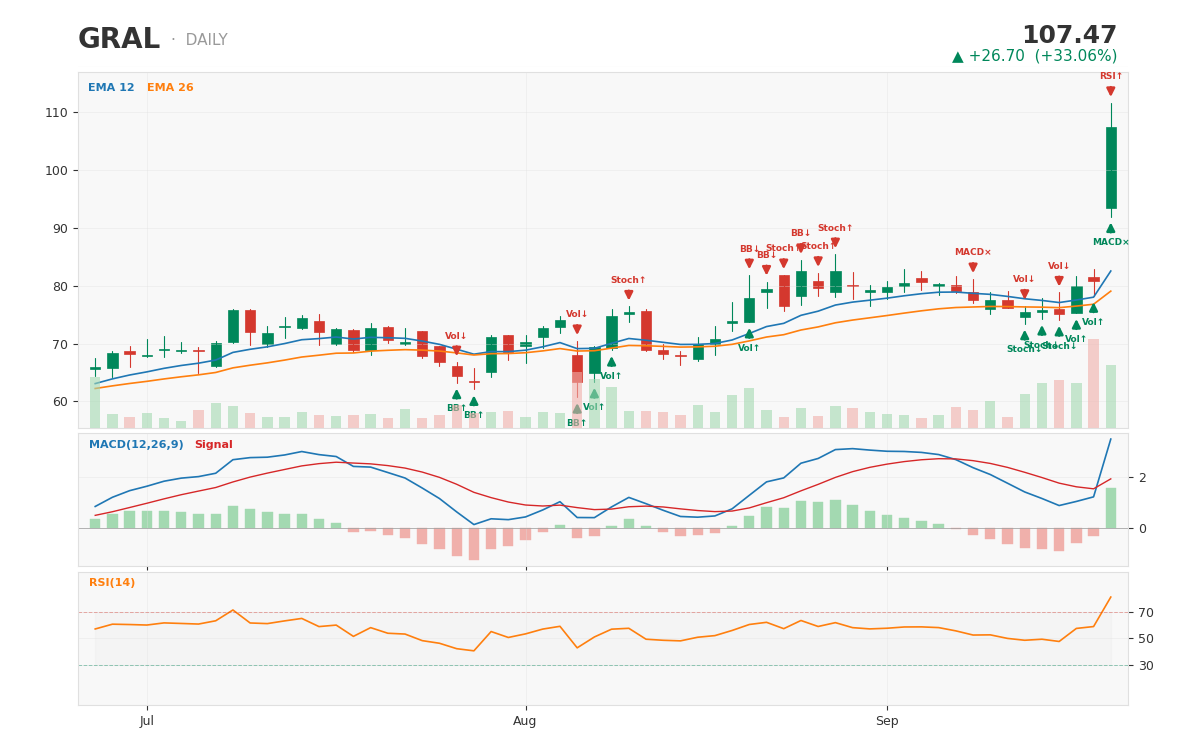 GRAL daily chart with technical signals — captured at $108.805 after a 34.7% single-day surge ahead of the FDA advisory committee meeting on September 23, on 67,000 shares of volume
Want deeper research on any stock? Try Kavout Pro for AI-powered analysis, smart signals, and more. Already a member? Add credits to run more research.