Halozyme: CEO Sold 120,000 Shares While Street Consensus Sits Below the Price

Key Takeaways
- CEO Helen Torley sold 120,000 shares in six exact 20,000-share installments across August and September under a pre-arranged 10b5-1 plan – a schedule adopted last December, not a discretionary call on the stock, but the timing into a 52-week high raises a question every holder should understand.
- The stock now trades at $107.20, above its own Street consensus of $103.00, which hasn't caught up to a record Q2 (revenue +48%, royalty revenue +50%) and full-year guidance that calls for non-GAAP EPS growth of over 100%.
- Technical signals are split: the uptrend is intact and volume is confirming the move, but the trend-strength reading has turned bearish and a trend-following indicator has flipped to sell – a tension that suggests near-term caution even as the fundamental story remains strong.
Decoding the $12.7 Million Schedule
Between August 17 and September 11, the CEO sold exactly 20,000 shares on each of six trading days – not 19,999 or 20,001, but 20,000 every time, at prices between $102.60 and $107.43. The total proceeds: roughly $12.7 million. Every trade ran under a Rule 10b5-1 trading plan adopted on December 3, 2025 – meaning the decision to sell was made nearly nine months ago, at a stock price roughly half of today's. The shares themselves came from options granted in February 2018, exercised at $18.41 each, converting a nearly $89 gain per share into cash. After the series, Torley still holds 767,780 shares, worth about $82 million at the current price.
The consistency is the key. There is no signal in the size or timing – it is a written schedule running its course. What is worth noting: that schedule happened to execute into the stock's strongest quarter in years and at the highest prices since the company went public. It is a reminder that a 10b5-1 plan only removes the information content from a sale; it does not remove the sale itself. For a holder, the arithmetic matters: the CEO monetized options that were already deep in the money, in a programmed way, and retains a very large stake. The move is not a bearish omen, but it is also not a floor of confidence.
| Date | Shares | Price | Proceeds | Option Cost | Gain |
|---|---|---|---|---|---|
| Aug 17 | 20,000 | $102.60 | $2,052,091 | $368,200 | $1,683,891 |
| Aug 18 | 20,000 | $104.18 | $2,083,525 | $368,200 | $1,715,325 |
| Aug 19 | 20,000 | $107.00 | $2,139,976 | $368,200 | $1,771,776 |
| Sep 9 | 20,000 | $107.43 | $2,148,536 | $368,200 | $1,780,336 |
| Sep 10 | 20,000 | $107.17 | $2,143,319 | $368,200 | $1,775,119 |
| Sep 11 | 20,000 | $107.24 | $2,144,856 | $368,200 | $1,776,656 |
| Total | 120,000 | ~$107 | ~$12.71M | $2.21M | ~$10.5M |
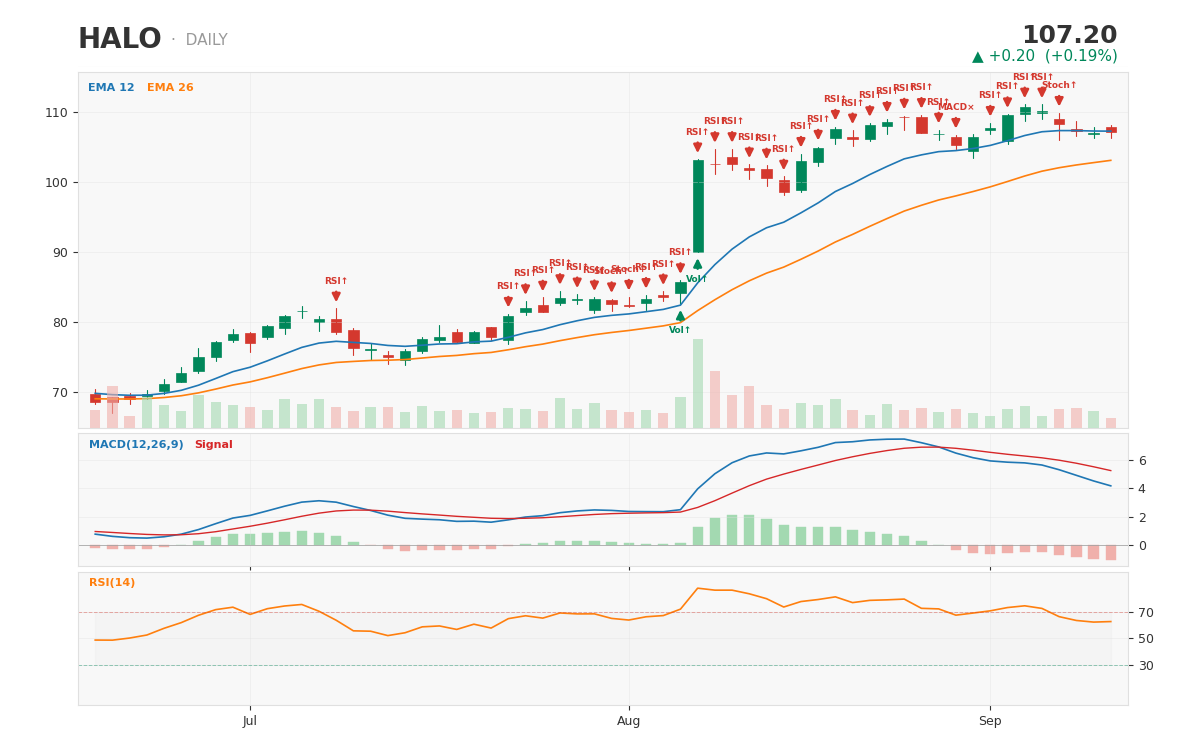 HALO 1-year daily chart with technical signals — captured at $107.20 above its own Street consensus, after CEO Helen Torley's sixth scheduled 20,000-share installment of a $12.7 million selling program
The Business That Just Raised Everything
The environment into which those sales landed could hardly be more different from the plan's adoption date. On August 6, Halozyme reported a record second quarter: total revenue $481 million, up 48% year over year; royalty revenue alone $307.7 million, up 50%, driven by the ENHANZE platform and especially DARZALEX SC. Net income hit $229.9 million, with non-GAAP EPS of $2.28 beating the $1.82 consensus by 25%. Management raised full-year guidance across every metric – revenue now $1.835-1.910 billion (up 31-37%), royalty revenue $1.220-1.245 billion (up 41-43%), and non-GAAP EPS $8.65-9.00, a year-over-year increase of 108% at the midpoint.
The operating mechanics are striking. The ENHANZE platform generates high-margin royalty streams, and the company is signing new collaboration agreements that extend the royalty runway beyond DARZALEX SC. Operating margin for the trailing twelve months stands at 56.8%, a level that would be exceptional for a software company, let alone a biotech. Return on equity, inflated by aggressive buybacks that have shrunk the equity base, is 180.6% – an artifact of the capital structure, but not irrelevant: it shows how efficiently the company is deploying its retained earnings.
The stock's reaction was immediate: it had already risen 36% in the month leading up to Q2, and it kept climbing, from the $83 area in late July to today's $107.20. That is a 29% gain in less than seven weeks on top of a strong uptrend.
The Consensus Gap That Hasn't Closed
Twenty-seven analysts cover Halozyme. Their consensus price target is $103.00, with a median of $105.00 and a range from $90.00 to $115.00. The stock closed Friday at $107.20 – above the consensus, slightly above the median, and within arms' reach of the high. This is the piece's sharpest observation: the Street has not yet incorporated the Q2 beat and raised guidance into its targets, at least not to the extent the market has. The analyst rating distribution is broadly positive – 18 buys, 8 holds, 1 sell – but the target prices lag the price action.
To be fair, the street is catching up. Since the Q2 release, HC Wainwright has reiterated its Buy rating (September 2 and August 7). But the first post-earnings price target updates likely won't hit until the next earnings call in early November, unless more firms issue notes in the interim. The gap creates a potential catalyst: if analysts begin raising targets to $110-$115, the stock could find a fresh floor of institutional demand. If they don't, the stock is trading on its own momentum without that support.
Technical Signals at a Crossroads
The composite score sits at 65 on a 0-100 scale, a solid reading that places the stock in the upper quartile of the universe – the AI-driven summary of all signals says "favorable." The moving average composite is 66, confirming the trend structure. Drilling into the technicals, the picture is genuinely split.
On the bullish side: the stock is in a confirmed uptrend, outperforming the broader market. On-balance volume is rising, meaning the buying pressure is distributed across the move rather than concentrated in a few high-volume days. The price trades above its volume-weighted average price, a sign that the intraday trend remains constructive.
On the cautious side: the trend-strength reading – the ADX – has turned bearish, which in plain English means the directional momentum that powered the rally from $83 to $107 is decelerating, even if the price itself is still making highs. Separately, the supertrend indicator, a trend-following tool that projects support and resistance levels, has flipped to a sell signal. That does not mean the trend is reversing, but it does mean the reward-to-risk of holding at current levels has deteriorated relative to the trend strength.
This is where the quant model and the technician diverge: the composite score (65) says "buy on any pullback," while the near-term signals say "the pullback may be starting." The tension is real and worth respecting.
Smart Money Is Already Piled In
Thirteen-F filings from last quarter show some of the most respected quantitative and fundamental investors holding large positions. Joel Greenblatt's Gotham Asset Management owned 747,000 shares, making it the largest reported holder among the gurus. Renaissance Technologies (Jim Simons) held 732,000 shares, and Ray Dalio's Bridgewater owned 511,000. Ken Fisher's firm had 445,000 shares. T. Rowe Price and Citadel also held sizable positions. One institutional investor initiated a new position of 132,600 shares, while another added more than 500% to its existing stake.
This level of heavyweight accumulation does not guarantee the stock will go higher, but it does mean that the smartest follow-the-fundamentals money in the market has already done its homework and decided the company is worth owning at lower prices. Their presence provides a degree of downside support: if the stock pulls back, these funds are likely to add, not cut, given the long-term revenue runway from the ENHANZE platform.
The Crossroads: Strong Fundamentals vs. Near-Term Exhaustion
The signal set resolves to a single question: is this a pause in an established uptrend, or is the market getting ahead of itself? The CEO's selling adds no new information – it was scheduled months before the Q2 beat – but it does add a headwind of optics. The consensus lag is a genuine tailwind waiting to be realized, but only if the stock holds its gains until the analysts update.
The most likely read is that Halozyme's fundamental story is intact and the revenue trajectory justifies a higher valuation than the $103 consensus. The 56.8% operating margin and the 108% EPS growth rate this year are not ephemeral: they are the product of a royalty platform with multiple collaboration agreements and a long patent runway. However, the technical signals are flashing a near-term warning that the risk of a 5-10% pullback is elevated. The smart money will likely use such a pullback to add, not exit.
The verdict here is not "buy or sell" but "when and where."
Verdict
This stock is a buy on pullbacks, not a chase. The entry zone is $100-103, where the consensus median sits and where a natural support level forms from the August breakout. A 12-month target of $120-125 is achievable if the market re-rates the stock to reflect the raised guidance – that target is above the current analyst high of $115, but the guidance delta (108% EPS growth) argues the stock can trade at a high-30s P/E on this year's earnings, which would support that level. The invalidation is a close below $95, which would break the uptrend that started in July and signal that the momentum has definitively turned. That level is 11% below the current price and within the range of a normal pullback; it would not negate the long-term story, but it would require a reassessment of the entry timing.
The single sentence worth remembering: Halozyme's royalty machine is printing cash and the Street hasn't fully priced it in, but the stock just ran 29% in seven weeks – the best edge here is patience, not aggression.
Want deeper research on any stock? Try Kavout Pro for AI-powered analysis, smart signals, and more. Already a member? Add credits to run more research.