Hasbro Beat Estimates by $1.04 a Share and Rose 19% in a Week. Tariff Refunds and an Early Magic Shipment Helped.

Key Takeaways
- Hasbro, Inc. (HAS) delivered a genuine earnings beat: adjusted earnings of $2.90 a share exceeded the roughly $1.86 consensus, while revenue reached $1.60 billion and grew 15%.
- The quarter was less repeatable than the headline suggests. About $55 million of tariff refunds supported profit, and roughly $40 million of Magic: The Gathering revenue arrived earlier than planned from the fourth quarter.
- The stock rose 18.9% for the week to $117.44, a 52-week high and above the published analyst consensus target. Hasbro raised its full-year guidance, but that guidance implies fourth-quarter revenue falls about 4% to 10% from a year earlier.
Hasbro Turned a Large Beat Into a Higher-Quality Catalyst Than the Headline Implies
Hasbro’s third-quarter report changed the debate from whether the turnaround was working to how much of the improvement can continue. Revenue rose 15% to $1.60 billion, beating the roughly $1.48 billion expectation by about 8%. Adjusted earnings per share reached $2.90, or $1.04 above consensus.
That is not a cosmetic beat. The company has now exceeded earnings expectations in each of the last eight quarters, and the latest result combined growth with a higher full-year outlook. Adjusted operating profit increased 52%, giving the earnings surprise enough breadth to matter beyond one product launch.
The strongest evidence came from Wizards and Digital Gaming, where revenue rose 31%. Magic: The Gathering generated more than $600 million in quarterly revenue for the first time, while the older backlist of Magic sets has already exceeded its revenue for all of 2025. That combination suggests the business is not relying solely on a single new-release weekend.
Consumer Products also provided an important but quieter confirmation. Revenue grew 4%, marking a fourth consecutive quarter of growth, and adjusted operating profit doubled. Entertainment revenue increased 9%, with adjusted operating profit rising 63%. Hasbro therefore had three operating pieces moving in the right direction, even though Wizards drove most of the acceleration.
The stock’s reaction reflects that breadth. Hasbro closed at $109.52 on the results day, a close-to-close gain of 11.2%, then advanced for three more sessions to $117.44. The weekly gain was 18.9%, while the S&P 500 declined 0.4% and Mattel fell 4.6%. This was not simply a sector rerating; investors were distinguishing Hasbro’s earnings trajectory from the broader toy group.
The Beat Survived the Tariff Refund, but Not Every Dollar Is Repeatable
The most useful adjustment to the headline result is not to dismiss the quarter, but to separate durable operating improvement from temporary assistance. Hasbro said the quarter included approximately $55 million of tariff refunds. Using the quarter’s tax rate and diluted share count, our calculation is roughly $0.31 of adjusted earnings per share after tax.
That would put adjusted earnings excluding the refunds at approximately $2.59 a share. The figure is our calculation, not company guidance, but it still sits well above the roughly $1.86 consensus. The proper conclusion is that the beat was real, though the reported margin overstated the earnings power that can be carried directly into the next quarter.
The concentration of the refunds matters. Consumer Products reported $178 million of adjusted operating profit, including $48 million of tariff refunds. Removing that benefit would leave approximately $130 million, meaning the segment’s apparent doubling in profit was substantially helped by an item that should not be modeled as recurring.
Wizards also included $7 million of refunds, but the bigger issue there was timing. About $40 million of Magic sales that management had previously expected in the fourth quarter landed in the third quarter, mainly around Reality Fracture. Management characterized the shift as timing rather than weaker demand, and the broader Magic figures support that explanation for now.
Still, timing changes the comparison that investors will face next. The fourth quarter will begin with less of that planned Magic revenue available to recognize, while the third quarter received an unusually strong combination of product momentum and an early shipment. The next report must show that demand remains healthy without relying on another pull-forward.
This distinction is why the quarter deserves a bullish but narrower interpretation. Hasbro has demonstrated improved earnings power, but the $2.90 result should not be annualized mechanically. The repeatable evidence is the growth in Magic’s backlist, the fourth consecutive quarter of Consumer Products growth, better cash generation, and the higher full-year guide.
A Higher Full-Year Guide Now Implies a Softer Fourth Quarter
Management raised its 2026 constant-currency revenue-growth outlook to 7% to 9%, from 5% to 7%. The adjusted operating-margin outlook moved to 27% to 28% from 25% to 26%, and the adjusted EBITDA range increased to $1.575 billion to $1.625 billion from $1.45 billion to $1.50 billion.
That is a meaningful upgrade. The $125 million increase at both ends of the EBITDA range is too large to describe as mere confidence language, especially when it arrived alongside the quarter’s operating-profit growth and stronger cash flow. Hasbro is signaling that the earnings improvement extends beyond the tariff refund.
The arithmetic creates a less comfortable near-term setup. Hasbro generated $3.735 billion of revenue through nine months, while 2025 full-year revenue was $4.701 billion. If the new full-year growth range is applied to the prior-year base, fourth-quarter revenue works out to roughly $1.30 billion to $1.39 billion, compared with $1.446 billion a year earlier.
That implies a fourth-quarter revenue decline of approximately 4% to 10%. It is not a contradiction for full-year guidance to rise while the next quarter declines: the first nine months were strong enough to absorb a weaker finish. But it does mean the market must be prepared for a report in which the year-over-year revenue line looks worse even if the underlying franchise remains intact.
The segment commentary fits that calculation. Wizards is expected to decline in the fourth quarter because of the timing shift, while Consumer Products is expected to be roughly flat to slightly higher. Consumer Products margin should also fall from the third-quarter level because the refund will not repeat and the mix will include more promotion and shipping costs.
The raised guide therefore says more about the full year than about the next earnings report. A fourth-quarter revenue decline is already built into the company’s own numbers, so the question for that report is the size of the decline, not whether there is one.
Magic Is Carrying the Upside, and That Creates Both Leverage and Concentration
Magic is now the central variable in Hasbro’s earnings model. Quarterly revenue above $600 million and 34% growth establish a scale that can move the consolidated company, while the performance of older sets indicates that customer engagement is extending beyond the newest release.
The operating leverage is visible in Wizards’ result. Revenue growth of 31% was accompanied by a 46% increase in operating profit, producing a 49% margin. That margin is powerful, but it also raises the bar for future quarters. The business does not need to repeat a 49% margin to remain attractive, yet investors who extrapolate the quarter may be disappointed by normalizing profitability.
Management expects Wizards revenue to grow 16% to 18% for the full year at a 44% to 45% margin. That outlook is still strong, but it is below the third-quarter margin and incorporates the timing issue. The guidance is better read as evidence of a durable franchise than as a promise that every quarter will resemble the latest one.
The 2027 setup adds another layer. Six major Magic sets are planned, with full product suites, while the video games Exodus and Warlock are expected to ship in 2027. Management expects Wizards margin to fall into the high 30s as non-cash amortization begins when those games launch.
That margin decline does not necessarily mean the economics are deteriorating. Amortization can reduce reported operating profit without consuming current-period cash. But it will make the income statement less clean, and the market will need to decide whether the new games create enough revenue and strategic value to offset the accounting burden.
The central risk is concentration. Hasbro itself identifies its growing dependence on Magic as a risk. The stock can continue to work if Magic remains strong and Consumer Products keeps improving, but the two businesses do not have equal weight in the current narrative. The next durable proof point is not another isolated record quarter; it is sustained Magic demand after the pulled-forward sales roll through the comparison.
Cash Flow and Capital Returns Give the Rally Fundamental Support
The earnings reaction would be more vulnerable if the profit improvement were failing to convert into cash. Instead, operating cash flow through nine months reached $907 million, an 85% increase. Inventory also declined 10% year over year to $359 million, and management described both company and retail inventory as clean heading into the holiday period.
The inventory figure matters because it lowers the risk that strong sell-in is merely pushing excess product into retailers. A clean channel gives Hasbro more flexibility on promotion and reduces the likelihood that the Consumer Products recovery is being purchased through future discounting.
The company also reduced debt by $226 million through nine months, including $79 million in the third quarter. Total debt remains approximately $3.5 billion against roughly $1.4 billion of cash, so deleveraging is not complete. But the direction of travel is favorable, particularly alongside stronger operating cash flow.
Capital returns became more aggressive after the report. Hasbro doubled its 2026 share-repurchase target from $200 million to $400 million, with $149 million completed through nine months. The company returned $206 million to shareholders in the third quarter, including $99 million of dividends.
The larger buyback should support per-share earnings over time. It does not change the fourth-quarter revenue math, and any repurchases at current prices would be made about 25% above the stock’s 50-day average.
Stronger cash generation, lower inventory, debt reduction, and a larger repurchase plan make the earnings upgrade more credible than a one-quarter margin spike would have been.
The Technical Signal Is Excellent, but the Price Has Outrun Its Moving Average
Hasbro’s quantitative technical reading is unusually strong. The technical rating is 100, and the moving-average reading is also 100, while the oscillator reading is 54. That combination says the trend is decisively positive, but the shorter-term momentum gauge is not registering the same extreme strength as the trend measures.
The price action explains the split. Hasbro closed at $98.49 the day before results and reached $117.44 by Friday, a gain of nearly 19% in four sessions. Results-day volume reached 8.0 million shares, far above the roughly 1.2 million to 2.4 million typical volume seen in early October. The breakout therefore had participation, not just a thin-market price spike.
Yet the stock is now 25% above its 50-day average of $93.96 and near the top of its $74.78 to $117.77 52-week range. The move was confirmed by earnings, volume, and higher guidance, but a 25% gap above the 50-day average is wide by any measure.
The technical picture is a strong trend that has moved far from its average. That leaves less room for disappointment if the market starts to read the implied fourth-quarter decline as a warning rather than a timing issue.
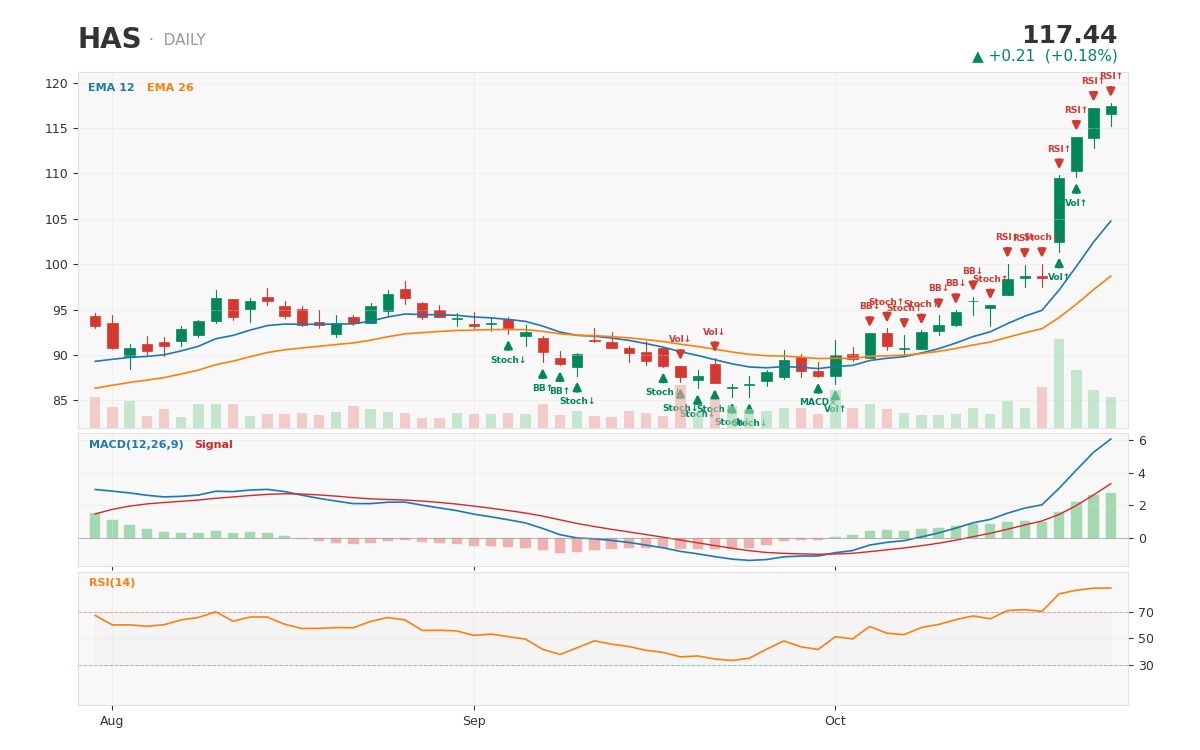 Hasbro daily chart with technical signals, through the Oct 23 close
Institutional Ownership Supports the Story, While Targets Have Not Caught Up
The positioning data does not show a rush of insider buying. There were no insider trades in the last 45 days, and earlier reported transactions included sales by Holly Barbacovi and Timothy Kilpin. Those sales do not establish a bearish signal because one involved tax withholding on vesting, but the absence of recent insider purchases removes a potential confirmation of the rally.
Longer-term institutional positioning is more supportive. Reported holdings include 3.74 million shares associated with Andreas Halvorsen, 1.22 million held by Ken Griffin, and 0.90 million held by Steven Cohen. Those positions show that several sophisticated investors have exposure, but they are holdings rather than evidence of fresh buying after the earnings release.
Analyst targets show the market struggling to update quickly enough. Citi raised its target to $137, and BNP Paribas Exane raised its target to $127, while Roth reaffirmed a Buy rating. However, the broader published consensus remains $110.60, below the $117.44 closing price, with a range of $95 to $125.
That spread is informative rather than merely inconsistent. The newer targets recognize the upgraded earnings trajectory, while the older consensus still reflects the pre-report view. The stock now trades above the older consensus, and whether the rest of the published targets move toward the newer ones will show how many analysts accept the higher earnings base.
At a trailing price-to-earnings multiple of roughly 17, Hasbro is not priced like a distressed toy manufacturer. The valuation is still defensible against the raised EBITDA outlook and improved cash flow, but the market now requires execution. With the stock above most published targets, further upside must come from estimates moving higher, not simply from investors paying the old estimates a richer multiple.
What the Evidence Adds Up To
Hasbro’s composite score is 64, well below its perfect technical readings. The price trend is stronger than the broader quantitative reading, and the market is already rewarding the catalyst before the new earnings level has been proven.
The strong side rests on several independent pieces that agree. Wizards and Magic are accelerating, Consumer Products has grown for four straight quarters, cash flow is up, inventory is lower, debt is falling, guidance went up, and the buyback target doubled. That is a firmer foundation than the 19% weekly move alone.
The cautions are just as specific. The quarter included approximately $55 million of tariff refunds and about $40 million of Magic sales pulled forward from the fourth quarter. The full-year guide implies fourth-quarter revenue falls about 4% to 10%. Wizards margin is expected to drop into the high 30s in 2027 as video-game amortization begins.
What to watch from here:
- Fourth-quarter Magic sales against a comparison that lost about $40 million to the third quarter.
- Consumer Products margin without tariff refunds. That segment earned roughly $130 million in the third quarter excluding the $48 million refund benefit.
- Analyst targets. Citi is at $137 and BNP Paribas Exane at $127, while the broader consensus of $110.60 sits below the price.
- The 2027 slate. That means six major Magic sets, and Exodus launching April 7, 2027.
Hasbro has shown a higher earnings base. Its next report, expected around February 9, will show how much of the third quarter carries over once the refunds and the pulled-forward Magic sales are gone.
Want deeper research on any stock? Try Kavout Pro for AI-powered analysis, smart signals, and more. Already a member? Add credits to run more research.