HNGE: When the Co-Founder Cashes Out $22.4 Million Into a 90% Winner, and the Technicals Are Already Flashing Red

Key Takeaways
- The CEO and co-founder sold 250,000 shares ($22.4M) on Sept 10 with no pre-arranged plan reported, while the CFO’s $4.97M sale that same day came from a June trading plan — a distinction that separates a personal monetization from a scheduled liquidity event.
- Hinge Health’s Q2 was its best quarter as a public company — 53% revenue growth, 86% gross margin, GAAP net income — yet every near-term technical signal has turned bearish, pinning the stock 6% off its 52-week high on the day the insider selling hit.
- With a 9.5x sales multiple on a GAAP-profitable, accelerating business and zero sell-side sells, the bull case is intact but is now priced for perfection, making the insider selling and technical deterioration a warning that the risk/reward is no longer one-sided.
The Insider Sales: Two Clocks, Two Stories
September 10 was a heavy day for insider transactions at Hinge Health. The co-founder, CEO, director, and 10% owner — all four roles held by one person — sold 250,000 shares at $89.45 for proceeds of $22.4 million. On the same day, the CFO James Budge sold 55,561 shares across five tranches priced between $88.22 and $91.62, totaling roughly $4.97 million. His sale was made under a Rule 10b5-1 trading plan adopted June 11, 2026, meaning the timing was set three months in advance, well before the Q2 results came out. The CEO’s sale has no plan reported in the filings; it was a discretionary decision.
These are not the only recent sales. The company’s president sold $2.9 million worth of shares on August 21 at $88.05, and an independent director sold $106,000 on September 4, trimming 4% of her position. In aggregate, more than $30 million of insider selling has come through in the past three weeks, all of it following a quarter that the Street called spectacular and after lockups expired in November 2025 — this is not a forced lockup-related exit.
The CFO’s plan-based sale is predictable and unremarkable; executives adopt them to sell shares on a schedule without market-timing concerns. The CEO’s sale is the signal that demands attention. A founder who holds a 10% stake, with the company trading nearly 90% above the IPO price of $32, monetizing $22 million in a single day without a pre-announced plan is a textbook “founder monetization at the peak of a run.” The stock is up ~177% from its first-day close of $37.56. A triple from the first-day close was within reach just a week ago (the 52-week high is $95.57). The founder chose to take chips off the table at $89.45, not at the high.
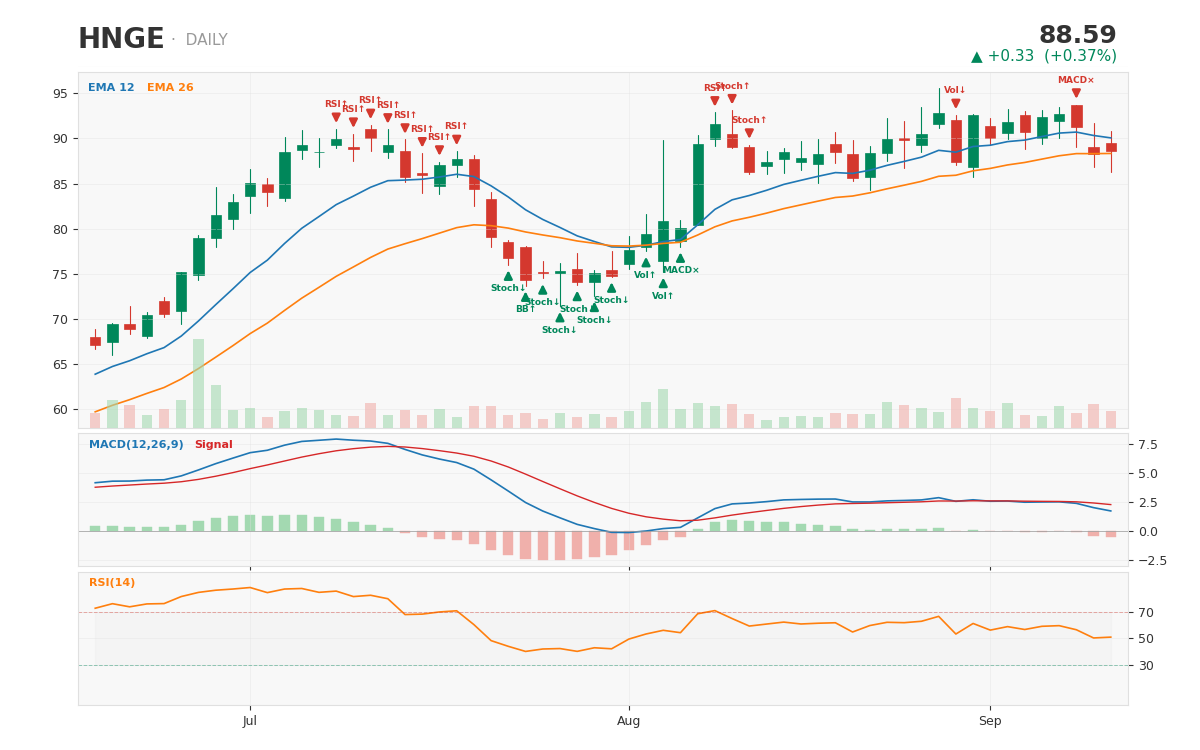 HNGE daily chart with technical signals — captured at $88.59, ~177% above its 2025 IPO price, on the Form 4 date the co-founder sold 250,000 shares and the CFO sold 55,561 under a June trading plan
The Quarter That Justified the Rally
Hinge Health’s Q2 2026 numbers, reported August 4, were the strongest of its young public life. Revenue hit $212.8 million, up 53% year-over-year from $139.1 million. Gross margin under GAAP was 86%, and GAAP net income reached $43.1 million — a profitable digital health company that went public just 16 months ago. Non-GAAP operating income was $61.5 million, a 29% margin. The company raised its full-year 2026 outlook.
On top of the core musculoskeletal business, the $105 million acquisition of Cylinder added roughly 100 clients and 2 million covered lives, opening access to a $135 billion gastrointestinal care market. It is a logical bolt-on: Hinge already manages musculoskeletal conditions for large employers and health plans; adding GI creates a two-specialty platform. The move was well received; Jim Cramer called the quarter “what a quarter they had” and recommended buying the stock.
The fundamentals are accelerating, margins are expanding, the addressable market is growing via acquisition, and the company is GAAP-profitable. This is the kind of story that earns a high multiple. The question is how much of that story is already in the price.
What the Price Already Assumes
At $88.59, Hinge Health carries a market cap of $6.86 billion. Trailing twelve-month revenue works out to roughly $722 million (using the Q2 run rate), putting the price-to-sales ratio at 9.5. The TTM GAAP net margin is 15.1%, so the P/E on trailing earnings is 65.8. The EV is $6.57 billion, below the market cap because the company holds net cash — a clean balance sheet that gives it acquisition firepower but does not cheapen the equity.
A 9.5x sales multiple on a company growing revenue at 53% is not unreasonable for a high-growth software-like business, but it is lofty for a company that derives a meaningful portion of its revenue from clinical service fees. The Street’s median analyst target is $105, roughly 18% above the current price, with a range from $65 to $125. Fifteen analysts rate it a buy, one holds, and none recommend selling. That is unanimous bullishness, and it sets a high bar for the stock to continue outperforming.
Compare the current valuation to where the stock was when it became profitable. At the time of its first GAAP-profitable quarter, the stock was trading around $60–$70. The P/S multiple has expanded as profitability and growth accelerated. The bull case says it deserves to trade like a high-margin SaaS company. The bear case says 9.5x sales on a business that still has execution risk around the Cylinder integration and competitive pressure in digital MSK is a full price, not a bargain.
The Technical Picture: Exhaustion at the Top
While the fundamentals are strong, the price action is not confirming it. On September 11, the stock closed at $88.59, down 0.37% and 6% below the 52-week high of $95.57 from a few weeks ago. The stock fell each of the last three days of the week, from $93.76 on September 8 down to $86.29 intraday on September 11 before recovering slightly. Volume was above average on the down days, a sign of distribution.
The technical signal set from our models is uniformly bearish. The composite score — a single aggregate rating — stands at 44 out of 100, which is weak. Every trend-following indicator has flipped: the Ichimoku cloud turned bearish, the ADX trend strength reading turned bearish, and the SuperTrend issued a sell signal. The Moving Average Convergence Divergence is in a downtrend, and On-Balance Volume is falling, meaning volume is declining on rallies and rising on pullbacks. The stock is trading below its Volume-Weighted Average Price, and the VWAP itself is declining. Finally, the stock is underperforming the broader market — a clear sign of relative weakness.
This combination of signals — all eight bearish across trend, volume, and momentum — tells a consistent story: the buyers who drove the stock from the mid-30s to the mid-90s are taking profits. That happens to coincide with the insider selling. It is not a coincidence; the people who know the business best are selling into this weakness, not into strength.
Insider Selling vs. Analyst Consensus: Who Has Better Information?
The consensus among analysts is 15–1–0 with a median $105 target, implying the stock is a buy. The CEO, CFO, and president have collectively sold $30 million in the past three weeks, with the CEO’s sale being unscheduled and large relative to his position. These are not marginal players trimming a few shares for tax planning; this is a material reduction by the founder.
Who is right? Analysts rely on public information — the Q2 results, the Cylinder deal, the raised guidance. Insiders have private knowledge of sales cycles, client retention, pipeline strength, and integration progress. The fact that the CEO chose to sell in the open market, not through a pre-arranged plan, suggests he wanted discretion over timing. When a founder with a long-term horizon sells a chunk of his stake at $89.45 — below the 52-week high and after a sharp run — the signal is that he values those dollars more than the next leg of upside. That does not mean the business is broken. It means the risk/reward at this level is sub-optimal for someone who knows the numbers intimately.
The best reconciliation is that Hinge Health is a great company at a stretched price. The insider selling does not invalidate the growth story, but it does argue that the easy money has been made. The next 50% gain, if it comes, will take years and require flawless execution, not just multiple expansion.
What Would Change the Picture
The bull case would be confirmed if the stock holds support above the $85 area and resumes its uptrend, or if the next earnings report shows a further acceleration in revenue growth and margin expansion. The bear case would be validated if selling volume continues to mount and the stock breaks below $80, which would negate the entire post-IPO uptrend and likely trigger further insider selling.
The wild card is the Cylinder integration. If the GI platform ramps revenue faster than expected, the multiple could expand. If it distracts management or fails to gain traction, the stock has downside to the $60–$65 range, where the analyst low target sits.
Verdict
This is a stock to watch, not to chase. The fundamentals are genuinely strong — a GAAP-profitable digital health company growing 53% with 86% gross margins is rare. But the insider selling, the unanimous bullish consensus (which often marks a top in sentiment), and the uniformly bearish technicals create a tension that argues for patience.
Entry zone: $75–$80, where the stock would trade closer to 8x sales and offer a better risk/reward. That zone also aligns with the February 2026 consolidation level before the breakout.
12-month target: $110, based on a 10x forward P/S on projected 2027 revenue of roughly $1.1 billion. That is above the median analyst target but assumes the growth story stays intact.
Invalidation level: $72, a break below the August 2025 lockup-expiry lows. If the stock loses that level, the post-IPO uptrend is broken, and the insider selling would look prescient.
The co-founder sold $22 million of a 90 percent winner. That is what winners look like when they become fully valued. The art is knowing when to follow the insider and when to trust the earnings. Right now, the signals say wait for a better price.
Want deeper research on any stock? Try Kavout Pro for AI-powered analysis, smart signals, and more. Already a member? Add credits to run more research.