LNTH Won the FDA Approval It Wanted. The Stock Had Already Moved

Key Takeaways
- Lantheus received final FDA approval for BRAVNETSA, formerly PNT2003, through the ANDA pathway. The FDA determined that it is bioequivalent and therapeutically equivalent to Lutathera, making it the only radiopharmaceutical with that determination and the first radiopharmaceutical approved through the abbreviated pathway.
- LNTH closed at $100.26 on September 22, down 0.02%. The most defensible interpretation is that investors had substantial time to assess the program after the January 2024 filing and March 2026 tentative approval, not that the market rejected the product.
- The regulatory milestone is now behind the company. The investment question is whether Lantheus can execute a thoughtful launch with reliable supply and broad patient access. At $100.26, I would hold existing shares but would not chase the approval without evidence of commercial progress.
The Approval Is Significant, but It Is Not a New Clinical Breakthrough
Lantheus has received final FDA approval for BRAVNETSA, a lutetium Lu 177 dotatate treatment for adults with SSTR-positive gastroenteropancreatic neuroendocrine tumors. The approval came through an abbreviated new drug application, or ANDA. It is the first radiopharmaceutical approved through that abbreviated pathway.
The more important distinction is the FDA's equivalence determination. According to the company announcement, BRAVNETSA is the only radiopharmaceutical the FDA has determined to be bioequivalent and therapeutically equivalent to Novartis' Lutathera. The accurate description is an equivalent product approved through the ANDA pathway, not a biosimilar.
That distinction matters because BRAVNETSA did not need to establish a separate clinical record through its own pivotal efficacy trial. Its commercial opportunity rests on offering an equivalent version of an established reference product. The regulatory route reduces the need to repeat the reference product's full development program, but it does not guarantee that physicians, treatment centers, payers, or patients will change their existing choices.
The reference product's evidence is substantial. Lutathera's NETTER-1 phase 3 trial reported a progression-free-survival hazard ratio of 0.21 against octreotide alone. Median progression-free survival was not reached for Lutathera versus 8.5 months for the control group, and median overall survival was 48.0 months versus 36.3 months.
Those are Lutathera results, not BRAVNETSA results. The distinction is central to the investment case. Lantheus is not claiming that BRAVNETSA produced a new efficacy result in NETTER-1. It is seeking to use the established reference product's clinical position through the FDA's bioequivalence and therapeutic-equivalence determinations.
That makes this a powerful regulatory event, but not a conventional clinical catalyst. The FDA has removed a major question about whether the product can enter the market through the abbreviated route. The remaining questions are commercial: how reliably it can be supplied, how broadly it reaches treatment centers, and whether the economics support meaningful share capture.
The Timeline Explains Why the Stock Did Not Reprice
Lantheus filed its first-to-file ANDA in January 2024. The product received tentative approval in March 2026, with the earlier approval held back by Lutathera patent protections. Final approval arrived on September 22, 2026.
That sequence gave investors a long period to assess the likely outcome. The final approval was important because it completed the regulatory process, but it was not the first indication that BRAVNETSA could become a commercial product. The filing created the opportunity, and tentative approval increased confidence in the regulatory path. The final decision removed the remaining approval uncertainty described in the supplied evidence.
LNTH closed at $100.26 on the approval day, down 0.02% from the previous close. The stock was reported to have opened around $100.31 on thin volume, but the available evidence does not establish a detailed volume-based reaction beyond the flat close. The fact that the shares did not rise sharply is clear; the precise reason for that reaction is not.
The leading explanation is that much of the approval's expected value had already been incorporated into the stock. That is an inference from the two-year timeline, not a fact that can be observed directly from one day's trading. The flat close does not prove that every investor had reached the same conclusion, and it does not prove that BRAVNETSA has no value. It says that final approval, by itself, was not enough to create a major change in the market price.
The proposed sale of Lantheus for $102 per share is another relevant piece of context in the supplied market news. At $100.26, the stock was $1.74 below that figure, or approximately 1.7% lower. That proximity may limit the market's willingness to assign an open-ended premium to a single corporate announcement, although the evidence does not establish that the proposed transaction caused the flat reaction.
The practical conclusion is narrower and more useful: investors should not treat the unchanged approval-day price as a verdict on BRAVNETSA's commercial prospects. Nor should they treat the approval as an unpriced surprise. The market had time to model the regulatory outcome. The next reassessment is more likely to depend on what Lantheus does with the approval.
The Technical Signals Are Positive, but They Do Not Make the Catalyst a Buy
The supplied daily signal set is broadly constructive. Nine of ten tracked signals were positive, including an uptrend, performance ahead of the market, a rising volume-weighted average price, and rising on-balance volume. The one negative reading was money flow.
The useful interpretation is not that every signal independently creates a buy case. It is that the stock entered the approval announcement with an existing positive trend rather than a visibly broken one. The negative money-flow reading is a reason not to treat the group of positive signals as unanimous confirmation of aggressive new buying.
The broader quantitative score was 66 out of 100, while the technical rating was 33 out of 100. Those figures point in different directions. The broader score is favorable, but the lower technical rating does not support the idea that the approval triggered an unusually powerful near-term momentum signal.
The stock also did not produce a meaningful approval-day price move. That matters more to the catalyst thesis than the number of green indicators. A positive trend can coexist with a flat response to new information. In this case, the technical evidence supports patience: the shares have not obviously broken down, but the tape does not show a reason to pay a large premium simply because final approval has arrived.
This is also where the technical data has limits. The dossier supplies signal labels and summary scores, but not a full history of the calculations or a defined support level. It is therefore reasonable to describe the setup as constructive, but not to present the indicators as proof that the stock will rise or that buyers are about to force a repricing.
Valuation and Cash Support the Business, Not the Trade
Lantheus has a trailing price-to-earnings ratio of 23.9 and a price-to-sales ratio of 4.2. Its return on equity is 23.3%, and its return on assets is 11.4%. These figures describe a profitable operating company rather than a pre-revenue approval gamble.
The balance sheet is also relatively supportive. Cash was $593 million against $571 million of debt, a difference of approximately $22 million in cash above debt. That is a near-net-cash position by simple subtraction. It gives Lantheus more flexibility than a heavily indebted company would have as it prepares for commercialization.
The balance sheet should not be overstated. The supplied figures do not show how much Lantheus will spend on manufacturing, distribution, patient access, or commercial infrastructure. They also do not show the margin it can earn if it uses pricing to compete with Lutathera. Near-net cash reduces one source of financial pressure; it does not establish launch economics.
The valuation tells a similar story. A P/E of 23.9 and P/S of 4.2 do not suggest that investors are valuing Lantheus as though BRAVNETSA will fail. But they also do not show that the market is offering a distressed entry price. The business has an operating base, and the share price requires investors to believe that the company's future execution will justify the current valuation.
That is why the approval is better viewed as a change in the type of risk than as the elimination of risk. Regulatory uncertainty has declined. Commercial uncertainty remains. The cash position can help Lantheus address that uncertainty, but it cannot make treatment centers adopt the product or guarantee that patients will receive it on schedule.
The Street Sees Limited Near-Term Upside
The consensus analyst target is $104.48, approximately 4.2% above the current price of $100.26. The median target is $102.50, with a range of $94 to $120. The rating distribution is 11 buys, 8 holds, and 0 sells.
The figures are favorable in tone but modest in price implication. The zero-sell count argues against a clear bearish consensus. The consensus target, however, offers only limited upside from the approval-day close. The median target is also close to the reported $102 proposed-sale price.
That combination does not prove that analysts have fully valued the approval. It does show that the available target data does not describe a large, universally expected revaluation. The $120 high target leaves room for a more successful launch scenario, while the $94 low target shows that some published views place the shares below the current price.
The analyst data is therefore useful as a boundary around expectations, not as a precise valuation model. It cannot tell investors whether BRAVNETSA will win meaningful share, and it cannot substitute for launch evidence. It does tell a prospective buyer that the apparent upside to the central estimate is small enough that execution disappointment could matter more than a modest approval-driven gain.
For existing holders, that supports waiting rather than selling solely because the stock did not rise. For new buyers, it weakens the case for chasing the headline at $100.26.
Launch Execution Is the Next Test
Chief Executive Mary Anne Heino described the company's focus as a “thoughtful launch” with reliable supply and broad patient access. Those are the right areas for investors to monitor because the dossier provides no launch timing, pricing, or revenue guidance.
A radiopharmaceutical can be approved and still face practical commercialization challenges. Reliable supply matters because treatment scheduling depends on product availability. Patient access matters because an approved therapy does not create value if reimbursement or distribution prevents patients from receiving it. Treatment-center reach matters because the product must become usable in the settings where these therapies are delivered.
The incumbent also has an advantage that the approval does not erase: Lutathera has an established clinical record and existing familiarity in treatment pathways. BRAVNETSA's equivalence determination may make the adoption argument easier than it would be for an unproven therapy, but it does not guarantee that providers will switch or that purchasers will immediately favor the new product.
The bull case is therefore credible. Lantheus has a product that the FDA determined to be bioequivalent and therapeutically equivalent to Lutathera, and it can point to the reference product's established NETTER-1 efficacy record. That is a stronger starting point than an ordinary development-stage launch.
The bear case is also specific. The company may struggle to translate regulatory equivalence into reliable supply, broad access, or share capture. The supplied evidence does not allow an estimate of launch revenue or pricing, so any claim that BRAVNETSA will quickly transform Lantheus's results would be speculation.
The first useful evidence will be operational rather than rhetorical. Investors should look for signs that the company is delivering on reliable supply and broad access, then assess whether that progress is reflected in adoption and economics. Until those data points arrive, the approval supports the business case more clearly than it supports a near-term trading call.
Ownership Data Adds No Fresh Catalyst
Farallon Capital is the largest holder with 5.58 million shares. The supplied ownership figures also list Cohen with 974,000 shares, T. Rowe with 920,000, Griffin with 285,000, Dalio with 44,000, and Greenblatt with 23,000. There were no reported insider transactions in the 30-day window and no reported congressional transactions.
This information does not establish that those holders support BRAVNETSA, expect a sale, or intend to hold through launch. It simply provides no reported evidence of a new ownership event that would independently explain a repricing.
The absence of insider activity is neutral. There was no reported insider purchase to reinforce the bullish case and no reported insider sale to weaken it. The same is true of the congressional-transaction data.
The ownership figures should therefore remain a secondary consideration. They do not overturn the flat approval-day reaction, and they do not supply the missing commercial evidence. The central question remains whether Lantheus can execute the launch it has described.
Hold Existing Shares; Do Not Chase Without Launch Proof
Lantheus has achieved a meaningful regulatory outcome. BRAVNETSA is the only radiopharmaceutical the FDA has determined to be bioequivalent and therapeutically equivalent to Lutathera, and it is the first radiopharmaceutical approved through the abbreviated pathway. The January 2024 first-to-file ANDA, March 2026 tentative approval, and September 2026 final approval show why the market had time to anticipate the event.
The stock's response is equally important. LNTH closed at $100.26, down 0.02%, rather than producing a major approval-day gain. The most reasonable reading is that the regulatory milestone was substantially anticipated, although the data cannot prove that was the only cause. The proposed $102 sale price and analyst targets near the current share price also limit the case for an immediate, large revaluation.
My stance is hold for existing shareholders and avoid chasing for new buyers. Existing holders have a reason to wait for evidence because the regulatory uncertainty has declined and the company has a near-net-cash balance sheet. New buyers do not have the same advantage: the consensus target implies only about 4.2% upside, while the launch's timing, pricing, and revenue contribution remain undisclosed.
A rough $94-to-$100 entry area is more attractive than paying above the current price, but it should not be treated as technical support. The lower end is simply the low published analyst target, and the upper end is the current price. A move below $94 would not prove that BRAVNETSA is failing; it would show that the market's published valuation range no longer supports the current level and would require investors to reassess the launch, the proposed transaction, or broader earnings expectations.
The fact worth remembering is simple: Lantheus has won the regulatory argument, but the approval is now the starting point for commercialization rather than the end of the investment case. Until reliable supply, broad patient access, and actual share capture become visible, the flat reaction is a reason for discipline, not a reason to chase the headline.
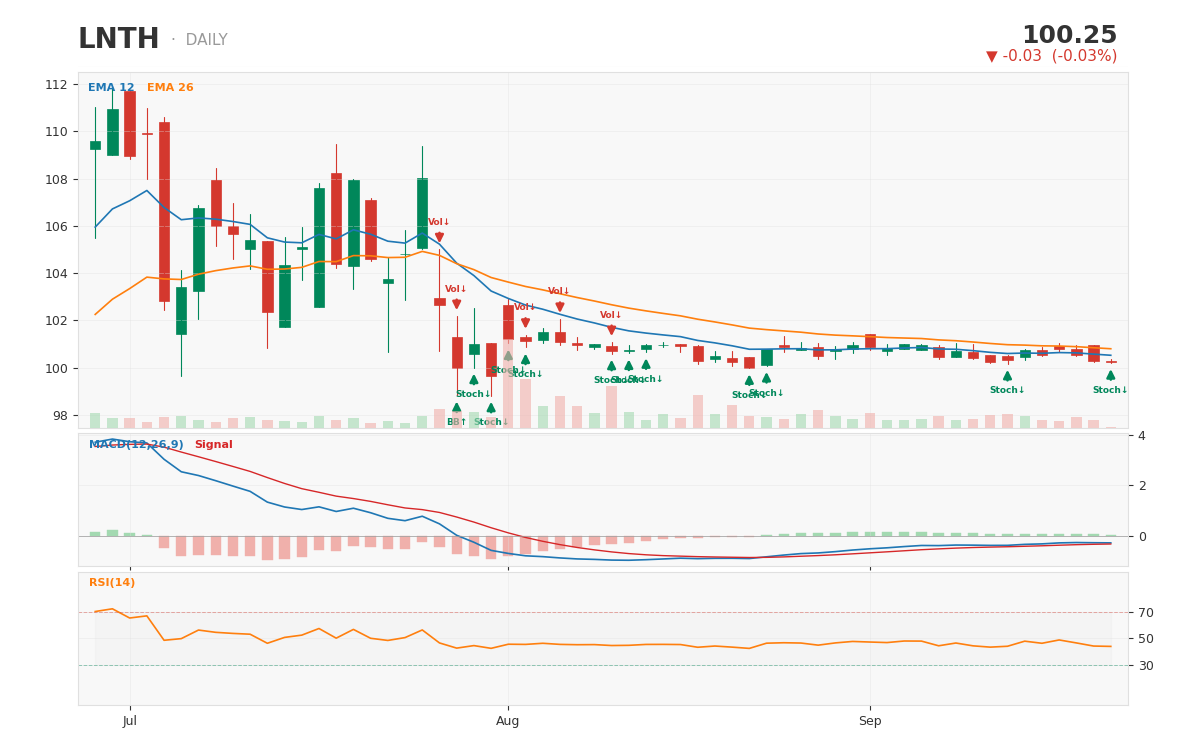 LNTH daily chart with technical signals -- captured at $100.26 on the day the FDA approved BRAVNETSA, the only bioequivalent Lutathera, and the stock closed flat
Want deeper research on any stock? Try Kavout Pro for AI-powered analysis, smart signals, and more. Already a member? Add credits to run more research.