NuScale Power: $75,000 in Revenue, a $750 Million Share Sale, and an 84% Drop from Highs — Is Dilution Worth the Dream?
Key Takeaways
- NuScale Power (SMR) reported just $75,000 in Q2 revenue and separately announced a $750 million share sale, implying approximately 21% dilution to existing shareholders at current prices.
- Despite extreme revenue figures and ongoing cash burn, NuScale holds a clean balance sheet with zero debt, anchored by a potentially transformative Tennessee Valley Authority (TVA) / ENTRA1 energy deal.
- The stock has plummeted 84% from its 52-week high and is deeply oversold on momentum indicators, yet trend-following signals confirm it remains in a downtrend, reflecting profound investor uncertainty.
The Extreme Disconnect: Near-Zero Revenue Against Massive Dilution
NuScale Power (SMR), a company at the forefront of small modular reactor (SMR) technology, recently found itself in a paradoxical position: reporting negligible revenue just weeks before announcing a substantial share sale. On August 5, 2026, NuScale announced its second-quarter 2026 earnings, reporting a quarterly loss of $0.13 per share, which aligned with consensus expectations. The striking figure, however, was revenue, which plummeted 98.8% year-over-year to a mere $75,000, down from $8.1 million a year earlier. This dramatic decline was attributed to the natural winding down of milestone-driven engineering work from previous contracts, rather than a loss of ongoing business, typical of a lumpy, milestone-driven revenue model.
Approximately two weeks later, on August 18, NuScale announced plans for a $750 million share sale. This news, combined with the already announced weak revenue, triggered a 6% drop in the stock that day. The scale of this potential dilution is significant: at NuScale's current market capitalization of $2.77 billion and recent closing price of $9.29 per share, the company has approximately 298 million shares outstanding. An offering of $750 million, if executed entirely in new shares at approximately the current price, would introduce roughly 80.7 million new shares. This illustrative calculation points to approximately 21% dilution for existing shareholders, a substantial figure that demands scrutiny against the company's near-term prospects.
A Clean Balance Sheet and a Potentially Transformative Catalyst
While NuScale’s revenue figures are undeniably stark, and the company experiences substantial ongoing cash burn (evidenced by a negative free cash flow of $4.74 per share and a yield of -28.0%), a deeper look at its financial health reveals important mitigating factors. The balance sheet remains remarkably robust, characterized by a current ratio of 37.88 and, critically, zero debt. This strong liquidity position, coupled with no leverage, suggests that NuScale’s immediate challenge is the timing of revenue generation rather than solvency. It's important to note that while some trailing twelve-month (TTM) margin percentages appear extremely negative (e.g., -6,854.0% operating margin), these figures are mathematically distorted by near-zero trailing revenue in the denominator, not by suddenly exploding costs.
Beyond the balance sheet, the narrative around NuScale is heavily influenced by a major, precisely dated catalyst: the Tennessee Valley Authority (TVA) / ENTRA1 deal. This agreement holds the potential for 6 to 8 gigawatts of new nuclear capacity, which NuScale’s CEO has called "the largest nuclear build-out in U.S. history." Under the announced structure, ENTRA1 Energy will develop, finance, own, and manage the plants, with NuScale playing a technology-licensing and equipment-supply role. As part of this complex arrangement, NuScale has already recorded a significant $507.4 million expense, representing a milestone payment it made to ENTRA1. This unique payment structure highlights NuScale's pivotal role in enabling the project. However, it is essential to acknowledge NuScale's past; the company has faced significant customer cancellations, a precedent that underscores the execution risks inherent in such large-scale, long-cycle projects. Regulatory hurdles have been cleared, aligning with renewed demand for clean energy, particularly from data centers driven by AI.
Deep Discount from Highs, But Volatility Dominates Price Action
The backdrop to NuScale's current situation is a dramatic collapse in its stock price. Trading at $9.29 as of August 28, 2026, the stock is down approximately 84% from its 52-week high of $57.42, which it reached last October. This represents a substantial swing in market sentiment, with the stock having plunged to a 52-week low in July 2026 before a mild bounce. Year-to-date, NuScale Power has fallen roughly 32%.
The recent price action for SMR has been characterized by extreme volatility and choppy, whipsaw movements, rather than a clear directional trend. In just the past two weeks, the stock recorded a 6% decline on August 18 following the share sale news, another 5% drop on August 20, a 5% rebound on August 25, a 7% fall on August 26, a 4% gain on August 27, and a 4.77% decline on August 28. This daily swing reflects the unresolved uncertainty weighing on the stock.
Technically, NuScale presents a two-sided picture. Momentum indicators like RSI and Stochastic show the stock is deeply oversold, suggesting it may be due for a relief rally. However, trend-following measures indicate the stock remains firmly in a downtrend, with indicators like the ADX signaling a bearish trend and a MACD bearish cross confirming the underlying negative momentum. This combination of deeply oversold readings within a confirmed downtrend is consistent with the recent choppy price action, signaling that while selling pressure may temporarily abate, a definitive reversal is not yet at hand.
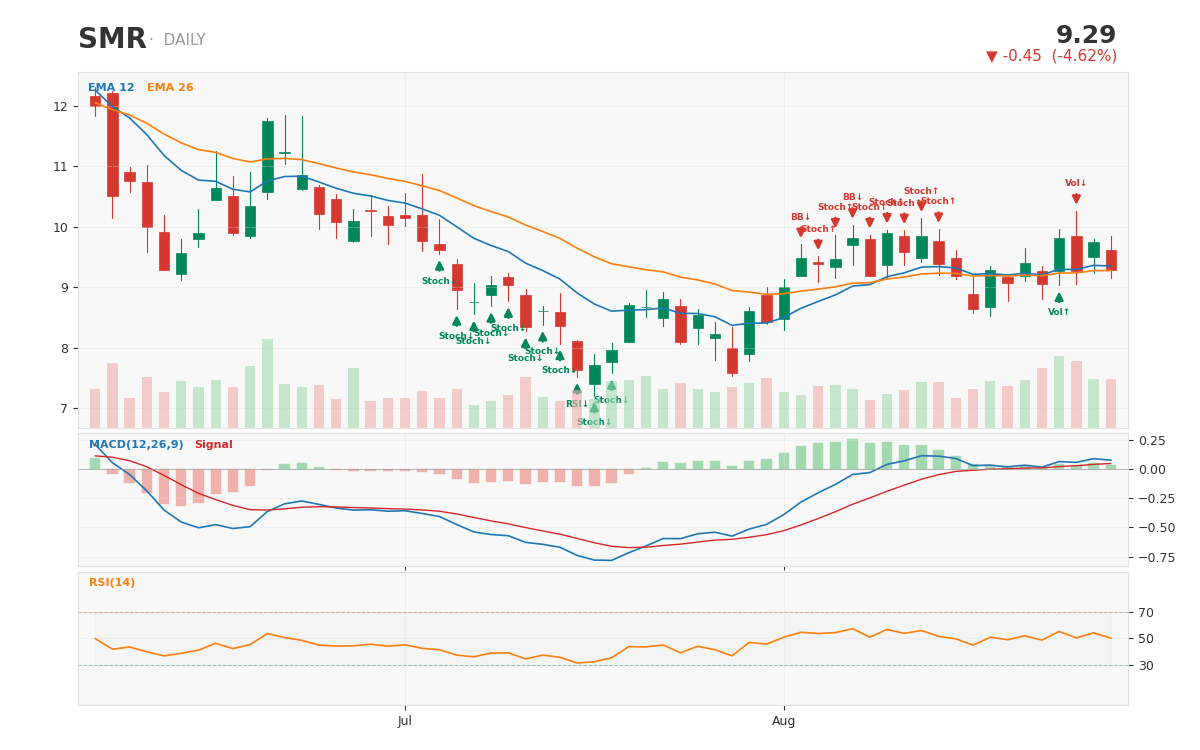 NuScale Power 1-year daily chart with technical signals -- a stock down roughly 84% from its 52-week high, deeply oversold on momentum measures but still confirmed in a downtrend by trend-following indicators
Smart Money Split: Insider Selling vs. Institutional Buying
The activity of "smart money" provides a genuinely mixed signal for NuScale, highlighting the divergent views among sophisticated investors. On one side, recent insider activity points to sales. Over the last month, three key executives divested shares: Chief Financial Officer Robert Ramsey Hamady sold 29,880 shares on August 27 at $9.39, Director Shinji Fujino sold 20,000 shares on August 18 at $8.86, and Chief Operating Officer Carl M. Fisher sold 18,771 shares on August 5 at $9.36. It is a factual observation that these sales coincided with significant news events, such as Q2 earnings and the share sale announcement. While this could be due to pre-scheduled selling plans, the timing stands out.
Conversely, institutional investors and options traders have demonstrated bullish conviction. Bank of America Corp DE significantly increased its position in NuScale by 33.4% to 2.06 million shares, as disclosed in a Q1 SEC filing on August 18. Similarly, Bank of New York Mellon boosted its holdings by 21.9% to 482,517 shares, disclosed on August 6. Furthermore, options market activity on August 21 showed distinctly bullish flow, with call volume twice the expected level (36,675 contracts), implied volatility rising over 4 points to 81.04%, and a Put/Call ratio of 0.36, indicating a meaningful skew towards speculative calls. Meanwhile, prominent gurus like Jim Simons, Ken Griffin, Paul Tudor Jones II, Steven Cohen, and George Soros hold stakes in NuScale. This combination of institutional accumulation and bullish options positioning directly counterbalances the recent insider selling, suggesting a genuine divergence in "smart money" sentiment on SMR's near-term trajectory.
Explore this yourself: See live 13F, guru, and insider flow on Kavout Smart Money
Sell-Side Consensus Maintains Optimism Amidst Bearish Voices
Sell-side analyst sentiment towards NuScale Power is net bullish, but the consensus is far from unanimous, reflecting the underlying uncertainties. The current median price target for SMR stands at $12.00, implying approximately 29.2% upside from the recent price of $9.29. Individual targets range widely, from a low of $9.00 to a high of $16.00. The overall grade is a "Buy," with 8 buy ratings, 5 hold ratings, and 3 outright sell ratings.
The presence of three "Sell" ratings on a company like NuScale is a meaningful signal of skepticism within the analyst community, not merely a statistical outlier. Notably, the lowest analyst target of $9.00 sits essentially at the current trading price, suggesting that the bear case anticipates no further re-rating from present levels, rather than a precipitous decline. This split in analyst opinion aligns with the volatile price action and mixed smart money signals, underscoring that while a segment of the market remains optimistic about NuScale's long-term potential, a significant portion harbors reservations regarding its near-term execution and valuation. Earlier in August, some analysts had projected a higher upside of 56.21%, reflecting the rapidly shifting landscape around the stock.
The High-Stakes Bet on Project Execution
NuScale Power (SMR) presents a high-conviction, high-risk proposition currently priced for a future far removed from its present financial realities. The dramatic disconnect between $75,000 in quarterly revenue and its $2.77 billion market capitalization, compounded by substantial dilution, would typically signal distress. Yet, the company’s pristine balance sheet and the massive, real catalyst of the TVA/ENTRA1 deal offer a compelling, albeit speculative, counter-narrative. The market is effectively weighing the short-term financial challenges and dilution against the long-term potential of its SMR technology becoming a cornerstone of energy infrastructure.
Given the deeply oversold technicals that conflict with a confirmed downtrend, alongside the split in smart money activity and analyst sentiment, the immediate-term price action will likely remain volatile. Investors should recognize this is not a story of incremental growth but one of potential binary outcomes: either the ambitious SMR projects materialize into substantial, recurring revenue, or the current valuation proves unsustainable. The immediate future hinges on tangible progress in converting its technological promise into contracted business. The existence of three sell ratings, with the lowest target essentially at the current price, highlights the real risk that the stock could fail to re-rate if this catalyst does not fully deliver.
Want deeper research on any stock? Try Kavout Pro for AI-powered analysis, smart signals, and more. Already a member? Add credits to run more research.