Pelosi Bought Millions, Then a Securities Fraud Suit Named the CEO, Then Two Former Fortune-500 CEOs on the Board Sold

Key Takeaways
- Bloom Energy Corporation (BE) is facing a pending securities class action, alleging misrepresentation of its China supply chain, with CEO K. R. Sridhar among the named defendants. The lead-plaintiff motion deadline is September 28, 2026.
- Rep. Nancy Pelosi's spouse made substantial purchases of BE stock and options in late July 2026, totaling between $2.5 million and $11 million across multiple disclosed ranges, critically after the alleged class period ended on July 8, 2026.
- Concurrently, two highly prominent board members—former GE CEO Jeffrey Immelt and former Cisco CEO John Chambers—sold a combined approximately $14 million in BE stock in August 2026, part of a broader cluster of insider selling totaling $16.3 million.
Bloom Energy Faces Allegations of China Supply Chain Misrepresentation
Bloom Energy (BE) is currently embroiled in a securities class action, a central and ongoing story shaping much of the company's recent news. Multiple independent law firms have issued press releases since late August, collectively describing a core allegation: Bloom Energy allegedly misrepresented its supply chain by routing Chinese-sourced scandium and components through intermediaries in Thailand, Japan, South Korea, India, and Taiwan, while telling investors it had "no China supply chain."
The lawsuit identifies four current and former Bloom Energy officers, including CEO K. R. Sridhar, as individual defendants. The alleged class period for these claims ran from February 27, 2025, through July 8, 2026. Investors who purchased securities during this window face an upcoming lead-plaintiff motion deadline of September 28, 2026. It is crucial to underscore that these are allegations, and the legal process is still unfolding, with no established findings of wrongdoing. The substantial volume of near-identical press releases from various law firms regarding this case reflects standard investor-solicitation practices for newly filed class actions, not escalating new developments with each publication.
Pelosi's Timed Purchases Contrast with Board-Level Insider Exits
Against the backdrop of the pending securities class action, trading disclosures show a notable cluster of activity from both congressional members and Bloom Energy's own corporate insiders. Congressional trading data confirms that Rep. Nancy Pelosi's spouse made multiple Bloom Energy-related purchases in late July 2026. These included a purchase of BE stock on July 24, valued between $1,000,001 and $5,000,000, and two BE stock option purchases—one on July 24 in the $1,000,001 to $5,000,000 range, and another on July 28 valued between $500,001 and $1,000,000. Across these disclosed transactions, the total value of Pelosi's spouse's Bloom Energy purchases is estimated to be between $2.5 million and $11 million.
An important sequencing detail: these purchases, made on July 24 and July 28, occurred 16 to 20 days after the alleged securities class action period concluded on July 8, 2026. This timing is critical for readers to understand the context of these transactions.
Conversely, Bloom Energy's corporate insider data reveals a distinct pattern of selling during the same period. Two particularly notable board members, Jeffrey R. Immelt, former Chairman and CEO of General Electric, and John T. Chambers, former Chairman and CEO of Cisco, significantly reduced their stakes in August 2026. Immelt sold 30,000 shares on August 17 at $238.91 per share, totaling $7,167,300. Chambers executed two sales: 15,000 shares on August 3 at $205.58 per share ($3,083,700), and another 15,000 shares on August 13 at $250.00 per share ($3,750,000). Combined, Immelt and Chambers sold approximately $14.0 million worth of BE stock in August.
This board-level selling was part of a broader cluster of insider dispositions. Three additional officers—Aman Joshi (Chief Commercial Officer), Shawn M. Soderberg (Chief Legal Officer and Corporate Secretary), and Satish Chitoori (Chief Operations Officer)—also sold shares in mid-August. Their combined sales contributed an additional $2.3 million. In total, Bloom Energy insiders sold approximately $16.3 million worth of stock during August 2026, creating a clear divergence between congressional buying activity and significant board-level and officer selling.
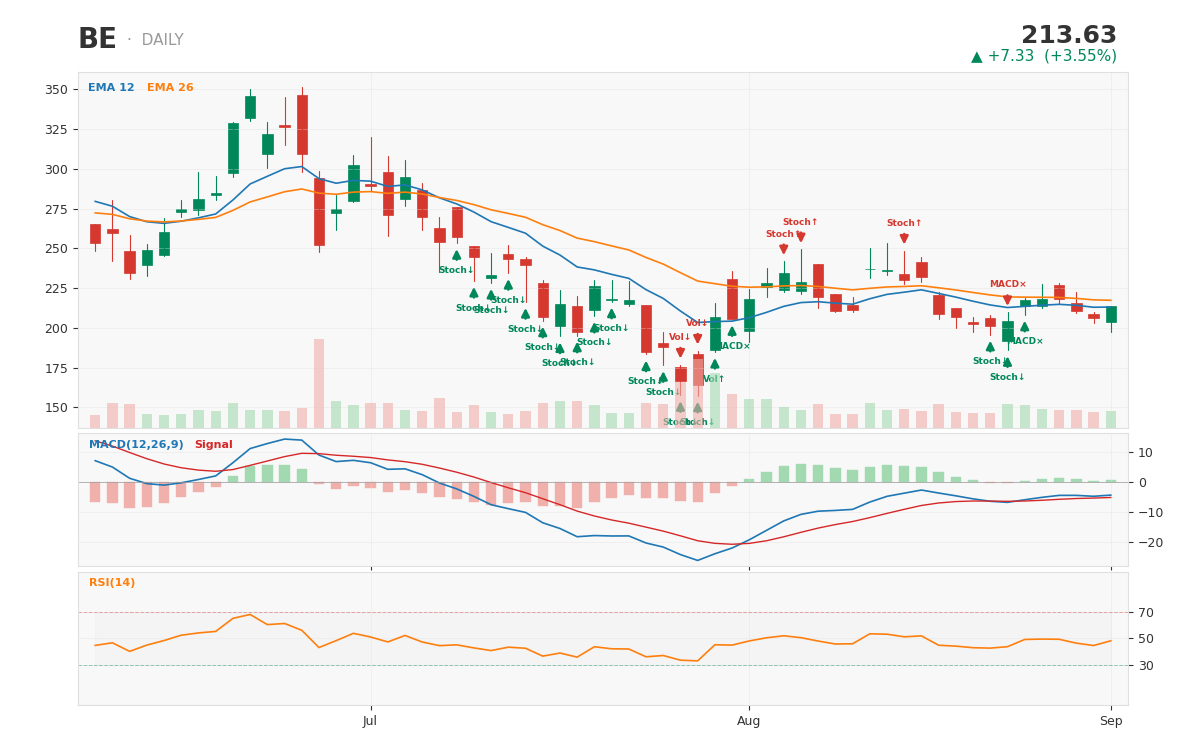 BE 1-year daily chart with technical signals -- captured the day after a pending securities class action and ~$14 million in board-member selling, during a real rebound from a ~40% pullback off the stock's 52-week high
August Insider Selling for Bloom Energy (BE)
| Insider Name | Role | Date | Shares Sold | Value ($) |
|---|---|---|---|---|
| Jeffrey R. Immelt | Director | 2026-08-17 | 30000 | 7,167,300 |
| John T. Chambers | Director | 2026-08-03 | 15000 | 3,083,700 |
| John T. Chambers | Director | 2026-08-13 | 15000 | 3,750,000 |
| Aman Joshi | CCO | 2026-08-14 | 4677 | 1,130,665 |
| Shawn M. Soderberg | CLO & Corp. Sec. | 2026-08-14 | 2895 | 676,272 |
| Satish Chitoori | COO | 2026-08-14 | 2053 | 496,087 |
| Total August Sales | 69625 | 16,304,024 |
Powering the Future: Bloom Energy's Strong Growth in AI Data Centers
Despite the legal and insider trading headlines, Bloom Energy's underlying business fundamentals present a compelling growth story, particularly driven by demand from the artificial intelligence (AI) data center industry. The company reported triple-digit revenue and earnings growth in the second quarter of 2026, highlighting the strength of its fuel cell technology. Bloom Energy is frequently cited in market commentary as a key "power stock" poised to benefit from the immense capital expenditure flowing into data centers, particularly those supporting AI infrastructure.
The scale of this demand is reflected in Bloom Energy's substantial and expanding backlog. The company confirmed a backlog of $20 billion at the end of 2025, with some market watchers predicting it could swell to $50 billion before the end of this year. While a significant portion of this represents future services rather than immediate equipment sales, it underscores robust long-term demand. The company is actively developing solutions to meet this surge, with its "Power Connect" solution reportedly cutting onsite installation time for its systems by over 40%, directly addressing the rapid deployment needs of AI data centers. Strategic agreements, such as one with American Electric Power for AI data centers, further solidify Bloom Energy's position. Multiple market analyses consistently frame Bloom as a stronger and more advanced player compared to some of its peers in the data center power sector.
Extreme Valuation Metrics Meet an Optimistic Analyst and 'Smart Money' Outlook
Bloom Energy’s robust growth story comes with a premium valuation that merits careful consideration. The company’s current valuation multiples are notably high, with a trailing price-to-earnings (P/E) ratio of 255.60, an enterprise value-to-EBITDA (EV/EBITDA) of 180.30, and a price-to-sales (P/S) ratio of 20.21. These figures indicate that the market has high expectations for the company's future earnings power and growth trajectory. One analyst perspective frames this as a "steep price, steep quality" scenario, arguing that despite a 300% stock surge over the past year and a forward P/E of 44x, Bloom Energy's fundamentals justify its premium.
A closer look at the trailing-12-month (TTM) financial figures reveals a nuanced picture. Revenue growth remains strong at 37.3% year-over-year. Current net margin stands at a positive 7.9%, and diluted earnings per share (EPS) is $0.85. However, the year-over-year comparisons for net income growth (-202.6%) and EPS growth (-184.6%) are sharply negative. This divergence most plausibly reflects an unusually large gain or a highly favorable non-recurring item in the prior-year comparative period, rather than a deterioration in current operating performance, as such accounting events can skew comparative growth rates.
Despite the extreme valuation and profit growth anomaly, analyst consensus paints an optimistic picture. The median analyst price target for Bloom Energy sits at $285.00, with a consensus target of $276.47. These figures imply a substantial upside of approximately 29% to 33% from today’s closing price of $213.63. The overall analyst grade is a "Buy," with 17 buy ratings, 12 hold ratings, and only 3 sell ratings. However, the wide range of individual price targets, spanning from $176.00 to $350.00, underscores the real disagreement among experts, reflecting the ongoing debate about whether the company's quality truly justifies its steep price.
Adding to the positive sentiment, Bloom Energy is also attracting attention from "smart money" investors. Notable guru funds holding BE shares include Ken Griffin's Citadel (the largest with 3.80 million shares), T. Rowe Price Equity Income, Sands Capital, Jim Simons' Renaissance Technologies, Leopold Aschenbrenner (who holds 408,500 shares), Stanley Druckenmiller, Louis Moore Bacon, Polen Capital, Paul Tudor Jones II, Ray Dalio, Steven Cohen, and Zevenbergen Capital. The presence of such prominent investors suggests a recognized long-term value in the company despite its current complexities.
Technical Rebound Signals Short-Term Strength
Bloom Energy stock has experienced significant volatility leading up to today's trading. The shares recently pulled back sharply, declining approximately 38% to 40% from a 52-week high of $351.28. This decline overlapped with the news of the securities fraud class action breaking in late August, suggesting a plausible connection, though the specific cause for each price movement cannot be isolated with certainty.
Today, September 1, 2026, the stock experienced a notable rebound, closing at $213.63, up $7.33 (3.55%) from its previous close of $206.30. This bounce reflects a genuine attempt by the market to find a floor after the recent declines. The broader technical picture, encompassing a scan of 25 signals, shows a strongly bullish bias, with 19 signaling a buy and only 6 a sell.
Curated technical signals further corroborate this short-term strength. The stock is currently in an uptrend, outperforming the broader market. Volume analysis indicates an accumulation distribution uptrend, with on-balance volume rising, suggesting that trading volume is confirming the recent price move. Furthermore, the stock is trading above its volume-weighted average price (VWAP). While some indicators, such as the trend strength reading and the supertrend indicator, show a bearish turn, the overall short-term picture is net-bullish following today's bounce. The composite score for Bloom Energy stands at 52 (out of 100), with an oscillator score of 54 (out of 100) reflecting the momentum from today's bounce, even as the moving average score of 25 (out of 100) reflects the lingering impact of the recent pullback on longer-term averages.
Adding to the positive sentiment, market commentary today notes a macro tailwind for alternative energy stocks like Bloom Energy. The escalating conflict in Iran is highlighting energy-security risks, which is expected to drive increased investment in nuclear and renewable power, positioning Bloom Energy favorably within this evolving energy landscape.
The Verdict: Navigating Growth Through Legal Crosscurrents
Bloom Energy presents a complex, yet compelling, investment thesis for investors comfortable with a higher risk profile. Its core business, providing power solutions for the burgeoning AI data center market, is robust, evidenced by triple-digit revenue growth and a substantial backlog that some predict could reach $50 billion. This strong fundamental tailwind is attracting significant institutional interest, with a diverse group of prominent guru investors holding positions. Analyst consensus also points to considerable upside from current price levels, suggesting that the underlying business quality is recognized despite a demanding valuation.
However, the legal cloud cast by the ongoing securities class action, naming CEO K. R. Sridhar, and the precise timing of both congressional purchases and substantial insider sales by highly respected board members, introduce a layer of elevated risk. The sharp divergence between recent Pelosi-affiliated purchases and the significant August sales by former Fortune-500 CEOs Jeffrey Immelt and John Chambers, totaling $14 million, cannot be ignored. While Pelosi's transactions occurred after the class period, the insider sales reflect informed decisions at the highest levels of the company amidst a recent stock pullback. Investors must weigh the compelling growth narrative against these real, material uncertainties.
My assessment of Bloom Energy is cautiously bullish. I believe the profound growth potential in its core markets justifies a premium, but I remain acutely aware of the unresolved legal challenges and the signals from recent insider selling. The market's reaction to the class action and insider sales has already resulted in a significant pullback from its 52-week high, and today's bounce shows some resilience.
For investors comfortable with the risk profile, an entry zone around $200.00 to $210.00 could offer a more favorable risk-reward entry, ideally on any further retest of support following today's rebound. My 12-month target for BE is $275.00, positioned slightly below the median analyst target. This conservative target accounts for the stock's premium valuation and the potential for overhang from the ongoing class action, while still recognizing the strong fundamental drivers and analyst optimism for significant upside.
The invalidation level for this thesis would be a sustained break below $175.00. This level sits just below the lowest analyst price target and would indicate a significant deterioration in sentiment or fundamentals, potentially driven by adverse developments in the lawsuit or a fundamental shift in the AI data center demand narrative. Bloom Energy’s future hinges on its ability to convert its impressive backlog into sustained, profitable growth, even as it navigates the complexities of its legal landscape.
Want deeper research on any stock? Try Kavout Pro for AI-powered analysis, smart signals, and more. Already a member? Add credits to run more research.