PVH: The CEO Wrote a Personal Check for Exactly One Million Dollars and One Cent

Key Takeaways
- CEO Stefan Larsson bought $1,000,001 of PVH stock on the open market, no trading plan, two days before presenting at Goldman Sachs — a deliberate statement from the person who knows the business best.
- The purchase lands on a quarter that looks ugly on GAAP (a $439M non-cash EMEA impairment drove a -$2.23 loss) but delivered $3.70 in operating EPS, beat consensus, and came with reaffirmed FY26 guidance of $11.80-12.10.
- Yet the stock is already technically overbought after a four-day run, with six momentum oscillators flashing stretched — the CEO bought into a short-term squeeze that needs to cool before the fundamental case can fully play out.
The $1,000,001 Statement
Stefan Larsson, PVH's CEO, filed a Form 4 on September 11 that reads like a deliberately crafted signal. He purchased 14,179 shares at a weighted price of $70.53, footing a total bill of $1,000,001.02 — exactly one million dollars and one cent. The precision is not accidental; it is the hallmark of a declaration buy, not a routine portfolio adjustment. The transaction was executed on the open market, with no 10b5-1 trading plan, meaning Larsson chose the timing and the size. Two days later he is scheduled to present at the Goldman Sachs Global Retailing Conference alongside CFO Alexis Rollier.
The purchase comes at a moment when the stock had seen zero insider buying over the prior twelve months — only about $600,000 in sales from other insiders. Larsson's $1M buy changes that narrative completely. After the transaction, his direct holdings total 349,889 shares, but 153,969 of those are unvested restricted stock units. The real discretionary stake is roughly 196,000 shares — still a meaningful personal bet at current prices, but worth noting that the headline number overstates his skin in the game. Even so, a $1M open-market purchase by a CEO who does not need to buy is about as clear a vote of confidence as a filing can deliver.
The Quarter He Bought Into
PVH's fiscal second quarter, ended August 2 and reported September 2, is easy to misunderstand at a glance. Revenue came in at $2.097 billion, down 3% on both a reported and constant-currency basis. That is soft but not alarming — the company has been navigating a challenging European wholesale environment, and the decline is within the range of expectations.
The headline that rattled some screens was the GAAP loss per share of $2.23, compared to a $2.52 profit a year earlier. But that loss is entirely the result of a $439 million non-cash goodwill impairment charge in the Europe, Middle East, and Africa reporting unit. It is an accounting write-down, not a cash drain. Strip that out, and operating results tell a different story: non-GAAP EPS of $3.70 beat the consensus estimate of $3.08 handily and came in well above the $2.52 reported in the same quarter last year.
A significant portion of that beat — roughly $1.80 per share, per Seeking Alpha's analysis of the filings — came from tariff refunds. That is not repeatable, and investors are right to question the quality of the earnings surprise. The core question is whether the underlying business is deteriorating. Revenue by brand: Tommy Hilfiger contributed $1.13 billion, Calvin Klein $913 million. Direct-to-consumer and digital strength in the Americas and Asia-Pacific offset European wholesale weakness. Asia was up 3%, a bright spot. The company reaffirmed its full-year outlook: revenue roughly flat year-over-year, non-GAAP EPS in the range of $11.80 to $12.10. At the midpoint of $11.95, the stock trades at just 5.9 times that operating earnings power — a multiple that screams value trap to the skeptics and bargain to the deep-value crowd.
The real bear case is not the impairment — it is the European wholesale weakness that caused the write-down in the first place, combined with net debt at 5.06 times trailing EBITDA. A premium apparel company with that leverage needs its free cash flow to keep flowing. The FCF yield of 22% suggests it can, but the margin for error is thin.
What the Stock's Numbers Actually Say
PVH trades at a price-to-book ratio of 0.68, meaning the entire market capitalization sits at barely two-thirds of the company's stated book value per share of $103.95. Price-to-free-cash-flow is 4.56, and the trailing free-cash-flow yield is 22%. A price-to-sales multiple of 0.37 rounds out a scorecard that would make any value screener sit up.
Trailing GAAP earnings are negative $3.67 per share because of the impairment, so traditional P/E is meaningless. But on an operating basis, using full-year guidance, the forward non-GAAP P/E is roughly 5.9 at the current price. The 52-week range of $59.60 to $100.75 has PVH sitting about 30% below its high and about 18% above its low.
| Metric | Value |
|---|---|
| Current Price | $70.64 |
| Book Value per Share | $103.95 |
| Price / Book | 0.68 |
| Price / Free Cash Flow | 4.56 |
| Free Cash Flow Yield | 22.0% |
| Enterprise Value / EBITDA | 10.2 |
| Price / Sales | 0.37 |
| Net Debt / EBITDA | 5.06 |
| Consensus Median Target | $83 |
| Consensus Average Target | $91 |
| FY26 Non-GAAP EPS Guidance | $11.80 - $12.10 |
| Forward Non-GAAP P/E (midpoint) | ~5.9 |
Analyst consensus on September 11 stood at a median target of $83, with a high estimate of $121 and a low of $78. Of 38 analysts, one rates it strong buy, 21 say buy, 14 hold, and two sell. The buyback plan is a crucial piece: the company executed $560 million in buybacks in fiscal 2025 but none in the first half of 2026. Management has promised at least $300 million for the full year, which implies heavy second-half activity. A CEO buying stock personally, alongside a company buyback program, is a powerful combination — but only if the buybacks actually materialize.
Technical Tension: The Bounce the CEO Bought Into
Here is where the signal set gets interesting. The stock had fallen 3.9% on September 9 without a clear catalyst, closing at $68.51, and was trading near the lower end of its recent range. Larsson's purchase on September 11 came at an average price of $70.53, which by that time was already a two-day bounce. The stock closed that day at $70.64, up 1.9% from the prior close of $69.35.
But the technical picture shows that the bounce has run hard and fast. After four consecutive up days, the stock triggered six overbought momentum readings — including the Relative Strength Index and stochastic oscillator, both of which measure whether a move has gone too far too fast. A Bollinger Band rejection also fired, which typically signals that the price has touched an upper volatility band and may revert. The composite score sits at 60 out of 100 (moderately positive), while the moving-average score is zero — meaning the stock is below its key moving averages even as short-term momentum is stretched. That is a contradictory setup: the trend is not your friend, but the short-term crowd has gotten ahead of itself.
What does this mean for an investor considering following the CEO? The buy signal from Larsson is fundamentally driven and long-term in horizon. But entering at a technically overbought level risks immediate drawdown as the stock mean-reverts. The more likely read is that the bounce will cool off — perhaps back toward the $68-70 zone — before the next leg higher, if it comes. A patient buyer might let the technicals reset before committing new capital.
The technical signals do not invalidate the fundamental case; they simply warn that the timing of an entry matters. There is no guarantee of a floor at the CEO's purchase price — insiders have been wrong before, and markets can stay irrational longer than a balance sheet can stay solvent. The 52-week low of $59.60 is the real support to watch, not the CEO's buy level.
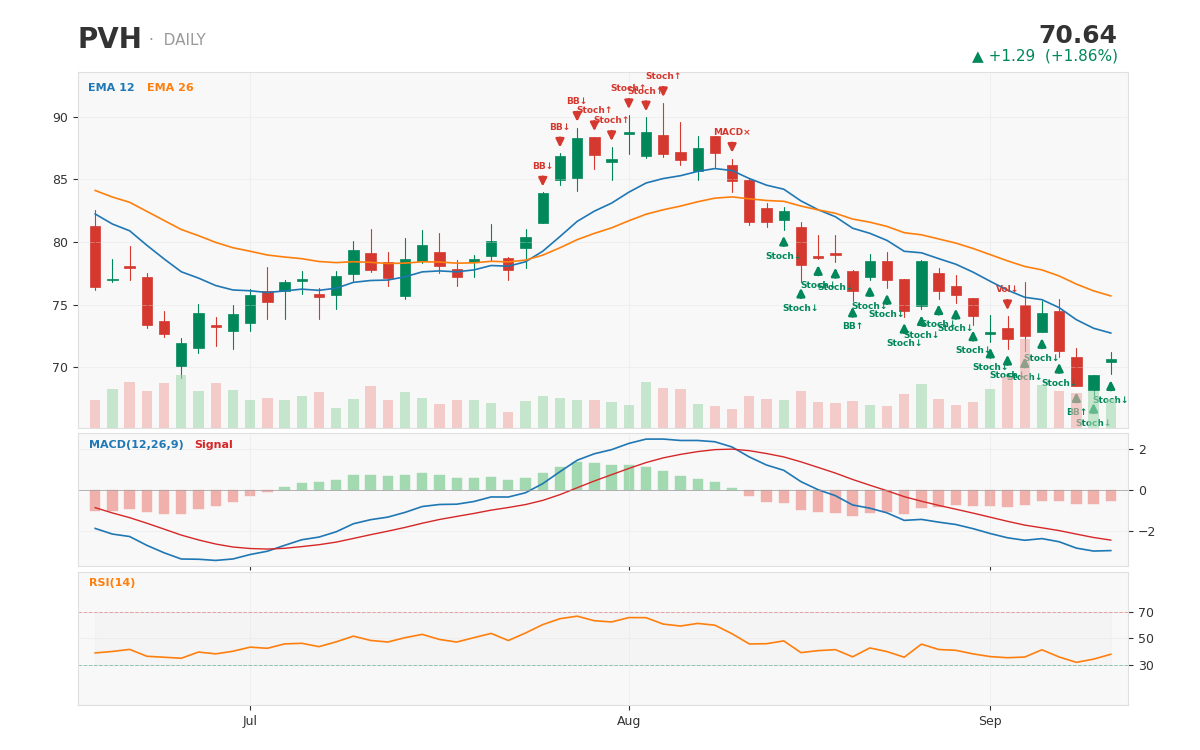 PVH 1-year daily chart with technical signals — captured at $70.64, the day after CEO Stefan Larsson's $1,000,001 open-market purchase, with six short-term oscillators overbought on a 4-day run
What the Signal Set Actually Says
Lay the independent lenses next to each other. The quantitative composite score of 60 is moderately positive but not screaming. The valuation factors are unanimously cheap — the stock screens as deeply undervalued on every book-value, cash-flow, and sales multiple. The technicals are mixed: the moving-average structure is bearish, but the oversold bounce has turned into an overbought short-term squeeze. The analyst consensus is cautiously bullish. And the insider signal is the strongest possible — a $1 million open-market buy by the CEO with no trading plan.
Where the signals agree: the stock is cheap, the CEO thinks it is cheaper than it should be, and the balance sheet is not broken. Where they disagree: the technicals say the immediate entry is poor, while the insider buy says the time to act is now. The resolution to that tension is to respect both, but to weigh the insider signal more heavily for a long-term investor and the technical signal more heavily for a trader.
The most likely path: the stock drifts back into the $68-$71 range over the next few sessions as the overbought oscillators reset. At that point, the valuation case becomes even more compelling as the buyback program ramps up. The risk is a break below the 52-week low of $59.60, which would suggest the market does not believe the guidance. That low is also roughly where the stock would trade at 5 times forward non-GAAP EPS — a level that would imply a serious deterioration in earnings power.
The Verdict: Buy on Weakness, Watch $59.60
Entry zone: $67-$70, with a preference for the lower half. The CEO bought at $70.53, so any level below that offers a discount relative to his cost basis. The technical overbought condition makes chasing the current price unwise; waiting for a pullback into this zone aligns the entry with both the insider signal and a healthier technical setup.
Twelve-month target: $83-$91. The midpoint of analyst targets is $83, and the mean is $91. Either represents a double-digit return from the entry zone. The catalyst for reaching that target will be steady operational execution, the fading of tariff-disruption comparisons, and the impact of buybacks on per-share earnings.
Invalidation level: $59.00, just below the 52-week low of $59.60. If the stock breaks below that level, it suggests that the impairment and European headwinds are worse than management is communicating, and the insider buy and analyst targets would need to be reconsidered. A close below $59 would also breach the book value support level, shifting the valuation narrative from deep value to value trap.
The single sentence worth remembering: PVH's CEO just put $1 million of his own money into a stock trading at 0.68 times book value and 5.9 times operating earnings — the market is pricing in a recession that the person who runs the company does not see. But that conviction does not make the stock a buy at any price, and the technical overbought condition is a real short-term headwind. Patience is the missing ingredient.
Want deeper research on any stock? Try Kavout Pro for AI-powered analysis, smart signals, and more. Already a member? Add credits to run more research.