Rocket Lab Trades at 59 Times Revenue -- With a Record Backlog and an Unflown Rocket to Justify It

Key Takeaways
- Rocket Lab (NASDAQ: RKLB) trades at an extreme valuation of approximately 59 times trailing revenue, despite showcasing a record $2.36 billion backlog and 60%+ year-over-year revenue growth in its latest quarter, propelled by ambitious vertical integration and defense contracts.
- The market's primary concern, which drove a recent share price pullback, centers on the narrowing window for the Neutron rocket's inaugural flight in late 2026, a critical development with direct implications for a significant portion of the company's backlog.
- Professional analysts are sharply divided on RKLB's valuation, presenting a stark contrast between calls for a "valuation trap" and arguments that "only the bad is priced in," while even its technical signals offer a genuinely ambiguous picture, from broadly bullish scans to significantly weaker composite scores.
An Extreme Valuation Driven by a Clear Growth Trajectory and Strategic Ambition
Rocket Lab USA, Inc. (RKLB) sits at a fascinating crossroads in the burgeoning space economy, commanding an eye-popping valuation of roughly 59 times its trailing twelve-month revenue. This metric, while extreme, reflects a market that is pricing in substantial future growth and the company’s ambitious strategic vision rather than current profitability. Rocket Lab’s latest quarterly earnings, reported on August 11, 2026, underscored this growth narrative, delivering revenue of approximately $234 million, an impressive 60% increase year-over-year.
Beneath the headline valuation, the company's backlog has swelled to a record $2.36 billion, indicating strong demand for its services. Over 90 launches are currently booked, reinforced by over $437 million in new launch contracts and more than $1 billion in total new contract awards in the last quarter alone. This aggressive expansion is part of a broader vertical integration strategy, as evidenced by strategic acquisitions like Mynaric and Motiv Space Systems, which aim to consolidate capabilities across space design, manufacturing, launch, and applications. Furthermore, Rocket Lab is exploring early-stage opportunities in Mars exploration, including a NASA study contract and a proposed 2028 Mars Telecommunications Orbiter, signaling long-term ambitions that extend beyond Earth orbit.
Neutron Rocket Delay Casts a Shadow on Future Backlog Conversion
Despite the stellar revenue growth and expanding backlog, RKLB shares experienced a sharp pullback of approximately 7% in after-hours trading following the Q2 earnings release. This sell-off was not due to a revenue miss (the company actually beat expectations on the top line) but stemmed from investor anxiety surrounding the Neutron rocket. Management reiterated a target of Q4 2026 for delivering Neutron to the launch pad, but explicitly acknowledged that the window for an actual launch this year is narrowing.
This delay risk is more than just reputational; a significant portion of the company's impressive $2.36 billion backlog is directly tied to the Neutron rocket. Any deferral in its operational readiness, therefore, has tangible implications for the conversion of that backlog into realized revenue. Founder and CEO Peter Beck acknowledged this pressure, stating that the company is "pushing hard" for a 2026 flight, while simultaneously urging investors not to "be focused on just the rocket's first flight," highlighting the company's broader value proposition.
Diversified Revenue Streams Beyond Launch: Defense and Hypersonic Testing
While the Neutron rocket dominates investor sentiment, Rocket Lab is actively diversifying its revenue streams, particularly through a strong and growing portfolio of defense and government contracts. This strategic pivot offers a more stable and high-value revenue base beyond its traditional commercial launch services. For instance, the company recently secured a $397 million missile-defense contract from the Space Force, a deal estimated to be worth more than six months of its current revenue.
Beyond this significant win, Rocket Lab has also been onboarded to the Space Force’s $981 million NITE-STAR IDIQ program. It is crucial to understand that an Indefinite-Delivery/Indefinite-Quantity (IDIQ) contract establishes a framework and spending ceiling, not a guaranteed revenue stream, though it positions Rocket Lab for substantial future task orders. Further expanding its defense footprint, Rocket Lab was selected by Viasat to construct a geostationary (GEO) satellite for the Space Force's Protected Tactical SATCOM-Global program and joined the Space Data Network Consortium with an initial $12 million in contracts. The company also successfully launched eight satellite platforms for MDA Space, part of a larger 17-platform program to replenish Globalstar's constellation, and completed its 93rd Electron mission for iQPS, an Earth-imaging client.
Perhaps one of the most interesting, yet underappreciated, strategic angles is Rocket Lab’s Hypersonic Accelerator Suborbital Test Electron (HASTE) vehicle. This specialized platform is actively conducting real hypersonic-weapons testing missions for the Pentagon, effectively creating a "defense business hiding inside a space stock." This capability provides a unique, high-value offering distinct from its conventional launch and satellite manufacturing segments. This expanding government and defense focus aligns well with a broader sector tailwind; a presidential memo signed on August 21, 2026, targets a fivefold increase in commercial rocket launches and re-entries, aiming for 1,000 per year by 2030, which should further support Rocket Lab's launch ambitions.
Strategic Acquisitions and the Material Dilution Trade-Off
Rocket Lab's vertical integration strategy is a key component of its long-term bull case, most notably exemplified by its pending acquisition of Iridium. This deal is actively progressing, with significant milestones achieved, including the lapse of the Hart-Scott-Rodino (HSR) antitrust waiting period, the filing of a Form S-4 registration statement, and the submission of necessary FCC applications. These steps confirm that the Iridium integration is not merely aspirational but moving through the required regulatory and financial processes.
However, growth of this magnitude often comes with financial implications for existing shareholders. On the same day the Iridium milestones were announced, Rocket Lab unveiled a new "at-the-market" (ATM) equity distribution program. The company explicitly stated that this program is intended to help fund "a portion of the cash payments for the Iridium acquisition and reduce debt commitments." An ATM program allows the company to issue new shares into the open market over time, representing a genuine and material dilution risk to existing shareholders that should be acknowledged.
Despite these capital-raising efforts, Rocket Lab maintains a strong balance sheet, providing a solid foundation for its ongoing development and acquisition activities. The company boasts a current ratio of 5.48, indicating strong short-term liquidity, and a very low debt-to-equity ratio of 0.04. While the Net Debt/EBITDA ratio appears high at 16.34, this figure requires careful interpretation. Rocket Lab is currently pre-profit, with trailing twelve-month EBITDA being deeply negative. In such cases, even a modest net-debt position can result in an extremely high, and somewhat misleading, ratio when divided by a small or negative denominator. This is not indicative of normal leverage risk but rather reflects the heavy investments required for its growth trajectory, including Neutron development and the Iridium acquisition, which its strong liquidity position is well-equipped to support.
A Fiercely Contested Valuation Debate and Volatile Price Action
Rocket Lab's stock has experienced significant volatility in 2026, marked by a low of $58.25 and a rebound to $82 in mid-August, spurred by strong Q2 results and new contract announcements. However, by August 20-22, the stock had pulled back, with one analysis noting it had "completely retraced its Q2 gains," trading down approximately 49% from its highs. At its current price of $72.57, the stock sits squarely between these recent extremes. This volatility is a symptom of a genuinely active and sharply divided professional debate surrounding Rocket Lab's lofty valuation.
On one side, a bearish argument, exemplified by a Seeking Alpha piece titled "Rocket Lab: 36x Forward P/S Looks Like A Valuation Trap," contends that even accounting for the impressive 62% year-over-year revenue growth, significant future growth is already overly priced into the stock. Conversely, bullish analysts, in an article titled "Rocket Lab: Only The Bad Is Priced In," argue that the nearly 50% pullback from recent highs has already absorbed concerns regarding the Neutron delay and potential margin compression, presenting an attractive entry point. One Seeking Alpha analyst even reiterated a Buy rating with a raised price target of $209 per share in mid-August. Furthermore, a relative-value comparison suggests Rocket Lab's space-specific revenue has actually been growing faster than that of SpaceX's comparable segments, offering a unique comparative advantage. This debate unfolds against the backdrop of an impressive long-term track record, with the stock having risen more than 650% over the past five years.
Wall Street analysts broadly share a positive outlook on RKLB, as shown by the consensus "Buy" rating and price targets indicating significant potential upside. Of 21 analysts covering the stock, the majority rate it a "Buy," while only one analyst maintains a "Sell" rating, reflecting varied professional forecasts on the stock's future trajectory.
Ambiguous Technical Signals Highlight Market Uncertainty
The technical picture for Rocket Lab presents a genuinely ambiguous and even contradictory narrative, reflecting the fundamental uncertainty surrounding its valuation and operational timelines. While a core set of signals indicates a roughly balanced view, with positive signs like an uptrend in price and on-balance volume confirming recent moves, alongside bearish signals such as a supertrend sell signal and underperformance relative to the broader market, a broader scan of 153 technical detectors presents a heavily bullish outlook, registering 25 "buy" signals against only five "sell" signals. This stark contrast points to underlying strength that may not be immediately obvious from a basic signal set.
Yet, when considering aggregated composite scores, the picture shifts again:
- Overall Composite Score: A low score of 34 out of 100 suggests weak overall sentiment.
- Technical Rating: An even lower score of 25 out of 100 indicates very weak technicals.
- Moving Average Score: A rock-bottom score of 0 out of 100 signals extremely poor momentum when assessed through traditional moving average crossovers.
- Oscillator Score: A neutral reading of 50 out of 100 provides little directional conviction.
This three-way divergence—a balanced core, a bullish broad scan, and weak composite scores—underscores the market's deep uncertainty. It suggests that while specific price actions might show underlying bullish tendencies, the broader trend and momentum, particularly on longer timeframes, remain challenging. This technical ambiguity reinforces the divided fundamental valuation debate, suggesting that conviction, either bullish or bearish, is difficult to establish solely through price action at this juncture.
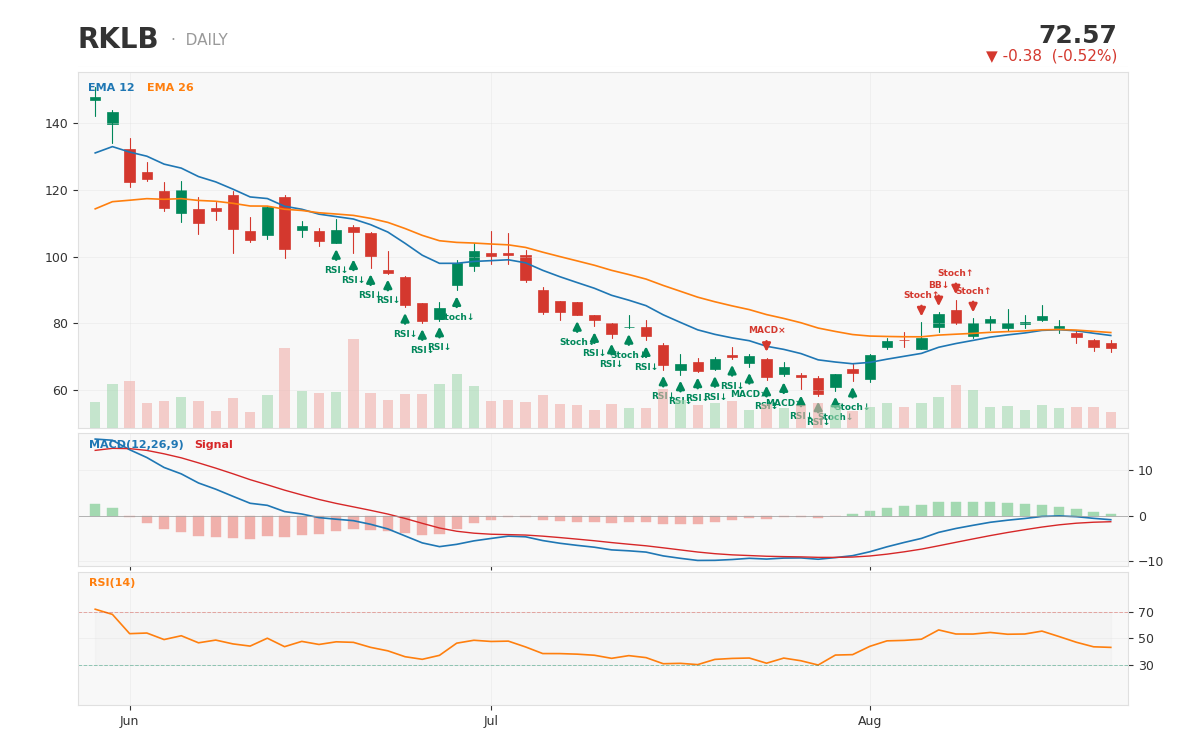 Rocket Lab 1-year daily chart with technical signals -- readings genuinely diverge depending on the source, from a roughly balanced core signal set to a heavily bullish broader scan (25 buy vs. 5 sell) to weak composite scores
Rocket Lab's Long-Term Potential Hinges on Neutron Execution
Rocket Lab stands as a compelling, high-growth space story with an impressive record backlog and a clear strategic vision for vertical integration, supported by a strong defense contract pipeline. The company’s robust balance sheet provides the necessary financial firepower for its ambitious projects, including the Iridium acquisition and Neutron development. However, the current valuation, trading at approximately 59 times trailing revenue, prices in substantial future success. The market’s primary focus and a key near-term risk remains the successful, timely maiden flight of the Neutron rocket, which is pivotal for converting a significant portion of the current backlog into revenue. While the long-term potential is evident, current market sentiment is sharply divided, a tension exacerbated by the genuinely mixed technical signals.
Given this dynamic, we maintain a bullish stance on Rocket Lab's long-term potential, contingent on successful Neutron execution and continued diversification of its revenue base. The recent sell-off, driven by Neutron's narrowing launch window, presents an opportunity for investors with a high tolerance for risk and a long-term horizon. Our entry zone for new positions sits between $65.00 and $70.00 per share, a range that represents a re-test of recent support levels while remaining above the year-to-date low of $58.25. Our 12-month target is $120.00 per share, aligning with the median analyst consensus, though we acknowledge the wide dispersion in professional forecasts from $83.00 to $135.00. The invalidation level for our thesis would be a definitive announcement of a further, significant delay in the Neutron program that materially impacts backlog conversion or a sustained break below the $58.25 annual low, signaling a deterioration of the broader growth narrative. Rocket Lab's trajectory will ultimately be defined by its ability to execute on its ambitious engineering and strategic vision, transforming a high-multiple growth story into a profitable, integrated space leader.
Want deeper research on any stock? Try Kavout Pro for AI-powered analysis, smart signals, and more. Already a member? Add credits to run more research.