SentinelOne’s AI Rally Has Outrun Its Earnings Proof

Key Takeaways
- SentinelOne has a credible operating case: revenue rose 21% year over year, ARR reached $1.22 billion, and management raised full-year guidance to $1.202 billion-$1.207 billion. But net new ARR grew only 4%, which is the clearest sign that incremental growth has not yet accelerated with the stock.
- The September 8 insider transactions were coordinated tax-withholding sales by four officers, including CEO Tomer Weingarten, who retained about 98% of his stake after his withholding sale. His separate September 11 sale of 114,890 shares for approximately $2.3 million deserves more attention, but its purpose is not stated.
- At $23.80, SentinelOne is close to its $24.25 52-week high, while the consensus target is $23.39. The company may continue benefiting from AI-security demand, but new buyers are paying for that possibility before the earnings evidence fully confirms it.
The rally has moved ahead of the valuation evidence
SentinelOne is participating in a strong cybersecurity-sector move associated with growing concern about the risks created by advances in artificial intelligence. Recent coverage identified SentinelOne among the cybersecurity stocks that surged during the week, and the company has also received favorable attention for its AI-native platform and product expansion.
The market data shows the speed of the repricing. SentinelOne was at $23.80 in the September 21 live market snapshot, up 5.73% from the previous close of $22.51. Its 52-week range was $11.81 to $24.25, leaving the shares about 1.9% below the high. The dossier also describes a gain of roughly 36% in a month.
That move matters because the shares are no longer being valued only on the company’s current operating results. Investors are also paying for continued demand for AI-related security products, successful adoption of the broader platform, and a future improvement in profitability. Those expectations may prove correct, but they raise the standard the next report must meet.
The valuation evidence is not keeping pace with the enthusiasm. The consensus target is $23.39, below the current $23.80 price. The recommendation mix is favorable, with 21 buys, 12 holds, no sells, and one strong buy, but that support has not translated into a target above the market.
The useful conclusion is not that analysts dislike SentinelOne. They largely do not. It is that positive business opinions have not yet established that the current quote offers attractive upside. The stock can continue rising, but a new buyer is entering after much of the favorable narrative has already been capitalized.
The operating story is real, but net new ARR is the pressure point
SentinelOne’s latest reported quarter supplies genuine fundamental support for the rally. Revenue increased 21% year over year. ARR reached $1.22 billion, up 22%, and management raised full-year guidance to $1.202 billion-$1.207 billion.
Those figures show that the company is still growing at a substantial rate. The guidance increase is especially important because it indicates that management saw enough demand and execution to raise its outlook rather than merely repeat the previous forecast.
The company also has developments that reinforce its AI-security positioning. Latio named SentinelOne an AI Security Platform Leader on September 15. The company expanded Wayfinder Frontier AI Services with OpenAI Daybreak models and signed a partnership with OpenAI Daybreak on September 3. These announcements support the argument that AI-related capabilities are becoming part of the company’s platform strategy rather than remaining a marketing theme detached from the product.
The less comfortable number is net new ARR. It was $56 million, up only 4%. That is far below the 22% growth rate of the existing ARR base. The comparison does not prove that demand is deteriorating, but it does show that the latest contribution from newly added recurring business was not expanding at the same pace as the installed base.
That distinction is central. ARR growth can remain healthy because existing customers continue to renew and expand. For a company valued on future growth, however, investors also need evidence that new business is building the next layer of expansion. A 4% increase in net new ARR is not fatal, particularly alongside raised guidance, but it is not the acceleration implied by an aggressive AI-growth narrative.
This is where the bullish and cautious readings meet. The bull case has more than publicity behind it: revenue, ARR, and guidance all moved in the right direction, and the company has a debt-free balance sheet. The caution is that the newest recurring-revenue contribution did not show the same strength as the headline growth rate. Until that changes, the rally is running ahead of the most important incremental-growth evidence.
The insider ledger is cautionary, not conclusive
The insider activity needs to be divided into two separate events.
On September 8, CEO Tomer Weingarten, Chief Accounting Officer Robin Tomasello, CFO Sonalee Parekh, and Chief Legal Officer Michael Conder recorded sales connected to coordinated tax withholding. Weingarten sold 38,759 shares at $19.79 to cover taxes associated with restricted-stock vesting and retained approximately 98% of his stake.
That transaction should not be treated as an ordinary discretionary sale. The shares were sold to satisfy a tax obligation created by vesting. The other September 8 officer sales were part of the same coordinated withholding activity. Their presence on the same day does not, by itself, establish a shared view that the stock was overvalued.
Weingarten then made a separate disposition on September 11: 114,890 shares at $19.89, worth approximately $2.3 million. The available sources do not state whether it was made under a trading plan, for personal liquidity, or for another reason. It would be unjustified to assign a motive.
The transaction is still relevant. It was substantially larger than his September 8 withholding sale, and it occurred during a period in which the shares were moving sharply higher. The proper inference is limited: the sale removes one piece of potential confirmation for investors chasing the rally. It does not establish that the CEO expects the company to decline or that management has lost confidence in the business.
Across the quarter, the insider data shows zero purchases and 17 sales, with 115,882 shares acquired and 515,222 disposed. The buy-to-sell ratio was 0.11. That is a negative signal for momentum buyers, but it is not a standalone forecast because the ledger includes the coordinated tax-withholding activity.
The two CEO dispositions totaled 153,649 shares and approximately $3.05 million in reported value. The CEO’s retained stake also matters: the September 8 filing did not represent an abandonment of the company. The best reading is therefore neither “the whole C-suite is abandoning ship” nor “the insider activity means nothing.” The tax transactions have limited bearish value; the separate CEO sale creates a meaningful caution flag; together, they increase the burden of proof for buying after the rally.
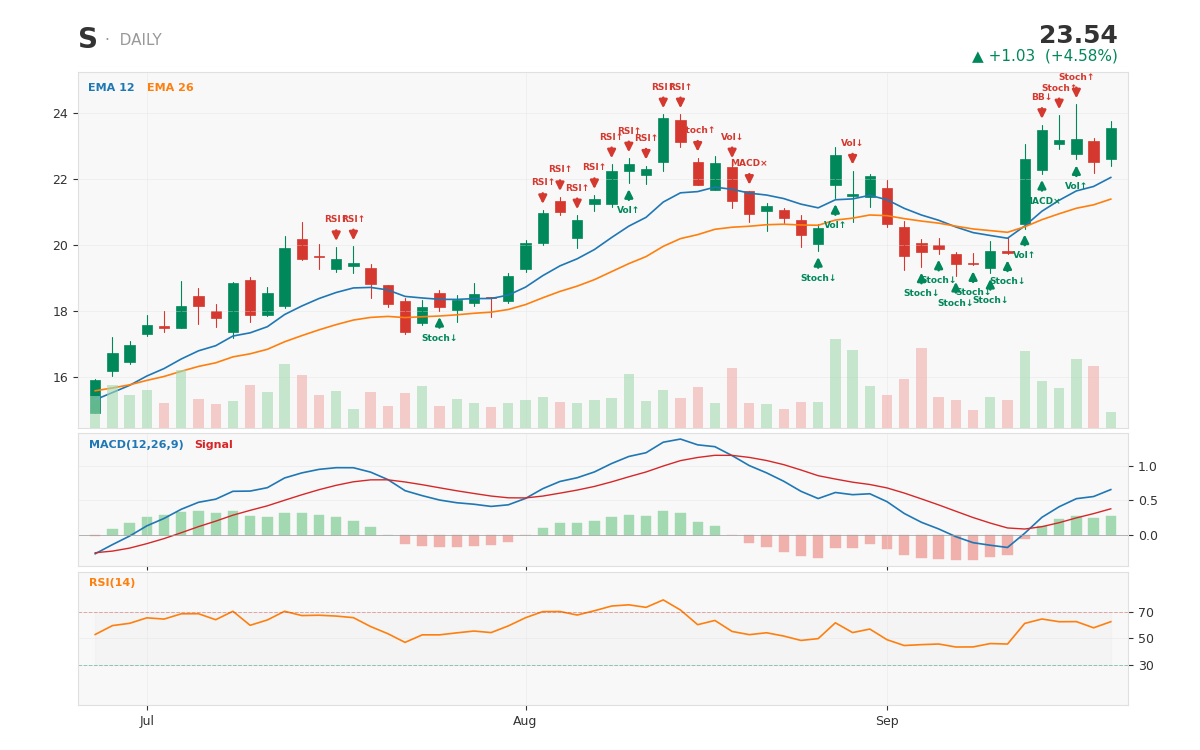 S daily chart with technical signals -- captured at $23.685 after a 5.2% surge on the AI-security wave, in the month the CEO sold 153,649 shares across two dispositions and the rest of the C-suite sold on the same day
Cash reduces financial risk, but the multiple demands execution
SentinelOne has financial resources that support the long-term bull case. The company has no debt and $813 million of cash. That gives management room to continue investing in the platform and reduces the immediate risk that higher interest costs or refinancing needs will overwhelm the operating story.
The company also reported a 73.3% gross margin. That is consistent with a software business that could eventually generate meaningful operating leverage if revenue grows faster than the expenses required to support it. The balance sheet and gross margin explain why the company can remain strategically relevant even though it is not yet profitable.
The current earnings profile is less forgiving. GAAP net margin was negative 31%, although it was improving, and earnings per share were negative $1.00. A cash-rich company can withstand losses for a period of time, but cash does not convert an unprofitable business into a cheap one.
SentinelOne trades at 7.2 times sales and 206.9 times price to free cash flow. The sales multiple can be defended if growth remains durable and future operating leverage becomes visible. The price-to-free-cash-flow figure shows how little room there is for disappointment in the eventual cash-generation story.
That is the economic problem with chasing the current quote. The company has enough cash to keep developing its strategy, but the stock price assumes that the strategy will produce stronger growth and future profitability. If net new ARR remains stuck near its latest growth rate, investors may be less willing to pay a premium for promises of later acceleration.
The balance sheet makes SentinelOne investable as a business to monitor. It does not make $23.80 an obvious bargain.
The Street likes the company more than it likes the price
The recommendation data is superficially bullish but valuation-sensitive. There are 21 buys, 12 holds, no sells, and one strong buy, yet the consensus target of $23.39 sits below the live price of $23.80.
That combination is more informative than the buy count alone. Analysts can favor a company’s long-term competitive direction while still viewing the shares as fully valued over the relevant target horizon. SentinelOne’s current profile fits that interpretation: strong revenue and ARR growth, a raised forecast, no debt, and a large cash balance, offset by a negative GAAP margin and demanding valuation ratios.
Bernstein’s September 17 downgrade adds a useful counterpoint. Bernstein downgraded SentinelOne, Palo Alto Networks, and Okta even as concern over AI-related security risks was helping create a bullish wave in the sector. The downgrade does not disprove the AI-security opportunity. It shows that sector demand and stock attractiveness are different questions.
For SentinelOne, the question is not whether the company has a plausible role in AI security. The evidence supports that it does. The question is whether the role is valuable enough, and monetized quickly enough, to justify buying after a 36% monthly advance and near a 52-week high.
The recommendation tally answers the first question better than the second. It indicates broad confidence in the company. The below-market consensus target indicates that broad confidence has not yet become a clear estimate of near-term upside.
The next report must show better incremental growth
The debate around SentinelOne can be reduced to one operating test: does the next period show that new recurring business is accelerating?
The bullish interpretation has a solid foundation. Revenue grew 21%, ARR grew 22% to $1.22 billion, management raised full-year guidance, and AI-related product and partnership announcements support the company’s strategic positioning. No debt and $813 million of cash give the company time to pursue that opportunity.
The cautious interpretation also has specific evidence. Net new ARR grew only 4%. GAAP net margin remained negative 31%. The stock has risen roughly 36% in a month and sits close to the 52-week high, while the consensus target remains below the quote. The separate $2.3 million CEO sale adds another reason not to treat the rally as self-validating.
Investors should therefore focus less on another AI headline and more on the next set of operating disclosures. The important questions are whether ARR growth holds, whether net new ARR improves from its 4% growth rate, whether guidance is raised again, and whether the GAAP loss narrows without sacrificing growth.
A good quarter in absolute terms may not be enough. At 7.2 times sales and 206.9 times price to free cash flow, the shares need results that support both the current business and the future improvement already embedded in the price. If net new ARR accelerates, the valuation argument becomes more defensible. If it remains modest, the market has a stronger reason to reconsider the premium attached to the AI-security theme.
That is why the risk is asymmetric for a new buyer. SentinelOne does not need to report bad results for the stock to fall. It may only need to report results that are good but not better than the expectations created by the rally.
Avoid chasing the high until the evidence improves
The appropriate stance is to hold existing shares but avoid initiating a position at $23.80. SentinelOne has a credible product and growth case, yet the current price requires stronger proof of monetization than the latest net new ARR figure provides.
A pullback toward $19.50-$20.00 would offer a more favorable entry than the current quote, but that range is a judgment call rather than established support. It is anchored to the recent insider transaction prices, including Weingarten’s $19.89 disposition and the other officer sales near $19.44-$19.95. Those prices do not prove that the market will find support there.
The consensus target of $23.39 is not an attractive upside target from the current price. Its importance is diagnostic: despite the favorable recommendation mix, the Street’s average estimate has not caught up with the latest rally.
The position should change only under one of two conditions. Either the shares pull back enough to improve the valuation, or the company reports a clear improvement in net new ARR and continues to support its raised guidance. A sustained move below $19.44 would weaken the near-term bullish setup, although it would not disprove the long-term product strategy.
The conclusion is straightforward: SentinelOne is a promising AI-security company, but the stock is ahead of its earnings proof. New buyers should wait for either a better price or better incremental growth. Until net new ARR begins to accelerate, the CEO’s separate sale, the demanding valuation, and the below-market consensus target outweigh the excitement surrounding the theme.
Want deeper research on any stock? Try Kavout Pro for AI-powered analysis, smart signals, and more. Already a member? Add credits to run more research.