TEAM - The SaaSpocalypse Victim That Just Rose 92% in a Month
Key Takeaways
- Atlassian’s AI tailwind is now measurable: Rovo usage surged 50% quarter over quarter, and the new Code Context tool positions the Teamwork Graph as the essential data layer for coding agents — a direct reversal of the “AI will disrupt SaaS” narrative that drove the stock to $56.
- The stock has blown past consensus ($189.58 vs. $177.50 median target), yet the AI-composite score sits at 62 and the technical rating at 64 — both solid but not extreme — while the long-term trend strength (MA 91) remains intact and the short-term oscillator (37) shows the August surge is digesting.
- Smart money is heavily concentrated in a few large holders (Baillie Gifford owns 9.96 million shares), and the insider selling into the rally is modest — CFO and CRO each sold roughly 3% of their direct holdings — not a signal of eroding conviction.
The Narrative Flip That Changed Everything
Atlassian spent most of 2025 as the poster child for the “SaaSpocalypse” fear — the idea that generative AI would let companies bypass traditional software by building their own internal tools, collapsing seat-based revenue models. The stock hit a 52-week low of $56.01. Then came fiscal Q4 2026 (ended June 2026, reported mid-August). Revenue of $1.77 billion and adjusted EPS of $1.87 both crushed expectations, sending the stock up more than 30% in a single day. August alone saw a 92% gain, and the move from the low now stands at 166%.
The catalyst was not just a beat. It was a complete inversion of the narrative. Atlassian’s Rovo AI assistant saw usage jump 50% quarter over quarter, and the company has shifted to a consumption-based pricing model for AI features — meaning more usage directly drives more revenue, not just more seats. The August 12 launch of Code Context, a feature that gives developers and AI coding agents secure access to source code across large-scale, multi-repository codebases, turns Atlassian’s existing Teamwork Graph into the context layer that makes those agents effective. In short: AI is no longer a threat to the business model; it is the growth driver.
The Numbers Behind the Rally — and What They Mean for the Next Move
The Q4 print is the foundation. Revenue of $1.77 billion and adjusted EPS of $1.87 were well above the Street’s expectations. The backlog is strong, subscription revenue is accelerating, and the consumption revenue stream from AI is additive to the seat-based base. But the stock has already priced in a lot of that optimism: at $189.58, it sits about 7% above the consensus price target of $177.50 and 8% above the median of $176.15. The rally has outrun the analyst community’s recalibration.
That creates an interesting tension. The long-term trend — measured by the moving-average composite (MA 91) — is firmly intact and scores a 91 out of 100, indicating the major trend is strongly bullish. But the short-term oscillator reading is 37, pointing to oversold conditions that reflect the consolidation after the August spike. The technical signal set includes two oversold flags and eight bearish short-term signals — downtrend, supertrend sell, falling on-balance volume, and price below VWAP. That is not a breakdown; it is a digestion. The stock gapped from $169 to $185 in late August and has been building a base between $185 and $198 ever since. Today’s close of $189.58, down 2.6% on the day, is right in the middle of that range.
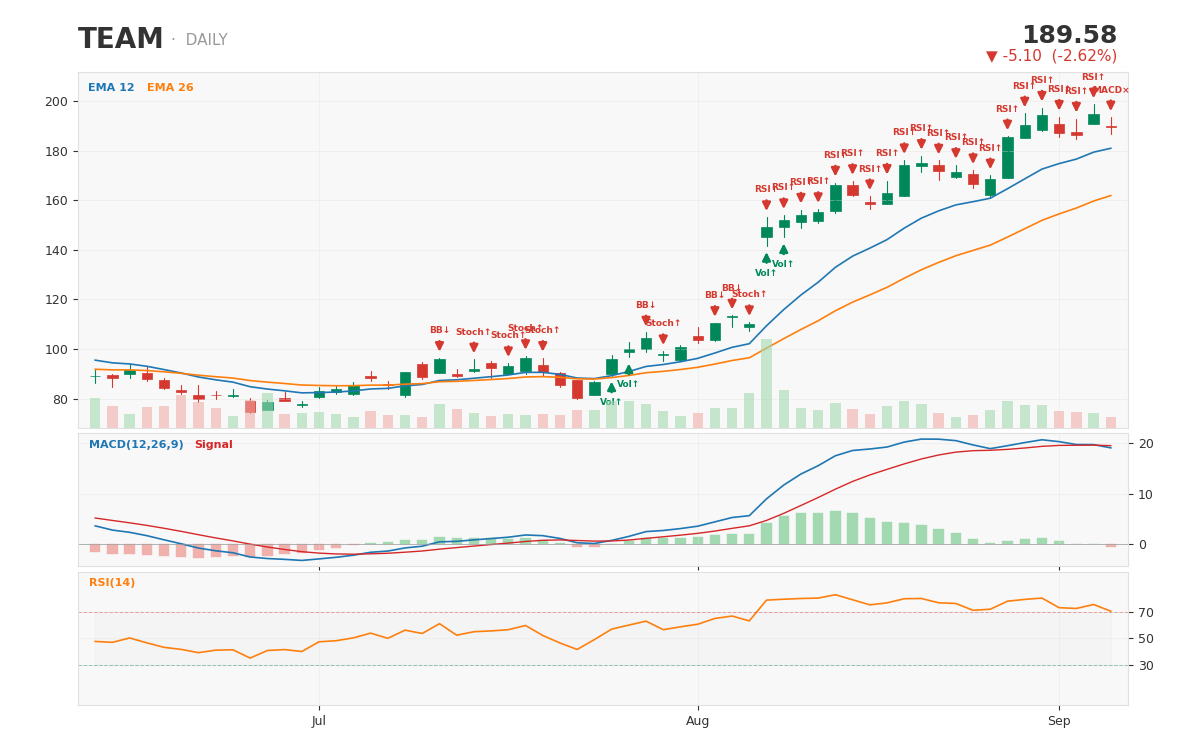 TEAM 1-year daily chart with technical signals -- captured in consolidation at the highs after a +92% August surge off the SaaSpocalypse lows, with the stock now above the analyst consensus
Where the Quant Scores and Technicals Agree — and Where They Split
The composite AI score of 62 is a moderate positive — it says the stock is above average but not screaming cheap or overbought. The technical rating of 64 is similarly moderate. The real divergence is between the long-term trend reading (91) and the short-term oscillator (37). That gap tells you the stock has made a massive structural move and is now taking a breather. The eight bearish short-term signals are exactly what you would expect to see after a 92% month: momentum exhaustion, profit-taking, and a rebalancing of positions.
This is not a sell signal. It is a consolidation pattern. The falling on-balance volume and below-VWAP readings suggest the immediate flow is neutral to slightly negative, but the supertrend sell is a lagging indicator that flips only after a sustained decline. The more likely read is that the stock is building a new support zone in the $185–$190 area before the next leg up, provided the fundamentals continue to support the narrative.
Smart Money: Gurus Are In, Insiders Are Taking Modest Profits
The institutional footprint is dominated by a few large, long-term holders. Baillie Gifford holds nearly 10 million shares, a position that predates the collapse and has been held through it. Other notable gurus with significant positions include Ken Griffin, George Soros, Jim Simons, and Joel Greenblatt. That is a strong bench of long-duration capital. None of them have been trimming in a way that suggests a loss of conviction.
Insider selling is more visible but modest in scale. The CFO sold 9,054 shares for about $1.6 million on August 19, representing roughly 3% of direct holdings. The CRO sold 7,617 shares for about $1.2 million on August 18, also about 3%. The CAO sold two smaller tranches — 1,125 shares and 939 shares — on August 19 and August 28. These are routine, option-exercise-related sales, not panic exits. The aggregate insider sell volume is trivial compared to the daily trading volume (2.5 million shares today alone). It does not signal a top.
The Valuation Debate: 5x FY28 Revenue and Zero GAAP Margins
The bull case rests on a multiyear outlook. The stock trades at 5.0 times fiscal 2028 revenue estimates and 18.9 times non-GAAP operating income. On a trailing 12-month basis, the picture is less flattering: the price-to-sales ratio is 7.6, the net margin is –0.8%, and GAAP EPS is –$0.21. Free cash flow is positive at $5.22 per share, so the business is self-funding, but GAAP profitability is still marginal. The bull case essentially says “pay for 2028 today and get a growing, high-margin subscription business with an AI tailwind.” The bear case says “the stock is already above analyst targets, the GAAP numbers are weak, and AI costs could compress margins.”
Jefferies has called the software rebound “real but selective,” with Atlassian, ServiceNow, and Cloudflare among the winners. The selectivity caveat matters: not every SaaS name will get the same re-rating. Atlassian earned it with a demonstrable product cycle and a usage-based AI monetization model that is already showing results. But the stock now sits above the average analyst target, which means the next leg up requires either earnings beats that push estimates higher or multiple expansion on the 2028 numbers. That is a higher bar than the one the stock just cleared.
The Sector Read: Why This Recovery Is Different
The “SaaSpocalypse” label was always an oversimplification. The fear was that AI would commoditize enterprise software. What actually happened is that companies with proprietary data — the Teamwork Graph, in Atlassian’s case — became essential infrastructure for AI agents. The Code Context feature is the clearest example: it gives coding agents access to the full codebase context they need to be useful, and that context lives inside Jira and Confluence. Atlassian is not being disrupted by AI; it is becoming a necessary layer for AI to work inside an enterprise.
That is why the 92% August rally was not just a dead-cat bounce. It was a re-rating of the entire narrative. The question now is whether the stock can hold those gains and build on them. The answer depends on execution — continued Rovo adoption, consumption revenue growth, and a path to GAAP profitability. The quant signals suggest the trend is intact but the stock needs time to digest. The guru positioning says long-term believers are still in. The insider selling says nothing alarming.
Verdict
The composite of evidence supports a constructive stance on TEAM, but the near-term risk is that the stock needs to consolidate after a historic month. The entry zone for a new position is $175 to $180 — the top of the pre-breakout range and a level that aligns with the analyst consensus median. If the stock pulls back to that area, it would offer a better risk/reward than chasing at $190. The 12-month target is $215, based on the average of the highest credible analyst targets ($212–$220) and the assumption that the FY28 revenue narrative continues to gain traction. The invalidation level is $160 — below the August 25 low of $165.10 and the point where the supertrend would likely confirm a trend change. A close below that would break the post-earnings structure and suggest the rally was a short squeeze rather than a sustainable re-rating.
Atlassian is no longer the SaaSpocalypse victim. It is the comeback that proved the narrative wrong. The question now is how much of that comeback is already in the price. The signals say the trend is still up, but the easy money has been made. The next move requires patience.
Want deeper research on any stock? Try Kavout Pro for AI-powered analysis, smart signals, and more. Already a member? Add credits to run more research.