Strategy’s Cash-Funded Bitcoin Buy Puts MSTR’s Discount at the Center of the Trade

Key Takeaways
- Strategy bought 950 Bitcoin for $75.7 million between September 14 and September 20, its first disclosed purchase since August. The purchase was funded with USD Cash, and the company reported no sales through its at-the-market program during the period.
- At approximately $86,300 per Bitcoin, 846,000 coins are worth about $73 billion by calculation, versus MSTR’s $55.78 billion market capitalization. That is roughly 0.76 times the gross value of the Bitcoin treasury, before accounting for debt, preferred securities, liquidity needs, or the software business.
- The filing improved the discount-closing argument, but it did not prove a durable financing shift. MSTR rose roughly 8% to 9% on September 21 and was nearly flat at $168.62 the next day, while the technical data remained sharply divided.
The Funding Line, Not the Bitcoin Count, Is the Catalyst
Strategy bought 950 Bitcoin for $75.7 million during the week ended September 20, at an average cost of $79,670 per coin including fees and expenses. It was the company’s first disclosed purchase since August, when it acquired 4,603 Bitcoin.
The latest purchase is small by Strategy’s standards. The filing should not be read as a major change in the size of the treasury. Its significance is the funding line: Strategy used USD Cash and reported no sales through its at-the-market share program during the purchase period.
That matters because common-stock issuance has been central to Strategy’s Bitcoin strategy. Issuing shares can provide capital for additional Bitcoin, but it also expands the number of common shares outstanding. When the equity trades above the value of its underlying assets per share, that mechanism can appear attractive. When the equity trades below the arithmetic value of its Bitcoin holdings, issuing more common stock risks increasing the denominator while the market is already applying a discount to the wrapper.
This filing shows a different allocation choice. Strategy added a modest amount of Bitcoin without an immediate ATM sale, and it repurchased preferred stock at the same time. That does not establish a permanent change in policy, but it does make the purchase more relevant as a capital-structure signal than as a Bitcoin-accumulation event.
MSTR rose roughly 8% to 9% on the September 21 disclosure and was nearly flat at $168.62 the following day. The price action is consistent with investors responding positively to the funding change, but it cannot prove why every investor bought the stock. The limited follow-through also argues against treating one cash-funded purchase as confirmation of a new multi-quarter financing model.
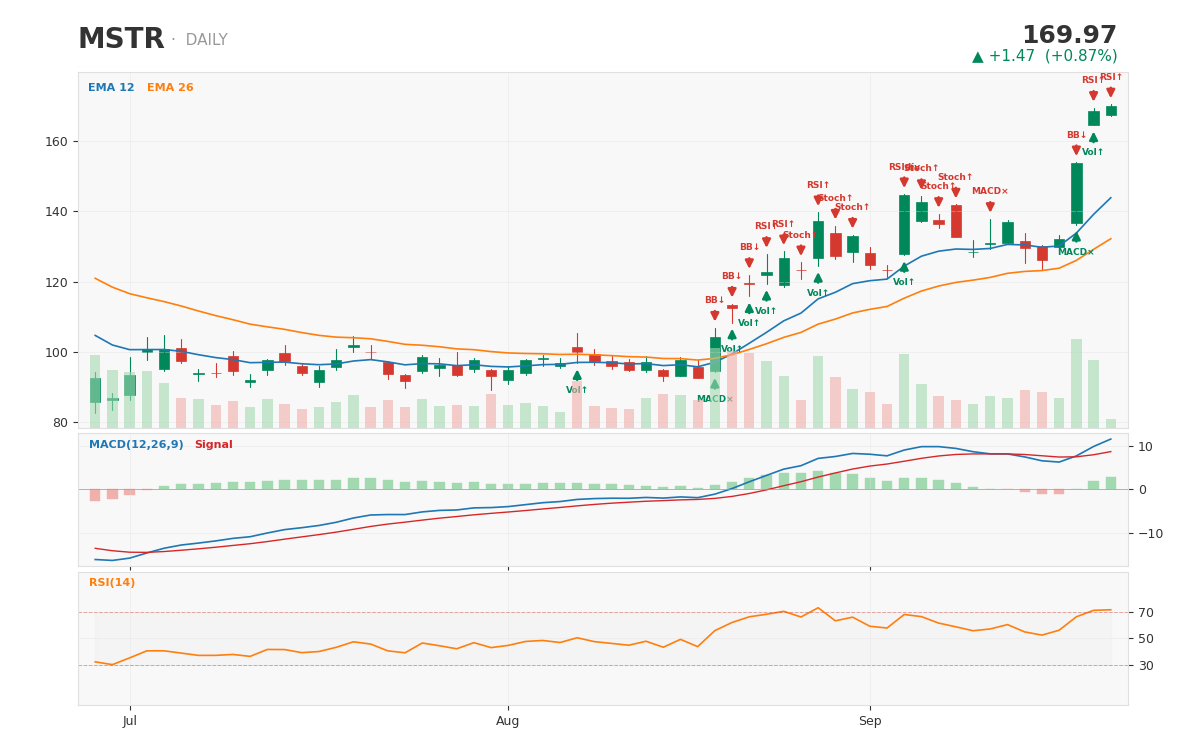 MSTR daily chart with technical signals -- captured at $168.71 the day after a no-dilution bitcoin purchase disclosure sent the stock up 9%, with the composite score still reading 29
The 0.76-Times Calculation Is a Gross Treasury Comparison
Strategy reports 846,000 Bitcoin with an aggregate cost of $63.80 billion and an average cost of $75,416 per coin. Using the approximately $86,300 Bitcoin price on September 22, 846,000 coins are worth about $73 billion by arithmetic.
Against MSTR’s $55.78 billion market capitalization, that produces a ratio of roughly 0.76 times the market value of the Bitcoin holdings alone. In simple terms, the equity market is valuing the company at about 76 cents for each dollar of gross Bitcoin value in the treasury.
The word gross is important. Market capitalization is the value assigned to common equity; it is not the same as enterprise value, and it does not remove debt or preferred claims. The dossier also puts total debt at $6.77 billion and cash and short-term investments at $2.45 billion in the fundamental data. Separately, the filing reported a $5.04 billion USD Reserve and $1.05 billion of USD Cash as of September 20. Those figures should not be treated as interchangeable without a fuller balance-sheet reconciliation.
The 0.76-times figure is therefore a market snapshot, not a net asset value or a guaranteed arbitrage. It changes with Bitcoin and MSTR’s share price. It also says nothing by itself about how much value should be assigned to Strategy’s software business, future financing costs, or preferred securities.
Even with those limitations, the calculation changes the question investors should ask. The trade is not only whether Bitcoin rises. It is whether the market becomes more willing to value MSTR closer to the assets it holds after considering the obligations around those assets.
The cash-funded purchase helps that argument because it added Bitcoin without reported common-share issuance during the period. The preferred repurchase points in the same general direction, but the discount will not close merely because the gross treasury value exceeds the market capitalization. Investors still have to believe that Strategy can preserve liquidity and manage its financing structure through a Bitcoin decline.
The Preferred Repurchase Adds a Capital-Structure Signal
Alongside the Bitcoin purchase, Strategy repurchased $174 million of its STRC preferred stock, representing 1,771,238 shares. That action is relevant because the company was not simply adding another asset; it was also reducing part of the preferred financing structure surrounding the common equity.
The filing reported $5.04 billion in USD Reserve and $1.05 billion in USD Cash as of September 20. Those balances provide the immediate context for using cash to buy 950 Bitcoin rather than selling common stock through the ATM program. Cash was a stated funding source, not an assumption inferred from the size of the purchase.
Still, the preferred repurchase should not be inflated into a balance-sheet repair by itself. A $174 million retirement is meaningful as a signal of capital allocation, but it is small relative to the $6.77 billion total-debt figure supplied in the fundamental data. It reduces one set of claims; it does not remove the company’s broader dependence on Bitcoin prices, liquidity, and access to capital markets.
The operating business also does not provide a conventional valuation anchor. MSTR’s price-to-sales ratio is about 110, while earnings and return on equity are negative in the available data. That supports viewing Strategy primarily as a Bitcoin holding vehicle with a software business attached, rather than as a conventional software company whose Bitcoin holdings are incidental.
This structure cuts both ways. A strong Bitcoin market and favorable equity valuation can give Strategy access to capital on attractive terms. A Bitcoin decline, a wider equity discount, or more expensive financing can make future purchases harder to fund without new equity or additional leverage. The latest filing reduces immediate dilution risk for this purchase; it does not eliminate that longer-term exposure.
The Technical Picture Is Supportive and Unsettled at the Same Time
MSTR’s technical data contains a sharp internal split. The technical rating is 100 out of 100, and the moving-average score is also 100 out of 100. The oscillator score is 58, however, while the broader composite score is only 29 out of 100.
The useful conclusion is not that one score is correct and the other is wrong. The moving-average reading captures the strength of the recent price move, while the weaker oscillator and composite readings show that the broader setup has not become uniformly positive. The September 21 jump improved the trend-related reading quickly; it did not by itself establish durable demand.
The individual signals point in the same direction. The dossier identifies one bullish flag, a bullish MACD divergence. Against it are a downtrend flag, falling on-balance volume, trading below the volume-weighted average price, and a declining volume-weighted average price. Those indicators do not prove that the filing-driven move will fail, but they give investors a reason to demand confirmation rather than chase the first reaction.
The technical evidence is therefore best treated as a timing warning. MSTR may have improved faster than its supporting volume and momentum measures. A sustained advance would be more credible if the stock could hold the gains while volume and its volume-weighted reference levels improve. Without that confirmation, a retest remains plausible.
That distinction matters for a retail investor. The filing creates a fundamental argument about the discount, but the technical data does not yet show that the market has fully accepted it. A bullish thesis based on the treasury calculation should not be confused with a completed breakout in the stock.
Analyst Targets Support the Direction, Not the Precision
The analyst consensus target is $233.70, roughly 38% above the $168.62 market price, with 18 buy ratings, 8 holds, and 3 sells. The median target is $201.50, and the published range is $155 to $350.
Those figures support the possibility of a higher stock price, but they do not establish that the 0.76-times treasury comparison will close. The wide range shows that analysts disagree about Bitcoin’s future value, the appropriate treatment of Strategy’s financing structure, and how much of the treasury should be reflected in the common equity.
The target also should not be treated as an independent valuation of the filing. The $233.70 consensus predates or incorporates a broader set of assumptions than this one purchase. It is useful as a market-expectations reference, not as proof that the cash-funded transaction is worth 38% upside.
The 29 out of 100 composite score supplies a counterweight. It does not specifically reject the September 21 filing, but it indicates that the broader quantitative picture remains difficult despite the 100 out of 100 technical rating. The analyst consensus is therefore a direction-of-travel signal. It is not a reason to ignore the debt, preferred claims, Bitcoin volatility, or the possibility that future purchases again require equity issuance.
The Real Test Is Whether the Funding Pattern Repeats
The central bull case is not that 950 Bitcoin materially changes Strategy’s treasury. It is that this purchase shows management can add Bitcoin with cash while avoiding common-share issuance and repurchasing preferred stock.
If that pattern continues, the company would be reducing the need to expand the common-share base while attempting to narrow the gap between the equity value and the gross Bitcoin value. That would make the 0.76-times calculation more relevant as a discount-closing thesis rather than a static comparison.
The bear case is that this was a one-week exception made possible by available cash. If the next purchase requires substantial ATM issuance, the latest filing will look more like a timing decision than a durable change in capital allocation. Issuance would not automatically invalidate Strategy’s Bitcoin strategy, but it would force investors to compare additional coins with the cost of expanding the equity base.
The balance-sheet counterargument also deserves more than a passing mention. The roughly $73 billion Bitcoin calculation is a gross asset figure. Debt, preferred securities, liquidity requirements, and the possibility of a Bitcoin drawdown all stand between that figure and the value ultimately available to common shareholders. A discount can remain rational if investors believe those claims or risks are large enough.
That is why the filing improves the setup without making MSTR low risk. The upside requires both a supportive Bitcoin price and greater confidence that Strategy can manage its claims without returning immediately to dilution.
MSTR Is a Speculative Buy Only for a Specific Thesis
MSTR is a speculative buy for an investor who wants leveraged Bitcoin exposure and believes the equity discount will narrow. The September filing improves that case: Strategy bought 950 Bitcoin with cash, reported no ATM share sales during the period, and repurchased $174 million of STRC preferred stock.
That is not the same as saying the stock is cheap on a net-asset basis or that the company has entered a low-risk phase. The 0.76-times figure compares market capitalization with gross Bitcoin value. It does not subtract the full financing structure, establish a liquidation value, or guarantee that the discount will close. The technical split and the $155-to-$350 analyst range also show how uncertain the market’s valuation remains.
I would not treat the September 21 jump as a reason to chase the stock. The better decision point is the next disclosure: does Strategy again use cash or another non-dilutive source, or does it return to common-share issuance? A repeat of the latest funding pattern would strengthen the discount-closing thesis. A rapid return to ATM issuance would weaken it.
For a practical risk marker, a sustained move below $155 would be a serious warning that the market is rejecting the current repricing case; that figure is the low end of the published analyst range, not a demonstrated technical support level. More important than any single price is whether the stock can hold its post-filing gains while the volume and momentum evidence improves.
The conclusion is therefore narrow and falsifiable: MSTR is attractive as a speculative discount-closing trade, not as a straightforward claim on $73 billion of Bitcoin. The thesis is strengthened by another cash-funded, no-ATM purchase and weakened if the next filing shows that this was only a temporary exception.
Want deeper research on any stock? Try Kavout Pro for AI-powered analysis, smart signals, and more. Already a member? Add credits to run more research.