Stride’s Activist Director Just Bought $12 Million of Stock. A Plan for $884 Million of Cash Is Due by January

Key Takeaways
- Fivespan Partners bought 154,196 additional Stride shares for approximately $12.2 million in discretionary open-market purchases, lifting its stake to about 4.6% and putting meaningful capital behind the board agreement.
- The operating picture is mixed rather than broken: first-quarter revenue rose 3.0% and adjusted EBITDA increased 3.1%, but total enrollment fell 2.5% and adjusted EPS declined 9.9% as the new platform disrupted applications.
- The new Capital Allocation Committee must publish a target capital structure and cash-allocation framework within about three months, with $884.2 million of cash and securities and $420 million of convertible notes due in 2027 on the table. At $79.21 the stock is up 22% this year but 48% below its October 2025 record.
A $12 Million Purchase Makes the Capital Plan the Immediate Catalyst
Fivespan’s latest buying in Stride is more consequential than a routine insider transaction. The investment group purchased 154,196 shares across October 23 and October 26 for approximately $12.2 million, at a weighted average price of about $78.98. Stride closed October 27 at $79.21, almost exactly around the level where the activist committed fresh capital.
The purchases were open-market transactions, and the Form 4 did not identify a prearranged trading plan. That makes the decision discretionary: Fivespan chose to add after Stride’s mixed quarterly report, not before it. The group’s holding now stands at approximately 1.9 million shares, or 4.6% of the company, compared with roughly 4.2% before the purchases.
This does not prove that a buyback, special dividend, acquisition, or sale is coming. The cooperation agreement does not prescribe one. It does, however, establish a shareholder with enough economic exposure to care about the outcome and enough room to increase ownership under the agreement’s 7.5% cap.
The timing also narrows the market’s question. Fivespan is not merely arguing that Stride should change; it is now buying around the price at which the market has valued the company after the enrollment setback. The next question is what the new Capital Allocation Committee does with that influence.
The Committee Has a Deadline, but Not Yet a Prescription
The October 8 cooperation agreement created a three-member Capital Allocation Committee co-chaired by Brian Shepherd and Dylan Haggart, with Aida Alvarez as the other member. Its mandate is to evaluate Stride’s capital structure and cash-allocation priorities, solicit shareholder input, and publicly announce a target capital structure and a framework for future cash flows within about three months.
That timetable matters because Stride has an unusually visible capital-allocation decision in front of it. The company held $884.2 million in cash, cash equivalents, and marketable securities at September 30. It also has $420.0 million of convertible notes due in 2027. The committee therefore has flexibility, but not an unlimited blank check: liquidity must be weighed against refinancing or repayment needs.
The agreement gives the market a defined catalyst rather than an indefinite promise. Haggart joined the board under the settlement, and Steven Guttentag is a board observer who is expected to become a director after the December 10 annual meeting. The framework should arrive around January 2027, making the committee’s eventual language more important than the mere fact of its creation.
The setup is unusual: a profitable company with a large cash balance, a weak share price, and a formal process with a deadline. The market is not pricing in a completed capital-return program. It is pricing the possibility that one emerges, alongside the obligation to deal with the 2027 notes.
Stride Beat Estimates While Losing the Enrollment Argument
Stride’s first-quarter results explain why the stock did not respond more strongly to the activist development. Revenue reached $639.4 million, up 3.0% year over year, while adjusted EBITDA rose 3.1% to $111.8 million. Adjusted EPS of $1.37 exceeded the roughly $1.07 consensus estimate, so the quarter was a beat on the conventional earnings scoreboard.
But the earnings beat concealed a weaker operating signal. Total enrollment declined 2.5% to 241,400 students, and adjusted EPS fell 9.9% from the prior-year quarter. The company’s revenue per enrollment increased 7.0%, which partly offset the lower student count, but that improvement needs to continue if enrollment does not recover.
The mix is doing important work. Career Learning enrollment increased 2.0%, while the larger General Education business contracted and produced a 1.8% revenue decline. Adult revenue fell 34.4%, although it is the smallest of the reported lines. The more favorable revenue-per-enrollment figure says Stride is monetizing each student better; the enrollment decline says the company is not yet replacing lost or delayed demand.
Management tied the enrollment pressure to friction from the new Launchpad platform overlay, according to a summary of the earnings call. That explanation offers a potential repair mechanism rather than a permanent demand verdict, but it also makes the next enrollment print unusually important. If applications recover, the first quarter may prove to be a transition cost. If they do not, the revenue-per-enrollment gain may be compensating for a shrinking addressable base.
The forward outlook is cautious. The midpoint of fiscal 2027 revenue guidance implies only about 2% growth from the approximately $2.52 billion generated in fiscal 2026. Adjusted operating income guidance of $500 million to $530 million is more encouraging than the top-line outlook, but the market will need evidence that profitability can hold while General Education enrollment is under pressure.
The Balance Sheet Creates Value Optionality, Not Free Cash
At the current market capitalization of approximately $3.29 billion, Stride’s cash position is large relative to the equity value. Subtracting cash and adding the convertible notes produces a rough enterprise value of about $2.83 billion. Against the midpoint of adjusted operating-income guidance, that works out to roughly 5.5 times.
That valuation arithmetic is the financial foundation of the activist case. A profitable company with substantial liquidity can potentially improve per-share value through a disciplined mix of debt management, reinvestment, and shareholder returns. The point is not that every dollar of cash should be distributed. The point is that the capital structure has enough scale for the committee’s framework to matter.
The competing claim on that cash is equally concrete. The $420 million of convertible notes due in 2027 represents nearly half the reported cash and marketable securities balance. A company facing that maturity may rationally preserve liquidity, refinance, or use cash to retire obligations rather than maximize near-term repurchases.
There was no ordinary share-repurchase activity in the first quarter beyond tax-withholding transactions. That leaves a clean before-and-after test for the committee. If the eventual framework includes repurchases, investors can compare the proposed pace and funding source with the note maturity and the company’s seasonal cash needs.
The strongest bullish interpretation is therefore narrower than “Stride is cheap.” It is that Stride has a potentially valuable capital-allocation decision ahead of it, while the current valuation gives that decision room to matter. The decision itself remains unknown, and the cash balance cannot be treated as surplus until the 2027 obligation and operating requirements are addressed.
The Price Trend Is Still Weak
The price action is more skeptical than the balance sheet. At $79.21, Stride is below its 50-day moving average of $81.79 and its 200-day moving average of $85.77. Kavout’s composite score is 66, against a technical rating of 33 and a moving-average score of 16: the broader reading is constructive, the price trend is not.
That split is consistent with the recent reaction to earnings. The shares fell 3.2% on October 21 after the quarterly release, with volume around 2.8 million shares versus roughly 700,000 typically. A beat that produces heavy-volume selling suggests the enrollment decline and weaker adjusted EPS mattered more to investors than the headline estimate beat.
The stock has since stabilized near the activist’s purchase price, but stabilization is not confirmation while the price remains below both trend averages.
The broader history makes the risk asymmetric in both directions. Stride remains approximately 48% below its October 2025 record close and about 22% below its 2026 high. That drawdown creates room for a re-rating, but it also shows that investors have previously repriced the company violently when enrollment and platform execution disappointed.
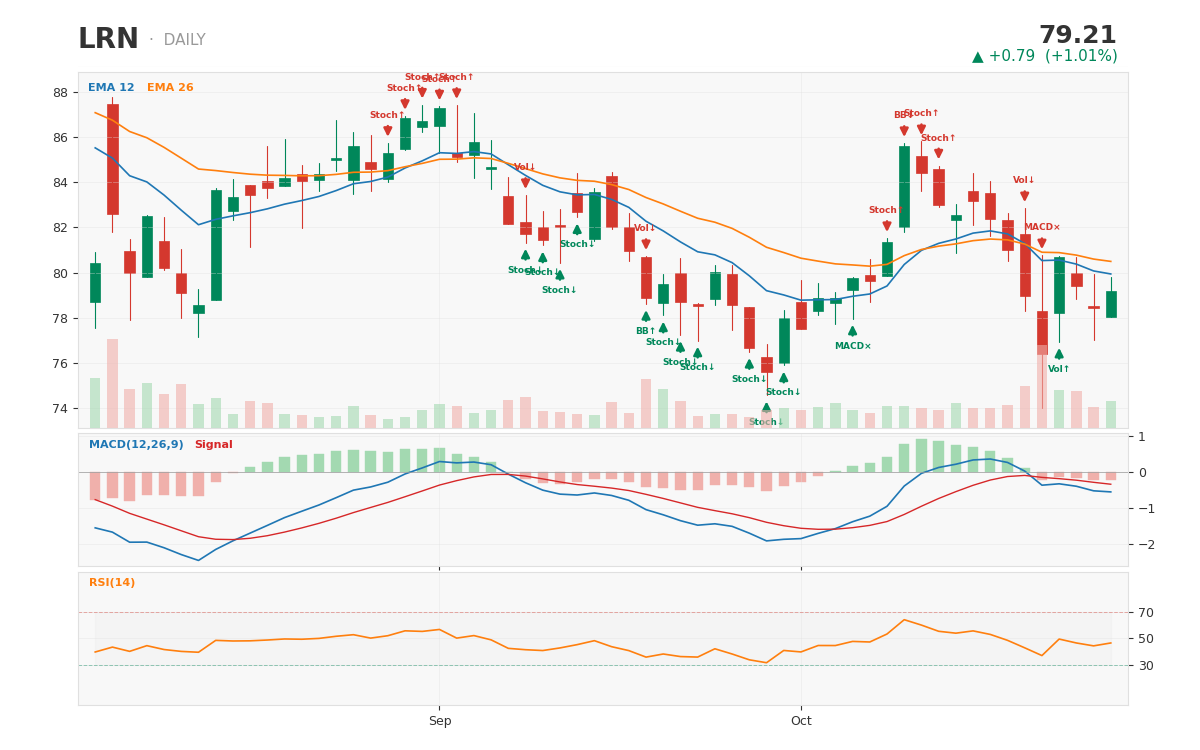 Stride daily chart with technical signals, through the Oct 27 close
The Catalyst Is Specific, but the Outcome Is Not
Several facts point in the same direction. The activist is buying with discretionary capital, the company has significant cash relative to its equity value, and the committee has a public framework due within roughly three months.
The operating data prevents that thesis from becoming a simple value call. Enrollment is down, General Education revenue is down, and fiscal-year revenue guidance implies only modest growth. The first-quarter adjusted EPS decline also shows that an estimate beat can coexist with deteriorating year-over-year earnings quality.
The conventional market view is similarly restrained. The consensus rating is Hold, with five buy recommendations, ten holds, and two sells. The target-price range runs from $38 to $115, while the average target is $76.50, below the current price. That spread is too wide to treat the average as a reliable valuation anchor; it mainly shows that the stock’s capital structure and operating recovery are being assessed very differently.
The decisive evidence should arrive in stages. Fivespan’s buying around $79 provides a real-time test of activist conviction. The December annual meeting will clarify the board’s final composition, while the committee’s January framework will show whether the settlement creates a credible use-of-cash plan. Before then, the next quarterly report must show whether enrollment is stabilizing and whether adjusted operating income is tracking the $135 million to $145 million second-quarter guide.
If those pieces align, the weak price trend may prove to be delayed recognition. If they do not, the low valuation will look like a reflection of shrinking demand rather than an opportunity.
What the Evidence Adds Up To
The case Fivespan is making with its own money is specific. Stride is profitable, guides to $500 million to $530 million of adjusted operating income, holds $884.2 million of cash and securities, and trades at roughly 5.5 times that operating income on a rough enterprise-value basis. Fivespan settled for two board seats and a committee with a deadline, then added about $12.2 million of stock at around $79, with room left under its 7.5% cap.
The business evidence is weaker. Enrollment fell 2.5%, General Education revenue declined, adjusted EPS fell 9.9% from a year earlier despite beating consensus, and fiscal 2027 revenue is guided to grow only about 2%. Stride has had two leadership and execution shocks in 12 months, $420 million of convertible notes come due in 2027, and analysts are split, with targets from $38 to $115. An activist may buy for governance leverage as well as valuation, and the committee’s framework is still unknown.
The checkpoints are Haggart’s formal start and the December 10 annual meeting, the committee’s framework around January 2027, second-quarter results against the $135 million to $145 million adjusted operating income guide, the enrollment trend as Launchpad problems are addressed, and any further Fivespan purchases.
Fivespan has put capital and a deadline behind its view. Whether that changes the stock depends on what the plan says and whether students return.
Want deeper research on any stock? Try Kavout Pro for AI-powered analysis, smart signals, and more. Already a member? Add credits to run more research.