Tempus AI's $14 Million Insider 'Cluster Sale' Was a Tax Bill — Moderna Was the Real Story

Key Takeaways
- A recent $14 million cluster of insider sales at Tempus AI was largely non-discretionary tax withholding tied to RSU vesting, not a signal of diminishing executive confidence.
- A Moderna and Merck cancer vaccine breakthrough, validating Tempus AI's strategic direction in minimal residual disease (MRD) monitoring, ignited a dramatic 46% rally in TEM stock since August 18, 2026.
- The stock's current price of $72.69 has rapidly outstripped prior analyst targets, even the highest estimate, prompting sell-side coverage to race for re-ratings, including a new $80 price target from BTIG.
The $14 Million "Insider Dump" Was a Tax Bill
A series of insider sales at Tempus AI (TEM) between August 14 and 19, 2026, totaling approximately $14.25 million, might have initially suggested a coordinated executive exit. However, detailed reporting clarifies that most of these transactions were routine and non-discretionary. Founder and CEO Eric Lefkofsky's $6.6 million sale on August 18, for example, was explicitly executed to satisfy statutory tax withholding obligations following the vesting of restricted stock units (RSUs). Data CEO Ryan Fukushima, CFO James Rogers, Chief Legal Officer Andrew Polovin, Chief Accounting Officer Ryan Bartolucci, and Diagnostics CEO Thomas Schoenherr made similar sales for the same reason.
This synchronous selling on August 18 at a uniform price of $49.61 is a mechanical outcome of shared RSU vesting schedules, triggering automatic "sell-to-cover" events for tax liabilities. It reflects a standard compensation process, rather than a deliberate decision by executives to divest based on company outlook. This distinction is crucial for investors, as it refutes any inference of internal foreknowledge of impending negative news.
A smaller, distinct transaction involved Director Nadja West, who sold 3,000 shares for $161,700 on August 14. This sale reduced her direct position by 8%, but the same tax-withholding explanation was not reported for her specific filing. Furthermore, an earlier sale by CEO Lefkofsky around July 30-31 for 250,000 shares was conducted under a pre-scheduled trading plan, also indicating a non-discretionary nature. Ironically, these scheduled sales occurred just days before Tempus AI experienced its most significant multi-day surge in months, underscoring the mechanical, rather than predictive, nature of the transactions.
Moderna's Cancer Vaccine Breakthrough Ignites a 46% Rally
The true catalyst for Tempus AI's recent ascent lies not within its internal share transactions but in external, third-party breakthroughs in personalized medicine. On July 20, 2026, Tempus AI had announced its agreement to acquire Personalis, Inc. for $1.5 billion, a move designed to significantly expand its capabilities in minimal residual disease (MRD) cancer monitoring. This all-stock transaction initially met with investor skepticism, leading to a 6% drop in TEM shares on concerns of shareholder dilution.
The strategic rationale for the Personalis acquisition received powerful validation this week. News of a clinical breakthrough in a Moderna cancer vaccine program, further supported by Merck, underscored the critical importance of personalized genomic monitoring for developing and deploying such therapies. Analysts immediately recognized Tempus AI's positioning as a "picks and shovels" beneficiary, providing essential diagnostic and data infrastructure for this burgeoning field.
The market reaction was swift and substantial. Beginning around August 19, the stock experienced a technical short squeeze, pushing it decisively above key moving averages. From the primary insider sale price of $49.61 on August 18, Tempus AI's stock surged to $72.69 by the close of August 21, representing an impressive gain of approximately 46.5% in just three trading sessions. This powerful upward momentum continued on August 22, fueled by BTIG Research raising its price target on Tempus AI from $70 to $80, while reiterating its Buy rating.
A Rapid Re-Rating Leaves Analysts Scrambling to Catch Up
One of the most striking current findings is the disconnect between Tempus AI's live market price and prevailing analyst expectations. As of August 21, 2026, the consensus price target for TEM stood at $59.40, with a median of $56.00. Crucially, the highest estimate in the coverage universe was $70.00. With the stock trading at $72.69 at the close of August 21, Tempus AI's share price had not only surpassed the consensus target but also exceeded every single analyst's high estimate in the panel.
This reveals a market in rapid re-evaluation, with price action far outpacing the sell-side's capacity to update models and targets. The dramatic rally, ignited by the Moderna/Merck catalyst, reflects a fundamental shift in perception that analysts are actively working to catch up to. BTIG's swift move to raise its target to $80 on August 22 underscores this dynamic, marking an early step in what is likely to be a broader re-rating across the analyst community. Investors should view this as a period of active price discovery, where the market is validating the company's long-term growth story more aggressively than traditional models have yet assimilated.
Fundamentals: Explosive Growth, Narrowing Losses, Rich Valuation
Tempus AI remains a pre-profit company, a common characteristic among innovative biotech and AI firms focused on capturing market share and building infrastructure. Its trailing 12-month (TTM) P/E and EV/EBITDA ratios are negative, reflecting ongoing investments into growth rather than immediate profitability. However, a deeper look into its financial trajectory reveals a genuinely improving operational picture.
The company boasts explosive revenue growth, with TTM revenue up 83.4% year-over-year. Importantly, this growth isn't coming at the expense of widening losses. TTM net income improved by 65.3% year-over-year, and EPS saw a 69.3% year-over-year improvement, indicating that losses are actively narrowing. The gross margin is solid at 64.0%, and strategic shifts, such as the faster growth of the higher-margin Data & Applications segment (reported with 72-75% gross margins), are expected to further improve profitability as the revenue mix evolves.
Below is a snapshot of key financial ratios:
| Metric | Tempus AI (TEM) | Interpretation |
|---|---|---|
| P/S (TTM) | 8.41x – 8.89x | Very rich; strong premium for growth |
| P/B (TTM) | 27.80x – 29.39x | Extremely high; reflects intangible assets & future value |
| Gross Margin | 64.0% | Solid for a tech-driven healthcare platform |
| Operating Margin | -19.8% | Reflects ongoing investment in growth |
| Net Margin | -17.8% | Losses are narrowing (TTM net income +65.3% YoY) |
| Current Ratio | 3.30 | Strong liquidity position |
| Debt/Equity | 3.25 | Carries leverage |
| Net Debt/EBITDA | -9.29 | Net cash position despite negative EBITDA |
The balance sheet presents a nuanced view, showing leverage with a Debt/Equity ratio of 3.25. However, the company also holds a net cash position, as indicated by a negative Net Debt/EBITDA of -9.29 (even with negative EBITDA). This suggests that while debt is present, it is outweighed by cash holdings, providing some financial flexibility. Valuation, based on Price/Sales ratios of 8.4x to 8.9x and Price/Book ratios around 28x to 29x, is undoubtedly very rich, reflecting the market's high expectations for future growth and profitability in its specialized and expanding market.
Smart Money Split: Growth Gurus Hold, Institutions Trim
Institutional positioning for Tempus AI is genuinely split: growth-oriented gurus are adding conviction while at least one major institution is trimming hard. The guru roster for TEM includes ten notable names, heavily skewed towards growth and momentum strategies. Leading the pack are Cathie Wood, holding 9.61 million shares, and Baillie Gifford with 8.65 million shares. Other significant guru holders include Ken Griffin, Ron Baron, and Samantha McLemore, alongside T. Rowe Price Equity Income and Paul Tudor Jones II. This group's presence underscores the belief in Tempus AI's long-term disruptive potential within healthcare and AI.
It is worth noting that Cathie Wood's position in Tempus AI was reported as "bleeding" in July, prior to this week's rally. The recent surge in stock price has likely alleviated this pressure and affirmed the strategic bets made by these growth-focused gurus.
However, the institutional picture is not uniformly positive. DefenseWorld reported on August 20 that Bank of America Corp DE significantly reduced its position in Tempus AI, cutting its holdings by 63.6% during the reported quarter. This substantial reduction from a major institution presents a counterpoint to the guru accumulation, suggesting that some larger funds may be rotating out or trimming positions, potentially due to valuation concerns or a rebalancing of their portfolios.
A news headline from Benzinga on July 30 referenced "Nancy Pelosi-Owned Tempus AI Stock." However, a direct check of available congressional trading data for Tempus AI in this analysis returned no matching filings. This discrepancy suggests the Benzinga report might refer to an older disclosure or a different data pull window, and should not be taken as independently verified information within the scope of this analysis.
Explore this yourself: See live insider, congress, and guru activity on any stock
Technicals Confirm Momentum, But Flash Overbought Warnings
The technical picture for Tempus AI confirms the powerful recent rally but also presents a nuanced view with clear signs of near-term overextension. The stock is in a confirmed uptrend, showing strong buying interest and price action well above its volume-weighted average price. This is further underscored by a perfect 100 on the moving average score, indicating that all key moving averages are aligned in a bullish configuration, reflecting rapid price appreciation.
Despite this strong momentum, several indicators suggest that the stock is becoming technically stretched. The stochastic RSI shows the stock deep into overbought territory, which often precedes a period of consolidation or a pullback. Furthermore, the ADX trend strength indicator has turned bearish, suggesting that the underlying strength of the current uptrend may be waning even as prices rise. Falling On-Balance Volume also indicates that the volume accompanying recent price moves may not be confirming the strength of the rally, adding to the caution signals.
A broader technical scan reveals a near-perfect split, with 15 buy signals against 16 sell signals. This delicate balance reflects the inherent tension: a stock enjoying a powerful, fundamentally-driven uptrend that has simultaneously triggered multiple cautionary technical flags due to the speed and magnitude of its advance.
The composite technical score of 49 sits noticeably below the technical rating of 75. This divergence is primarily explained by deeply negative value factors, which rank Tempus AI as expensive across all three value-composite measures, dragging down the overall composite score independent of the strong price action. For investors, this means the technical strength must be weighed against a valuation that already bakes in substantial future growth.
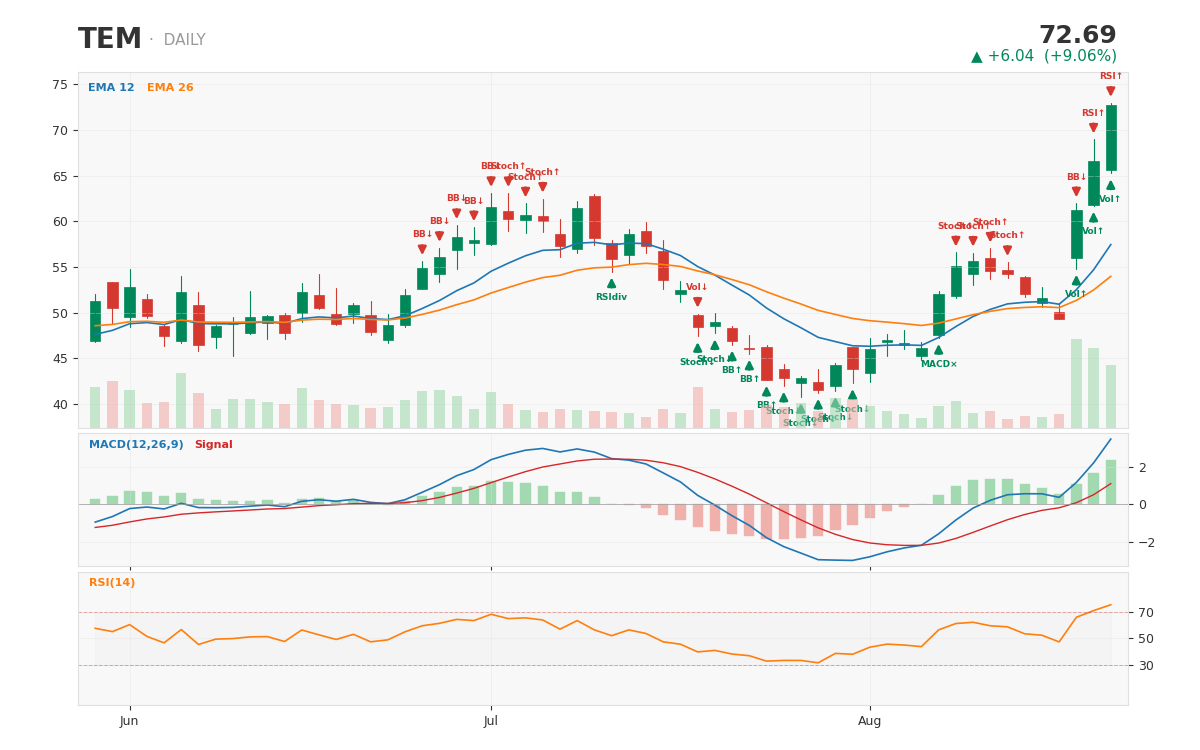 Tempus AI 1-year daily chart with technical signals -- a powerful recent uptrend that also shows real signs of being technically stretched, 15 buy vs. 16 sell on the broader scan
Investment Stance: High-Conviction Growth, Rapidly Adjusting Curve
Tempus AI (TEM) presents a compelling, high-conviction growth narrative driven by its pivotal role in personalized oncology, recently validated by significant industry breakthroughs. The market has swiftly re-rated the stock, recognizing its strategic positioning following the Personalis acquisition and the tailwinds from Moderna and Merck's cancer vaccine advancements. The recent 'insider cluster sales' are overwhelmingly explained as routine, non-discretionary tax-related transactions, not a sign of executive mistrust.
The stock has already rocketed past prior analyst targets, underscoring a rapid re-evaluation by the market that sell-side coverage is still scrambling to integrate. Tempus AI's fundamentals show explosive revenue growth and a positive trajectory towards profitability with narrowing losses, despite its current pre-profit status and rich valuation. While the technical picture confirms powerful momentum, it also flashes overbought signals, suggesting a period of consolidation could follow such a rapid ascent. Investors must balance this impressive growth story and its substantial upside against the current elevated valuation and technical extension.
Stance: Tempus AI is a compelling high-growth investment at the intersection of AI and precision medicine, with recent catalysts solidifying its long-term potential. The market has rapidly priced in a significant portion of this future, but the underlying narrative supports continued outperformance.
Entry Zone: A prudent entry zone would be a pullback into the $65.00 to $70.00 range, which would allow for consolidation of recent gains and potentially re-test the prior analyst high estimate as new support.
12-Month Target: Based on the fresh BTIG upgrade and the ongoing re-rating, a 12-month price target of $80.00 appears achievable as analyst models catch up to the accelerated growth narrative.
Invalidation Level: A decisive break and sustained close below $60.00 would invalidate the current bullish momentum, suggesting the market has fundamentally re-evaluated the catalyst-driven rally.
Want deeper research on any stock? Try Kavout Pro for AI-powered analysis, smart signals, and more. Already a member? Add credits to run more research.