The Sponsor Publicly Promised to Buy SUJA, Then Spent $16.6 Million Doing It

Key Takeaways
- Paine Schwartz Partners (PSP), Suja Life's pre-IPO sponsor, publicly announced its intention to buy shares on August 4, 2026, the same day the stock crashed following a disappointing earnings report and guidance cut.
- PSP followed through precisely, executing ten separate open-market purchases totaling approximately $16.6 million over three weeks, at prices that steadily rose from $6.27 to $9.59 per share, demonstrating conviction even as the stock rebounded sharply.
- Despite this strong sponsor signal, Suja Life carries significant financial leverage with a Net Debt-to-EBITDA ratio over 20x and negative free cash flow, underscoring ongoing risks for this modestly profitable beverage company.
A Public Commitment Followed by Substantial Open-Market Buying
The story of Suja Life, Inc. (SUJA) presents a rare instance where a significant "insider buying" signal isn't a mystery to be deciphered, but rather the transparent execution of a public commitment. On August 4, 2026, the exact day Suja's stock plummeted after its Q2 earnings report, Paine Schwartz Partners (PSP) — the private-equity sponsor that guided Suja through its May 2026 initial public offering (IPO) and held its full stake — issued a press release. That announcement plainly stated PSP's intention to increase its ownership through open-market purchases, signaling confidence in the functional beverage company despite immediate market headwinds.
PSP then meticulously followed through on its promise. Between August 13 and August 28, 2026, the sponsor executed ten distinct open-market purchases. These transactions, filed individually, totaled approximately $16.6 million for 1,988,625 shares. A genuinely notable detail in this buying program is that the purchase price consistently rose throughout the period, starting at $6.27 per share on August 13 and climbing to $9.59 per share by August 26, representing a 53% increase in the price PSP was willing to pay. This pattern indicates a conviction beyond mere bargain-hunting on a dip; PSP continued to accumulate shares even as the stock price recovered sharply, with its most recent purchase on August 28 at $9.33 per share.
This buying program is substantial relative to the company's size. The $16.6 million investment represents roughly 7.4% of Suja Life's current market capitalization of $222.9 million, added on top of PSP's already significant pre-IPO stake. This makes the buying not just a signal, but a material increase in ownership by a deeply informed party.
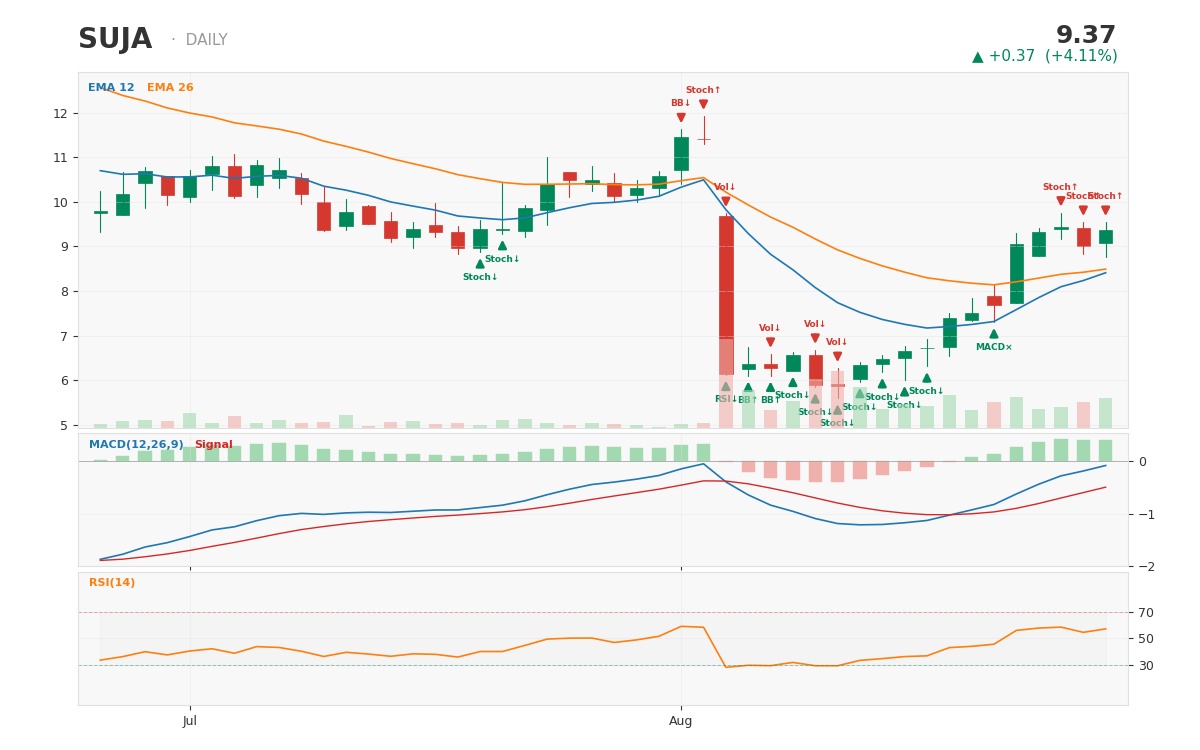 Suja Life daily chart since its May 2026 IPO, with technical signals -- a sustained recovery during Paine Schwartz Partners' publicly pre-announced, three-week, $16.6 million open-market buying program
The Post-IPO Plunge and Underlying Business Strength
Suja Life debuted on the public markets in May 2026. Its first earnings call as a public company for Q1 2026, reported in June, showed promising signs, including double-digit sales growth, margin expansion, and a strengthened balance sheet. However, the narrative shifted dramatically with the Q2 2026 report on August 4, 2026.
Despite continued year-over-year net sales growth of 11.6% to $83.9 million, management flagged softer recent bookings in the grocery channel and subsequently lowered its full-year sales outlook. This guidance cut, while specific to a particular channel, triggered a severe market reaction. The company's net loss increased by 391% in the quarter. The stock experienced a steep decline, with reports citing a "70% Post-IPO Stock Crash" from its May IPO levels.
It is worth noting that the subsequent flurry of securities-fraud investigation notices from various plaintiff law firms, while numerous, is a common occurrence after any significant post-earnings decline and typically represents boilerplate solicitation rather than definitive evidence of wrongdoing. Interestingly, some market participants appeared to anticipate weakness ahead of the August 4 announcement, with short interest in SUJA rising 75.5% during June to 745,246 shares.
Even amid the market turmoil, the company announced an Amended and Restated Credit Agreement on August 20, 2026 – right in the middle of PSP's buying spree. This refinancing move was reported to reduce borrowing spreads and lower the company's cost of capital, representing a positive, concurrent balance-sheet improvement.
Analyzing the Fundamentals: Modest Profitability and Significant Leverage
A look at Suja Life's fundamentals reveals a small, real, and modestly profitable consumer beverage business. The company maintains a healthy gross margin of 48.9% and an operating margin of 10.9%. While positive, the net margin sits at a thinner 2.3%. For the trailing twelve months (TTM), revenue growth stands at a genuinely strong 26.1%, which provides a useful longer-term perspective against the more recent quarterly deceleration.
However, the financial picture is not without its risks, creating a critical tension against the strong sponsor conviction. Suja Life carries genuinely high leverage, evidenced by a Net Debt-to-EBITDA ratio exceeding 20x. Furthermore, the company is currently free cash flow negative, with a price-to-free cash flow (P/FCF) multiple of -12.01x. These factors indicate that while the core business generates sales and modest operating profits, its capital structure and cash generation capabilities present real financial risks. This leverage, coupled with negative free cash flow, is a distinct concern that the sponsor's buying program, while signaling confidence, does not inherently resolve.
Here is a summary of key financial ratios:
| Metric | Value |
|---|---|
| Price/Earnings (P/E) | 48.58x |
| Price/Sales (P/S) | 1.15x |
| Price/Book (P/B) | 1.87x |
| Gross Margin | 48.9% |
| Operating Margin | 10.9% |
| Net Margin | 2.3% |
| Current Ratio | 1.53 |
| Debt/Equity | 1.63 |
| Net Debt/EBITDA | 20.82x |
| Price/Free Cash Flow | -12.01x |
| ROE | 5.7% |
| ROIC | 5.5% |
| TTM Revenue Growth | 26.1% |
Technical Recovery Amidst Signal Divergence
The stock's recent price action has shown a sustained bounce, with SUJA currently trading at $9.37 as of August 28, 2026, up from its 52-week low of $5.59. This recovery aligns with the sustained open-market buying by Paine Schwartz Partners throughout August. The moving average score, a component of the broader technical picture, reads strongly bullish at 87, which is consistent with the upward trend observed during PSP's accumulation phase.
However, a divergence appears when examining the composite score, which sits much lower at 19. This discrepancy is likely attributable to Suja's very short trading history since its May 2026 IPO, which limits the data available for some longer-term or more complex signal detectors. While the curated technical signal flags are currently empty due to this brief history, a broader scan of available data points (79 bars) leans net-bullish, with 13 buy signals versus 9 sell signals. This suggests that near-term price momentum has indeed been positive, even if a comprehensive, long-term technical profile has yet to fully develop.
Thin Analyst Coverage and Smart Money Insights
For a recently public micro-cap like Suja Life, institutional coverage and "smart money" positioning are still evolving. The available analyst consensus is notably thin, with only two analysts currently covering the stock. Their median price target stands at $26.67, with a high of $31.00 and a low of $24.00. While these targets imply a substantial upside of nearly 3x the current price, this dispersion most likely reflects stale price targets set before the August 4 guidance cut and the subsequent 70% stock crash. Without updated research, this consensus target should be treated as a data artifact rather than a meaningful, current signal of fair value.
Regarding other "smart money" indicators, Suja Life is too recent an IPO for most institutional 13F disclosure cycles to have captured guru holdings, and there are no congressional filings to report. However, it is worth noting that at least one institutional holder, the Wasatch Micro Cap Value Fund, publicly identified SUJA as the "largest detractor from Fund performance" in its Q2 2026 portfolio review, offering a balancing perspective on the impact of the stock's decline on other investors.
Explore this yourself: See live 13F, guru, and insider flow on Kavout Smart Money
A Sponsor-Backed Rebound With Underlying Leverage Concerns
Suja Life finds itself at a pivotal juncture. The public commitment and substantial follow-through by Paine Schwartz Partners inject a rare level of conviction into the narrative of a company that experienced a sharp post-IPO correction. The methodical, rising-price accumulation by its pre-IPO sponsor suggests a belief in a longer-term strategic game, looking past short-term grocery channel softness and a widened net loss. This sponsor buying occurred concurrently with a favorable credit agreement amendment, suggesting internal efforts to improve financial flexibility.
However, the investment is not without its distinct and material risks. Suja's balance sheet carries a high degree of leverage, and the company operates with negative free cash flow. While the business demonstrates solid TTM revenue growth and modest operating profitability, these financial characteristics warrant careful monitoring. The stock's technical picture points to a robust near-term recovery, though the low composite score underscores the immaturity of its trading history and the potential for volatility. The extremely thin and likely outdated analyst coverage means investors should lean on the qualitative conviction signals from PSP rather than headline price targets.
My stance on Suja Life leans bullish, driven primarily by the strong, transparent sponsor buying, which provides a unique vote of confidence. This signal helps de-risk the narrative around the post-IPO volatility, indicating a powerful insider perspective on eventual recovery and growth.
Stance: Bullish, buoyed by highly transparent and substantial sponsor buying following the post-IPO correction, but mindful of leverage and cash flow challenges.
Entry Zone: Consider initiating or adding to positions in the $8.50 to $9.20 range. This zone represents an attractive level that PSP consistently bought into, especially towards the latter, higher-conviction stages of their accumulation, and provides a clear technical re-test of support levels established during the recent rebound.
12-Month Target: Based on the strong sponsor conviction and the long-term growth potential in functional beverages, a 12-month target of $14.00 appears reasonable. This target reflects a partial recovery towards its 52-week high of $18.48 but accounts for the current financial leverage and the need for sustained execution and improved free cash flow. This is a derived target, with a degree of uncertainty given the thin analyst coverage and the rapidly changing post-IPO landscape.
Invalidation Level: A sustained close below $7.50 would invalidate this thesis. This level represents a breakdown of the recent recovery trend and would suggest that the underlying business or broader market conditions have deteriorated beyond what the sponsor's buying was able to support, indicating fundamental weakness not accounted for by the current read of the signals.
Want deeper research on any stock? Try Kavout Pro for AI-powered analysis, smart signals, and more. Already a member? Add credits to run more research.