Ultragenyx: A 44% Crash After Trial Failure, Two Weeks After First Gene Therapy Approval

Key Takeaways
- Ultragenyx Pharmaceutical Inc. (RARE) shares plummeted 44% on September 3, 2026, following the failure of its Phase 3 Aspire trial for Angelman syndrome, leading to immediate cost-cutting measures and program review.
- Despite this setback, the company's commercial operations remain strong, highlighted by five approved products, including the recent August 19, 2026 FDA approval of GENGLYCOS, its first gene therapy, and reaffirmed 2026 revenue guidance of $730 million to $760 million with an 83% gross margin.
- Pre-crash analyst targets and technical indicators have been rendered obsolete by the event, now giving way to extreme oversold conditions and anticipated deep downward revisions from a prior median target of $46.50.
A Staggering Crash After a Critical Clinical Setback
Ultragenyx Pharmaceutical Inc. (RARE) shares plunged 44.03% on September 3, 2026, closing at $14.85 and wiping out $1.46 billion from its market capitalization. This dramatic decline directly followed the company's announcement after market close on September 2: its Phase 3 Aspire trial for GTX-102 (apazunersen) in Angelman syndrome had failed. The investigational therapy missed both its primary endpoint (change from baseline in Bayley-4 cognitive raw scores) and its key secondary endpoint (net response in the Multidomain Responder Index). Ultragenyx has since stated it is reviewing the program's future and planning significant corporate expense reductions in response to the disappointing results, signaling a rapid operational shift.
The Commercial Foundation and Recent Success
Crucially, this clinical disappointment must be weighed against Ultragenyx’s established commercial business, which largely remains intact. Just two weeks prior, on August 19, 2026, Ultragenyx achieved a significant milestone: the U.S. FDA approved GENGLYCOS gene therapy. This marked the company's first-ever FDA-approved gene therapy and its fifth overall FDA approval, addressing the underlying cause of Glycogen Storage Disease Type Ia (GSDIa). The approval also brought a valuable Priority Review Voucher.
Ultragenyx reaffirmed its 2026 financial guidance in its Q2 earnings report on August 4, projecting total revenue between $730 million and $760 million. This guidance is underpinned by a growing portfolio, with Crysvita generating $156 million in Q2 revenue and Dojolvi adding $27 million. The company reported a trailing twelve months gross margin of 83.1%, indicating robust product economics. Management also maintained its pre-crash "path to profitability in 2027" statement. While the trial failure will necessitate a re-evaluation of R&D expenditure and may impact the precise timeline for profitability, the core commercial engine, bolstered by high gross margins, is still active.
Future Catalysts and Market Speculation
Beyond its existing commercial portfolio, Ultragenyx has another near-term pipeline event: a Prescription Drug User Fee Act (PDUFA) date for UX111 is set for September 19, 2026. Prior to the Aspire failure, market observers estimated a credible approval path with approximately 65% odds. While the GTX-102 setback casts a shadow, the UX111 program is distinct, and its outcome could provide a much-needed positive catalyst within weeks, making this date a critical watchpoint.
The extreme price movement has also spurred contrarian views. On September 3, the same day as the crash, Martin Shkreli publicly stated that Ultragenyx is undervalued and could be a takeover target for rare-disease peers. While this is one individual's opinion, it reflects a perspective that the company's core assets—especially its commercial portfolio and recent gene therapy approval—may be worth more than the current market capitalization, particularly at such a depressed valuation. This echoes a prior industry view from September 1, which listed Ultragenyx among four rare disease drugmakers with strong long-term growth prospects. The significant repricing could make an acquisition by a larger pharmaceutical company a more plausible, though still speculative, scenario.
Fundamental Snapshot Amidst Volatility
Ultragenyx's pre-crash fundamentals reflected a growth-oriented biotech firm with an emerging commercial base, characterized by high gross margins but heavy R&D investment leading to negative profitability.
The table below summarizes key pre-crash and current financial metrics:
| Metric | Value |
|---|---|
| Market Capitalization (Current) | $1.46 Billion |
| Enterprise Value (TTM) | $2.51 Billion |
| Price-to-Sales (TTM) | 2.00x |
| Price-to-Book (TTM) | -5.11x |
| Gross Margin (TTM) | 83.1% |
| Operating Margin (TTM) | -73.8% |
| Net Margin (TTM) | -81.8% |
| Earnings Per Share (TTM) | -$5.75 |
| Book Value Per Share (TTM) | -$2.79 |
| Free Cash Flow Per Share (TTM) | -$4.80 |
| Current Ratio (TTM) | 1.73 |
| Cash Ratio (TTM) | 0.36 |
| Revenue Growth (FY25 YoY) | +20.1% |
The negative book value per share and consistent losses are typical for biotechs prioritizing pipeline development. However, the 2.00x price-to-sales ratio (based on pre-crash market cap) against reaffirmed 2026 revenue guidance of $730 million to $760 million, combined with an 83.1% gross margin, underscores the bull case for the company's commercial assets. The current $1.46 billion market capitalization sits near the bottom of its 52-week range ($13.81 to $39.89), suggesting a valuation that has significantly discounted future prospects post-Aspire failure.
Repricing Expectations: Analyst Targets Post-Event
Prior to the devastating Phase 3 news, analysts held a decidedly bullish view on Ultragenyx. As of September 2, 2026, the consensus price target stood at $51.88, with a median target of $46.50. Even the lowest target was $30.00, more than double the stock's current trading price of $14.85. The overall analyst grade was a strong "Buy," with 26 buy ratings, 6 holds, and only 1 sell rating out of 33 analysts.
These figures are now entirely outdated and reflect historical sentiment that predates the trial failure. Wall Street analysts are in the process of rapidly repricing their expectations. The significant discrepancy between pre-crash targets and the current share price highlights the immediate need for a comprehensive re-evaluation of the company’s prospects. While Barron's noted that "Wall Street Isn't Giving Up Yet," investors should anticipate significant downward revisions to these targets as analysts incorporate the impact of the Aspire trial failure and associated cost-cutting.
Smart Money Positioning
Institutional investors showed mixed signals leading up to the trial failure. Eight prominent guru investors held positions in Ultragenyx, with Sands Capital being the largest holder with 3.2 million shares. Other notable holders included Ken Griffin, Steven Cohen, T. Rowe Price Equity Income, Jim Simons, Louis Moore Bacon, Paul Tudor Jones II, and Jefferies Group.
However, evidence of de-risking by some institutional players also emerged. Assenagon, for instance, sold a substantial 94.6% of its stake, liquidating 2.14 million shares during Q2 2026, well before the Aspire trial results. This suggests some institutions may have reduced binary event exposure. Insider activity was minimal, with two small, routine sales by the CFO and CLO in early August, a month before the trial results, unlikely connected to the trial outcome.
Technical Snapshot: From Momentum to Oversold
The stock's technical picture prior to the crash indicated a period of recovery and bullish momentum. On September 2, before the news hit, Ultragenyx displayed multiple bullish technical signals, including an established uptrend, outperformance relative to the broader market, and rising accumulation/distribution. These indicators suggested the stock had been building positive momentum into the critical Phase 3 readout.
The 44% decline on September 3, however, completely reset this landscape. A post-crash scan now shows an extremely oversold condition, with 20 "buy" signals against 10 "sell" signals across various technical measures. This technical exhaustion could set the stage for an oversold bounce or stabilization if the market finds a new floor for Ultragenyx. The previous bullish setup has been invalidated by the gap down, shifting focus to identifying signs of capitulation and potential consolidation.
Navigating the Post-Crash Landscape
Ultragenyx now faces a critical period, having endured a devastating trial failure that halved its valuation, yet retaining a significant commercial franchise and a recently approved, first-in-class gene therapy. The market has immediately priced in the Aspire failure, pushing the stock into deeply oversold territory. The key for investors is to differentiate between the failed pipeline asset and the revenue-generating commercial business. The company's confirmed cost-cutting initiatives will be crucial in preserving capital and accelerating its path to profitability, now likely delayed but still achievable.
This environment presents a potential entry zone for risk-tolerant investors looking beyond the immediate shock. A suitable entry zone for long positions appears to be around $13.50 to $15.50, establishing positions as the stock attempts to consolidate after the sharp decline near its 52-week low. For a 12-month target, factoring in retained commercial strength, the recent gene therapy approval, and anticipated analyst revisions (likely settling in the mid-$20s from the current $14.85), a target of $28.00 seems reasonable, assuming no further major pipeline setbacks and successful execution of cost controls. This target is considerably lower than prior analyst consensus but represents a significant rebound potential. The invalidation level for this thesis would be a sustained break below $12.50, which would signal a further erosion of confidence in the company's core commercial assets or a deeper re-evaluation of its future growth prospects. The immediate future will hinge on Ultragenyx's ability to articulate a clear path forward post-Aspire, demonstrate resilience in its commercial operations, and potentially deliver positive news from its remaining pipeline, particularly the upcoming UX111 PDUFA date.
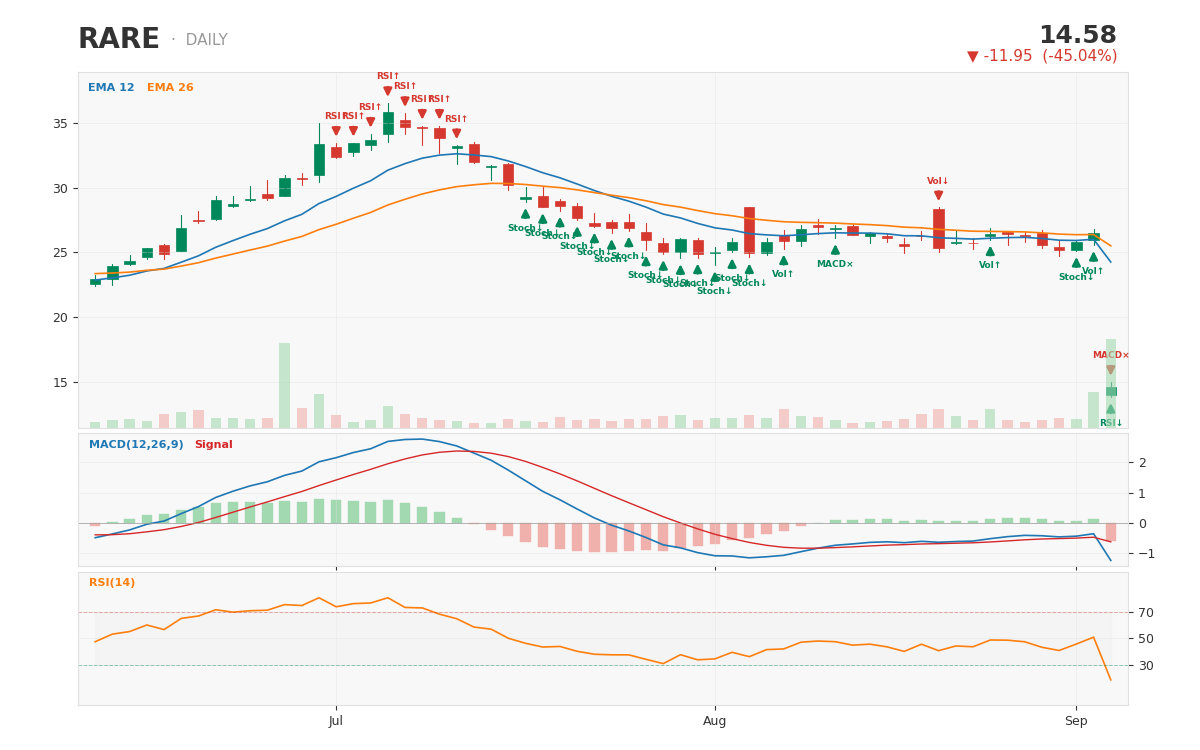 RARE 1-year daily chart with technical signals -- captured on a -45% day after the Phase 3 Aspire trial in Angelman syndrome missed its endpoints, two weeks after the company's first-ever FDA gene-therapy approval
Want deeper research on any stock? Try Kavout Pro for AI-powered analysis, smart signals, and more. Already a member? Add credits to run more research.