UPS Navigates Executive Shift and Strategic Rebuild: Is Its 118% Earnings Payout Sustainable?

Key Takeaways
- UPS's dividend payout ratio sits at a concerning 118% of trailing GAAP earnings, with adjusted earnings coverage also tight, raising questions about future dividend growth despite the company maintaining its current payment.
- Today's executive reorganization and new global operating model coincide with an 18-month strategic pivot away from low-margin Amazon volume, a move now "behind us" that contributed to a Q2 earnings beat but also stock weakness on cost concerns.
- Despite a split "Hold" analyst consensus and mixed technical signals, institutional investors like Bank of America have significantly increased their positions, suggesting some smart money sees value in UPS's current 6.3% yield and strategic direction.
New Leadership and Operating Model Underpin a Strategic Shift
United Parcel Service (UPS) is undergoing significant strategic and leadership transitions, highlighted by today's announcement of a new global operating model and key executive changes. Effective September 1, 2026, Kate Gutmann, Executive Vice President and President of International, Healthcare, and Supply Chain Solutions, will retire after nearly 37 years with the company. This leadership shift comes as UPS names the head of its U.S. business to lead global operations, signaling a focused effort on operational realignment.
These organizational changes are not isolated; they are layered onto a much broader strategic pivot that has been underway for roughly 18 months. Since early 2025, UPS has deliberately reduced its exposure to lower-margin Amazon delivery volumes, a strategy CEO Carol Tomé declared "behind us" during the company's Q2 2026 earnings call on July 28, 2026. The impact of this "glide-down" has been substantial, with Fool.com reporting in late August that UPS stopped carrying approximately 2 million Amazon packages per day.
The company's Q2 2026 results, reported in late July, reflected both the successes and challenges of this strategy. UPS posted adjusted earnings per share of $1.76, surpassing the Zacks consensus of $1.65, and reported revenues of $22.8 billion. Buoyed by these figures, management raised its full-year 2026 outlook. However, the market reaction was muted; shares fell 6% following the earnings release as investors focused on weaker near-term domestic expectations, lower international operating profit, and substantial restructuring charges. This divergence underscores a key challenge for UPS: while strategic shifts are delivering on some fronts, the market remains keenly focused on their impact on profitability and cost structure. The company is actively targeting approximately $3 billion in network savings for 2026, an ambitious goal to offset these pressures.
The Dividend's Tightrope Walk: Can a 118% Payout Be Sustained?
The most pressing question for many investors in UPS revolves around the sustainability and future growth of its attractive 6.3% dividend yield. While the company confirmed its regular quarterly dividend of $1.64 per share on August 5, 2026, payable on September 3, 2026, the underlying financial metrics paint a complex picture of its coverage. This is a critical distinction: the current payment is not at risk, but the prospect of future dividend growth is subject to genuine debate.
Trailing twelve-month (TTM) financial fundamentals reveal a GAAP (Generally Accepted Accounting Principles) dividend payout ratio of 118.4%. This figure implies that UPS's dividend payments currently exceed its GAAP earnings over the past year, a situation that typically raises red flags for dividend safety. Compounding this concern, free cash flow (FCF) generation has also been under pressure. First-half FCF of $1.6 billion covered only about 60% of the $2.7 billion in dividends paid over the same period. For the full fiscal year 2025, UPS's dividend nearly consumed all of its adjusted free cash flow, according to Benzinga.
However, a more nuanced perspective emerges when considering adjusted earnings. Fool.com, in late August, predicted a dividend freeze through 2027, noting that UPS's $6.56-per-share annual dividend equals approximately 91% of the adjusted earnings per share the company expects for 2026. This adjusted figure, while still high, suggests a tighter but potentially manageable situation, depending on how "adjusted" earnings are defined. The company's FCF yield of 6.2% also sits very close to its 6.3% dividend yield, indicating a tight relationship where cash flow generation is barely exceeding dividend obligations.
Despite these concerns, there are constructive arguments for the dividend's long-term viability. Seeking Alpha highlighted in mid-August that UPS, with its 6.3% yield and a forward P/E of 14.5, might be undervalued. Furthermore, Barron's noted in late August that UPS's yield matches or beats 10-year U.S. Treasuries, making it an attractive option for income-focused investors in the current market environment. The core of the dividend debate thus centers on operational execution and the company's ability to translate its strategic shifts into more robust and consistent free cash flow generation that comfortably covers its payout.
Strategic Volume Reduction Impacts Margins and Leverage
UPS's strategic decision to shed low-margin Amazon volume, while intended to improve overall profitability, has visibly impacted its top-line and earnings growth in the trailing twelve months. The company's TTM revenue declined by 2.5%, accompanied by a 3.6% reduction in net income. These figures are not a sign of collapsing demand, but rather a direct and expected consequence of deliberately culling less profitable business segments.
Examining UPS's core profitability, margins remain relatively thin, a characteristic often seen in logistics businesses with high operational costs. Gross margin stands at 16.6%, operating margin at 7.3%, and net margin at 5.1%. While these figures are consistent with trailing twelve-month data from authoritative financial APIs, they highlight the challenge UPS faces in expanding profitability, especially given ongoing restructuring charges and the necessity to reinvest in its network for faster service, as announced in late August.
The company also carries a notable level of debt. Its debt-to-equity ratio is 1.90, and net debt-to-EBITDA stands at 2.27x. While these leverage metrics are not excessive for a capital-intensive industry, they do add another layer of scrutiny to the dividend coverage debate. Any significant deterioration in cash flow or earnings could quickly put pressure on these ratios. The current ratio, at 1.18, indicates adequate short-term liquidity, reflecting a lean operating environment where efficient cash management is paramount.
| Metric | UPS (TTM) | Notes |
|---|---|---|
| Valuation Multiples | ||
| P/E Ratio | 19.34x | |
| P/S Ratio | 0.98x | |
| EV/EBITDA | 10.62x | |
| P/FCF Ratio | 16.14x | |
| Profitability | ||
| Gross Margin | 16.6% | |
| Operating Margin | 7.3% | |
| Net Margin | 5.1% | |
| Returns | ||
| Return on Equity (ROE) | 29.1% | Strong return on shareholder capital |
| Leverage & Liquidity | ||
| Debt/Equity (D/E) | 1.90 | Moderate leverage for a capital-intensive industry |
| Net Debt/EBITDA | 2.27x | |
| Current Ratio | 1.18 | Indicates adequate short-term liquidity |
| Dividend Health | ||
| Dividend Yield | 6.3% | Attractive, above 10-year Treasury yields |
| Payout Ratio (GAAP) | 118.4% | Exceeds TTM GAAP EPS, a key point of contention |
| FCF Yield | 6.2% | Close to dividend yield, implying tight coverage |
The chart above illustrates the key financial metrics that underpin the current investment thesis for UPS. The tight payout ratio and FCF yield are especially noteworthy, setting the stage for the dividend safety debate.
Institutional Investors See Value Amidst Retail Uncertainty
While retail investors may be grappling with the complexities of UPS's operational shifts and dividend coverage, a closer look at institutional and "smart money" positioning reveals a different perspective. Bank of America, for instance, significantly increased its position in UPS by 23.3% as of an early August 2026 disclosure, bringing its stake to over 9.7 million shares, valued at approximately $957 million. This substantial accumulation suggests a conviction in UPS's long-term value proposition, despite the near-term challenges. Other institutional moves around the same period were mixed, with some smaller firms decreasing holdings while others increased, but none matched the scale of Bank of America's move.
The list of guru holders in UPS is also robust, featuring 21 named institutional investors including prominent names like T. Rowe Price Equity Income, PRIMECAP Management, Jim Simons, Ken Griffin, Joel Greenblatt, Bill Miller, Ken Fisher, and Ray Dalio. These are sophisticated investors known for their deep research and long-term horizons, and their collective presence suggests that UPS remains a stock of interest for seasoned money managers. It is important to note that specific insider trading activity, particularly open market purchases by corporate executives, has been absent in recent records. While Q2 2026 did show some net acquisition of shares by insiders, these were primarily through non-open market transactions like option exercises and tax-related share dispositions rather than direct purchases, making it less indicative of strong bullish sentiment from within the company.
The strong institutional buying, particularly from a large player like Bank of America, provides a counterweight to the market's more immediate concerns following the Q2 earnings report. It implies that certain segments of smart money are looking beyond the temporary pressures of restructuring charges and the Amazon glide-down, focusing instead on the potential for strategic realignment to drive future shareholder value, especially through the attractive dividend yield. This divergence between institutional confidence and broader market apprehension creates a fascinating dynamic for UPS shares.
Explore this yourself: See live 13F, guru, and insider flow on Kavout Smart Money
Technicals and Analyst Views Signal a Delicately Balanced Outlook
The current market sentiment for UPS, as reflected in both analyst consensus and technical indicators, mirrors the complex fundamental picture. Sell-side analysts are genuinely divided on the stock's prospects, with 19 "Buy" ratings, 20 "Hold" ratings, two "Strong Buy" recommendations, and 4 "Sell" recommendations. This near-even split appropriately culminates in an overall "Hold" consensus grade. The median price target of $119.00 to $120.00 suggests an upside of approximately 14% from the current price of $104.22. However, the target range is notably wide, stretching from a low of $76.00 to a high of $132.00, implying significant disagreement among analysts regarding both upside potential and downside risk.
From a technical perspective, the picture is similarly balanced, lacking a strong directional bias. Our curated signal set shows a modest lean towards bullish indicators, with five bullish flags such as the stock being in an uptrend, outperforming the market, showing an uptrend in accumulation/distribution, experiencing rising on-balance volume, and trading above its volume-weighted average price (VWAP). These signals suggest underlying strength in the current move. However, three bearish signals temper this optimism: the trend strength indicator (ADX) has turned bearish, a supertrend indicator has issued a sell signal, and the stochastic RSI oscillator shows overbought conditions, suggesting potential for a near-term pullback.
A broader scan of technical signals further corroborates this equilibrium, with 13 buy signals almost perfectly balanced against 14 sell signals. This suggests that the stock is currently in a consolidation phase, with neither buyers nor sellers able to assert dominant control. Our composite score of 66, which integrates various fundamental, quantitative, and technical inputs, sits notably higher than the individual technical component scores. The technical rating is 35, the moving average score is 33, and the oscillator score is 37. This divergence indicates that while the overall AI model sees some underlying strength in UPS, the pure price action and momentum signals are currently less compelling, suggesting that fundamental or strategic factors are contributing more significantly to the composite's higher reading. The blend of a split analyst community and a balanced technical setup underscores the ongoing uncertainty surrounding UPS's near-term trajectory.
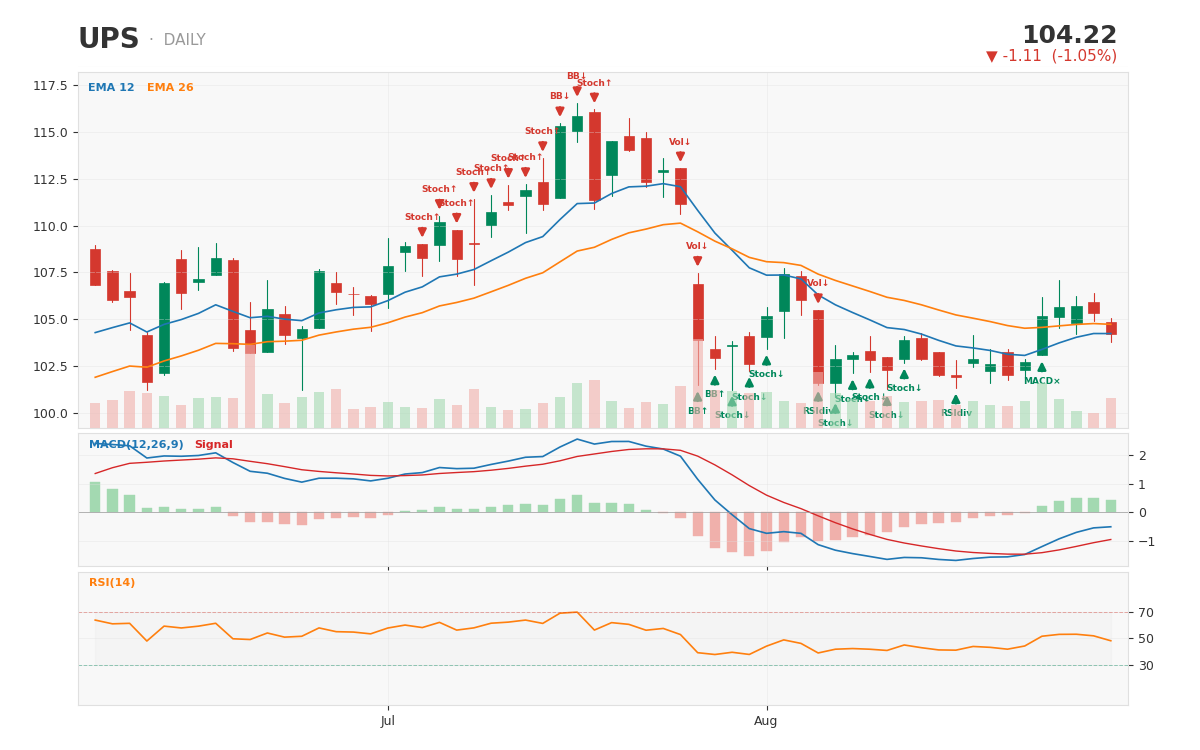 UPS 1-year daily chart with technical signals -- a genuinely balanced signal picture, consistent with a split analyst grade and an open debate over dividend sustainability
Verdict: A Calculated Risk for Income-Focused Investors
UPS presents a compelling, albeit complex, opportunity for income-focused investors willing to embrace a calculated risk. The current 6.3% dividend yield is highly attractive, especially when compared against broader market benchmarks, and the company has confirmed its latest quarterly payment. However, the high dividend payout ratio, particularly the 118.4% against trailing GAAP earnings, demands close scrutiny of operational execution and free cash flow generation moving forward.
Our stance is that UPS offers a cautious buy for long-term income investors who have a high conviction in management's ability to execute its strategic transformation and realize the promised cost savings. The company’s ongoing executive reorganization and shift to a new global operating model are critical catalysts that could unlock efficiency and improve margins over time.
For an entry zone, we would look for consolidation around the current price levels, specifically between $103 and $105. This area has shown some stability recently, and a move above $105 could indicate renewed buying interest, while dips towards the lower end of this range might present an attractive entry point. This zone aligns with the recent trading patterns and sits comfortably above the 52-week low.
The 12-month target is set at $118. This aligns with the lower end of the analyst consensus range and reflects a modest upside of approximately 13% from the current price. We acknowledge that the wide analyst target range and "Hold" consensus mean this target carries moderate confidence, relying on successful execution of the new operating model and a gradual improvement in market sentiment towards the dividend's long-term sustainability.
An invalidation level for this thesis would be a sustained break below $98.00. This level represents a significant technical support point and a break below it, especially if accompanied by further negative news regarding the company's profitability or, crucially, any indication of a dividend cut or further freezes beyond 2027, would signal a fundamental breakdown in the investment thesis. While the current dividend remains secure, ongoing operational challenges or a failure to materially improve payout coverage would challenge UPS's appeal as an income play.
Want deeper research on any stock? Try Kavout Pro for AI-powered analysis, smart signals, and more. Already a member? Add credits to run more research.