WBD – The Deal Is One Hurdle From Done, and Insiders Have Sold $53 Million

Key Takeaways
- Warner Bros. Discovery has cleared antitrust review in nearly 70 countries for the Paramount Skydance $111 billion takeover, but a single 12-state lawsuit led by California remains the only obstacle — and the clock is ticking toward a $7 million per day break fee on October 1.
- Company insiders including CEO David Zaslav have sold approximately $53 million worth of stock since mid-August, with several sales representing option exercises locked in after a 146% rally from the $11 strike.
- Meanwhile, billionaire investors Dan Loeb, David Einhorn, and George Soros opened new stakes (Loeb alone bought 20 million shares), while Pentwater Capital, Bill Nygren, and Ken Griffin hold blocks of 30‑50 million shares each — setting up a rare symmetric tension between corporate insider exits and smart‑money entry.
The Last Hurdle: A 12‑State Lawsuit
Paramount’s acquisition of Warner Bros. Discovery has satisfied every regulatory condition under the merger agreement and received clearance in nearly 70 countries, per the companies’ own August 14 release. The single remaining barrier is a 12‑state antitrust lawsuit led by California Attorney General Rob Bonta, filed in federal court. Settlement talks collapsed in late August after California canceled a meeting accusing Paramount of leaking — Paramount denies the claim and says it remains ready to negotiate.
The remedies California is seeking are structural: required divestitures of certain TV channels, a commitment to keep the movie studio operationally separate, and even a potential sale of CNN. News reports from Reuters and CNBC confirm that a CNN sale is “on the table” — Ellison, the buyout’s lead, is willing to sell CNN to save the $111 billion deal. That concession was not yet part of a settlement, but it signals a real willingness to give ground.
The deal’s termination deadline matters. Starting October 1, Paramount owes about $7 million per day if the transaction hasn’t closed. Prediction markets on Kalshi and Polymarket price roughly 1‑in‑4 odds that the bid fails by July 2027. Those odds have narrowed since the clearance wave but widened again after the settlement breakdown. For a stock trading at $28.25, just 10% below the $31 consensus target, the spread itself is a bet on the lawsuit’s outcome. If the deal goes through, the stock likely closes to $31 immediately. If it fails, the fundamental support underneath is much lower.
Insiders Exited $53 Million Into the Rally
The insider selling record between mid‑August and September 3 is striking in both scale and concentration. The combined value is approximately $53 million across six executives and directors. The largest single block came from CEO David Zaslav, who sold $27.1 million across two filings, including a $21.7 million block. Zaslav exercised options at $10.16 per share — the market data shows two M-Exempt transactions for 678,267 and 194,999 shares — and sold the resulting shares into the strength.
Gerhard Zeiler, President of International, exercised options struck at $11.02 and sold 591,038 shares at $27.05 — about $16 million across one filing. Zeiler’s sale represented roughly 52% of his direct holdings, a meaningful reduction. Director Fazal Merchant sold 71,539 shares (68% of his direct stake) for $2 million on August 13. Director Kenneth Lowe sold 120,000 shares on August 11 for $3.2 million and another 200,000 shares on September 3 for $5.7 million, bringing his total to $8.9 million. Richard Fisher sold 20,000 shares for $549,000, and J-B Perrette, CEO of global streaming, sold 126,707 shares at $28.96 for $3.7 million on August 27.
Option exercises are not in themselves bearish — they can simply be tax planning or liquidity. But the consistent pattern of selling into strength, at prices near the 52‑week high of $30, and in many cases reducing holdings by double‑digit percentages, is a datapoint that demands attention. Insider sales are not a guarantee of future decline, but they are a real signal of conviction at the top of the company.
Billionaires Are Betting the Other Way
On the other side of the trade, some of the most recognized names in event‑driven and value investing opened or increased positions in WBD during the same period. Dan Loeb’s Third Point filed a brand new stake of 20 million shares — roughly $560 million at current prices. David Einhorn and George Soros also bought in, per public filings from mid‑August.
Beyond the glamour names, the largest holders in the stock include Pentwater Capital at 50.2 million shares, Bill Nygren’s Oakmark fund with 32.9 million shares, and Ken Griffin’s Citadel at 29.4 million shares. Independent Franchise Partners and Paul Tudor Jones also hold meaningful positions (7.1 million). These are not passive index holders; these are active managers who tend to make conviction bets based on deep fundamental research or catalyst anticipation.
The divergence between insider selling and billionaire buying is the central tension of this stock right now. Both groups have access to high‑quality information — insiders obviously know the business intimately; Loeb, Einhorn, and Soros have teams that can analyze merger outcomes, debt structure, and synergy estimates. One group is reducing exposure heavily; the other is increasing exposure heavily. Both cannot be right in the same way. The resolution likely hinges on the lawsuit’s outcome and the underlying business performance separate from the deal.
Fundamentals Caught in Merger Limbo
With the stock’s price pinned by merger arbitrage, traditional fundamental analysis is partly suspended. But the underlying business still matters for the downside case if the deal fails. Warner Bros. Discovery is not a healthy company on an operating basis right now.
Revenue declined 5.1% year over year on a trailing twelve‑month basis. Gross margin is 43.4%, but operating margin is only 5.4%, and the net margin is negative 8.8%. The company lost $1.26 per share over the last four quarters. Debt to equity is 0.98, and net debt to EBITDA stands at 4.74 — elevated, though not alarming for a media conglomerate undergoing transformation. Free cash flow yield is 3.1%, reflecting some cash generation but not at a multiple that would support the current stock price without the merger premium.
The consensus from covering analysts is essentially a hold: 12 buys, 19 holds, 1 sell. The average target is $31, about 10% above current levels. That target is effectively a merger‑arb valuation — the base case is that the deal closes at 0.3% per week of carry. If the deal fails, analysts would almost certainly cut targets significantly, likely to the high teens or low $20s based on depressed cash flows and debt service.
Technical Signals Are Flat — But One Divergence Stands Out
The stock’s technical picture matches the fundamental limbo. The composite AI score for WBD sits at 52 out of 100, the technical rating at 47, and the moving average rating at 58. All three are neutral, suggesting no strong directional bias from price action. Volume on September 4 was 11.4 million shares, below the recent average, consistent with a waiting tape.
The one notable technical signal is an RSI bullish divergence. While the stock’s price has made a lower low over the past few weeks, the relative strength index has formed a higher low. That divergence often suggests fading downside momentum. However, it appears against a backdrop of seven bearish signals elsewhere. The RSI divergence is not strong enough to override the overall flat read.
In simple terms: the technicals are not giving a clear entry or exit signal. They reflect a market that is waiting for the next piece of news — a settlement, a trial date, or a ruling. The lack of conviction in the tape is itself a signal that the stock is being driven entirely by legal and regulatory headlines, not by fundamentals or technicals.
Verdict: The Spread Tells You Everything
The most important signal agreement in this data set is that the stock is priced for a high probability of deal completion. The $31 consensus target, the flat tape, and the relatively narrow spread (roughly 10% upside to target versus a typical merger‑arb spread of 5‑15%) all point to the same conclusion: the market believes the lawsuit will be resolved in favor of the deal, even at 1‑in‑4 odds of failure.
The most important signal disagreement is the insider‑versus‑billionaire divergence. Insiders are sellers. Gurus are buyers. That is not a disagreement that resolves by averaging. It is a true fork. One interpretation is that insiders are simply taking profits after a 146% rally from the $11 lows — a rational portfolio rebalancing that does not imply a negative view on the deal. The other interpretation is that insiders see risks in the business or the regulatory outcome that outside billionaires underestimate.
The data supports both readings. The insider sales are large, but they are also heavily weighted toward option exercises that were always going to generate cash tax obligations. Zeiler’s sale at $27 after a $11 strike is a textbook example of locking in a multi‑bagger. Zaslav’s sales are also option exercises. Lowe’s sales were direct share disposals, but even those may be diversification for a director.
On the other side, Loeb, Einhorn, and Soros have strong records in special‑situation investing. Loeb’s 20 million‑share bet is a big one even for a fund his size. It suggests real conviction that the deal closes and that the combined entity’s synergies are undervalued.
The stock at $28.25 offers a 10% return if the deal closes in the next six months — that works out to roughly 20% annualized, which is attractive for a merger‑arb play. The 1‑in‑4 failure odds imply an expected value of roughly $25 if the deal fails (a 50% haircut from the current price). That arithmetic is consistent with the current spread: if the deal closes, you earn 10%; if it fails, you lose about 30% from here. Those risk/reward numbers are roughly symmetric.
The evidence leans toward a neutral‑to‑slightly‑bullish stance on the merger‑arb trade, but a cautious one given the insider selling. The best entry zone is near current levels. A move above $30 would likely require a concrete settlement announcement, at which point the easy upside is gone. A break below the 52‑week low of $11.92 would be a clear sign of deal failure, but that is a distant level. More practically, if the stock drops below $20, the market would be pricing failure at high odds, and the risk/reward flips.
The single sentence worth remembering: Warner Bros. Discovery is a bet on one lawsuit, not on the underlying business — and the insider selling says the executives are reducing their exposure to that single‑outcome wager, while the billionaires are doubling down. The tape is telling you to wait for a settlement headline before committing big capital.
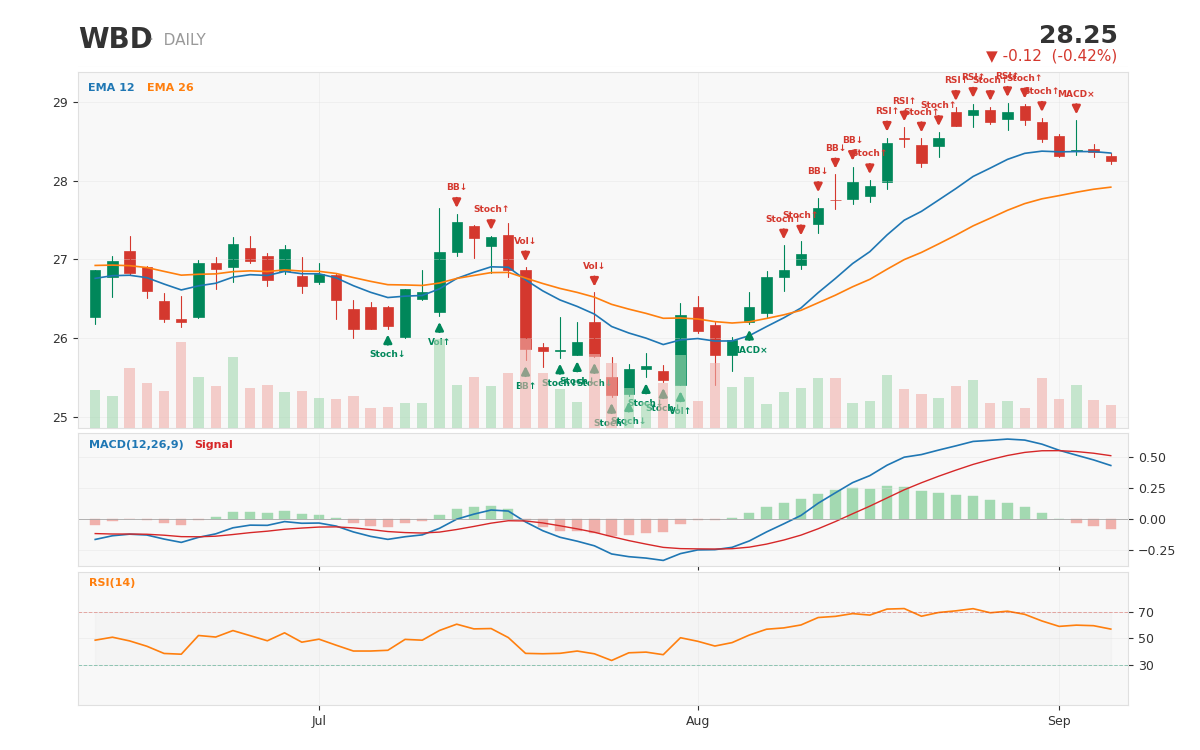 WBD 1-year daily chart with technical signals -- captured in merger limbo after a 146% rally, with ~53 million of insider sales since mid-August offset by new Loeb/Einhorn/Soros stakes, awaiting the California antitrust endgame
Want deeper research on any stock? Try Kavout Pro for AI-powered analysis, smart signals, and more. Already a member? Add credits to run more research.