WULF - The CEO Sold $2.3M the Day Before a Sector-Wide Selloff
Key Takeaways
- TeraWulf's CEO, Paul Prager, sold $2.35 million in shares on August 27, 2026, the day before a sector-wide selloff triggered by a peer's writedown, not any company-specific news.
- Despite extreme valuation metrics distorted by a capital-intensive buildout, the company's core AI infrastructure business exhibits healthy 69.3% gross margins, supported by significant contracted revenue and a $19 billion, 20-year lease with Anthropic.
- An unusual divergence exists in the technical picture: all 11 curated trend flags signal bullish momentum, yet broader quantitative scores, including the composite score (7) and moving average score (0), remain at rock-bottom levels.
CEO's Pre-Drop Sale Navigates Sector Volatility
On August 27, 2026, TeraWulf Inc. (NASDAQ: WULF) CEO and Director Paul B. Prager executed a sale of 137,500 shares at a price of $17.06 per share, totaling approximately $2,345,654. This transaction occurred precisely one day before the stock experienced a sharp 6.91% decline to $15.35 per share on August 28, 2026. This decline was not driven by any TeraWulf-specific negative news but rather by a broader sector-wide repricing event. Prager's sale at a materially higher price point ($17.06 versus the next day's close of $15.35) means he sold ahead of the market contagion, rather than into it or with foreknowledge of the specific peer disclosure that caused it.
While the CEO's significant sale might draw attention, it contrasts with other insider activity during the same period. Director Michael C. Bucella made two separate open-market purchases in August 2026: 3,023 shares at $16.54 on August 14 and 2,860 shares at $17.47 on August 17. These purchases, though smaller in scale than the CEO's sale (totaling around $100,000), represent a genuine counter-signal from another insider within the company, indicating confidence at similar price levels.
TeraWulf's Strategic Pivot to High-Performance Computing
Beneath the short-term trading dynamics, TeraWulf is undergoing a substantial and verifiable strategic pivot. The company has shifted from its origins in Bitcoin mining to focus on high-margin high-performance computing (HPC) leases, driven by significant contracts. A pivotal anchor deal, announced on July 6, 2026, is a $19 billion, 20-year lease agreement with Anthropic, securing 401 megawatts of computing capacity. This transaction, alongside the sale of a majority stake in a joint venture, represents a concrete, large-scale commitment.
This strategic shift is further evidenced by the doubling of contracted revenue to $27 billion and the fact that AI infrastructure contracts now generate over 70% of the company's revenue. Operational updates from Q2 2026, reported on August 5, 2026, noted 102 megawatts of revenue-generating IT capacity online at its Lake Mariner facility, with an additional 336 megawatts under construction and on track for delivery within cost and schedule guidance. Moreover, a recent regulatory milestone on August 24, 2026, saw Kentucky's Public Service Commission approve a 482-megawatt power agreement for TeraWulf's "Justified Data Campus," further enabling future buildout and capacity expansion. While a New York moratorium on new data center development was cited as a risk in mid-July 2026, Wall Street analysts largely dismissed it as posing no real threat to TeraWulf.
Market Contagion Drives Friday's Decline, Not Internal News
TeraWulf's Q2 2026 earnings, reported on August 5, 2026, showed a quarterly loss of $0.37 per share, wider than the consensus estimate of a $0.20 loss. This also represented a widening loss year-over-year compared to a loss of $0.05 per share in the prior year. However, the company simultaneously beat revenue estimates, underscoring a business in transition where construction and operating costs are front-loaded ahead of ramping HPC revenue. This pattern is consistent with a company making significant capital expenditures to build out future revenue streams.
The sharp 6.91% price decline on Friday, August 28, 2026, closing at $15.35, was a direct result of market contagion from a close peer. On that day, Applied Digital and IREN Limited, both part of the Bitcoin-miner-to-AI-infrastructure-pivot cohort, experienced significant drops. IREN Limited notably tumbled 13% after disclosing a substantial $639 million impairment charge related to its older Bitcoin mining equipment. This writedown, which affected IREN's legacy assets as it transitions to AI, caused investors to re-price "transition costs" across the entire peer group, including TeraWulf, even though no TeraWulf-specific writedown or negative disclosure was made that day.
Extreme Valuation Metrics Reflect a Capital-Intensive Transition
TeraWulf's current financial ratios reflect a company deep in a capital-intensive buildout phase, rather than a mature, cash-generating enterprise. This distorts many conventional valuation metrics, requiring a nuanced interpretation.
| Metric | Value |
|---|---|
| P/E Ratio | -3.64x |
| Price/Sales | 47.98x |
| Price/Book | 52.75x |
| Debt-to-Equity | 35.56x |
| Gross Margin | 69.3% |
| Current Ratio | 0.75 |
| Debt-to-Assets | 0.65 |
| Book Value per Share | $0.30 |
| FCF per Share | -$5.16 |
| FCF Yield | -32.9% |
The book value per share is exceptionally low at $0.30, meaning the company's equity base is significantly diminished relative to its market capitalization. This mechanically inflates ratios like Price-to-Book (52.75x) and Debt-to-Equity (35.56x) to extreme levels that are not meaningfully comparable to a company with a stable, mature balance sheet. Similarly, negative Free Cash Flow per share of -$5.16 and a Free Cash Flow yield of -32.9% highlight substantial, ongoing cash burn. These figures are consistent with a company heavily financing its rapid buildout and expansion through debt, a necessary condition for its transition into a leading AI infrastructure provider.
However, a cleaner read on the underlying business unit economics is the gross margin, which stands at a healthy 69.3%. This suggests that the core HPC leasing operations are fundamentally profitable at the gross level; the reported losses and extreme ratios are concentrated in the significant buildout, financing costs, and depreciation expenses layered on top of the nascent revenue stream. While trailing twelve-month revenue growth of +20.3% appears modest, it significantly understates the company's current trajectory, which is now dominated by the much larger and rapidly growing AI infrastructure contracts referenced earlier. This situation makes the stock highly sensitive to interest rate fluctuations, as its debt-funded expansion model relies on accessible and affordable capital.
Wall Street's Unanimous Buy vs. a Widening Price Gap
Analyst sentiment towards TeraWulf is overwhelmingly bullish, presenting an almost unanimous buy consensus. A review of analyst ratings shows 14 buy recommendations, with zero hold or sell ratings. This represents an even more one-sided picture than commonly seen for high-growth stocks. The median price target sits at $34.00, with a consensus average of $38.50. This is an extraordinary figure when compared to the current price of $15.35, implying a potential upside of approximately 150.8%.
This extreme implied upside is unusual and warrants closer scrutiny. It likely reflects a significant lag between sell-side price targets and the stock's recent sharp, sector-driven decline, or it could genuinely represent a structural re-rating thesis around the AI pivot that has not yet been fully reflected in the market price. The analyst targets themselves range widely, from a low of $28.00 to a high of $72.00, indicating substantial disagreement on the magnitude of potential upside, even as there is universal agreement on the stock's positive direction. This divergence suggests that while the long-term growth story is compelling to analysts, the short-to-medium term volatility and execution risks associated with the capital-intensive transition are still being assessed differently across the Street.
Institutional Players Show Both Confidence and Caution
The "smart money" landscape for TeraWulf reveals a blend of strong institutional conviction alongside some instances of portfolio rebalancing. Eight prominent guru investors are named holders, with Steve Mandel holding the largest position at 19.92 million shares, followed by Ken Griffin with 13.02 million shares. Other notable holders include T. Rowe Price Equity Income, Steven Cohen, Ray Dalio, Paul Tudor Jones II, Jefferies Group, and Polen Capital. The presence of such significant, high-profile institutional investors indicates considerable belief in the company's long-term potential, particularly given its AI infrastructure pivot.
Adding to the picture of institutional interest, a new position was disclosed on August 24, 2026, by Deutsche Bank AG, which acquired 324,328 shares valued at approximately $8.01 million. This fresh institutional buy underscores continued interest from large financial players in the growth story. For balance, it's worth noting an older data point: First Trust Advisors LP trimmed its position by 8.7% to 821,483 shares, as disclosed on July 31, 2026, based on Q1 SEC filings. This reduction, however, predates much of the recent positive news regarding the Anthropic deal and the subsequent acceleration in AI infrastructure revenue, suggesting it reflects an earlier investment thesis. No Congressional insider filings for WULF were found in the current data.
Explore this yourself: See live 13F, guru, and insider flow on Kavout Smart Money
Technical Strength Undermined by Lagging Quant Scores
The technical picture for TeraWulf presents a striking divergence that requires careful consideration. A review of curated trend flags reveals an unequivocally bullish signal across the board: every single one of the 11 key indicators — including Ichimoku, Supertrend, DMI, MACD, and On-Balance Volume — currently reads bullish. The stock is identified as being in an uptrend, outperforming the market, and trading above a rising Volume Weighted Average Price (VWAP). A broader technical scan corroborates this, showing 13 buy signals against only 3 sell signals out of 16 indicators.
However, this strong signal from trend-following technicals stands in stark contrast to the underlying quantitative scores. The composite score sits at a mere 7, the technical rating at 20, and the moving average score at 0. These values are effectively at rock-bottom levels, indicating a disconnect between the recent price action and broader quantitative assessments. A plausible, though unverified, mechanism for this divergence is that the trend-following flags are computed based on recent price structure (direction, crossovers, strength of trends), which can remain bullish even after a sharp single-day drop if the broader multi-week trend remains intact. In contrast, percentile-based quantitative scores may be weighing the stock's current level relative to its own longer-range history, where a 6.91% single-day decline, even if sector-driven, would register heavily and pull down the overall standing. This tension suggests that while the stock's immediate price behavior appears to favor continued upward movement, its relative quantitative attractiveness on a longer timescale or against its historical range is significantly diminished.
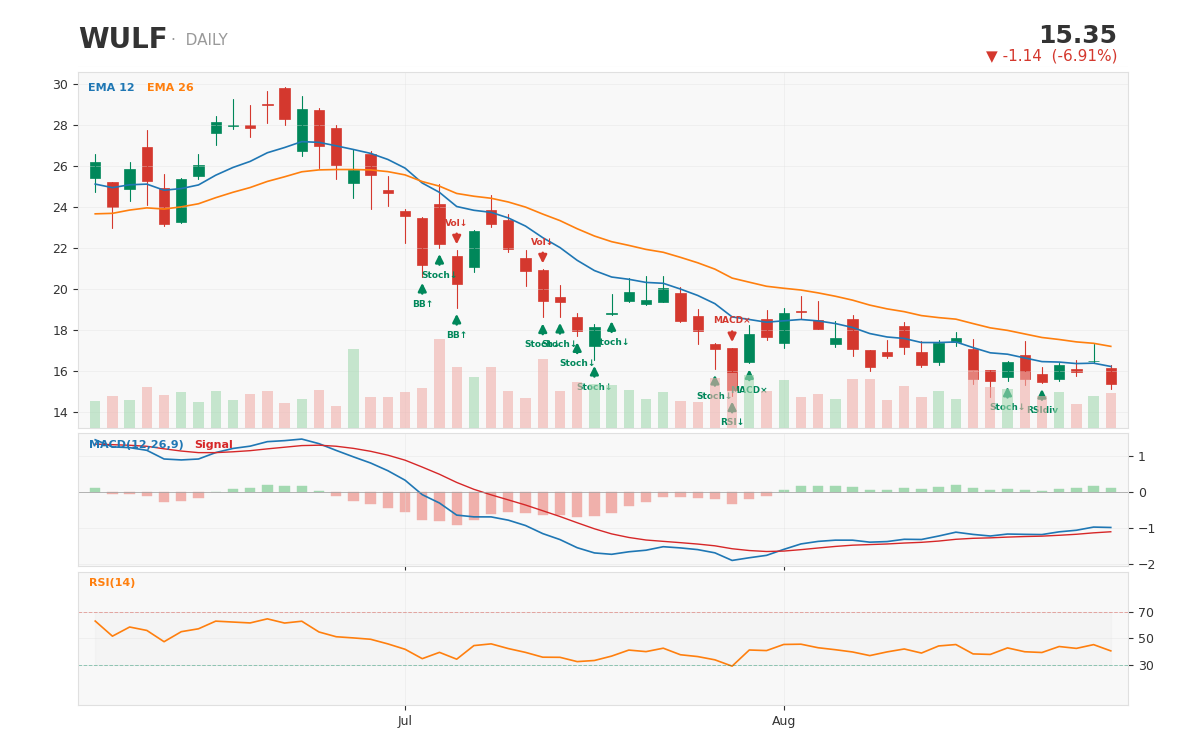 TeraWulf 1-year daily chart with technical signals -- every curated trend flag reads bullish even as composite/moving-average scores sit near zero following a sector-wide selloff triggered by a peer's writedown
A High-Conviction Growth Play Amidst Volatility
TeraWulf presents a compelling long-term growth story driven by its validated pivot to AI infrastructure, anchored by substantial contracts and significant institutional backing. The CEO's recent sale, while large, appears to be a well-timed transaction ahead of a sector-wide contagion event, rather than a signal of company-specific distress. The underlying unit economics, as evidenced by a strong gross margin, are healthy, even as the company navigates a capital-intensive, debt-funded expansion that distorts traditional valuation metrics and introduces rate sensitivity. The unanimous bullishness from Wall Street, implying significant upside to a median target of $34.00, reinforces the conviction in the strategic direction, but this must be balanced against the current price volatility and the extreme valuation metrics. The divergence between strong technical signals and low quantitative scores highlights the market's ongoing struggle to fully price a business in such a profound, rapid transition.
Despite the near-term volatility and the current low quantitative scores, the foundational elements of TeraWulf's AI infrastructure pivot are strong and validated. We maintain a bullish stance on WULF, recognizing its position as a high-conviction growth play. The continued execution of capacity buildout and the growth in high-performance computing revenue will be key to realizing its long-term potential.
Want deeper research on any stock? Try Kavout Pro for AI-powered analysis, smart signals, and more. Already a member? Add credits to run more research.