Financial Performance and Valuation
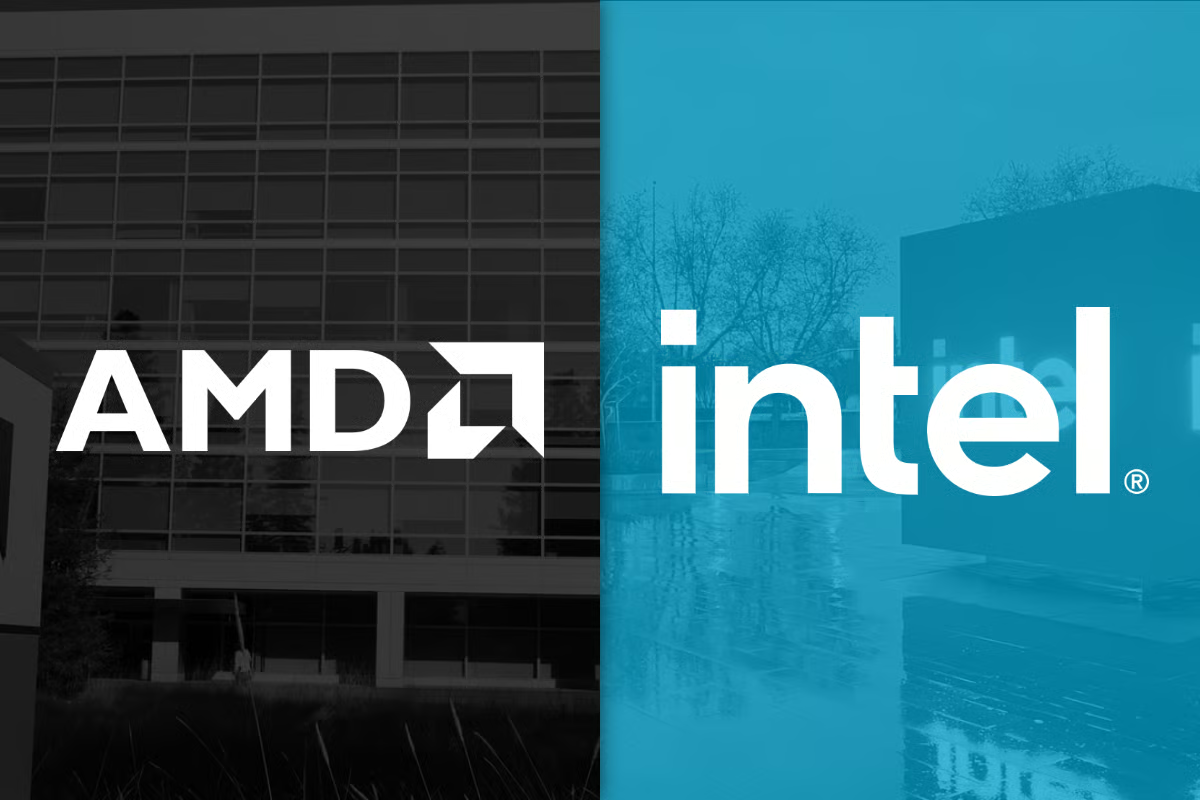
Intel Corporation (INTC) Intel has experienced volatility in its stock price due to concerns about its future growth prospects. As of February 2023, Intel’s stock price was around $30 per share. Despite this, Intel offers a dividend yield of approximately 1.43%, providing a steady income stream for investors. Intel’s maximum drawdown since inception is -82.25%, and it has a current volatility of 7.41%, indicating smaller price fluctuations and lower risk compared to AMD.
Financially, Intel reported a 10% drop in revenue for its foundry business in Q1 2024, with operating losses of $2.5 billion. However, Intel expects quarter-over-quarter improvement in its foundry business until 2030, aiming for 40% non-GAAP gross margins and 30% operating margins by the end of the decade. Intel’s lower price-to-earnings (P/E) and price-to-sales (P/S) ratios suggest that it may be trading at a better value compared to AMD.
Advanced Micro Devices, Inc. (AMD) AMD has seen strong growth in its stock price, reaching around $100 per share as of February 2023, significantly outperforming Intel. However, AMD does not pay dividends, which may be a drawback for income-focused investors. AMD’s maximum drawdown since inception is -96.57%, and it has a current volatility of 11.73%, indicating higher risk compared to Intel.
AMD’s recent earnings were disappointing, with revenue growth in its data center and client segments being offset by declines in its client and gaming segments. Despite this, AMD’s partnership with TSMC has allowed it to produce smaller and more efficient chips, giving it a manufacturing edge over Intel.
Market Positioning and Technological Advancements
Intel Corporation (INTC) Intel controls 64% of the x86 CPU market and is playing the long game by launching new AI accelerators, expanding its manufacturing capacity, and making changes to its business model. Intel’s Gaudi 2 and Gaudi 3 accelerators are capable of running AI workloads for data centers. The company plans to return to process technology leadership by 2025 with its 18A node, which will manufacture 1.8 nm chips. Intel has secured a lifetime deal value of greater than $15 billion for its 18A external foundry customers.
Intel’s Lunar Lake promises 50% faster graphics performance and a neural processing unit (NPU) that delivers 48 TOPS, but it will be launched in the third quarter of 2024. Intel’s strategic focus on AI and its investments in manufacturing capacity position it well for future growth.
Advanced Micro Devices, Inc. (AMD) AMD has restructured its business to prioritize AI, launching its own AI GPUs and signing big-name clients like Microsoft and Meta Platforms. AMD is currently the second-largest player in the GPU market, which positions it well for the AI race. The company recently unveiled its upcoming MI350 chips, which are expected to perform 35 times better in inference than its current MI300 series.
AMD has made significant gains in market share, capturing 31.4% of the desktop CPU market and 28.6% of the mobile CPU market in Q2 2022. However, increased competition from Qualcomm and other CPU designers may pose challenges for AMD in maintaining its market share gains in the coming years.
Future Growth Prospects and Market Trends
Intel Corporation (INTC) Intel’s future growth prospects are tied to its ability to regain process technology leadership and expand its foundry business. The company’s focus on AI accelerators and its strategic partnerships with major tech companies like Microsoft indicate a promising future. Intel’s expectation of achieving 60% gross margins and 40% operating margins in its Intel Products business by 2030 further underscores its growth potential.
However, Intel’s ability to compete with TSMC’s manufacturing technology and navigate the competitive landscape will be crucial. The company’s long-term vision and strategic investments position it well for future growth, but execution risks remain.
Advanced Micro Devices, Inc. (AMD) AMD’s growth prospects are driven by its strong position in the GPU market and its focus on AI. The company’s partnership with TSMC has been a key advantage, allowing it to produce cutting-edge chips. AMD’s recent product launches and market share gains indicate strong growth potential.
However, increased competition from Intel and other CPU designers may pose challenges. AMD’s ability to maintain its manufacturing edge and continue innovating will be critical for its future success. The company’s focus on AI and its strategic partnerships position it well for growth, but it must navigate a competitive and rapidly evolving market.
Conclusion
In conclusion, both Intel and AMD present compelling investment opportunities, each with its own strengths and challenges. Intel offers a more stable investment with a steady dividend yield, lower volatility, and a strategic focus on AI and manufacturing capacity. The company’s long-term vision and strategic investments position it well for future growth, but execution risks remain.
On the other hand, AMD has demonstrated strong growth in its stock price and market share, driven by its partnership with TSMC and focus on AI. However, the company faces higher volatility and increased competition, which may pose challenges in maintaining its market share gains.
Ultimately, the decision to invest in Intel or AMD should depend on individual financial goals, risk tolerance, and investment horizon. Investors seeking stability and income may prefer Intel, while those looking for growth and willing to accept higher risk may find AMD more attractive. As the semiconductor industry continues to evolve, both companies are well-positioned to capitalize on emerging trends and drive future growth.