MarketLens
Is AMC Entertainment Finally Turning the Corner on Profitability

Key Takeaways
- AMC Entertainment's recent Q4 2025 earnings showed operational strength with revenue beating expectations and improving margins, yet a substantial debt load continues to drive net losses.
- Strategic debt refinancing efforts have pushed out significant maturities, but the company's $4.30 billion Enterprise Value and negative equity highlight persistent financial strain and the ongoing risk of dilution.
- While premium formats and alternative content offer promising growth avenues, AMC's long-term viability hinges on sustained box office recovery and its ability to generate consistent positive free cash flow to service its massive debt.
Is AMC Entertainment Finally Turning the Corner on Profitability?
AMC Entertainment's latest financial disclosures present a nuanced picture for investors, showcasing operational improvements battling a formidable debt burden. The company's fourth-quarter 2025 results, released on February 23, 2026, revealed revenue of $1.41 billion, a solid beat against analyst expectations and an improvement from $1.31 billion in the prior year. This top-line strength, coupled with an anticipated EPS loss of 5 cents (a significant improvement from the 18-cent loss in Q4 2024), suggests that the core movie exhibition business is indeed on a recovery trajectory.
Looking deeper into the operational metrics, the trend in 2025 has been one of massive improvement, though AMC is certainly not in the clear. The third quarter of 2025 saw revenue hit $1.3 billion, driving Adjusted EBITDA to an impressive $122.2 million. Even more telling, the second quarter of 2025 recorded a dramatic swing toward positive operating income, with total revenues reaching $1,397.9 million. This surge pushed the company's Gross Profit Margin to 65.08% and Operating Profit Margin to 6.62%, a critical sign of operational leverage.
Despite these gains, the company still posted a net loss of (298.2) million in Q3 2025 (though largely due to non-cash charges from debt restructuring). This persistent unprofitability, even with strong operational performance, underscores the primary challenge: AMC's massive interest expense. The core business is making money, but the debt service is a killer, pushing operating profit down into a net loss.
Comparing AMC to its peers further highlights this dynamic. While its TTM Operating Margin of 2.67% (as of November 2025) surpasses Marcus Corporation's TTM of 1.21%, it still lags behind healthier competitors like Cinemark, which reported a Net Margin of 9.13% in Q3 2025. The gap is closing, but the path to full profitability for AMC requires sustained operational efficiency and, crucially, a significant reduction in its debt burden.
How Does AMC's Massive Debt Load Impact Its Financial Health?
AMC's financial health remains fundamentally constrained by its substantial debt, a burden that overshadows its operational improvements. As of Q3 2025, the company carried over $4 billion in total debt, a figure that has driven its Enterprise Value (EV) to $4.30 billion against a Market Cap of just $611.5 million. This stark difference highlights how much of the company's value is tied up in its liabilities, leaving little for equity holders. The debt-to-equity ratio of -2.17 (TTM) further signals extreme financial strain, reflecting a negative book value per share of -$3.69.
Management has been proactive in attempting to shore up the balance sheet. Strategic debt refinancing in July 2025 successfully reduced debt by approximately $183 million and, critically, pushed significant maturity dates out from 2026 to 2029. This move buys the company crucial time, extending its financial runway to capitalize on anticipated box office tailwinds. More recently, on February 23, 2026, AMC announced a first lien notes offering and a conditional notice of redemption for existing Odeon notes, signaling ongoing efforts to optimize its debt structure.
However, these refinancing efforts come with their own set of risks, particularly the potential for further shareholder dilution. An amended note agreement permits AMC to offer up to $150 million in new stock offerings beginning in February 2026. This potential influx of new shares could dilute the value of existing holdings, creating a significant headwind for the stock price. The fear among investors is that any rally could be met with an equity offering, effectively placing a ceiling on potential gains and discouraging long-term investment.
The constant need for liquidity is evident in the company's cash flow statement. For the year ended December 31, 2025, AMC reported net cash used in operating activities of (50.8) million in 2024. While the company believes existing cash and cash equivalents, along with cash from operations, will be sufficient for the next twelve months, it explicitly states that its current cash burn rates are "not sustainable long-term." Achieving net positive cash flows from operating activities requires revenues to increase to pre-COVID-19 levels, a significant challenge given the evolving entertainment landscape.
What Are AMC's Key Growth Opportunities and Strategic Shifts?
Despite the formidable debt, AMC is actively pursuing several strategic initiatives to drive revenue growth and improve profitability, moving beyond its traditional exhibition model. A primary focus is the Premium Experience Rollout, with plans to triple the number of proprietary premium screens (like IMAX and Dolby Cinema) over the next two years. This strategy is already yielding results, with consolidated admissions revenue per patron hitting an all-time record of $12.14 in Q2 2025, and food and beverage revenue per guest also reaching a record $7.95. These premium formats command higher ticket prices and boost high-margin concession sales, directly impacting the bottom line.
Another significant growth avenue is Alternative Content Partnerships. AMC has demonstrated success in distributing non-traditional content, notably the Taylor Swift concert film, which generated a remarkable $50 million in box office receipts from just one weekend screening, with $34 million coming from the domestic market. This represents a new, high-margin revenue channel that bypasses the typical studio-exhibitor split, offering a diversified income stream beyond the traditional Hollywood pipeline. The company is actively pursuing this model to reduce its reliance on volatile studio release schedules.
Loyalty Monetization is also a key strategic pillar. With approximately 37.7 million loyalty member households, AMC possesses a massive customer base that can be leveraged to drive repeat visits and targeted promotions. This direct relationship with patrons allows for more effective marketing and personalized offers, enhancing customer lifetime value. Furthermore, the company is optimizing its theater circuit by closing underperforming locations (a net reduction of 17 theaters in 2025 alone), which, while reducing revenue from those specific sites, improves overall profitability by eliminating cash-burning operations.
Beyond the theater, AMC is pursuing adjacent opportunities that extend its brand, such as entering the multi-billion dollar popcorn industry. The launch of "AMC Theatres Perfectly Popcorn" in grocery stores and online via Amazon.com aims to monetize its food and beverage expertise outside of its auditoriums. These strategic shifts, from premium formats to alternative content and brand extensions, are crucial for AMC to diversify its revenue streams and build a more resilient business model capable of supporting its long-term financial obligations.
What Are the Major Risks and Headwinds Facing AMC Investors?
While AMC's operational improvements and strategic shifts offer a glimmer of hope, significant risks and headwinds continue to challenge its investment thesis. The primary concern remains the company's high leverage and the associated interest expense, which consistently pushes the company into net losses despite positive operating income. With a current ratio of just 0.41 (TTM), AMC's ability to cover its short-term liabilities is precarious, signaling ongoing liquidity challenges. The company's own statements acknowledge that current cash burn rates are not sustainable long-term, requiring revenues to reach pre-COVID-19 levels for sustained positive cash flow.
Box office volatility is another major external headwind. In Q3 2025, the North American box office saw an industry-wide decline of approximately 11% year-over-year, directly impacting AMC's bottom line and causing Adjusted EBITDA to fall 24% to $122.2 million. While the first quarter of 2026 has shown an encouraging 9% lead over the same period last year, and a strong film slate is anticipated for the remainder of 2026 (including titles like SPIDER-MAN: BRAND NEW DAY and AVENGERS: DOOMSDAY), the movie slate remains a high-stakes gamble every quarter. Labor stoppages in film production, shrinking exclusive theatrical release windows, and the increasing use of AI technology in filmmaking also pose unpredictable risks to content supply and audience acceptance.
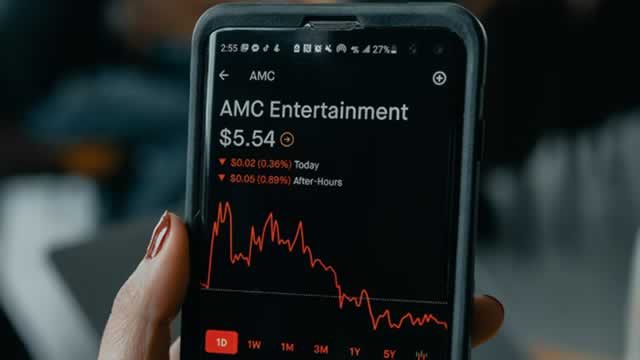
The looming threat of share dilution is a persistent overhang for investors. The company's ability to offer up to $150 million in new stock offerings, coupled with previous debt-to-equity conversions, means that any significant upward movement in the stock price could be met with new share issuance. This effectively places a ceiling on potential gains and has contributed to the stock's dramatic decline of 99.7% from its 2021 peak. The market capitalization currently stands at $611.5 million, with the stock trading at $1.19, near its $1.15 52-week low.
Finally, the "meme stock" phenomenon, while providing a loyal retail investor base, also contributes to extreme volatility. This dynamic can lead to rapid price swings unrelated to fundamental performance, making it a risky proposition for traditional investors. Analyst ratings reflect this caution, with a consensus "Hold" rating and price targets varying widely, from Citigroup's $1.30 to Wedbush's $4.00, underscoring the uncertainty surrounding AMC's future valuation.
What Does This Mean for Investors in AMC?
For investors, particularly the dedicated retail base, AMC Entertainment remains a high-stakes play defined by a stark contrast: improving operational efficiency against a backdrop of crushing debt. The company's ability to consistently beat revenue expectations and drive higher per-patron spending through premium formats and alternative content is a testament to its management's strategic execution. However, these operational wins are largely consumed by the massive interest expense, preventing a sustained return to net profitability.
The recent debt refinancing efforts, extending maturities to 2029, provide critical breathing room, but the total debt load of over $4 billion continues to be the elephant in the room. The ongoing need for liquidity means that further equity offerings and the associated dilution remain a tangible risk, potentially capping any significant rallies. This dynamic is reflected in the stock's current price of $1.19, hovering near its 52-week low, despite a seemingly optimistic outlook for the 2026 film slate.
Looking ahead, investors should closely monitor AMC's ability to translate its operational improvements into consistent positive free cash flow. This is the ultimate metric that will determine its capacity to organically reduce debt and achieve long-term financial stability. While the company's strategic pivots are promising, the path to sustained profitability is long and fraught with external risks like box office performance and evolving consumer habits.
The "meme stock" status adds another layer of complexity, making the stock highly susceptible to sentiment-driven volatility. While a surprise catalyst could trigger a short-term rally, fundamental investors must weigh the company's improving business model against its formidable balance sheet challenges and the ever-present risk of dilution.
AMC's journey is a compelling narrative of resilience and adaptation in a challenging industry. While operational improvements are undeniable, the company's financial future hinges on its ability to outrun its debt burden and consistently generate free cash flow. For investors, this means a continued focus on execution, liquidity management, and the unpredictable nature of the box office.
Want deeper research on any stock? Try Kavout Pro for AI-powered analysis, smart signals, and more. Already a member? Add credits to run more research.
Related Articles
Category
You may also like
No related articles available
Breaking News
View All →No topics available at the moment